
Paraguay.
Landlocked,
Underestimated,
Strategic.
Paraguay is the smallest economy in the Southern Cone — and one of the most consistently misread. Landlocked, bilingual, and sitting at the geographic heart of the Bioceanic Corridor, it generates nearly all its electricity from hydropower, exports more soy per capita than almost any country on Earth, and is emerging as a logistics node of regional significance.
A Small Economy With Outsized Regional Weight
Paraguay's GDP is the smallest among the five Econosur countries — but its economic model is more distinctive than its size suggests. Low corporate taxes, dollarised trade flows, a large informal sector, and an agricultural export base that punches well above its weight have produced consistent growth rates that regularly outperform regional neighbours.
The country's re-export economy — goods entering Paraguay and being redistributed across the region, particularly into Argentina and Brazil — has historically been significant. Ciudad del Este, on the Brazilian border, is one of the largest free trade zones in Latin America. This commercial activity operates in a regulatory grey zone that is part of Paraguay's economic reality, not an anomaly to be explained away.
More recently, Paraguay has attracted attention as a location for energy-intensive industries — particularly cryptocurrency mining and data centres — drawn by cheap, renewable electricity prices that are among the lowest in South America.
"Paraguay is not a market to dismiss because it is small. It is a logistics node, an energy hub, and an agricultural exporter whose position in the regional system is growing, not shrinking."
Mercosur Position
Paraguay is a full Mercosur member and the bloc's smallest economy. Its geographic centrality — bordered by Argentina, Brazil, and Bolivia — makes it a natural transit country for regional trade. The Bioceanic Road Corridor, which will connect Brazil's Atlantic ports to Chile's Pacific ports, passes through northern Paraguay and positions the country as a future logistics hub of continental significance.
The Pantanal, the Chaco, and the Pressure of Agricultural Expansion
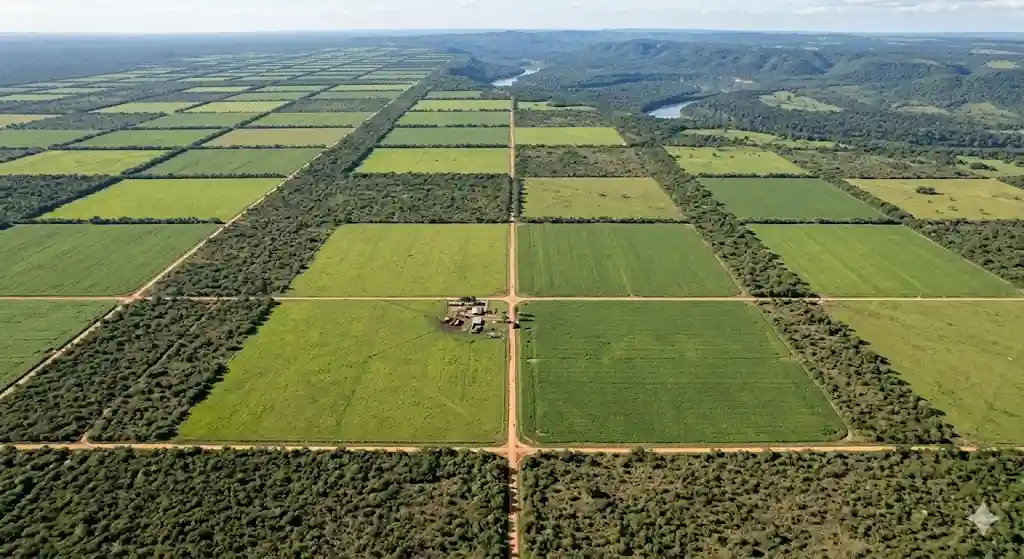
Paraguay contains two of South America's most significant ecological zones — the eastern humid forests connected to the Atlantic Forest system, and the Gran Chaco in the west, one of the largest dry forests in the world. Both have experienced dramatic land conversion over the past three decades, driven by soy expansion in the east and cattle ranching in the west. The ecological consequences are visible, documented, and increasingly subject to international scrutiny.
The Gran Chaco
The Paraguayan Chaco is one of the world's most rapidly deforested regions. Cattle ranching has converted vast areas of dry forest into pasture over the past two decades. The Chaco's biodiversity — including species found nowhere else — and its role in regional water and carbon cycles make its conversion one of the most significant ecological losses in the Southern Cone.
Eastern Forests & Soy
Eastern Paraguay's Atlantic Forest remnants have been largely converted to intensive soy production. The country's Zero Deforestation Law for the eastern region, in force since 2004, has slowed but not stopped forest loss. EU supply chain due diligence requirements are creating new pressure on Paraguayan soy exporters to demonstrate compliance with deforestation standards.
Water Systems
The Paraguay and Paraná rivers define the country's geography and connect it to the broader Río de la Plata basin. Itaipu's reservoir, shared with Brazil, is one of the largest man-made lakes in the world. Water governance, wetland conservation in the Pantanal border zone, and downstream water quality are shared regional issues that no single country can manage alone.
Cheap Clean Energy, Complex Land Use
Paraguay's sustainability profile is marked by a fundamental contradiction: it generates nearly all its electricity from renewable hydropower — one of the cleanest energy matrices in the world — while simultaneously being one of the most rapidly deforesting countries in South America on a per-hectare basis.
This contradiction is not accidental. It reflects the country's economic model, where energy and land are the two primary productive assets, and where regulatory enforcement of environmental standards has historically been weak relative to the pace of agricultural expansion.
The EU Deforestation Regulation is changing the external pressure on this model. Paraguayan soy and beef exporters who sell into European markets — directly or indirectly through Brazilian supply chains — are now subject to due diligence requirements that were not part of the export calculation a decade ago.
Hydropower Surplus
Paraguay generates far more electricity than it consumes. The surplus from Itaipu is sold to Brazil under a treaty arrangement that has been a source of ongoing negotiation — particularly around the pricing terms, which Paraguay has historically argued undervalue its contribution. A renegotiated Itaipu treaty is one of the country's most significant medium-term economic opportunities.
Deforestation & EU Standards
The EU Deforestation Regulation applies to soy, beef, and other commodities produced in Paraguay. Compliance requires traceability systems and deforestation-free sourcing commitments that many Paraguayan producers are only beginning to implement. How the country responds to this external standard will shape its European market access over the next decade.
International Presence in Paraguay
Paraguay's international business presence is smaller than its neighbours but growing — driven by its low tax environment, cheap energy, and emerging logistics role. European companies are present primarily in agribusiness, energy, and financial services. The Bioceanic Corridor is beginning to attract infrastructure investment interest from international players.
Agribusiness
International trading companies and input suppliers have significant operations in Paraguay's soy and beef sectors. The country's agricultural productivity is high, but the supply chain traceability and sustainability standards required by European buyers are creating operational demands that smaller local producers are not yet equipped to meet without support.
Energy & Industry
Paraguay's cheap electricity has attracted energy-intensive industries — including steel production, cryptocurrency mining, and data infrastructure. The country is positioning itself as a location for green industrial production, where renewable electricity is a genuine competitive advantage rather than a marketing claim.
Logistics & Infrastructure
The Bioceanic Road Corridor is the most significant infrastructure development affecting Paraguay's medium-term economic position. When complete, it will connect the Atlantic and Pacific coasts of South America through Paraguayan territory — transforming the country from a landlocked periphery into a continental transit hub.
Insights on Paraguay
Need More Than a Country Profile?
Paraguay rewards those who look past the surface. If you are assessing logistics exposure, agribusiness supply chains, or investment context in the country, direct regional expertise makes the difference.
Connect via Econosur