
Uruguay:
Renewables,
Export Systems
and Infrastructure
Uruguay combines institutional reliability with export-oriented production systems, renewable electricity, pulp, digital infrastructure, tourism and specialized logistics. In 2026, that platform is being tested by e-fuels, high-power electric transport, large data-center investment and a new technology-community and urban-development proposition around Colonia.
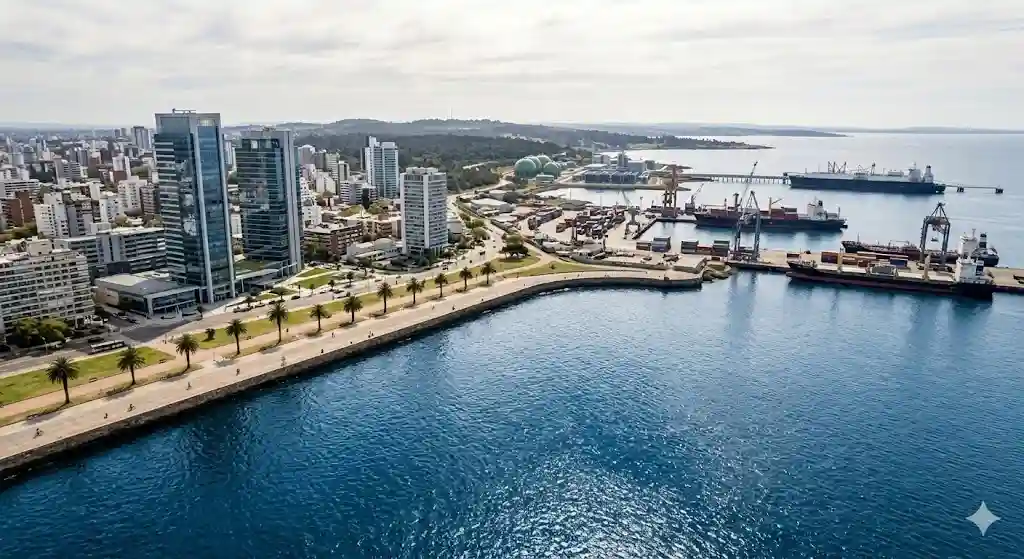
Uruguay combines institutional continuity with an economy organized around international demand. Beef, pulp, soy, dairy, tourism and globally traded services sit on top of a logistics, energy and regulatory system whose credibility carries disproportionate weight in a small domestic market.
Uruguay 2026: softer growth, resilient export systems and a broader investment test
Uruguay’s GDP contracted 0.5% year on year in the second quarter of 2026 and fell 0.8% from the first quarter on a seasonally adjusted basis. The Banco Central attributed the year-on-year decline mainly to agriculture, fishing and mining, partly offset by growth in commerce, accommodation and food services and manufacturing. Domestic demand increased while external demand declined.
Goods exports reached approximately US$8.94 billion between January and August 2026. August alone totaled US$1.121 billion, down 16% year on year. Beef remained the leading product, followed by pulp, while the sharp fall in soy exports weighed heavily on the month after a weaker harvest.
The infrastructure and investment test is now broader than export industry. HIF Paysandú tests whether renewable electricity can support a multi-billion-dollar industrial load. China Zorrilla tests high-power transport and port electrification. Google and Antel are expanding the physical digital-infrastructure base in Canelones. Praxis has selected +Colonia for a planned city-scale development and says it intends to mobilise US$1 billion over three years.
These cases sit at different execution stages. Operating export systems, infrastructure under construction, announced projects and early-stage investment plans should not be treated as equivalent evidence of commercial activity.
An export economy with industrial and service layers
Uruguay’s goods exports reached US$13.493 billion in 2025, the highest level of the previous decade. Beef led the ranking with US$2.68 billion and 20% of total goods exports. Pulp followed with US$2.307 billion and 17%, while soy represented 11%.
Between January and August 2026, goods exports reached approximately US$8.94 billion. August exports totaled US$1.121 billion and fell 16% year on year. Beef remained the leading product with US$214 million, pulp followed with US$205 million, and soy fell sharply to US$86 million, making the weaker harvest a major drag on the month.
The export structure combines primary production with industrial processing, free-zone activity, logistics systems and globally traded services. This makes infrastructure and operating reliability central to the country’s commercial position.
Uruguay is a compact economy whose export platforms carry national-scale weight.
Grasslands, agriculture and managed production systems
Uruguay’s productive landscape combines temperate grasslands, agriculture, forestry plantations, river systems, wetlands and a long Atlantic and Río de la Plata coastline. Beef, soy, dairy, forestry, water quality and coastal demand interact inside a heavily managed territory.
Grasslands & Beef
Native and improved grasslands support cattle production, biodiversity and export positioning, while traceability and land management shape export eligibility and commercial conditions.
Agriculture & Dairy
Soy, rice, dairy and other agro-industrial systems link territorial production areas with processing, storage, logistics and external buyers.
Forestry & Water
Commercial eucalyptus plantations supply large pulp mills and connect land use with industrial water, biodiversity and export infrastructure.
Forestry, pulp and export infrastructure
Pulp is one of Uruguay’s central industrial exports. Three operating mills provide approximately 4.7 million tonnes of combined nominal annual capacity: UPM Fray Bentos, UPM Paso de los Toros and Montes del Plata at Punta Pereira.
The system combines commercial forestry, foreign investment, free zones, biomass energy, rail and river logistics, dedicated port infrastructure and global buyer markets. In 2025, pulp generated US$2.307 billion and remained the country’s second-largest goods export product after beef.
UPM Uruguay
UPM operates Fray Bentos and Paso de los Toros. The newer central-Uruguay mill is connected by rail to a specialized Montevideo terminal, while Fray Bentos uses river logistics through Nueva Palmira.
Read UPM company insight →Montes del Plata
Montes del Plata integrates pulp production, biomass energy, the Punta Pereira terminal and barge logistics from M’Bopicuá in a single forest-industrial export platform.
Read Montes del Plata insight →| Infrastructure layer | UPM | Montes del Plata |
|---|---|---|
| Industrial footprint | Two mills: Fray Bentos and Paso de los Toros. | One integrated large-scale complex at Punta Pereira. |
| Inland logistics | Rail from Paso de los Toros to Montevideo; barges from Fray Bentos. | Road and river supply, including barges from M’Bopicuá. |
| Export interface | Specialized terminal in Montevideo and transshipment through Nueva Palmira. | Direct ocean export through the integrated Punta Pereira port. |
Renewable electricity and the industrial energy layer
In 2025, renewable sources supplied 98% of Uruguay’s electricity generation. Hydropower accounted for 46%, wind for 34%, biomass for 14% and solar for 4%. Fossil generation represented 2%, while around 8% of generated electricity was exported.
The biomass share links electricity directly to industrial production. Pulp mills generate energy from process residues and can supply surplus electricity to the national system. Uruguay’s renewable transition therefore includes industrial self-generation as well as utility-scale hydro, wind and solar.
Hydro & Wind
Hydropower and wind remain the two largest generation sources, supported by long-term planning and coordinated grid operation.
Biomass & Industry
Industrial residues, especially from forestry and pulp, give biomass a significant role in electricity generation and self-supply.
E-Fuels & Hydrogen
HIF Paysandú links renewable generation, electrolysis, biogenic CO₂, industrial water, rail logistics and export demand inside one proposed industrial platform.
Electric transport and port power: Buquebus tests a second demand layer
Uruguay’s renewable electricity system is beginning to support a more visible transport load as well as industrial demand. The China Zorrilla battery-electric ferry links the Buenos Aires–Colonia passenger corridor with dedicated grid capacity, port electrification and high-power shore charging on the Uruguayan side.
ANP states that the Port of Colonia has been reinforced to 15 MW of electrical capacity for the electric-ferry operation. UTE’s infrastructure plan includes expansion of the Colonia transmission station and roughly 9 kilometres of underground electrical network to the port connection point. ANP later placed the electrical and charging works in Colonia at approximately US$20 million.
The project is useful because it turns Uruguay’s renewable-power advantage into an operating-infrastructure question. The vessel is the visible asset; the commercial system depends on grid connection, substations, charging, passenger and vehicle turnaround, terminal capacity and coordinated infrastructure on both sides of the Río de la Plata.
Current status: China Zorrilla completed its float-off at Nueva Palmira and reached the Port of Colonia on September 13, 2026. Buquebus says the vessel is in the final phase of charging tests, inspections, crew preparation and operating setup. Regular commercial passenger service has not yet been verified by Econosur; the latest company timetable reported publicly points to operation around late October.
E-fuels and industrial power: HIF Paysandú tests the renewable advantage
HIF Paysandú is one of the clearest tests of whether Uruguay can turn a highly renewable electricity system into a new export-oriented industrial platform. In March 2026, HIF Global submitted its Prior Environmental Authorization application and Environmental Impact Study to DINACEA. The project is planned in four production trains with investment of roughly US$5.3 billion and capacity of up to 876,000 tonnes of e-methanol per year.
The project combines a 1.1 GW electrolyzer platform with dedicated renewable generation, biogenic CO₂ supply and logistics infrastructure. HIF’s project design includes dedicated solar and wind parks, while the government agreement also identified railway infrastructure to the Port of Montevideo as part of the implementation agenda.
Paysandú authorities have identified energy price, taxation and logistics as structural factors affecting industrial viability. The HIF project has also been discussed in relation to a possible relocation within Paysandú for logistical and environmental reasons. The investment case therefore depends on delivered power cost, infrastructure, permitting, location and export logistics.
Uruguay’s renewable advantage becomes commercially meaningful when clean electricity can be delivered to industrial projects at a viable cost and location.
Current project status: HIF Paysandú remains a development and permitting case. The environmental process is active and the project still depends on energy agreements, permits, infrastructure and a final investment decision.
Digital infrastructure and state capacity
Uruguay’s digital position now combines mature connectivity with large physical technology investments. Antel remains the core national telecom and fiber actor, but the market has moved beyond connectivity alone into cloud, data-center and AI infrastructure.
Google’s data center in the Parque de las Ciencias in Canelones is under construction after an announced investment of roughly US$850 million. In February 2026, Antel and Google Cloud also announced that Antel would become the first local provider enabled to offer Google Distributed Cloud in Uruguay, with the infrastructure hosted in Antel’s Pando data center for hybrid-cloud, sovereignty and low-latency use cases.
In August 2026, the Uruguayan government announced a separate US$70 million Antel data center specialised in artificial intelligence in Canelones. Construction is planned to begin in the first quarter of 2027, with operation targeted for 2028–2029. That project is announced and pre-construction; it should not be treated as existing operating capacity.
Antel
Antel links national fiber and mobile networks with data-center capacity, Google Distributed Cloud and a new AI-specialised data-center investment in Canelones.
Read Antel company insight →Uruguay’s Digital Bet
The related analysis separates operating connectivity and cloud capacity from projects under construction and announced AI infrastructure.
Read digital infrastructure analysis →Colonia: connectivity, urban development and technology investment
Colonia is becoming a useful test of how Uruguay’s infrastructure, cross-border access and institutional position can translate into a different type of investment demand. The +Colonia development describes a 515-hectare waterfront project with more than 7 kilometres of coastline, more than 50% green and recreational space and a location beginning about 800 metres from the Port of Colonia.
On September 22, 2026, Praxis announced that it had selected Uruguay for its first city-scale development, with the first phase at +Colonia. Praxis says it plans to mobilise US$1 billion in investment over the next three years across residences, infrastructure, hospitality and cultural and commercial spaces, with first residents expected in mid-2027.
The project belongs in the country profile because it tests whether Uruguay can convert internationally mobile technology-community demand into land purchases, construction, operating companies, local suppliers and recurring economic activity. It should not be treated as US$1 billion of capital already deployed. The relevant execution evidence will be binding land transactions, construction, company formation and resident relocation.
Cluster connection: Colonia’s investment proposition is strengthened by physical connectivity rather than by technology branding alone. The Buquebus electric-ferry infrastructure adds passenger and transport capacity across the Río de la Plata, while Uruguay’s digital infrastructure provides the connectivity and power context. The small-market analysis explains why those functions can matter despite limited domestic scale.
Offshore exploration and the onshore service economy
Uruguay has no commercial offshore oil or gas discovery. The current opportunity is an exploration and service-market story. Seismic work, environmental studies, vessels, port calls, procurement and logistics already create contractable activity on land.
ANCAP states that the OFF-6 exploration well operated by APA is currently scheduled to commence from September 2027, subject to authorizations, equipment availability and operational planning.
Current market reading: Uruguay has an emerging offshore-service layer. Durable supplier demand will depend on drilling results and later development decisions.
Tourism, passenger access and visitor value
Uruguay received 3.604 million international visitors in 2025 and generated US$2.04 billion in tourism revenue. Argentina supplied 2.404 million visitors and remained the volume base of the market.
Ferry connections across the Río de la Plata make passenger transport part of tourism infrastructure. Colonia and Montevideo operate as access points as well as destinations, while Punta del Este anchors the coastal and premium segment. The China Zorrilla infrastructure case now adds port electrification and grid capacity to that tourism-access system.
Buquebus
Buquebus links passenger demand, Buenos Aires, Colonia, Montevideo, port infrastructure and the electrification of high-volume ferry transport.
Read Buquebus company insight →Uruguay Tourism Market
The tourism analysis separates Argentina-driven visitor volume from the higher average spending generated by selected regional and long-haul segments.
Read tourism market analysis →Companies and projects
Uruguay’s company and project map shows how the wider economy operates. UPM and Montes del Plata explain export-oriented forestry and pulp. Antel and Google show the expansion from connectivity into cloud, data centers and AI infrastructure. Buquebus links cross-border passenger access with port electrification and grid infrastructure. HIF Paysandú adds a larger industrial-energy test, while Praxis +Colonia introduces a technology-community and urban-investment model.
UPM
Two mills and two logistics systems connect commercial forestry with national rail, river and port infrastructure.
UPM company insight →Montes del Plata
An integrated forest-industrial complex combines pulp, biomass energy, barges and direct ocean access.
Montes del Plata insight →Antel
The state operator provides the infrastructure layer behind Uruguay’s fiber, mobile and digital-services position.
Antel company insight →Buquebus
Regional passenger transport now links tourism demand with terminals, grid capacity, high-power charging and cross-border coordination.
Buquebus company insight →HIF Paysandú
A proposed multi-billion-dollar e-fuels project connecting dedicated renewable generation, electrolysis, biogenic CO₂, environmental permitting and export logistics.
Read HIF Paysandú analysis →Praxis +Colonia
Praxis plans to mobilise US$1 billion over three years around its first +Colonia phase. The commercial test is whether reported member demand converts into land transactions, construction, suppliers, companies and recurring activity.
Read Praxis +Colonia analysis →Uruguay’s advantage is visible where institutions become executable infrastructure
Uruguay’s strongest competitive argument is not any single headline: neither the renewable share, nor a data-center investment, nor a US$1 billion urban-development announcement. The important question is whether institutions, electricity, connectivity, ports, land, logistics and financing can be assembled into operating systems that companies and investors can actually use.
Pulp remains the clearest mature example. UPM and Montes del Plata combine forestry, industrial production, biomass power and dedicated logistics in systems that already generate exports. Google’s Canelones data center is under construction. Antel’s new AI data center has an announced investment and timetable but remains pre-construction. HIF Paysandú is still a development and permitting case. Praxis +Colonia is earlier still: its investment thesis has to move from community demand and plans into land transactions, construction and operating companies.
Buquebus sits between those categories. The grid and port infrastructure is physical and China Zorrilla is now in Colonia, but regular commercial service still has to demonstrate that vessel, charging, terminal operations and both shores of the corridor work together reliably.
That execution ladder is the useful way to read Uruguay. The country is small enough that individual projects matter disproportionately, which makes it especially important to distinguish operational capacity from construction, announced investment and early-stage demand signals.
Uruguay’s advantage is increasingly visible in the infrastructure around its export systems
Uruguay’s strongest competitive argument is not the renewable share of electricity on its own. The more important question is whether electricity, grid capacity, ports, transport links and institutions can be assembled into operating platforms that international companies can actually use.
Pulp already provides the clearest mature example: forestry, industrial production, biomass power, rail, barges and specialized port infrastructure operate as integrated export systems. HIF Paysandú tests whether that institutional and energy base can support a much larger new industrial load. Buquebus adds a smaller but operationally concrete case in which renewable electricity is being converted into high-power transport and port infrastructure.
The relevant country question is therefore shifting from whether Uruguay has renewable electricity to where delivered power cost, grid connection, logistics, water, permitting and execution allow that electricity to create competitive economic activity. That distinction matters for any company evaluating projects, suppliers or infrastructure-dependent demand in Uruguay.
Three business questions that require deeper research
1. Which Uruguayan energy, industrial and infrastructure projects are moving from announced investment into actual procurement and supplier demand?
Public announcements show the direction of investment. Commercial opportunity depends on permitting, financing, final investment decisions, package ownership, contractor appointment, procurement timing and whether a project is actually buying equipment and services.
2. Where does Uruguay’s renewable-electricity advantage remain commercially attractive once power price, grid capacity, water, logistics and project location are included?
A high renewable share creates a strong emissions profile. Industrial competitiveness depends on the delivered cost and contractual availability of electricity together with grid connection, water, transport and location-specific infrastructure.
3. Which buyers, operators and project companies control procurement across pulp, e-fuels, logistics, digital infrastructure and other export-oriented sectors?
Uruguay’s small market concentrates purchasing power in a limited number of major operators, state companies, project vehicles and infrastructure platforms. The relevant buyer map changes by sector, package and project phase.
Research boundary: where public information stops
Public information establishes Uruguay’s major projects, companies, export sectors, power system and infrastructure. It does not provide a complete commercial map or place all projects at the same execution stage.
Econosur therefore separates operating systems from projects under construction, announced investments and early-stage plans. UPM and Montes del Plata are operating industrial platforms. Google’s Canelones data center is under construction. Antel’s AI data center is announced with a future timetable. HIF Paysandú remains in development and permitting. Praxis +Colonia is an investment plan whose commercial execution still depends on land transactions, construction and company formation.
Published sources also rarely show complete procurement calendars, package-level buyer responsibility, approved-vendor gaps, incumbent supplier performance, current decision makers, actual industrial power terms, location-specific infrastructure constraints or the commercial impact of a project moving between development stages.
For new industrial and infrastructure projects, deeper research may need to verify power pricing, grid connection, water and CO₂ supply, rail and port capacity, environmental milestones, contractor capacity, land status, financing, procurement ownership and whether announced investment has moved into executable demand.
Research services for Uruguay
Econosur structures Uruguay research around a defined commercial question and the evidence needed to answer it. Work can combine official and company sources with local verification where public information is incomplete, including investment projects, infrastructure, technology, urban development, industrial buyers and cross-border systems.
Where the objective is a concrete commercial connection, Econosur can also identify and screen potential buyers, suppliers, distributors and business partners in Uruguay and facilitate introductions where there is a relevant fit. See B2B Connections in South America.
Project & Investment Verification
Distinguish announced, permitted, financed, tendering, under-construction, delayed and operating investments and identify the evidence behind each status.
Buyer & Operator Mapping
Map operators, industrial buyers, state companies, project vehicles and organizations that influence specifications, qualification and purchasing decisions.
B2B Connections in Uruguay
Identify and screen relevant buyers, suppliers, distributors and business partners and facilitate direct introductions where the commercial requirement and counterparty fit are clear. Explore B2B Connections.
Supplier & Procurement Research
Map technical suppliers, contractors, qualification requirements, procurement routes, package ownership and evidence of current or upcoming demand.
Competitor & Market-Structure Analysis
Assess incumbent positions, competing operators, concentration, infrastructure control and the commercial structure around a defined sector or corridor.
Infrastructure & Location Assessment
Compare sites and projects through power, water, ports, rail, roads, grid connection, local services and execution constraints.
Direct Local Verification
Verify selected assumptions through local sources, company contact, interviews and on-the-ground checks in Uruguay and the wider Southern Cone where required.
Primary & official sources
- Praxis — Uruguay announcement, September 22, 2026: planned first phase at +Colonia, intention to mobilise US$1bn over three years, first residents expected mid-2027 and planned local economic participation.
- +Colonia — official project site: 515-hectare development, more than 7 km of coastline, location about 800 metres from the Port of Colonia and current development positioning.
- Presidencia Uruguay — Antel AI data center, August 11, 2026: US$70m investment in Canelones, with construction planned from Q1 2027.
- Antel — Google Distributed Cloud, February 25, 2026: Pando deployment, hybrid cloud, data sovereignty and low-latency corporate services.
- Presidencia Uruguay — Google Canelones data-center construction, April 14, 2026: government confirmation of active construction at Parque de las Ciencias.
- Banco Central del Uruguay — Q2 2026 national accounts: GDP −0.5% year on year and −0.8% seasonally adjusted from Q1 2026.
- Uruguay XXI — August 2026 foreign trade: August exports US$1.121bn, down 16% year on year; beef and pulp led the month while weaker soy exports were the main negative contribution.
- Uruguay XXI — Foreign Trade Annual Report 2025: goods exports, product ranking, destinations and export values.
- Ministry of Industry, Energy and Mining — 2025 electricity generation: 98% renewable share and generation mix.
- MIEM — Balance Energético Nacional 2025: electricity use in electric transport exceeded leather and textiles combined and reached about 70% of electricity consumption in cement.
- Administración Nacional de Puertos — China Zorrilla and electrification of Colonia: approximately US$20m in electrical infrastructure and the port-electrification context.
- ANP — September 2026 China Zorrilla delivery operation: Nueva Palmira operation and 15 MW electrical capacity at the Port of Colonia.
- ANP — China Zorrilla received in Nueva Palmira, September 12, 2026: official reception after the vessel’s delivery voyage from Tasmania.
- Comisión Administradora del Río de la Plata — China Zorrilla reaches Colonia: confirms the successful float-off and arrival at the Port of Colonia on September 13.
- UTE — ANP agreement for Port of Colonia electrical works: transmission-station expansion and approximately 9 km of underground electrical network to the port.
- Ministry of Environment — HIF Paysandú environmental process: project documents and March 2026 Environmental Impact Study submission.
- HIF Global — March 2026 project update: investment, production design and environmental authorization application.
- Intendencia de Paysandú — industrial operating costs: energy, tax and logistics costs and HIF project viability.
- Ministry of Tourism — 2025 tourism results: visitor totals, revenue and spending indicators.
- ANCAP — OFF-6 exploration-well schedule update: current planning from September 2027.
Institutional & secondary sources
- Uruguay XXI — Parque de las Ciencias: confirms the Google data-center investment and that construction remains underway.
- Report News, September 22, 2026: current Buquebus timetable and operating-preparation context for China Zorrilla.
- World Bank — Uruguay country context: institutional, growth and development context used as an external reference alongside national statistics.
- IMF — 2025 Article IV Consultation for Uruguay: macroeconomic risks, policy framework and institutional context.
- Baird Maritime — China Zorrilla vessel review: independent maritime-industry context for the battery-electric ferry and the importance of adequate low-carbon electricity supply.
- Source hierarchy: Econosur uses official Uruguayan data, regulators, public companies and project documents for current figures and project status. Institutional and specialist secondary sources are used for comparison and industry context rather than to override primary evidence.
Frequently asked questions about Uruguay
Why is Uruguay relevant despite its small domestic market?
Uruguay combines institutional reliability with export-oriented industries, renewable electricity, ports, digital infrastructure and regional coordination functions. Its commercial relevance comes from these operating platforms rather than domestic scale alone.
How did Uruguay achieve its renewable electricity transition?
Uruguay used long-term energy planning, competitive wind procurement, stable investment frameworks and coordinated grid policy. In 2025, 98% of electricity generation came from renewable sources.
What does HIF Paysandú test about Uruguay’s renewable advantage?
HIF Paysandú tests whether Uruguay can convert a highly renewable power system into a competitive large-scale industrial platform. The project depends on environmental permitting, energy agreements, renewable generation, water and CO₂ supply, logistics and an economically viable electricity cost.
Why does the Buquebus electric ferry matter for Uruguay’s infrastructure model?
The China Zorrilla project links Uruguay’s renewable electricity system with dedicated port and grid infrastructure. The ferry reached Colonia in September 2026 and is in final operating preparation, making it a practical test of whether high-power charging, port operations and cross-river passenger service can work as one system.
What does the Praxis +Colonia plan add to Uruguay’s investment story?
Praxis announced plans to mobilise US$1 billion over three years around +Colonia, with first residents expected in mid-2027. The case is important because it tests whether Uruguay can convert international technology-community demand into land transactions, construction, companies and recurring economic activity. The announced amount is not treated as capital already deployed.
What is changing in Uruguay’s digital-infrastructure market?
Google’s Canelones data center is under construction, Antel is deploying Google Distributed Cloud in Pando and announced a separate US$70 million AI-specialised data center in Canelones. These projects move Uruguay’s digital story from connectivity and policy into physical infrastructure and investment.
Why does pulp matter for Uruguay’s industrial model?
Pulp connects commercial forestry, foreign investment, free zones, renewable electricity, rail and river logistics, dedicated port infrastructure and global export demand.
Is Uruguay already an offshore oil and gas market?
Uruguay has offshore exploration activity and an emerging onshore service layer, with no commercial offshore discovery or producing field. The OFF-6 exploration well is currently scheduled to commence from September 2027.
How can Econosur research a Uruguay market question?
Research can be structured around a defined project, supplier category, buyer group, procurement question, infrastructure requirement, location or competitor set and can combine public-source analysis with supplier mapping, project verification and targeted market checks.
Can Econosur help identify buyers, suppliers or business partners in Uruguay?
Yes. For a defined commercial requirement, Econosur can research and screen potential buyers, suppliers, distributors and business partners in Uruguay and facilitate an introduction where there is a relevant fit.
Need a defined Uruguay research question answered?
Econosur can structure research around a specific project, company, investor, supplier category, buyer group, procurement question, power requirement, infrastructure system or location and combine public evidence with targeted commercial validation.
Discuss a Uruguay research question