
Brazil:
Industry, Trade,
Energy
and Market Scale
Brazil is South America’s scale anchor: a large industrial economy, global agribusiness supplier, offshore-energy power, critical-minerals market and logistics system with strong regional differences. Econosur reads Brazil nationally while keeping Southern Brazil as a distinct Mercosur and industrial interface.
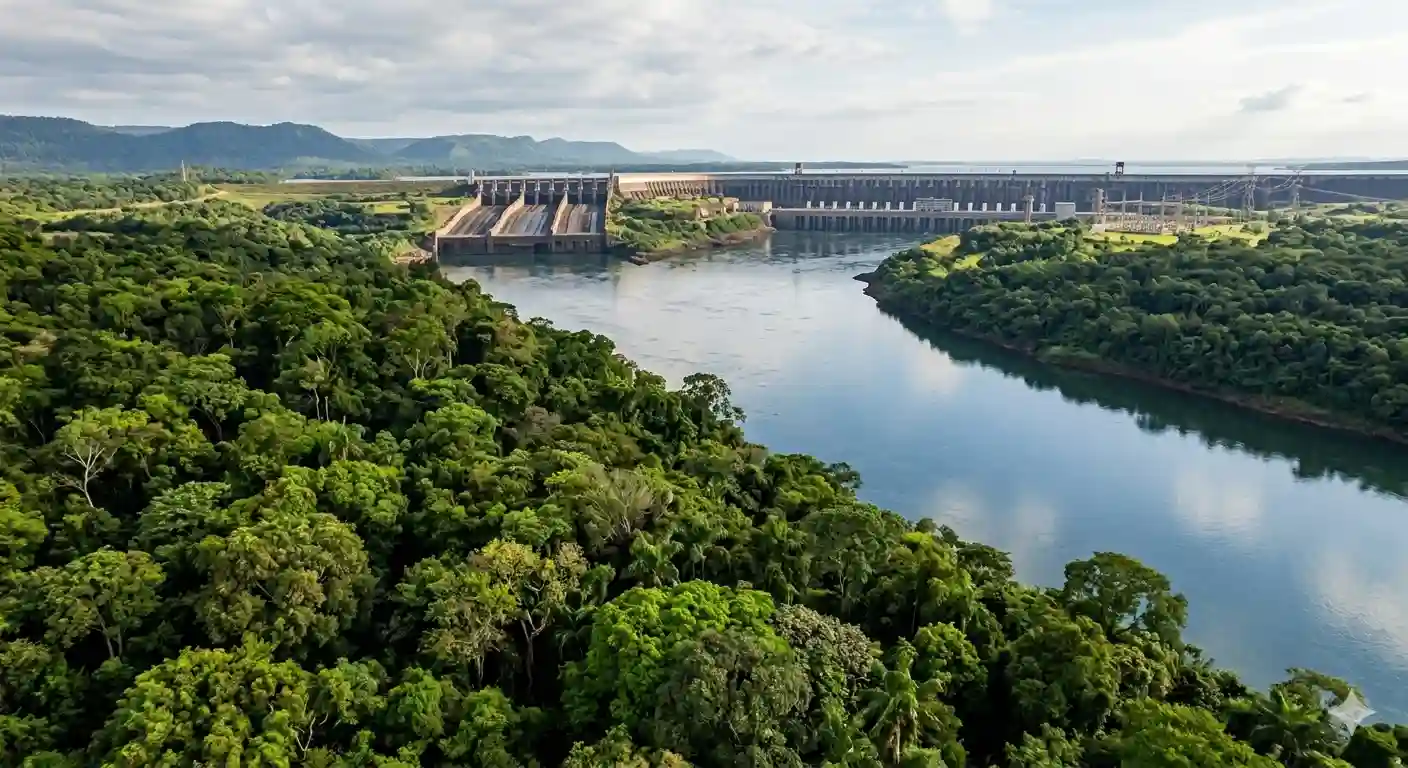
Brazil 2026: growth, trade implementation and a wider investment cycle
Brazil’s economy continued to expand in the second quarter, but at a slower pace. GDP grew 0.5% from the first quarter on a seasonally adjusted basis and 2.0% from the second quarter of 2025. Agriculture led the quarterly increase at 2.8%, while services grew 0.2% and industry 0.1%. GDP expanded 1.9% in the first half of 2026 compared with the same period of 2025.
The external commercial framework also changed materially. The EU-Mercosur Interim Trade Agreement has been provisionally applied since 1 May 2026, moving the relationship from negotiation into implementation. At the same time, Brazil’s investment story is broadening across offshore energy, refining, critical minerals, low-carbon fuels, agribusiness infrastructure, forestry and industrial supply chains.
Trade remained large through August. MDIC reports US$250.86 billion in exports and US$195.54 billion in imports for January–August 2026, producing a US$55.32 billion trade surplus. Exports were 10.3% above the same period of 2025.
Econosur reads Brazil as a national market with strong regional operating differences. São Paulo, Rio de Janeiro, Minas Gerais, Goiás, Amapá, Paraná, Santa Catarina and Rio Grande do Sul matter for different reasons. The commercial value lies in identifying which geography, buyer structure, supplier system and regulatory layer applies to a defined business question.
Core market reading: Brazil offers scale, but scale alone does not identify the commercial route. The relevant market is usually narrower: a sector, project, procurement package, buyer group, industrial corridor or regional supplier system.
A continent-sized market with different operating systems
Brazil combines a large domestic economy with substantial manufacturing depth, global agricultural exports, offshore oil and gas, mining, bioenergy, infrastructure and increasingly strategic critical-mineral projects. These systems are geographically dispersed and often governed by different commercial networks.
Rio de Janeiro anchors Petrobras and much of the offshore-energy ecosystem. Minas Gerais and Goiás are increasingly important for critical minerals and rare earths. São Paulo remains the deepest industrial, financial and corporate market. Paraná, Santa Catarina and Rio Grande do Sul connect Brazilian industry and agribusiness directly to Mercosur and the Southern Cone. Northern states such as Amapá become commercially relevant when new frontier projects create infrastructure and supplier demand.
Industrial Brazil
Machinery, automotive, chemicals, food processing, pulp and paper, wood processing, industrial services, energy equipment and large corporate buyer systems.
Resource Brazil
Offshore oil, iron ore, critical minerals, rare earths, agricultural commodities, biomass and large-scale renewable resources.
Regional Brazil
Commercial conditions differ materially by state, infrastructure corridor, operator network, port system and sector concentration.
EU-Mercosur is now an implementation question
The EU-Mercosur Interim Trade Agreement began provisional application on 1 May 2026. That changes the business discussion. Companies now need to work with actual tariff schedules, rules of origin, customs procedures and sector-specific implementation rather than treating the agreement as a future scenario.
The European Commission states that tariff relief began from day one across selected goods and will phase in across wider industrial categories. Machinery, appliances, automotive components, pharmaceuticals, chemicals, food and agricultural trade are among the sectors where companies need to translate the agreement into product-level commercial consequences.
Commercial implication: the useful question is now product-specific. Which tariff changed, which origin rule applies, what documentation is required, and does the new framework alter sourcing, pricing or supplier competitiveness for a defined product line?
Energy and offshore: Petrobras remains the central platform
Brazil’s offshore market is one of the clearest areas where national scale becomes a procurement system. Petrobras’ 2026–2030 business plan carries a total investment portfolio of US$109 billion. Exploration and production remain the largest investment area, supported by the pre-salt production system and a wider exploration program.
The Equatorial Margin adds a new frontier layer. Petrobras’ current exploration plan includes 15 new wells in the Equatorial Margin between 2026 and 2030. The Morpho discovery offshore Amapá has shifted part of the market discussion toward logistics bases, marine support, environmental response, ports and the question of which capabilities need regional presence.
ROG.e 2026 in Rio de Janeiro brings this investment cycle into a concentrated supplier environment. The event runs from 21 to 24 September 2026 at Riocentro, and its Supply Chain Forum on 21 September focuses directly on trends and opportunities in the energy supply chain.
Petrobras
Petrobras is the central operator and procurement anchor for pre-salt production, offshore projects, refining, logistics and selected low-carbon investments.
Equatorial Margin
The Equatorial Margin is becoming a supplier and infrastructure question around Amapá, ports, vessels, environmental response and regional capacity.
ROG.e 2026
ROG.e 2026 concentrates operators, contractors, suppliers and procurement intelligence in Rio de Janeiro.
Critical minerals: geology is becoming an industrial strategy
Brazil’s critical-minerals position is moving beyond reserve potential. Rare-earth projects in Goiás and Minas Gerais now sit inside a wider debate about separation, processing, financing, offtake, permanent magnets and supply-chain diversification away from China-dominated systems.
Serra Verde is already producing from the Pela Ema operation in Goiás, while development-stage projects in Minas Gerais are building permitting, processing and buyer relationships. The strategic commercial question is how much value Brazil captures between extraction and downstream industrial use.
Market question: Brazil’s rare-earth opportunity depends on processing capability, qualified buyers, finance, permits and downstream integration as much as on resource size. See Econosur’s Brazil critical-minerals analysis and Serra Verde company insight.
Agribusiness, traceability and the next EU compliance cycle
Agribusiness remains one of Brazil’s strongest external market systems. Soy, beef, poultry, coffee, sugar, pulp, wood and other value chains connect Brazilian production regions with ports, processors, traders and international buyers.
For EU-linked supply chains, traceability is becoming more operationally important. The EU Deforestation Regulation applies from 30 December 2026 to large and medium-sized operators and from 30 June 2027 to most micro and small operators. The regulation covers cattle, cocoa, coffee, palm oil, rubber, soy and wood as well as specified derived products.
A separate September 2026 development shows how agricultural land is also entering carbon markets. Google and Terradot announced a long-term agreement that combines methane reduction in rice cultivation with enhanced rock weathering, using finely ground volcanic rock on farms across Brazil. The planned deployment covers more than 200,000 hectares, starting in Rio Grande do Sul, and links rice farms with quarry supply, transport, measurement, verification and a global carbon buyer.
New market layer: the Google–Terradot model turns agricultural land into part of a second value chain alongside food production. Econosur examines the commercial structure in Google and Terradot in Brazil: How Rice Fields and Basalt Are Creating a Carbon Removal Value Chain.
Traceability
Origin, land-use history, supplier documentation and due-diligence systems increasingly affect buyer requirements and supply-chain design.
Trade implementation
EU-Mercosur tariff changes and EUDR compliance now operate in parallel, creating both commercial opportunity and documentation requirements.
Buyer requirements
Public regulation sets the framework, while actual procurement often adds buyer-specific standards, audits, certifications and supplier-risk controls.
Forestry and wood processing: Paraná adds a supplier-technology layer
Brazil’s forestry economy is broader than pulp. Paraná is one of the clearest examples of the solid-wood and industrial-processing layer. APRE Florestas reported in July 2026 that the state has about 1.17 million hectares of planted forests, including 710,836.77 hectares of pinus, and produces more than half of Brazil’s pinus wood.
The downstream position is also substantial. ABIMCI’s 2026 sector study reports that Paraná accounted for 67% of Brazil’s pinus plywood export volume in 2025. This links the state to sawmilling, plywood, mouldings, doors and other processed wood products rather than only to plantation forestry.
The commercial issue is now adjustment inside an established cluster. Export concentration has become more visible, while processors still need to protect yield, quality, uptime and product value. That creates structural relevance for automation, material handling, scanning and grading, drying, maintenance, treatment, digital production systems and higher-value wood processing.
Supplier implication: Paraná’s forestry opportunity is not simply more forest area. It is the plant-level requirement created when processors need to become more efficient, more flexible or more valuable per cubic metre.
The detailed cluster analysis is available in Brazil’s Wood Industry Is Rebalancing: Where the Supplier Opportunity Sits in Paraná. The wider regional context is covered in Forestry, Pulp, Wood Processing & Paper in South America.
Southern Brazil: the Mercosur and industrial interface
Paraná, Santa Catarina and Rio Grande do Sul remain a distinct part of the Brazil story. Together they had an estimated 31.50 million residents in the 2026 IBGE population estimate. Their relevance comes from manufacturing density, agribusiness, ports, Itaipu, regional logistics and direct commercial proximity to Argentina, Paraguay and Uruguay.
Paraná combines agriculture, industrial production, Itaipu and the Port of Paranaguá. Santa Catarina has dense manufacturing and food-processing systems with strong machinery, components and export activity. Rio Grande do Sul combines agriculture, industry and direct Argentina-Uruguay proximity.
Paraná
Paraná combines Paranaguá, Itaipu, agribusiness, manufacturing and a major forestry-processing cluster. APRE attributes more than half of Brazil’s pinus wood production to the state, adding machinery and industrial-technology demand to its logistics and agricultural role.
Santa Catarina
Manufacturing, machinery, food processing, ports and dense supplier ecosystems make Santa Catarina one of Brazil’s strongest regional industrial systems.
Rio Grande do Sul
State GDP grew 0.2% in Q2 2026 versus Q1 and 3.3% in the first half of the year versus the same period of 2025. Agriculture rose 19.7% in the first half, while industry grew 2.0% and services 1.1%. The state is also the starting point for the Google–Terradot rice and carbon-removal project.
Southern Brazil is best read as Brazil’s strongest operational interface with Mercosur, while the national market extends far beyond the Southern Cone.
Logistics: ports, corridors and distance shape commercial viability
Brazil’s size makes logistics a market-structure issue. Ports, inland roads, coastal shipping, warehouses, customs, river systems and project-specific supply bases can determine whether an otherwise attractive market is commercially accessible.
Paranaguá is central to southern agricultural exports. Rio de Janeiro and the Southeast anchor offshore-energy logistics. Northern frontier projects create a different problem: Amapá’s offshore opportunity depends on ports, marine services, road reliability and local support capacity. The relevant logistics model therefore changes by sector and geography.
Brazil is rarely one logistics market. Supplier economics depend on where the buyer operates, where inventory must sit, which port or corridor is used, response-time requirements and whether local service capacity is required.
Marcus A. Volz perspective: Brazil should be segmented by operating system
Brazil is too large for a useful supplier strategy to begin with “the Brazilian market”.
The practical unit of analysis is usually smaller: an offshore procurement ecosystem in Rio de Janeiro, a rare-earth project chain in Goiás or Minas Gerais, a wood-processing cluster in Paraná, an industrial supplier network in Santa Catarina or an export corridor connected to a specific port.
This matters because the same international supplier can face completely different commercial routes inside one country. One sector may require operator qualification, another a distributor, another a local service partner, and another direct access to a plant engineering team.
The value of a Brazil market analysis therefore lies in locating the actual buying system: where demand is generated, who specifies the product, who approves the supplier, what local capability is required and whether the investment has moved from a public announcement into a real procurement process.
The Google–Terradot case in Rio Grande do Sul shows that this logic also applies outside conventional industrial procurement. Agriculture, quarrying, logistics, laboratories, verification and carbon purchasing can become one commercial system even though they normally sit in separate sectors.
Three business questions that require deeper research
1. Which Brazilian sectors and projects are moving from announced investment into actionable procurement and supplier demand?
National investment figures show scale, but supplier opportunity depends on project stage, tender timing, package ownership, qualification requirements and whether capital has moved into execution.
2. Which buyers, operators, contractors and intermediaries actually control purchasing decisions in the relevant Brazilian market?
Purchasing authority can sit with operators, industrial groups, EPC contractors, distributors, importers, utilities, trading companies or project vehicles. Commercial research has to identify the real decision chain for the product or service in question.
3. Where can an international supplier compete from abroad, and where are local qualification, distribution, service capacity or Brazilian partners commercially necessary?
The answer varies by sector and region. Offshore energy, industrial equipment, agribusiness, critical minerals and infrastructure have different expectations around local support, registration, inventory, technical service, compliance and buyer relationships.
Where Published Information Stops
Public sources establish Brazil’s macro scale, investment programs, regulations and major projects. They do not provide the complete commercial map.
Public information rarely shows a complete procurement calendar, approved-vendor gaps, buyer-specific requirements, incumbent supplier positions, distributor performance, realistic switching behavior, current decision makers, local service expectations or how a particular foreign company fits into an existing supply chain.
Those questions require supplier and buyer research, interviews, procurement checks, competitor mapping, project-status verification and targeted market validation.
Research services for Brazil
Econosur can structure research around one defined Brazil question: a sector, project, plant, supplier category, buyer group, competitor set, procurement route or location. The objective is to move from national-scale context to the specific commercial system that matters for the decision.
Where the objective is a concrete commercial connection, Econosur can also identify and screen potential buyers, suppliers, distributors and business partners in Brazil and facilitate introductions where there is a relevant fit. See B2B Connections in South America.
Market & sector screening
Compare sectors, demand drivers, investment activity, regional concentration and commercially relevant market structures.
Supplier & competitor mapping
Identify local and international suppliers, incumbents, distributors, contractors and competing positions around a defined market.
Buyer & decision-maker research
Map operators, industrial buyers, procurement authorities, intermediaries and the organizations that influence purchasing decisions.
B2B Connections in Brazil
Identify and screen relevant buyers, suppliers, distributors and business partners and facilitate direct introductions where the commercial requirement and counterparty fit are clear. Explore B2B Connections.
Procurement & tender research
Track tender timing, package ownership, qualification requirements, contracting routes and supplier-access conditions.
Project-status verification
Distinguish announced, permitted, financed, tendered, awarded, under-construction and operating projects.
Primary interviews & market checks
Test assumptions through focused conversations with relevant suppliers, buyers, contractors, industry specialists and market participants where practical.
Regional & location comparison
Compare infrastructure, ports, service capacity, industrial concentration, logistics and operating conditions across Brazilian regions.
Commercial research synthesis
Combine public evidence, market checks, supplier information and project status into a decision-oriented brief.
Frequently asked questions about Brazil
Why does Brazil matter for international B2B markets?
Brazil combines South America’s largest economic scale with deep industrial supply chains, major agribusiness exports, offshore energy, critical minerals, logistics infrastructure and a large domestic buyer base. The commercial challenge is translating national scale into sector-, project- and location-specific opportunity.
What changed with EU-Mercosur trade in 2026?
The EU-Mercosur Interim Trade Agreement began provisional application on 1 May 2026. Tariff reductions and rules-of-origin procedures now create an operational trade framework for companies dealing between Brazil and the European Union.
Why is Paraná important to Brazil’s industrial market?
Paraná combines agribusiness, Itaipu, Paranaguá, manufacturing and a major forestry and wood-processing cluster. APRE Florestas attributes more than half of Brazil’s pinus wood production to the state, while ABIMCI reports that Paraná accounted for 67% of Brazil’s pinus plywood export volume in 2025.
Why is Brazil’s offshore market important for suppliers?
Petrobras’ 2026–2030 investment portfolio, Brazil’s established pre-salt system and exploration in the Equatorial Margin create demand across FPSOs, subsea systems, marine logistics, ports, environmental services, maintenance, engineering and supplier qualification.
Why are critical minerals becoming more important in Brazil?
Brazil combines major rare-earth and critical-mineral resources with producing assets, development-stage projects and growing European and US interest in diversified processing and supply chains.
Why does Southern Brazil remain important inside a national Brazil profile?
Paraná, Santa Catarina and Rio Grande do Sul form Brazil’s strongest interface with the Southern Cone through manufacturing, agribusiness, ports, Itaipu, cross-border trade and Mercosur-linked logistics.
Can Econosur help identify buyers, suppliers or business partners in Brazil?
Yes. For a defined commercial requirement, Econosur can research and screen potential buyers, suppliers, distributors and business partners in Brazil and facilitate an introduction where there is a relevant fit. See B2B Connections in South America.
Need a defined Brazil research question answered?
Econosur can structure research around a specific sector, project, buyer group, supplier category, competitor set, procurement assumption or regional market question and combine public evidence with targeted commercial validation.
Discuss a Brazil research question