
Paraguay's Soy Model:
Quiet Efficiency,
Structural Exposure, and
the New Compliance Frontier
Paraguay is the world's third-largest soy exporter, running more than 80% of its grain exports through a river system that is simultaneously its greatest logistical asset and its most exposed vulnerability. As regulatory and climate pressures reshape the rules of the global commodity trade, the country's export model faces a test that goes beyond production and logistics.
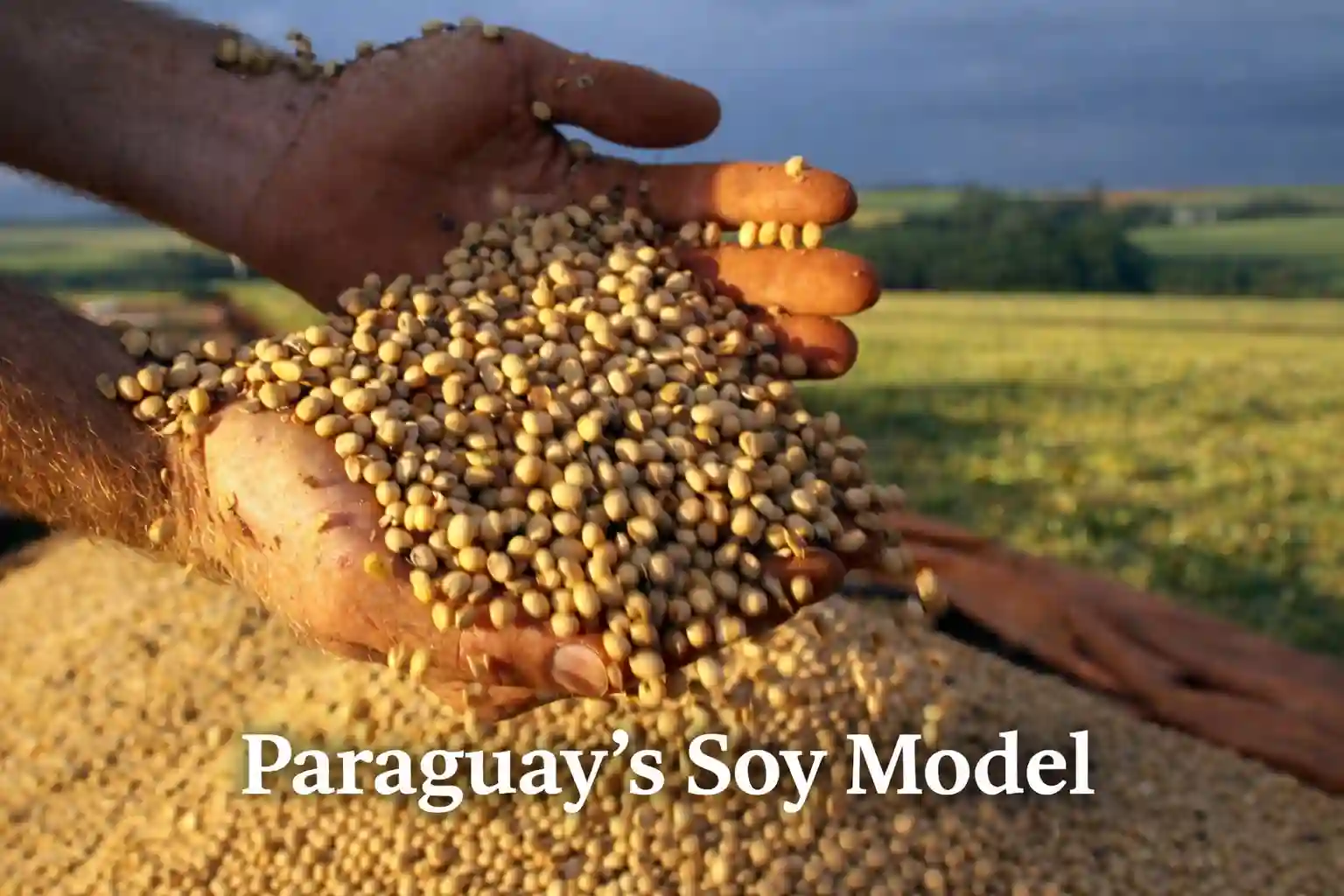
Paraguay does not produce global narratives. It produces soy. While Brazil dominates the sector with over 160 million tonnes of annual production and Argentina commands the processed derivatives market, Paraguay operates in a quieter register — but at a scale that matters. According to the American Soybean Association, Paraguay ranked third globally in soybean exports in the 2023/24 marketing year with 8 million tonnes, behind Brazil (104m t) and the United States (46m t), and ahead of Argentina and Canada. It cultivated 3.65 million hectares in that season, producing 11 million tonnes in total. Soy and its derivatives account for roughly 40 percent of all Paraguayan exports by value, generating approximately USD 4 billion for the economy in the 2023/24 harvest cycle, according to CAPECO, the Paraguayan Chamber of Grain and Oilseed Exporters and Traders.
For international buyers, processors, and investors, the model is attractive precisely because it is legible. Paraguay produces for export — consistently, at scale, without the institutional noise that accompanies Argentina's periodic agricultural policy reversals or Brazil's geopolitical visibility. But that legibility has a structural underside that is becoming more relevant as the external environment changes.
The River as Infrastructure — and as Risk
Paraguay's most significant logistical asset is also its most structurally exposed. The Paraguay-Paraná waterway — a 3,400-kilometre river corridor connecting the country's inland soy-producing regions to Atlantic export terminals in Argentina and Uruguay — carries more than 80 percent of Paraguay's grain exports. The country operates the world's third-largest fleet of river barges, according to its commerce ministry, and the corridor handles over 100 million tonnes of cargo annually across the basin.
That dependence is not abstract. In the first quarter of 2024, low water levels on the Paraguay River — caused by drought conditions upstream in Brazil's Pantanal — cut soybean exports by 14 percent compared to the same period a year earlier, according to CAPECO. Barge convoys could not load to full capacity; transit times lengthened; logistics cost overruns were passed downstream. A country that is nominally a production efficiency story was exposed, in real time, to a climate variable it cannot control and an infrastructure corridor it shares with its larger neighbours.
"Paraguay's waterway is its most competitive infrastructure asset. It is also the point where climate risk, regional geopolitics, and export dependency converge into a single chokepoint."
The structural vulnerability is understood domestically. CAPPRO, the Paraguayan Chamber of Oilseed and Cereal Processors, has called for a comprehensive master plan for the waterway, citing persistent challenges with water levels, sedimentation, and channel maintenance. Plans to deepen and expand sections of the corridor are under negotiation — but involve Argentine concession processes that are contested, slow-moving, and not under Paraguayan control.
The Deforestation Question — More Nuanced Than It Looks
Paraguay sits at the intersection of two narratives that are both partly true and both insufficient on their own. The first — that Paraguayan soy is an environmental problem — draws on the country's deforestation record and on the general association between soy expansion and land conversion across South America. The second — that Paraguay's soy model is relatively clean — draws on the scientific finding that in Paraguay's main soy-producing region, the eastern Atlantic Forest zone, direct conversion of forests to soy has been declining since a peak in 2013, partly due to a Zero Deforestation Law enacted in 2004. Research published in Global Forest Watch confirms that soy expansion in Paraguay has occurred predominantly on former pasture land rather than primary forest, particularly in the east where 98 percent of the country's soy is concentrated. In the Paraguayan Chaco, it is cattle ranching — not soy — that scientific studies identify as the dominant proximate driver of forest loss.
Both framings miss the operational point for international buyers and investors. The relevant question is not whether Paraguay's soy is abstractly sustainable or unsustainable. It is whether Paraguay's supply chains can meet the documentation, traceability, and land-use verification requirements that are increasingly embedded in regulatory frameworks — and where the gaps are.
CAPECO itself has acknowledged the regulatory pressure directly. As the EU Deforestation Regulation moves toward enforcement, Paraguay's industry body has been actively working to open new markets and develop compliance frameworks. The scale of indirect exposure is substantial: a World Bank analysis estimates that with approximately 90 percent of Paraguay's soy shipped to Argentina for re-export as beans, meal, or oil, up to USD 2.5 billion of Paraguayan soy revenue could be exposed to EUDR requirements — not through direct EU sales, but through the Argentine processing and re-export chain that carries Paraguayan origin beans into European markets.
Indirect Exposure, Direct Consequences
This indirect exposure mechanism is the part of the EUDR story that is most often missed in analysis of Paraguay. Direct soy exports from Paraguay to EU member states are modest. But Paraguay's soy is present in EU markets through a different route: Argentina crushes a substantial share of Paraguayan beans and exports the resulting oil and meal to Europe. That processing step creates an entry point for EUDR due diligence requirements that traces back to the Paraguayan origin.
The consequence is that Paraguay's traceability systems, land-use documentation, and certification coverage matter for EU market access even when Paraguayan exporters are not selling directly to European buyers. A regulatory framework designed around direct import relationships has supply chain effects that extend well upstream. CAPECO's acknowledgment that it is working to open new markets "amid potential challenges exporting to the European Union" reflects an industry that understands this, even if the broader discussion around Paraguayan soy has not fully caught up.
Efficiency Under New Conditions
Paraguay's soy model has been built on a specific definition of efficiency: high volumes, clear export orientation, competitive logistics, minimal institutional friction. That model has delivered. Total soy-related export revenues have grown substantially over two decades, and the country has established itself as a reliable third-tier supplier in global commodity flows behind Brazil and the United States.
But efficiency is being redefined. The USDA projects Paraguay's soybean production at 10.3 million tonnes for 2025/26, with exports of 6.5 million tonnes — solid numbers by global standards. What those numbers do not capture is the compliance cost trajectory: the investment required to build traceability systems at scale, document land-use history across 3.65 million hectares of plantation, and integrate with the due diligence frameworks that EU importers and their financiers are building into procurement contracts.
Paraguay is not uniquely exposed to this challenge relative to other major soy producers. Brazil faces it at far larger scale. Argentina faces it with the added complexity of its processing industry. But Paraguay's position as a smaller, less institutionally resourced producer — with concentrated waterway dependence, documented gaps in land cadaster coverage and environmental licensing data, and limited direct regulatory leverage with the EU — means the adjustment path is less straightforward than its production efficiency numbers suggest. The IFC's 2025 Country Private Sector Diagnostic notes explicitly that "land cadaster and secure tenure conditions remain a key constraint" despite recent legislative reforms, and the World Resources Institute has documented that supply chain actors face "enormous difficulties" tracing ranch and farm boundaries in Paraguay due to incomplete public data systems.
That is the core tension in Paraguay's soy model: a system built for volume and logistics reliability, now asked to also demonstrate provenance, traceability, and ecological documentation — not because the EU is Paraguay's largest market, but because the global supply chain architecture is being reorganised around these requirements, and Paraguay is embedded in it whether it exports directly to Brussels or not.