
Paraguay · Agriculture · Soy · Waterway · EUDR · Supply Chains
Paraguay's Soy Model: Quiet Efficiency, Structural Exposure and the New Compliance Frontier
Paraguay’s record 2025/26 soy crop is reinforcing its export role, but the model is becoming more concentrated around Argentina, more exposed to river logistics and more dependent on traceability ahead of EUDR application.
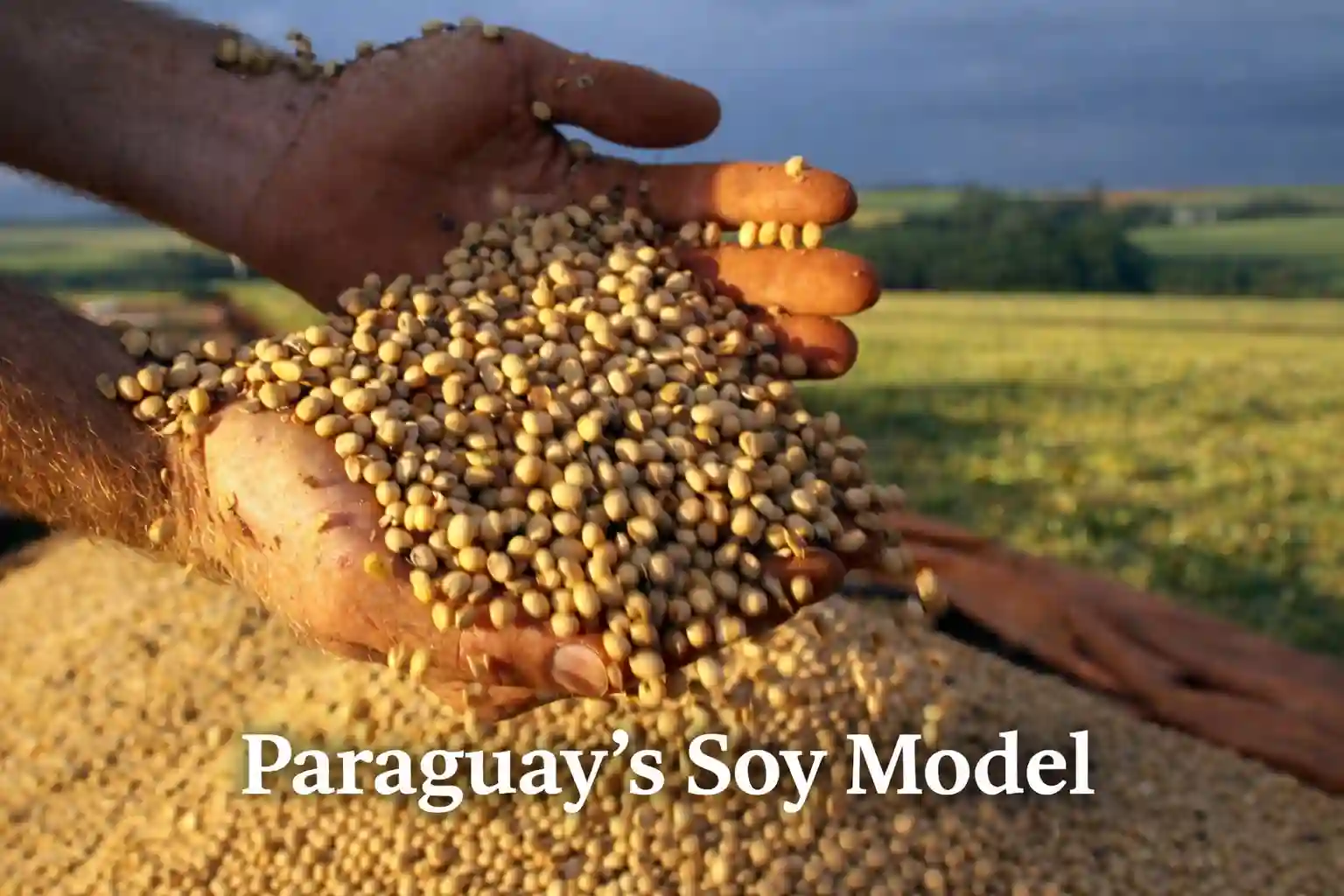
Paraguay’s soy model is entering 2026 from a position of production strength but growing concentration risk.
CAPECO currently estimates roughly 12.2 million tonnes of soy production for 2025/26 including the main crop and zafriña. By July, Paraguay had exported 6.8 million tonnes of soybeans and the soy complex had generated US$3.513 billion in foreign-exchange revenue. But 89% of soybean shipments went to Argentina and another 8% to Brazil.
The model therefore combines three strengths and exposures at once: high-yield export production, dependence on the Paraguay-Paraná logistics system and a downstream chain concentrated in Argentina just as EUDR traceability becomes operational for large and medium EU operators from 30 December 2026.
For broader context, see Paraguay market insights, Paraguay market profile and Mercosur agriculture and the illusion of regional autonomy.
Core market reading:
Paraguay’s soy model was built for volume and logistics reliability. It is now being asked to demonstrate provenance, land-use documentation and regulatory compliance inside global commodity chains.
August 2026: Record Output, Buyer Concentration and a New Compliance Clock
The production side of Paraguay’s soy model strengthened materially in 2026. CAPECO’s current statistics put the 2025/26 main crop at 11.5 million tonnes and the zafriña at roughly 0.7 million tonnes, taking the combined estimate to about 12.2 million tonnes. That is above the 10.0 million tonnes confirmed for 2024/25.
The export response has been equally strong. By July 2026, Paraguay had shipped 6.8 million tonnes of soybeans, around 1.9 million tonnes more than in the same period of 2025. Soybean oil exports reached 390,705 tonnes and pellets 1.418 million tonnes. The complete soy complex generated US$3.513 billion in foreign-exchange revenue through July, 40% more than a year earlier.
But the stronger crop has also made concentration more visible. CAPECO reports that 89% of soybean shipments through July went to Argentina and 8% to Brazil. Only 3% was distributed among other destinations. On August 27, CAPECO also reported that a Taiwan Sugar Corporation delegation was evaluating the possibility of resuming purchases of Paraguayan soy — a diversification signal, but not yet a contracted new market.
The 2026 story is not simply that Paraguay produced more soy. It is that production strength is increasing the importance of the systems around the crop.
A record harvest creates value only if river capacity, Argentine processing demand, buyer diversification and origin documentation can absorb it. The commercial risk therefore moves downstream: from agronomy toward logistics, destination concentration and verifiable supply-chain identity.
Paraguay’s Quiet Soy Scale
Paraguay does not produce global narratives. It produces soy.
While Brazil dominates the sector with over 160 million tonnes of annual production and Argentina commands the processed derivatives market, Paraguay operates in a quieter register — but at a scale that matters.
Paraguay remains one of the world’s major soybean exporters, although its exact ranking changes by marketing year. USDA projections published in early 2026 placed Paraguay in the global top five for 2025/26 soybean exports, while CAPECO’s current crop statistics point to approximately 12.2 million tonnes of production when the main crop and zafriña are combined.
The current export cycle is materially stronger than the previous one. Through July 2026, CAPECO reports US$3.513 billion in foreign-exchange revenue from soybeans, soybean oil and pellets, compared with US$2.493 billion in the same period of 2025.
For international buyers, processors and investors, the model is attractive precisely because it is legible. Paraguay produces for export — consistently, at scale, without the institutional noise that accompanies Argentina’s periodic agricultural policy reversals or Brazil’s geopolitical visibility.
But that legibility has a structural underside that is becoming more relevant as the external environment changes.
The River as Infrastructure — and as Risk
Paraguay’s most significant logistical asset is also its most structurally exposed.
The Paraguay-Paraná waterway — a 3,400-kilometre river corridor connecting the country’s inland soy-producing regions to Atlantic export terminals in Argentina and Uruguay — carries more than 80 percent of Paraguay’s grain exports.
The country operates the world’s third-largest fleet of river barges, according to its commerce ministry, and the corridor handles over 100 million tonnes of cargo annually across the basin.
That dependence is not abstract. In the first quarter of 2024, low water levels on the Paraguay River — caused by drought conditions upstream in Brazil’s Pantanal — cut soybean exports by 14 percent compared to the same period a year earlier, according to CAPECO.
Barge convoys could not load to full capacity; transit times lengthened; logistics cost overruns were passed downstream. A country that is nominally a production efficiency story was exposed, in real time, to a climate variable it cannot control and an infrastructure corridor it shares with larger neighbours.
"Paraguay's waterway is its most competitive infrastructure asset. It is also the point where climate risk, regional geopolitics and export dependency converge into a single chokepoint."
The structural vulnerability is understood domestically. CAPPRO, the Paraguayan Chamber of Oilseed and Cereal Processors, has called for a comprehensive master plan for the waterway, citing persistent challenges with water levels, sedimentation and channel maintenance.
Plans to deepen and expand sections of the corridor are under negotiation — but involve Argentine concession processes that are contested, slow-moving and not under Paraguayan control.
That governance risk became more concrete in July 2026. A joint statement by Paraguayan waterway-user associations — including CAPECO and CAPPRO — warned that the unresolved Argentine toll dispute, the new concession of Argentina’s Vía Navegable Troncal and proposed dredging/tariff schemes on the Paraguay River could accumulate costs along the export corridor. The statement specifically argued that a tariff based on net register tonnage can have a disproportionate effect on barge convoys carrying Paraguayan soy, meal and oil.
Hydrology is also back in focus. Paraguay’s meteorological authority reported declining river levels during August. On August 23, the Paraguay River stood at 1.25 metres in Asunción after further daily declines. That does not by itself establish an export disruption, but it confirms that navigability remains a live operating variable even during a record production year.
The record crop strengthens rather than weakens the waterway thesis.
Higher output puts more commercial value through the same corridor. The relevant risk is therefore not only a dramatic river closure. Smaller changes in draft, convoy efficiency, tolls, dredging charges or downstream concession rules can compound across millions of tonnes and directly alter Paraguay’s delivered-cost advantage.
The waterway gives Paraguay export reach and systemic vulnerability at the same time.
The country’s soy model depends on a corridor whose hydrology, dredging, concession politics and downstream infrastructure are only partly under Paraguayan control.
The Deforestation Question — More Nuanced Than It Looks
Paraguay sits at the intersection of two narratives that are both partly true and both insufficient on their own.
The first — that Paraguayan soy is an environmental problem — draws on the country’s deforestation record and on the general association between soy expansion and land conversion across South America.
The second — that Paraguay’s soy model is relatively clean — draws on the finding that in Paraguay’s main soy-producing region, the eastern Atlantic Forest zone, direct conversion of forests to soy has been declining since a peak in 2013, partly due to a Zero Deforestation Law enacted in 2004.
Research cited in the original analysis notes that soy expansion in Paraguay has occurred predominantly on former pasture land rather than primary forest, particularly in the east where most of the country’s soy is concentrated. In the Paraguayan Chaco, it is cattle ranching — not soy — that scientific studies identify as the dominant proximate driver of forest loss.
Both framings miss the operational point for international buyers and investors.
The relevant question is not whether Paraguay’s soy is abstractly sustainable or unsustainable. It is whether Paraguay’s supply chains can meet the documentation, traceability and land-use verification requirements that are increasingly embedded in regulatory frameworks — and where the gaps are.
CAPECO has acknowledged the regulatory pressure directly.
As the EU Deforestation Regulation moves toward enforcement, Paraguay’s industry body has been working to open new markets and develop compliance frameworks. The relevant issue is not only direct EU sales, but indirect exposure through Argentina’s processing and re-export chain.
EUDR: The Deadline Moved, the Traceability Requirement Did Not
The regulatory calendar changed again after the original version of this article. Following the EU’s December 2025 amendment, the EUDR now begins to apply to large and medium EU operators on 30 December 2026 and to most micro and small operators on 30 June 2027. In July 2026, the European Commission also adopted updated product-scope and Information-System measures to support implementation.
The underlying condition remains unchanged: relevant soy products placed on the EU market must be linked to production that is deforestation-free under the Regulation’s 31 December 2020 cut-off date and produced in accordance with the relevant laws of the country of production.
Paraguay is also important in the EU benchmarking system. Under Commission Implementing Regulation (EU) 2025/1093, countries listed in the Annex are classified as low or high risk; countries not listed remain standard risk. Paraguay is not in either list and therefore currently remains a standard-risk country. That means the simplified due-diligence regime available for low-risk sourcing does not automatically apply to Paraguayan origin.
Direct Paraguay-to-EU soybean flows are only one part of the exposure. CAPECO’s 2026 trade data show why Argentina matters much more operationally: by July, 89% of Paraguayan soybean exports were going to Argentina. When Paraguayan beans enter Argentine crushing and the resulting covered soy products are placed on the EU market, the relevant EU operator still needs supply-chain information that reaches back to the production plots and origin evidence required by the Regulation.
The commercial implication is broader than a legal deadline. Exporters, crushers and traders can begin transmitting geolocation, land-use and supplier-documentation requirements upstream before December 2026 because EU buyers need compliant systems in place before the rules apply.
Paraguay’s EUDR risk is better understood as a buyer-access problem than as a direct-export problem.
The critical question is not how many Paraguayan soybean cargoes sail directly to Europe. It is whether Paraguayan origin can remain admissible inside Argentine crushing, global trading and European downstream chains once buyers require plot-level evidence. Compliance can therefore become commercially binding before the physical trade route changes.
Efficiency Under New Conditions
Paraguay’s soy model has been built on a specific definition of efficiency: high volumes, clear export orientation, competitive logistics and minimal institutional friction.
That model has delivered. Total soy-related export revenues have grown substantially over two decades, and the country has established itself as a reliable third-tier supplier in global commodity flows behind Brazil and the United States.
But efficiency is being redefined.
CAPECO’s current statistics place combined 2025/26 soybean production at roughly 12.2 million tonnes, while soybean exports had already reached 6.8 million tonnes by July 2026. Those numbers demonstrate production strength, but they do not capture the compliance-cost trajectory: the investment required to maintain plot-level traceability, document land-use history and integrate Paraguayan origin data with the due-diligence systems used by EU-facing traders and processors.
Paraguay is not uniquely exposed to this challenge relative to other major soy producers. Brazil faces it at far larger scale. Argentina faces it with the added complexity of its processing industry.
But Paraguay’s position as a smaller, less institutionally resourced producer — with concentrated waterway dependence, documented gaps in land cadaster coverage and environmental licensing data, and limited direct regulatory leverage with the EU — means the adjustment path is less straightforward than its production efficiency numbers suggest.
Paraguay’s soy model has to be evaluated beyond production volume.
The practical questions are waterway exposure, traceability coverage, land-use documentation, indirect EUDR exposure, Argentine processing dependence and the ability of exporters to produce compliance evidence at scale.
The Core Tension
That is the core tension in Paraguay’s soy model: a system built for volume and logistics reliability, now asked to also demonstrate provenance, traceability and ecological documentation.
This is not happening because the EU is Paraguay’s largest direct soy market. It is happening because the global supply-chain architecture is being reorganised around these requirements, and Paraguay is embedded in that system whether it exports directly to Brussels or not.
Infrastructure Risk, Compliance Opportunity & Market-Entry Questions
How exposed is Paraguay’s soy export model to disruption on the Paraguay–Paraná waterway?
The exposure is structural, not marginal. Paraguay’s inland export model depends on the waterway for most grain shipments. Low river levels can reduce barge loading, slow convoys and raise logistics costs, while dredging, channel maintenance, downstream port capacity and concession decisions involve infrastructure and institutions beyond Paraguay’s direct control.
This means a strong harvest does not automatically translate into frictionless export performance. For buyers, traders, logistics providers and investors, river conditions and corridor governance are part of the commercial risk assessment alongside production volumes.
Which business opportunities are emerging from EUDR, traceability and land-use compliance in Paraguay’s soy supply chain?
Compliance pressure creates potential demand for traceability platforms, geospatial and land-use verification, documentation systems, certification and audit support, supply-chain data integration and origin verification. The opportunity is broader than direct Paraguay-to-EU trade because Paraguayan beans can enter downstream European supply chains after processing in Argentina. With large and medium EU operators facing the EUDR from 30 December 2026 and Paraguay currently classified as standard risk, the evidence burden is now a concrete procurement issue rather than a distant policy scenario.
However, regulatory need should not be confused with a confirmed procurement pipeline. Public information can identify the compliance problem and the actors exposed to it; it does not reliably show which exporters, traders or processors are currently buying new systems, which vendors are already installed, what budgets are available or when qualification and purchasing decisions occur.
What should international agribusiness suppliers verify before entering Paraguay’s soy value chain?
Suppliers need to identify the actual commercial gatekeepers for their offer: producers, exporters, crushers, global traders, river-logistics operators, technology integrators or specialist local partners. They also need to verify buyer standards, traceability requirements, local service expectations and the role of Argentine processing in the downstream chain.
The practical commercial-access question is therefore not simply whether Paraguay has a large soy sector. It is where a specific product or service fits into the value chain, who controls the buying decision, which requirements determine access and whether the opportunity is commercially reachable now.
Public sources are useful for export volumes, waterway dependence, regulation, industry structure and broad compliance pressure. They usually do not establish current buyer priorities, active supplier searches, incumbent technology providers, qualification rules, local-partner preferences, commercial budgets or the exact point at which a specific supplier can enter the decision process.
Those gaps require targeted company research, interviews, supplier and distributor checks, buyer verification and supply-chain research rather than another layer of public statistics.
Paraguay Agribusiness Market Research and Supply-Chain Verification
Marcus A. Volz and Econosur research the commercial layer behind Paraguay’s agricultural export data for international suppliers, technology companies, logistics providers, investors and other B2B decision-makers.
- Which exporters, processors, traders or logistics operators are relevant buyers for a specific product or service?
- Which traceability or land-use verification systems are already used, and where are capability gaps visible?
- What documentation and qualification requirements do international buyers transmit back into Paraguayan origin chains?
- Which local partners, distributors, integrators or service structures offer a realistic route into the market?
- How much does waterway dependence or Argentine processing exposure change the commercial opportunity?
From public soy data to commercial verification
Export statistics and regulation show where structural pressure exists. They do not show whether a specific company has a reachable customer, a current technology gap or an open route into the buying process.
Econosur can investigate buyer structures, competing suppliers, traceability requirements, logistics dependencies and commercial-access routes for a defined Paraguay agribusiness question.
Discuss a research questionThe August 2026 update prioritizes current industry and regulatory sources. Production and export figures refer to the periods stated by the source rather than to a full-year estimate unless explicitly identified as such.
- CAPECO — Soy area, production and yield: current 2025/26 main-crop and zafriña estimates.
- CAPECO — Soy-complex exports through July 2026: soybean volumes, revenue, destination concentration and exporter ranking.
- CAPECO — Taiwan buyers explore Paraguayan soy purchases: August 2026 diversification signal.
- Paraguayan waterway-user associations via CAPECO: toll, concession, dredging and cumulative logistics-cost concerns.
- European Commission — EUDR: current application dates and implementation framework.
- European Commission — July 2026 implementation measures: product-scope and Information-System updates.
- Commission Implementing Regulation (EU) 2025/1093: country benchmarking; unlisted countries remain standard risk.
- Regulation (EU) 2023/1115: deforestation-free condition and 31 December 2020 cut-off date.
- ABC Color — Paraguay River levels, August 20, 2026.
- ABC Color — Paraguay River at Asunción, August 23, 2026.
- CAPPRO statistics: crushing capacity and current production context.
- USDA Foreign Agricultural Service: global soybean market context and Paraguay’s position among leading exporters.
FAQ
Why is Paraguay important in global soy exports?
Paraguay is one of the world’s major soybean exporters despite its small size, with soy and derivatives forming a large share of national export revenues.
Why is the Paraguay-Paraná waterway a structural risk?
The Paraguay-Paraná waterway carries most of Paraguay’s grain exports, making the export model highly exposed to drought, low river levels, sedimentation, regional infrastructure decisions and downstream logistics constraints.
How does the EU Deforestation Regulation affect Paraguayan soy?
The EUDR applies to large and medium EU operators from 30 December 2026 and to most micro and small operators from 30 June 2027. Paraguayan soy can enter EU-linked supply chains through Argentine crushing, so geolocation, land-use history and origin documentation can matter even when Argentina is the first export destination.
How is Paraguay classified under the EUDR country benchmarking system?
Paraguay is currently a standard-risk country. It is not included in the EU’s low-risk or high-risk lists under Implementing Regulation (EU) 2025/1093. Standard-risk sourcing therefore does not receive the simplified due-diligence treatment available for low-risk countries.
Why does Argentina’s crushing industry matter for Paraguay’s soy exposure?
A large share of Paraguayan soy is shipped to Argentina for processing and re-export as beans, meal or oil. That creates indirect exposure to buyer and regulatory requirements in downstream markets.
How exposed is Paraguay’s soy export model to disruption on the Paraguay–Paraná waterway?
Paraguay’s soy export model is highly exposed because most grain exports depend on the Paraguay–Paraná waterway. Low river levels, drought, sedimentation, dredging, downstream infrastructure and regional concession decisions can reduce loading capacity, extend transit times and increase logistics costs.
Which business opportunities are emerging from EUDR, traceability and land-use compliance in Paraguay’s soy supply chain?
Rising traceability and land-use requirements can create demand for geospatial verification, traceability platforms, documentation systems, certification support, audit services and supply-chain data integration. Public sources show the compliance pressure, but not which buyers are purchasing specific systems or which supplier opportunities are commercially open.
What should international agribusiness suppliers verify before entering Paraguay’s soy value chain?
Suppliers should verify who controls purchasing and technical requirements, which exporters, crushers, traders and logistics operators matter for their offer, what traceability and buyer standards apply, whether a local partner or service capability is required, and how waterway and Argentine processing exposure affect the commercial case.