
Uruguay
Uruguay is the Southern Cone's most analytically underestimated economy — stable, high-income, digitally advanced and increasingly able to attract capital through highly visible infrastructure, technology and urban-investment projects. Econosur covers Praxis and +Colonia, electric maritime transport, the emerging e-fuels economy, dairy exports, forestry and pulp, offshore exploration, export geography, digital infrastructure, logistics, tourism and market structure for readers who need more than macroeconomic summaries.

Technology and urban investment, electric maritime transport, e-fuels, dairy exports, forestry and pulp, offshore exploration, port logistics, digital infrastructure, renewable energy, tourism and the strategic logic of a small but highly legible economy.
Uruguay is not a scale play. Its value lies in predictability, institutional trust, infrastructure and its function as a reliable Mercosur interface.
HIF Paysandú links wind, solar, river water and biogenic CO2 in a proposed USD 5.385 billion platform whose final viability still depends on electricity price, siting, financing and offtake.
Four processors collect 91% of industrial milk, whole milk powder dominates export value, and Algeria and Brazil concentrate market-access risk.
UPM and Montes del Plata connect plantation forestry with rail, river barges, dedicated terminals, renewable power and global pulp demand.
Praxis and +Colonia test whether Uruguay can convert an international technology community into property demand, construction, company formation and recurring local activity.
Buquebus’ electric ferry links Colonia’s port directly to grid reinforcement, substations and high-power shore charging, while offshore activity shows how ports also support project-based service demand.
Uruguay’s pulp system from sector to company
Three operating mills, certified forestry and the infrastructure architecture behind one of Uruguay’s central industrial exports.
Read analysis →Two mills, Ferrocarril Central, the Montevideo terminal and separate Fray Bentos barge logistics through Nueva Palmira.
Open company insight →Punta Pereira, M’Bopicuá, river barges, direct port access and integrated biomass generation inside one export platform.
Open company insight →The regional industry map connecting Uruguay with Brazil, Chile and emerging forestry-industrial projects in Paraguay.
Open industry hub →UPM and Montes del Plata alongside Antel and Buquebus as operating platforms that reveal Uruguay’s market structure.
Open company hub →Two pulp companies, two infrastructure models: UPM connects Paso de los Toros to Montevideo by rail while Fray Bentos uses barges and Nueva Palmira. Montes del Plata integrates M’Bopicuá river logistics with the direct industrial port at Punta Pereira.
Uruguay market insights
Praxis has selected +Colonia for a projected US$1 billion development plan. The central question is not the headline amount, but how member demand converts into binding land transactions, construction, company formation and recurring economic activity in Uruguay.

Archive · September 2026
September analysis on the Praxis–+Colonia investment model and the infrastructure behind Buquebus’ new battery-electric ferry.
The China Zorrilla is the visible part of a larger infrastructure project. Colonia had to combine grid reinforcement, substations, underground cabling and high-power shore charging with Uruguay’s renewable-heavy electricity system to prepare for a new generation of battery-electric maritime transport.

Archive · August 2026
August analysis on HIF Paysandú’s proposed e-fuels platform and Uruguay’s dairy export system, covering renewable-energy economics, water, processor concentration, product mix and market exposure.
HIF Global wants to combine renewable electricity, Uruguay River water and biogenic CO2 into a new export industry in Paysandú. Environmental constraints are already influencing project design and location, while electricity pricing remains a central test before final investment decision.

Uruguay reached record milk deliveries and USD 965 million in dairy exports in 2025. The same system is concentrated at every critical point: four processors collect 91% of industrial milk, whole milk powder dominates export value, and Algeria and Brazil absorb most of the leading products.

Archive · July 2026
July analysis on offshore exploration, ports, vessels and the service economy forming before a commercial discovery.
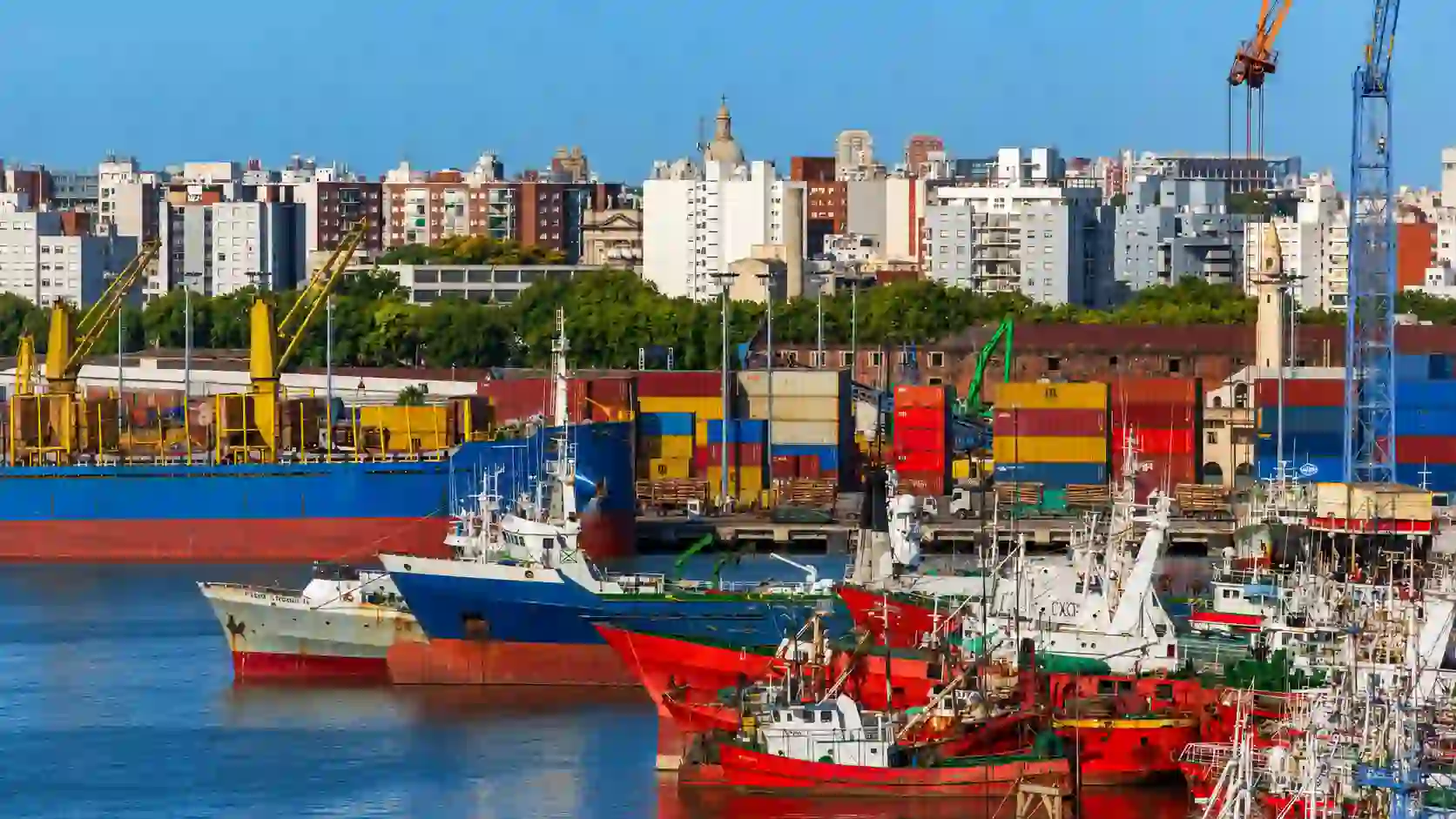
Uruguay has no commercial offshore oil discovery, but the exploration cycle already creates activity on land. Seismic acquisition, port calls, vessels, environmental monitoring and logistics planning for APA’s OFF-6 well — currently scheduled to begin from September 2027 — reveal the first contractable layer of a possible offshore service economy.
Archive · June 2026
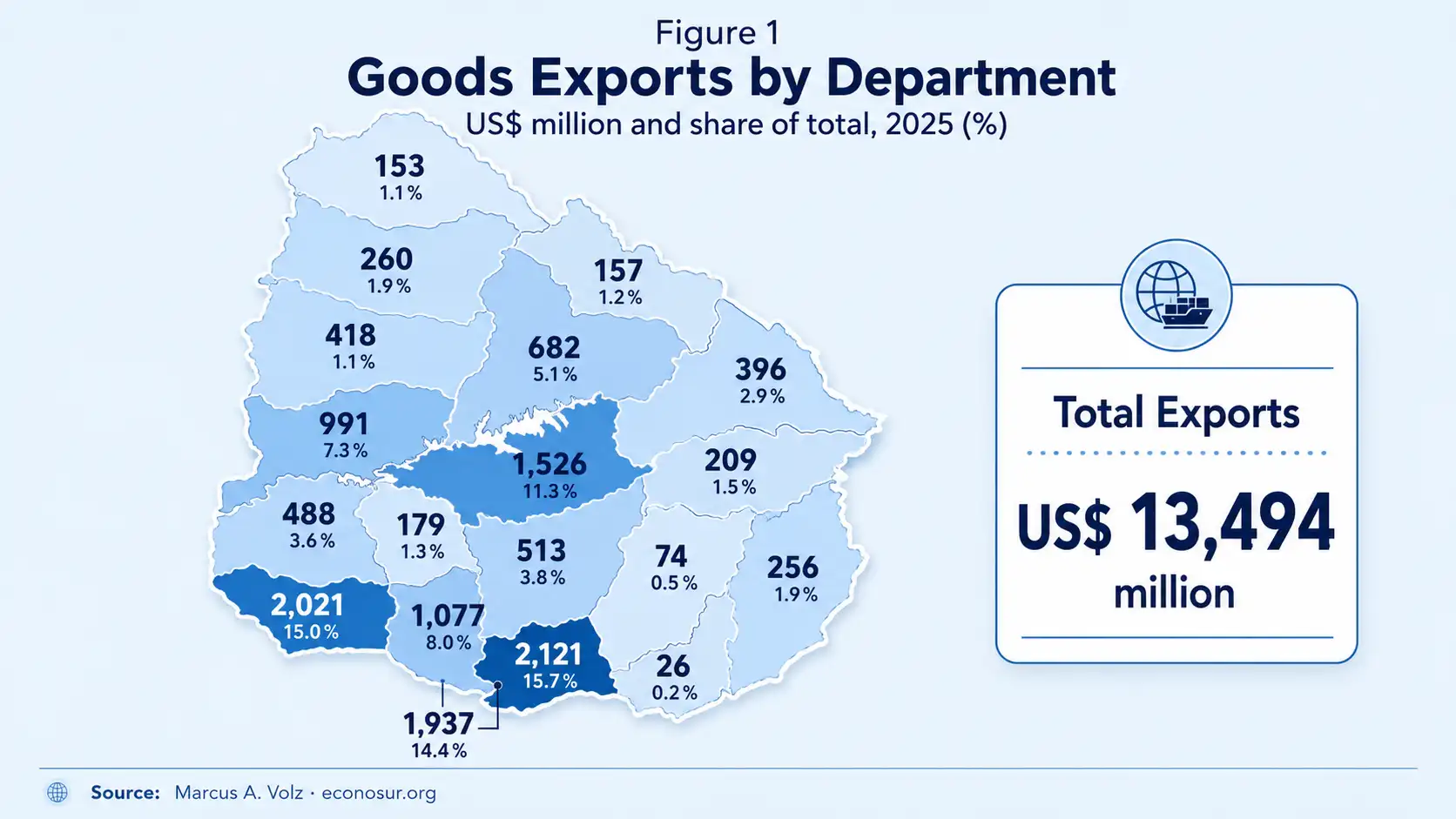
June analysis on Uruguay’s territorial export systems, China exposure and EU-Mercosur market access.
Uruguay does not export as a single uniform economy. Rice comes from the east, soy from the west, beef from the north, cellulose from the interior and dairy from specific regional production systems. This analysis shows why territorial production geography matters for China exposure, EU-Mercosur quota strategy and Uruguay's trade logic.
Archive · May 2026
May analysis on Uruguay’s digital positioning, infrastructure credibility and AI readiness inside Mercosur.
Uruguay is positioning fiber infrastructure, renewable electricity, AI governance and institutional stability as competitive assets in a Mercosur economy increasingly shaped by data, cloud infrastructure, clean energy and geopolitical uncertainty.

Archive · April 2026
Earlier Uruguay analysis on market entry logic, forestry and pulp, and the structure of the tourism market.
Uruguay consistently ranks among Latin America’s strongest institutional performers, including first place in the region in the World Justice Project’s overall Rule of Law ranking. For companies evaluating Mercosur, its legal certainty, regulatory stability and regional position make it a structurally distinctive coordination market.

Pulp became Uruguay’s leading export in 2024 and remained one of its central industrial exports in 2025. The analysis examines three operating mills, certified forestry and the contrasting logistics systems of UPM and Montes del Plata, including rail, river barges and dedicated port infrastructure.

Uruguay received 3.6 million visitors in 2025, generating USD 2.04 billion. Argentina accounted for roughly two thirds of arrivals, while European and North American visitors spent about 55–62% more per person. The structural tension between regional volume and long-haul value is the central question for the sector.

Operating platforms behind Uruguay’s market structure
Uruguay’s largest pulp platform, connecting two mills with rail, port, barge, free-zone and renewable-energy systems.
Read company insight →The Punta Pereira model combines plantations, M’Bopicuá river logistics, a direct industrial port and biomass generation.
Read company insight →The state-owned operator behind Uruguay’s fiber coverage, mobile infrastructure, data capacity and digital-policy credibility.
Read company insight →A cross-border passenger platform linking Buenos Aires, Colonia and Montevideo through ferry, port and tourism infrastructure.
Read company insight →Key Uruguay Questions
Why does Uruguay matter despite its small market size?
Uruguay matters because its competitiveness is based on stability, institutional trust, trade position, digital infrastructure, renewable electricity and its function as a reliable Mercosur interface.
What does the Praxis +Colonia investment plan mean for Uruguay?
Praxis has selected +Colonia for a projected US$1 billion city-scale investment plan. The current evidence points to aggregated member demand and an early-stage development process; land acquisition, binding contracts, construction and company formation remain the main execution tests.
How does Uruguay support Mercosur market entry?
Uruguay can support Mercosur market entry as a stable coordination point between Brazil, Argentina and the wider Southern Cone, especially when legal certainty and regional explainability matter.
Why is Uruguay’s digital infrastructure relevant?
Fiber coverage, cloud services, AI governance and renewable electricity make Uruguay relevant for data-sensitive services, B2B operations, digital business models and regional support structures.
Which sectors define Uruguay’s strategic profile?
Important sectors include e-fuels and renewable-energy projects, dairy exports, forestry and pulp, offshore exploration, port logistics, export geography, tourism, digital infrastructure and services connected to Mercosur.
Why does offshore exploration matter before a commercial discovery?
Seismic campaigns and well preparation already require ports, vessels, environmental monitoring, logistics and specialist services. The current opportunity is project-based, while a permanent offshore market still depends on a successful well and later development decisions.
Why does HIF Paysandú matter for Uruguay’s industrial model?
HIF Paysandú tests whether Uruguay can combine renewable electricity, Uruguay River water, biogenic CO₂, forestry residues and export infrastructure into a new e-fuels industry. The project remains pre-FID, and electricity pricing, final siting, environmental authorization, financing and offtake still determine whether the proposed USD 5.385 billion investment becomes an operating industrial platform.
Why does dairy matter for Uruguay’s export economy?
Dairy matters because Uruguay exports most of the milk processed by its industrial system. The sector combines productive farms, concentrated processing, a product mix led by whole milk powder and significant exposure to Algeria, Brazil and changing market-access rules.
Why does pulp matter for Uruguay’s industrial model?
Pulp matters because Uruguay’s three operating mills connect plantation forestry, foreign investment, free zones, rail and river logistics, dedicated port infrastructure, renewable electricity and global export demand. UPM and Montes del Plata show two different infrastructure models inside the same national sector.
Why does Buquebus’ electric ferry matter for Uruguay’s infrastructure model?
The China Zorrilla shows that maritime electrification depends on more than the vessel itself. Colonia required grid reinforcement, substations, high-power shore charging and port works, linking transport electrification directly to Uruguay’s renewable-heavy electricity system and infrastructure execution capacity.
How should companies read Uruguay’s role in the Southern Cone?
Companies should read Uruguay less as a volume market and more as a stable, explainable and strategically positioned economy with specific advantages in trust, infrastructure and regional coordination.
Technology and urban-investment projects, electric maritime transport and shore charging, e-fuels and renewable-energy projects, dairy exports, forestry and pulp, offshore exploration, port logistics, export geography, digital infrastructure, tourism and the structural characteristics that define Uruguay's role in the Southern Cone.
Econosur provides strategic market insights, market-structure analysis and regional intelligence for South America. Its Uruguay coverage connects technology and urban investment, electric maritime transport, e-fuels and renewable-energy projects, dairy exports, forestry and pulp, company infrastructure platforms, offshore exploration, export geography, digital readiness, tourism and regional logistics.