
Benetton in Patagonia:
Land, Wool, and the
Long History Behind
a Supply Chain
Benetton is Argentina's largest private landowner — 920,000 hectares across four Patagonian provinces, acquired in 1991 through the Compañía de Tierras Sud Argentino. The case is a lens on how a European company came to hold direct ownership of land, animals, and processing infrastructure in Patagonia — and what that position looks like when it becomes contested.
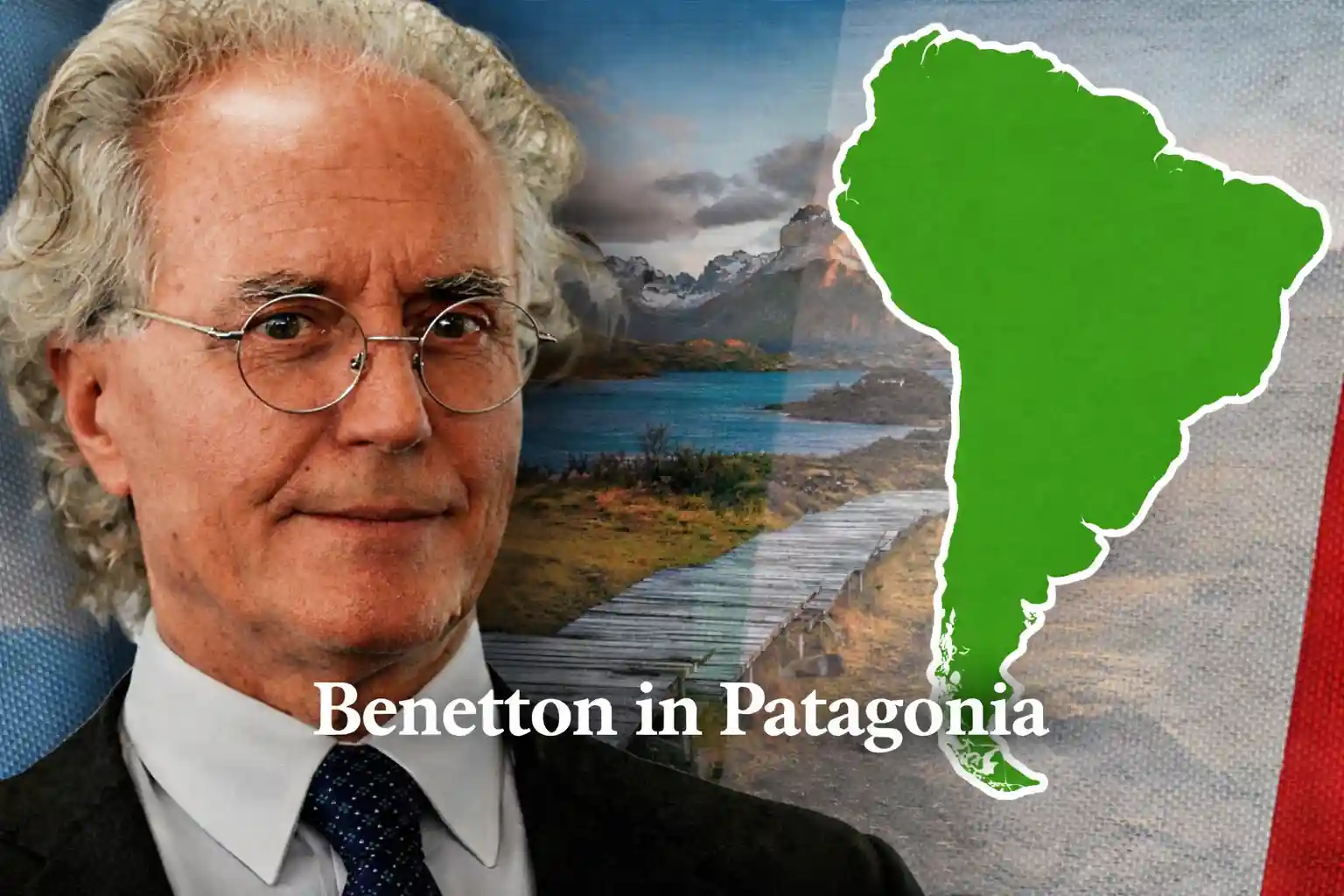
Benetton is read internationally as a fashion brand. In Patagonia, the name refers to something else: 920,000 hectares of land across Chubut, Santa Cruz, Río Negro, and Buenos Aires provinces — an area larger than any national park in Argentina, and the largest private landholding in the country. The connection between the Italian textile group and southern Argentina runs through the Compañía de Tierras Sud Argentino, a company whose history begins in 1889, with British capital, and which Benetton's family holding Edizione acquired in 1991 for approximately USD 50 million.
Why the acquisition continues to generate legal disputes, evictions, and political controversy in 2025 requires following the land through its ownership history — which predates Benetton's involvement by over a century.
The Ownership Chain: From 1879 to 1991
The land that Benetton now holds was not acquired on an open market. Its origin lies in the Conquista del Desierto of 1879 — the Argentine military campaign that dispossessed the Mapuche, Aonikenk, and other indigenous peoples of Patagonia by force. The Argentine state then distributed the territory it had seized, allocating large tracts to the British investors who had financed the campaign. The Argentine Southern Land Company, incorporated in London in 1889, was one of the vehicles created to administer that land on behalf of its British shareholders.
The Production Logic
The Compañía operates across three main productive activities. The Cordillera estancias — Leleque, El Maitén, El Montoso, and Pilcaniyeu, distributed across approximately 356,000 hectares in Chubut and Río Negro — focus on Merino sheep and Hereford cattle. Around 80,000 ewes produce approximately 390,000 kilograms of wool annually. The remaining Santa Cruz and Buenos Aires estancias are oriented toward agriculture: wheat, maize, soy, sunflower. A forestry operation covers around 10,000 hectares of pine. A processing plant in Río Gallegos — the Faimali frigorífico — slaughters up to 2,500 lambs per day.
Benetton's own documentation describes the Compañía as "synergic with the core business" of the group, which is one of the world's largest consumers of wool. The CTSA wool output has been cited as covering roughly 10 percent of Benetton's annual wool needs, though that figure dates to earlier reporting and the current proportion is not confirmed by recent company disclosures. Annual revenue of the Compañía is approximately USD 30 million — less than 4 percent of the Benetton group's global operations, according to company data cited by Bichos de Campo.
The Compañía's revenue — approximately USD 30 million per year — represents less than 4 percent of the Benetton group's global operations. The acquisition price of USD 50 million in 1991 covered the full landholding, livestock, and infrastructure. Benetton's own documentation describes the operation as "synergic with the core business" of the group as one of the world's largest consumers of wool, and notes investments of over USD 80 million in production infrastructure since acquisition.
The Conflict That Does Not End
The Mapuche territorial conflict is not a historical footnote. It is an active, ongoing dispute with documented legal, political, and physical dimensions that have escalated rather than resolved over time.
The sequence matters. In 2001, Atilio Curiñanco and Rosa Nahuelquir occupied 385 hectares of CTSA land in Santa Rosa, Chubut, claiming ancestral rights. A court confirmed Benetton's legal title; the family was evicted after 39 days. In 2005, Luciano Benetton announced a donation of 7,500 hectares to indigenous communities, describing it as a "symbolic gesture of social responsibility." The Chubut provincial government declined the offer in July 2006, citing questions about land quality — though the company's own description noted ten kilometres of Chubut riverbank and water resources.
In 2015, the Lof en Resistencia Cushamen community began occupying land in the CTSA Cushamen area. In January 2017, more than 200 federal and provincial police raided the community. In August 2017, Santiago Maldonado — a 28-year-old solidarity activist present during a subsequent Gendarmerie operation on CTSA property — disappeared. His body was found in the Chubut river 78 days later. The official investigation concluded that he drowned accidentally and found no criminal responsibility attributable to the security forces. Human rights organisations and Maldonado's family disputed that conclusion and called for further investigation. The case became a major public controversy in Argentina and drew international attention to the Patagonian land conflict.
The current regulatory context has shifted significantly. In December 2024, the Milei government eliminated Ley 26.160 — the emergency law that had suspended evictions of indigenous communities pending a survey of ancestral territories, in force since 2006. The Pailako community in Chubut was evicted within weeks. In February 2025, the government declared the Resistencia Ancestral Mapuche (RAM) a terrorist organisation, a designation contested by legal scholars and human rights groups. Simultaneous police operations were carried out against 12 Mapuche communities in Chubut that same month. The Benetton landholdings are directly adjacent to several of the affected areas.
What the Case Shows
The Benetton case is one of the better-documented examples of a pattern that recurs across the Southern Cone: a company holding direct ownership of land, animals, and processing infrastructure in Patagonian territory, through a company whose title traces to a 19th-century colonial distribution. The production logic — wool supply, vertical integration, local employment — was built on top of that territorial position over decades. Both are part of the same case.
For anyone examining supply chains, land tenure, or corporate risk exposure in the Southern Cone, the case raises questions that are practical as well as contested. How does a company account for the origin of its land in sustainability reporting? What is the legal and reputational exposure when land rights disputed since the 19th century remain unresolved in 2025? And what does the current Argentine regulatory direction — the elimination of indigenous land protection, the criminalisation of territorial claims — mean for the medium-term stability of these arrangements?
Benetton's legal title to the CTSA land has been confirmed by Argentine courts. That is a statement about current law. It is not a statement about the conflict's trajectory or the risk profile that unresolved territorial tensions create over time. The supply chain begins in Patagonia. What that beginning looks like is now, in 2025, more visible than it has been at any point since 1991.