
Chile SaaS Market 2026:
B2B Software
and Cloud Adoption
Chile is becoming more than a disciplined B2B software test market. In late 2026, enterprise SaaS, fintech and AI products increasingly have to prove data governance, security, interoperability and workflow value as Chile moves toward a new privacy regime and a technically defined Open Finance system.
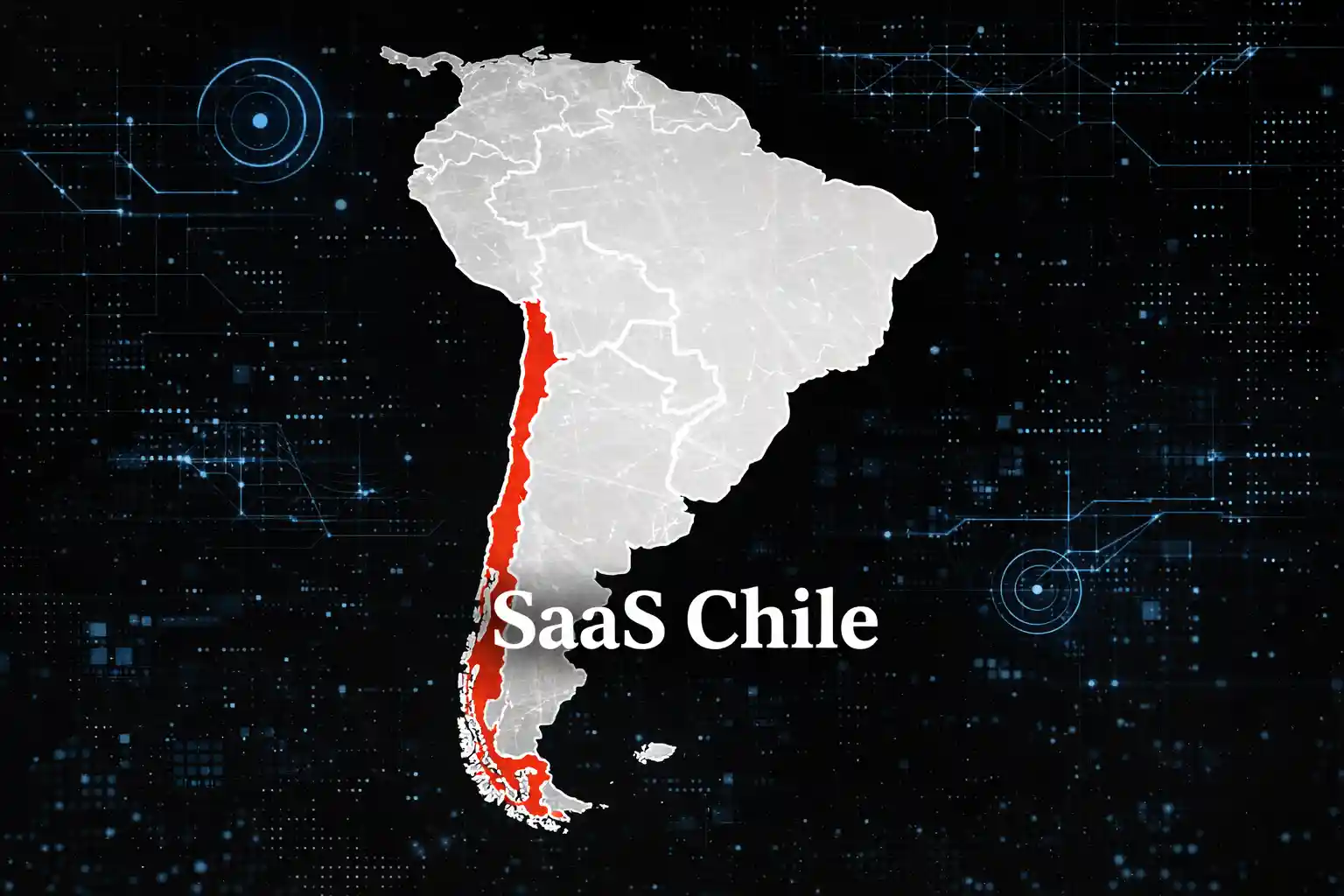
Chile remains one of the clearest environments in South America for reading B2B software adoption. The market is small enough to map, but sophisticated enough to test whether cloud products can win enterprise trust, replace fragmented workflows and scale into wider Spanish-speaking Latin America.
What changed in 2026 is the quality of that test. Chile is adding a stronger compliance and infrastructure layer. Law 21.719 enters into force on December 1, 2026 and materially raises the standard for personal-data processing. In parallel, the CMF has now defined the technical architecture of the Open Finance System, including APIs, consent management, security profiles and payment initiation, while moving full entry into force to July 2027.
Across Chile’s digital economy, SaaS demand is therefore being shaped by more than cloud adoption. Enterprise buyers increasingly have to evaluate data governance, cybersecurity, interoperability, AI use, documentation and regulatory fit alongside normal workflow value.
Market reading: Chile is moving from a “clean signal market” toward a regulated proving ground for B2B software. The useful question is no longer only whether a SaaS product can win enterprise trust. It is whether that product can remain useful, auditable and interoperable as regulatory standards become more concrete.
August 2026 update: the market is becoming more regulated, not just more selective
The venture-capital signal remains disciplined. Cuantico VP records US$4.126 billion invested across 681 Latin American VC rounds in 2025. Chile accounted for US$249 million across 53 rounds, or roughly 6% of regional capital. The recovery therefore remains concentrated rather than broad.
The more important 2026 change is regulatory execution. Chile’s new personal-data regime enters into force on December 1. The CMF has also completed a major technical step for Open Finance, while delaying full implementation until July 2027. For SaaS companies, this moves privacy, consent, security, APIs and auditability closer to the buying decision.
AI is moving inside existing workflow products. Buk formalized Buk AI as a transversal layer inside its HR platform in July 2026 and its August product roadmap adds an AI tutor embedded directly in employee training workflows. Adereso continues to position generative AI around enterprise customer-service and WhatsApp workflows and currently says more than 150 companies use its WhatsApp Business API solution. Chile’s AI bill, however, remains in its second constitutional stage and should be treated as a regulatory direction rather than current law.
Chile’s SaaS relevance is not scale by itself. It is the ability to read B2B software demand before larger markets make the signal noisier.
The New Regulatory Layer: Data, Consent and AI Governance
Chile’s strongest new SaaS signal in 2026 is regulatory rather than promotional. Law 21.719 enters into force on December 1, 2026. It modernizes Chile’s personal-data framework, creates the Agencia de Protección de Datos Personales and establishes a much more explicit compliance environment around personal-data processing, data-subject rights, international transfers and sanctions.
For enterprise SaaS, this matters because privacy becomes part of product architecture and procurement. HR software, customer-service platforms, fintech, insurance technology, health software and AI-enabled tools all process data that can become commercially sensitive under the new regime. Buyers therefore have stronger reasons to ask how consent is managed, where data is stored, how access is controlled, what is logged, how cross-border processing works and how incidents are handled.
Chile is also debating a dedicated AI law. The consolidated AI bill remains in its second constitutional stage in the Senate as of August 2026. It should not be presented as a rule already in force. But its continued legislative treatment reinforces the direction of travel: enterprise AI products will increasingly be evaluated through governance, risk and accountability as well as functionality.
Marcus A. Volz perspective: Chile is becoming a more demanding market for business software. Companies increasingly need to show not only what their software can do, but also how they protect data, manage access, use AI and meet regulatory requirements. For me, that makes Chile a useful market for testing whether a B2B software product is really ready for professional customers. A general “we serve Latin America” message is not enough.
What is the market signal?
The market signal is that Latin American SaaS is moving from speculative growth into a more disciplined adoption phase. Capital is still present, but less forgiving. Enterprise buyers are digitizing, but they do not behave like buyers in fully mature software markets. Trust, implementation, support, payments, local workflow knowledge and regional distribution matter as much as product features.
Chile is useful because it is readable. The enterprise landscape is smaller than Brazil or Mexico and less distorted by macroeconomic volatility than Argentina. That makes it a clearer environment for observing whether a software product can win enterprise trust, support B2B workflows and then move into the wider Spanish-speaking Latin American market.
This is why the topic belongs inside the Chile market context and not only inside a generic “LatAm tech” story. The country’s value lies in the structure of adoption, not in a headline claim about market size.
What the Unit Economics Actually Show
The State of SaaS LatAm 2024 report — published by SaaSholic in collaboration with Latitud and based on a sample of 400 startups — found that top-decile Latin American SaaS companies outperform on two of the metrics that matter most: customer acquisition cost payback and net dollar retention. The CAC payback finding is the more striking one. The report commentary noted that many top-decile respondents record CAC payback periods materially below US benchmarks.
That is not a rounding error. It reflects a structural difference in how markets at earlier cloud-adoption stages reward distribution efficiency. When a company sells into an enterprise that is adopting structured software for the first time, the value proposition is not only “better than competitor X.” It is “better than fragmented manual work.” That can change adoption logic, pricing logic and retention dynamics.
The runway data reinforces this. Among VC-backed Latin American SaaS startups with more than USD 1 million in ARR, the same report found materially longer runway than comparable US counterparts. The explanation is not that Latin American founders are inherently more disciplined. It is that capital scarcity historically made near-breakeven operation a survival condition, not a branding choice.
Market structure point: In Latin America, efficient SaaS growth is partly a market-structure story: lower capital availability, first-time cloud adoption and workflow fragmentation force companies to build with sharper unit economics.
Adereso: what one Santiago startup illustrates about regional distribution
Adereso AI, founded in Santiago de Chile in 2014, does not appear in most international investor narratives. It is a generative AI and customer-service platform that centralizes interactions across WhatsApp, Messenger, Instagram and email, serving enterprise clients across Latin America in sectors such as automotive, retail and financial services.
By 2026, Adereso’s public product positioning has moved further toward generative-AI automation for medium and large enterprises. Its current material emphasizes WhatsApp Business API, omnichannel service and AI agents, with enterprise use cases across retail, banking, insurance, telecommunications and services. Its current WhatsApp Business API page says more than 150 companies use the solution and displays customers including Chilexpress, Adidas, Abastible, BCI, IKEA, Bayer and MetLife. These are company-reported customer references, not an independently audited market-share measure.
The important signal is not the customer count by itself; it is the category shift from “customer-service software” toward AI-operated customer workflows embedded in a communication channel already used across the region.
What Adereso illustrates is less about one company than about market architecture. A startup from Santiago can access enterprise clients across multiple Spanish-speaking markets through shared communication habits and common messaging infrastructure. WhatsApp is not just a consumer app in this context. It is a business-process layer.
That matters for SaaS because regional expansion in Latin America often does not start with a new office in every country. It starts with workflows that already cross borders: customer support, collections, sales, field service, logistics updates, appointment reminders, conversational commerce and claims handling.
Other Chile-linked B2B software signals
Adereso is not the only useful company reference. Buk, Fintoc and Betterfly show different layers of Chile’s B2B software market: HR and people management, payment infrastructure, and employer-facing benefits and wellness. Together they make the SaaS signal more concrete than a generic startup-market narrative.
Buk is useful because HR software is a trust-heavy B2B category. Payroll, attendance, benefits, documents and internal workflows require local adaptation, legal precision and long-term enterprise confidence. In August 2026, Buk’s product roadmap added an AI tutor inside its training module, extending the July rollout of Buk AI from a general assistant into specific operational workflows. That is a more useful adoption signal than a standalone AI feature because the AI sits inside an existing enterprise process.
Fintoc is useful because payments and collections sit close to financial infrastructure rather than normal software adoption. Betterfly is useful because it connects SaaS, insurance, employer benefits and workplace wellness into one B2B platform logic.
| Company | Software layer | Market signal |
|---|---|---|
| Adereso AI | Conversational AI, sales, post-sales, omnichannel support. | Shows how WhatsApp and AI workflows can become regional B2B infrastructure. |
| Buk | HR, payroll, people management, benefits, finance workflows. | Shows enterprise trust, local regulation and the shift toward embedded AI through Buk IA. |
| Fintoc | Payments, bank-based payment flows and collections. | Shows how software can move into regulated financial infrastructure; CMF Resolution 4745 authorized Fintoc Pagos S.A. in May 2026 as a non-bank issuer of payment cards with provision of funds. |
| Betterfly | Benefits, insurance, wellness and employer-facing engagement. | Shows regional consolidation: Betterfly highlighted its 2026 integration of Mexico’s Minu and its next-step expansion toward the United States. |
Where the Capital Is Going — and What It Signals
Venture capital in Latin America has stabilized after the post-2021 correction, but the structure of that recovery matters. 2025 data point to more capital deployed than in 2024, but with fewer or more selective rounds than during the boom period. That means investors are not simply chasing growth narratives. They are looking for traction, efficiency and credible expansion paths.
For SaaS founders, this is a different environment from the 2020–2021 cycle. A large addressable market is no longer enough. Investors want evidence that sales cycles are manageable, churn is controlled, CAC payback is reasonable and regional expansion does not destroy the economics of the business.
For international companies evaluating SaaS partnerships, acquisitions or commercial expansion, this selectivity is useful. It separates companies with real enterprise adoption from companies that were carried by funding-cycle optimism.
Marcus A. Volz perspective: The 2025 VC numbers are useful because they show capital concentration, but they are not the best measure of Chile’s software opportunity. The stronger 2026 signal is that software companies are being pulled closer to regulated operating systems — payroll, payments, benefits, customer data and AI-assisted workflows. That creates smaller but more defensible B2B markets than a generic “LatAm SaaS boom.”
Open Finance: A Defined API Market With a Delayed Commercial Clock
Chile’s Fintech Act is also creating a more concrete infrastructure market for software companies. On June 1, 2026, the CMF amended NCG 514 and incorporated the technical annex for the Open Finance System. The framework now specifies interoperability elements including APIs, consent management, security profiles, developer functions and payment initiation.
At the same time, the CMF postponed the system’s entry into force until July 2027 because of implementation complexity. That delay matters commercially. It does not remove the opportunity; it creates a preparation window for banks, fintechs, software vendors, security providers and integration partners to build and test the required infrastructure.
Fintoc illustrates how this infrastructure layer is becoming more concrete. CMF Resolution 4745, dated May 5, 2026, ordered the registration of Fintoc Pagos S.A. in the Single Registry of Payment Card Issuers and authorized it to operate as a non-bank issuer of payment cards with provision of funds. Fintoc describes the operating model commercially as business payment accounts connected directly to Chile’s transfer infrastructure. That is a different signal from startup funding: software is moving into regulated financial rails.
Marcus A. Volz perspective: Open Finance changes the type of SaaS opportunity. The interesting market is no longer only subscription software sold to a bank or fintech. It includes API infrastructure, consent management, identity, security, observability, payment initiation and integration work. In other words, part of Chile’s software market is becoming infrastructure procurement.
Chile’s Role: Smaller Market, Cleaner Signal
Chile works best as a cleaner signal market for Spanish-speaking B2B software demand. Brazil and Mexico are the anchor markets for regional scale, while Chile is useful for testing trust, implementation depth, enterprise workflows and regional expansion discipline.
Chile has a relatively sophisticated enterprise base, stronger institutional trust than many regional peers, a tradition of startup support through institutions such as Start-Up Chile and a business environment where SaaS adoption can be tested without the scale noise of Brazil or the macro distortions of Argentina.
This makes Chile particularly relevant for companies selling workflow software, customer-service automation, fintech infrastructure, HR tools, logistics software, compliance systems, procurement platforms and other B2B products that require trust before scale. The same country logic also appears in Chile’s wider strategic economy, from digital services to copper, lithium and China-linked industrial demand.
| Market layer | Chile signal | Why it matters |
|---|---|---|
| B2B trust | Enterprise buyers are small enough to map, but sophisticated enough to validate software value. | Useful for testing whether a product can win real business workflows. |
| Regional expansion | Spanish-language workflows can extend from Chile into Peru, Colombia, Mexico, Argentina or Central America. | Chile can act as an entry signal, not the final market. |
| Capital discipline | Smaller funding base forces efficiency and clearer traction. | Useful for investors looking beyond narrative-driven growth. |
| Digital workflows | Customer service, payments, HR, logistics and support processes are still digitizing. | Creates room for vertical SaaS and workflow automation. |
Why B2B Demand Is the Better Lens
The SaaS opportunity in Chile and the wider Southern Cone is not simply “more software.” It is the digitization of specific business functions that still operate through fragmented tools: WhatsApp, spreadsheets, email, manual approvals, legacy ERPs and informal workflows.
That is why horizontal SaaS categories can be misleading. The more interesting opportunity is often vertical or workflow-specific: insurance claims, retail support, SME finance, B2B commerce, logistics coordination, medical administration, education management, HR compliance, procurement or customer communication.
In those categories, SaaS adoption depends less on global software trends and more on the credibility of local implementation. A tool must fit the way regional companies actually work, not the way a US or European pitch deck assumes they work. This is also why SaaS belongs near the broader platform economy and retail discussion in South America.
The Structural Argument
The LATAM SaaS market is not a single story. It is a collection of markets at different stages of cloud adoption, with different regulatory environments, payment infrastructure maturity and enterprise buying behavior.
What Chile offers — relative to the two dominant regional markets Brazil and Mexico — is a smaller but clearer environment for reading software demand. In 2026 that clarity increasingly comes from defined rules as well as market size: a new data-protection regime, a technically specified Open Finance roadmap and active debate over AI governance create a more explicit operating framework for enterprise software.
The companies most likely to define the next phase of Latin American SaaS are probably already operating. They are not always visible in international pitch decks. They are managing CAC payback, runway, implementation, enterprise adoption and an increasingly demanding compliance layer under constraint. Whether that combination produces global-scale outcomes is an open question. But the starting conditions are genuinely distinct from what is available in saturated markets.
That distinction is measurable rather than speculative. For companies comparing SaaS categories, B2B software demand or cloud adoption across South America, this is the type of question that belongs in a structured custom market analysis.
Need a digital market brief on SaaS, B2B software or cloud adoption in South America?
Econosur prepares short market briefs and custom analysis for companies, analysts and institutions evaluating South American digital markets, SaaS categories, B2B software demand and commercial expansion questions.
Possible scopes include Chile SaaS, vertical software, customer-service automation, WhatsApp-based workflows, cloud adoption, fintech infrastructure, data-protection readiness, B2B commerce and regional commercial expansion from Chile into Spanish-speaking Latin America.
Request a Digital Market BriefFrequently asked questions
Why is Chile relevant for SaaS in Latin America?
Chile is relevant because it is a smaller but institutionally clearer B2B market. It can reveal enterprise software demand, cloud adoption, regional distribution potential and pricing discipline before larger markets become necessary.
Is Chile a large SaaS market?
Chile is smaller than Brazil or Mexico, but useful as a test market for B2B software, enterprise trust, operational discipline and regional expansion into Spanish-speaking Latin America.
What makes Latin American SaaS different from mature SaaS markets?
Much of Latin American SaaS growth comes from first-time cloud adoption rather than switching between mature providers. This changes unit economics, sales cycles, customer education needs and distribution strategy.
Why do WhatsApp workflows matter for SaaS in Latin America?
WhatsApp is a dominant communication layer across Latin America. SaaS companies that build around messaging, customer service, commerce or support workflows can use this shared infrastructure to scale across countries more efficiently.
What should investors look for in Chile SaaS companies?
Investors should look for enterprise traction, workflow specificity, low churn, reasonable CAC payback, implementation capacity, data-governance readiness and evidence that the product can expand beyond Chile without losing efficiency.
Why does Chile’s new data-protection law matter for SaaS companies?
Law 21.719 enters into force on December 1, 2026. It raises the standard for personal-data processing and creates a dedicated Data Protection Agency, making privacy, governance, consent, security and cross-border data handling more important in enterprise software procurement.
What changed in Chile’s Open Finance System in 2026?
In June 2026 the CMF incorporated the technical annex needed for interoperability, including APIs, security profiles, consent management and payment initiation. Because implementation is complex, the system’s entry into force was postponed until July 2027.
Is Chile’s AI regulation already in force?
No. Chile’s bill regulating artificial-intelligence systems remains in its second constitutional stage in the Senate. It is therefore a regulatory direction to watch, not a law already in force.