
LATAM SaaS: Chile,
the Southern Cone, and
What Early-Stage
Markets Actually Teach
Latin America's SaaS market is growing at roughly 25 percent annually — faster than Europe, faster than East Asia. The structural reasons behind that number are more instructive than the number itself, and Chile is one of the clearer places to read them.
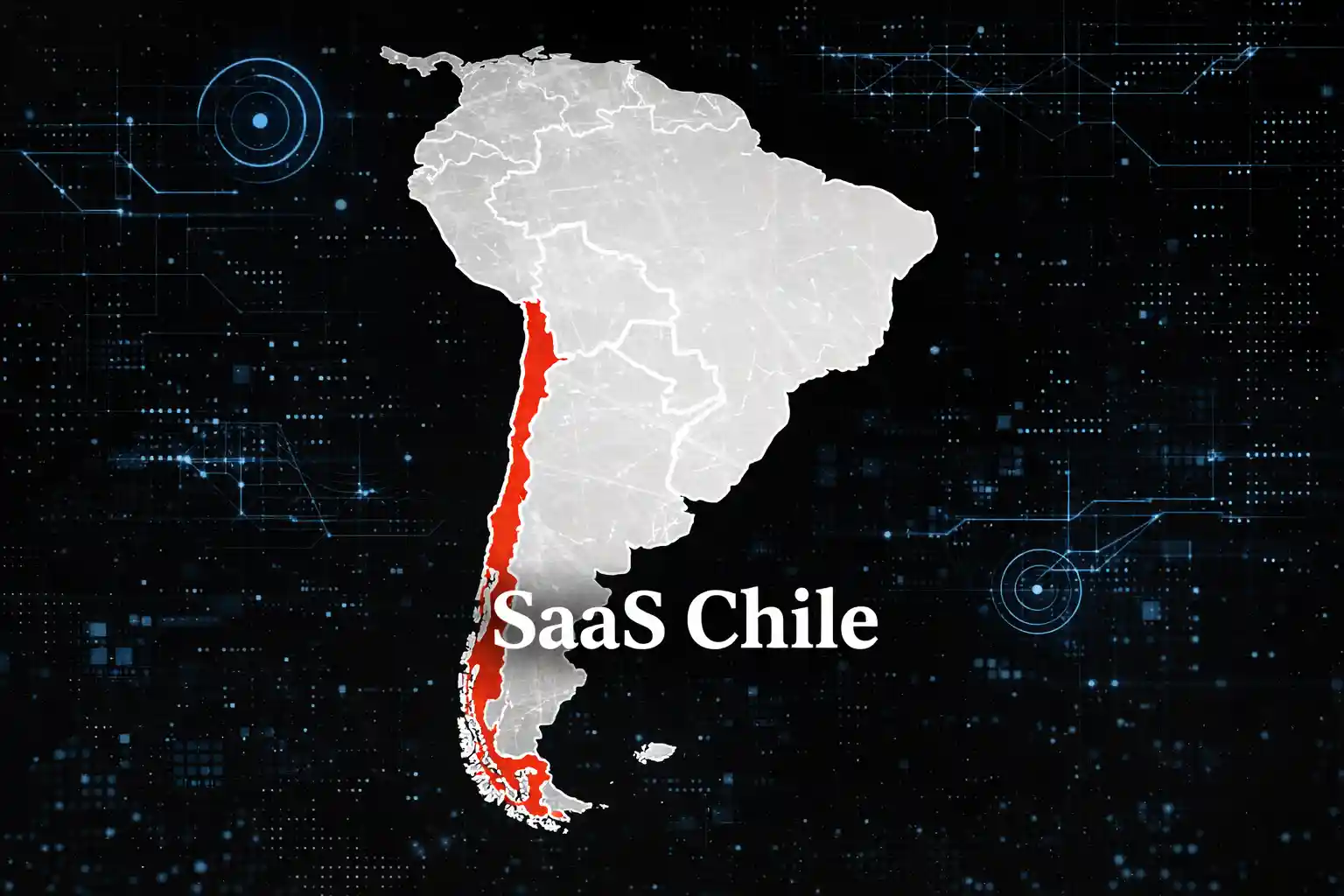
There is a number that tends to be absent from technology investment reports focused on Latin America: the region's SaaS market reached an estimated USD 8.3 billion in 2024 and is projected to grow to USD 31.9 billion by 2030, a compound annual growth rate of approximately 25 percent, according to Statista. That figure not only exceeds the global average — it outpaces mature markets including East Asia and Europe, which posted SaaS growth rates of 16 and 19 percent respectively in 2024, according to data compiled by EBANX and Payments and Commerce Market Intelligence. The gap is wide enough to make the trailing-market assumption worth revisiting.
What makes this more than a headline number is the structural logic underneath it. Latin American SaaS is growing primarily through first-time cloud adoption — enterprises migrating from on-premises systems for the first time, rather than switching between established providers. That dynamic produces different economics than a saturated market, and those economics are visible in the unit-level data of the companies operating here.
What the Unit Economics Actually Show
The State of SaaS LatAm 2024 report — published by SaaSholic in collaboration with Latitud and based on a sample of 400 startups — found that top-decile Latin American SaaS companies outperform on two of the metrics that matter most: customer acquisition cost payback and net dollar retention. The CAC payback finding is the more striking one. As NFX principal Anna Piñol noted in her commentary on the report, most top-decile respondents record CAC payback periods that are 32 percent below US benchmarks. That is not a rounding error. It reflects a structural difference in how markets at early adoption stages reward distribution efficiency.
The runway data reinforces this. Among VC-backed Latin American SaaS startups with more than USD 1 million in ARR, the median company carries 15 months more runway than its US counterpart, according to the same report. The explanation is not that Latin American founders are inherently more disciplined — it is that capital scarcity has historically made near-breakeven operation a precondition for survival, not an aspiration. The result is a cohort of companies that have been forced to build leaner operations and stronger unit economics than their better-funded peers in saturated markets. That is a durable structural advantage, not a temporary artifact of the funding cycle.
"Capital scarcity has historically made near-breakeven operation a precondition for survival in Latin America, not an aspiration. The efficiency metrics that result from that constraint are visible in the data — and are not easy to replicate in environments where capital is abundant."
Adereso: What One Santiago Startup Illustrates About Regional Distribution
Adereso AI, founded in Santiago de Chile in 2014, does not appear in international investor reports. It is a generative AI platform that automates and centralises customer service interactions across WhatsApp, Messenger, Instagram, and email — serving more than 150 enterprise clients across Latin America in sectors including automotive, retail, and financial services. It operates as a Meta-certified WhatsApp Business Solution Provider, a designation that gives it access to the business messaging infrastructure of the region's dominant communication channel.
What Adereso illustrates is less about the company itself — which remains early-stage by global standards — and more about the market architecture it is operating in. A startup from Santiago can access enterprise clients across a dozen countries through a single API integration. The distribution logic is regional from day one, without the localisation overhead that equivalent expansion would require in, say, Southeast Asia or Eastern Europe. WhatsApp's near-universal penetration across Latin America functions as a shared infrastructure layer that compresses the cost of regional reach. That structural condition benefits any SaaS company selling into enterprise customer service workflows in the region — Adereso is one instance of a repeatable pattern.
Where the Capital Is Going — and What It Signals
Venture capital in Latin America stabilised in 2024 after two years of contraction. According to LAVCA's 2025 Trends in Tech report, VCs invested USD 4.5 billion across 751 deals in 2024, up from USD 4.2 billion across 826 deals in 2023. The deal count decline alongside rising total volume tells the more important story: capital is concentrating. Investors are writing larger checks into fewer, more proven companies, and early-stage rounds — which accounted for 54 percent of VC dollars deployed in the first half of 2025 — are increasingly dominated by follow-on transactions from existing backers rather than new entries.
For investors considering the market now, that dynamic has two implications. First, the window for early positioning at competitive valuations is narrowing as more international capital rediscovers the region. Second, the bar for traction has risen: the average round size increased while deal count fell, meaning that the companies attracting capital are those with demonstrated efficiency metrics, not narrative alone. SaaS consolidated as the second-largest sector by deal count in recent LAVCA data, accounting for approximately 13 percent of transactions — a share that reflects both the sector's maturation and the continued appetite for enterprise software with clear unit economics.
Within the region, Chile and Argentina represent a distinct tier for Southern Cone-focused investors. While Brazil and Mexico together account for roughly 80 percent of regional SaaS spend and function as anchor markets, Chile and Argentina are growing their SaaS sectors at over 20 percent annually on smaller bases, according to data from Kairos Aureum citing Grand View Research. Both offer lower competitive density than the two dominant markets, and institutional support structures — Start-Up Chile being the most established in the region — that reduce the friction of early-stage company building. Argentina adds the variable of macroeconomic volatility, which shapes operator behaviour in ways that are legible once you understand the market but require local knowledge to navigate.
The Structural Argument
The LATAM SaaS market is not a single story. It is a collection of markets at different stages of cloud adoption, with different regulatory environments, payment infrastructure maturity, and enterprise buying behaviour. What Chile and Argentina share — relative to Brazil and Mexico — is a combination of lower competitive saturation, growing local venture ecosystems, and enterprise sectors that are underdigitised by global standards. The opportunity there is not primarily about capturing a large existing market. It is about building the software layer that a rapidly digitising economy will require, before that market becomes fully legible to the broader international investor community.
The companies most likely to define the next phase of Latin American SaaS are probably already operating. They are not yet in international pitch decks. They are managing CAC payback periods that the SaaSholic data would classify as top-decile, running on runway that reflects operational discipline built under constraint, and selling into enterprise customers who are adopting cloud software for the first time. Whether that combination produces global-scale outcomes is an open question — early-stage market advantages do not automatically translate into durable competitive moats. But the starting conditions are genuinely distinct from what is available in more saturated markets, and that distinction is measurable rather than speculative.