
South America Car Market:
China, Europe
and US Competition
South America’s automotive contest has moved beyond imports. Chinese automakers are localizing production and product development, EU-Mercosur is already changing tariffs, and regional roles are becoming clearer across Brazil, Argentina, Chile, Paraguay and Uruguay.
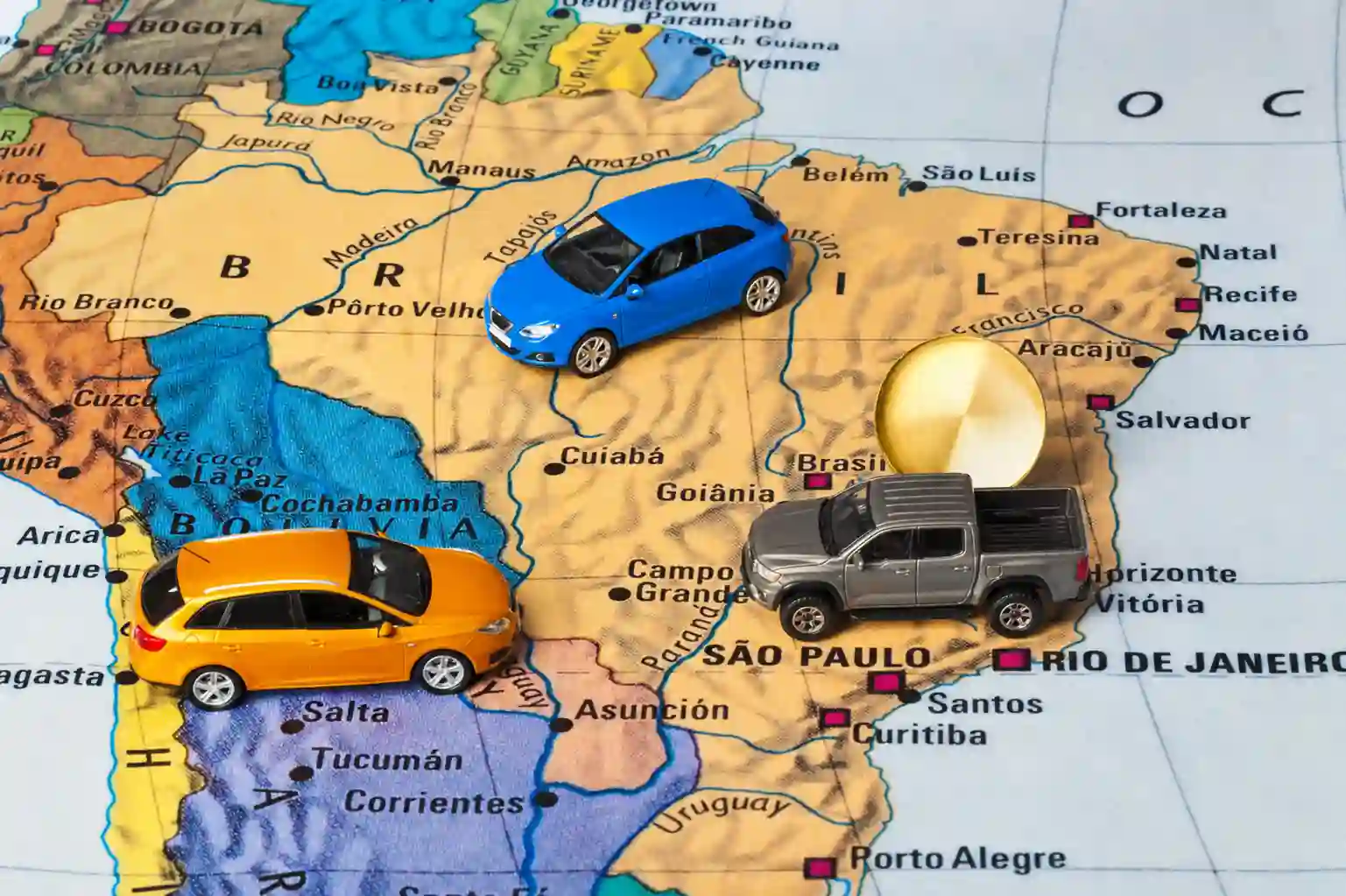
South America’s automotive competition is shifting from imported vehicles to competing production systems.
China is now localizing factories, components and even Brazil-specific powertrains. Europe gained an immediate tariff lever when the EU-Mercosur interim trade agreement began provisional application on May 1, 2026. US manufacturers retain important brands and industrial assets, but the regional contest is increasingly defined by who can combine production, sourcing, financing, software, after-sales networks and regional exports.
The country roles are becoming more distinct: Brazil is the industrial battlefield, Argentina is leaning harder on exports, Paraguay is a measurable supplier niche, Chile remains an open brand-competition laboratory and Uruguay has become one of the clearest adoption cases for Chinese brands.
Market analysis framework
August 2026 update: the competition has moved into localization
EU-Mercosur is now a real operating variable. Since May 1, the interim trade agreement has provisionally applied. Mercosur duties on EU electric and hybrid vehicles fell from 35% to 25%, while duties on internal-combustion cars fell to 17.5%. Tariffs on car parts also began a gradual reduction.
BYD has moved beyond assembly. On August 4, the company unveiled its first Brazilian-made plug-in hybrid flex-fuel vehicle, jointly developed by Brazilian and Chinese teams for the local market. BYD sold 23,465 vehicles in Brazil in July, reached 9.1% market share and ranked fourth. Its Camaçari plant is expected to produce around 180,000 vehicles in 2026 while the company pushes toward more than 50% local content in 2027.
GWM is building the supplier layer required for regional exports. Its Iracemápolis plant has 50,000 vehicles of annual capacity. The company is working to lift local content from roughly 20% toward 35%, a threshold it wants to reach in order to export the Haval H6 from Brazil to Argentina in 2027.
The surrounding markets are separating into clearer roles. Argentina’s exports are now carrying more of its production system, Paraguay’s automotive-cable maquila exports are growing, Chile shows broad Chinese brand penetration and Uruguay recorded a Chinese-brand majority in July.
The market signal: production systems are competing now
The strongest signal is no longer the number of Chinese vehicles arriving at South American ports. It is the transition from importing vehicles to building systems around them: factories, locally engineered products, domestic suppliers, regional exports, financing, software and dealer networks.
That changes the competitive frame. European and US manufacturers still possess deep industrial history, supplier relationships and brand trust. Chinese automakers are adding speed, electrification and localization. The EU-Mercosur agreement now gives European producers a tariff response that did not exist in the same form earlier in 2026.
The contest is shifting from who can sell the car to who can control the industrial system behind it.
EU-Mercosur gives Europe a real tariff lever
The EU-Mercosur automotive story changed on May 1, 2026. The interim trade agreement began provisional application after the required procedures were completed. For EU electric and hybrid vehicle exports, Mercosur duties fell immediately from 35% to 25%. For internal-combustion vehicles, the duty fell to 17.5%. Car-parts tariffs also began a staged dismantling process.
This does not recreate Europe’s old dominance automatically. Chinese manufacturers are competing through lower-cost platforms, electrified products, financing and increasingly local production. But European automakers and suppliers now have a concrete commercial variable to price into vehicle exports, components, machinery and supplier strategies.
The important question is where tariff relief changes sourcing decisions. A European component producer may gain export competitiveness before it has any reason to establish local manufacturing. A vehicle producer may use tariff reductions to test demand while keeping regional production options open. Suppliers already embedded in Brazil or Argentina can combine tariff access with local industrial relationships.
China is localizing products, suppliers and regional strategy
BYD is the clearest example. Its Camaçari investment is evolving from a factory story into a product-development story. The Song Pro Super-Híbrido Flex Fuel was developed by Brazilian and Chinese teams for Brazil’s ethanol-rich fuel environment. That is a deeper form of localization than importing a global model and assembling it locally.
The commercial scale is also changing. BYD reached 23,465 Brazilian sales in July 2026 and 9.1% market share, ranking fourth. The plant is expected to produce around 180,000 vehicles this year, and BYD is targeting more than 50% local content from January 2027.
GWM is pursuing a parallel but more supplier-intensive path. Its Iracemápolis plant is already operational, with annual production capacity of 50,000 vehicles. GWM is localizing glass, 12V batteries, welding processes and other components and is working with suppliers on electronics, tires and seats. The company wants at least 35% local content to support exports of the Haval H6 to Argentina.
Current China signal: Chinese automotive expansion in South America is becoming a localization strategy that combines factories, supplier development, local engineering, regional exports and open-market distribution.
Brazil: the production and localization battlefield
Brazil remains the only market in the region large enough to combine mass production, supplier depth, a major domestic market and multiple competing localization strategies at scale.
Vehicle production reached about 253,900 units in July and 1.63 million from January through July, up 8.3% year on year. Registrations increased 17.9% over the same seven-month period. Exports, however, fell 20.8%, showing that Brazil’s current strength is being pulled by domestic demand more than foreign shipments.
This matters because localization is happening inside a growing market. BYD and GWM can justify supplier development because Brazil provides domestic volume, tariffs on imports and a potential base for Mercosur exports. Legacy manufacturers must therefore defend market share while also competing for suppliers, engineering talent, dealer economics and electrification investment.
Chile: the open brand and distribution laboratory
Chile continues to play a different role. It is less important as a production base and more useful as a direct test of brand acceptance, distribution, pricing and after-sales credibility.
By July 2026, Chile had sold 178,296 new light and medium vehicles year to date, up 3.3%. The brand ranking shows Chinese groups spread across the market rather than relying on a single breakout brand: GWM held 5.1% year-to-date share, Changan 4.4%, MG 3.7%, Chery 2.8% and Jetour 2.4%. Tesla had reached roughly 1%.
The point is structural. Buyers can compare Chinese, Japanese, Korean, US and European brands in a relatively open market. That makes Chile valuable for reading whether Chinese manufacturers can sustain service, residual value, financing and brand trust after the initial price advantage.
Argentina: exports increasingly carry the production base
Argentina’s automotive system is moving through a difficult rebalancing. Production from January through July reached 235,847 vehicles, down 18.0% year on year. Wholesale domestic deliveries fell 24.9%.
Exports tell a different story. The industry exported 150,270 vehicles in the first seven months, 1.6% more than a year earlier, and July exports jumped 28.3% year on year. ADEFA itself described exports as the sector’s current support channel.
That strengthens Argentina’s role as an export-specialized production base rather than a broad domestic-growth story. The commercial question for suppliers is therefore which vehicle platforms remain export-competitive, which local components can defend their position and where imported parts or Brazil-based production will replace domestic sourcing.
Paraguay: a measurable supplier niche
Paraguay is becoming more relevant because the supplier role can now be measured in trade data. Through May 2026, exports of wires and cables classified as automotive parts under the maquila regime reached US$182.8 million, up 24.0% year on year. They represented 30.7% of Paraguay’s maquila exports.
This is a very different automotive role from Brazil or Argentina. Paraguay does not need to become a full vehicle-production center to participate in the regional industry. It can specialize in labor- and process-intensive components that feed larger Mercosur plants.
The business question is whether the country can deepen that role into higher-value electrical systems, electronics, assemblies and industrial services while keeping its cost and tax advantages.
Uruguay: Chinese adoption is now a market fact
Uruguay has moved from a small illustrative case to one of the clearest open-market signals in the region. In July 2026, BYD led the market. Dongfeng ranked third, and Chinese brands together accounted for 52.7% of light-vehicle sales according to market data based on ACAU registrations.
The model ranking is even more revealing. Dongfeng’s Nammi led passenger cars, while BYD’s Yuan Pro was one of the strongest SUV performers. Multiple Chinese electric models appeared among the leading passenger cars.
Uruguay therefore shows what happens when brand acceptance, EV availability, pricing and distribution converge in a small open market. The strategic value of the case is not its absolute volume. It is the speed with which the competitive order can change.
One region, five different automotive roles
| Market | Role in the regional system | Current signal | Commercial question |
|---|---|---|---|
| Brazil | Production and localization core | 1.63m vehicles produced Jan–Jul; BYD and GWM building local industrial systems. | Which suppliers and technologies become localized as Chinese production scales? |
| Argentina | Export-specialized manufacturing base | Production down, exports slightly up; export channel is carrying the system. | Which platforms and local suppliers remain internationally competitive? |
| Chile | Brand, distribution and after-sales laboratory | Chinese brands occupy multiple top ranking positions in an open import market. | Which brands convert price and model availability into durable trust? |
| Paraguay | Supplier and maquila niche | US$182.8m in automotive cable exports through May, up 24%. | Can the supplier base move into higher-value components and assemblies? |
| Uruguay | Open-market adoption signal | Chinese brands reached 52.7% of July light-vehicle sales. | Does rapid adoption translate into durable dealer, service and residual-value strength? |
What automotive suppliers should watch
Three business questions that require deeper research
Which vehicle and component categories are actually moving into local sourcing in Brazil?
Factory announcements do not reveal which packages are open to new suppliers, which parts remain imported, which local-content thresholds apply or when supplier nominations occur.
Where can an international supplier enter the regional value chain without duplicating existing capacity?
The answer depends on buyer responsibility, incumbent suppliers, homologation, local-content rules, logistics, technical support and whether the relevant vehicle platform serves Brazil, Argentina or both.
Which Chinese brands are building durable market positions rather than short-lived sales spikes?
Sales rankings alone cannot answer this. Distribution quality, financing, parts availability, warranty performance, dealer economics, fleet penetration and residual values determine whether early adoption becomes structural.
Where Published Information Stops
Public information now shows vehicle production, factory capacity, tariff schedules, headline local-content targets, trade flows and brand rankings. It does not provide a complete package-level map of automotive procurement.
The main gaps include supplier nomination calendars, approved vendor lists, component-level sourcing decisions, current local-versus-import cost comparisons, homologation requirements, buyer responsibility, regional platform volumes, warranty performance, dealer economics, fleet contracts and the commercial reasons why a manufacturer changes suppliers.
Those gaps require buyer research, supplier mapping, competitor observation and project-level validation.
Automotive market and supplier research
Econosur can extend the public analysis with targeted research for manufacturers, component suppliers, technology providers and industrial-service companies evaluating South America’s automotive system.
This August 2026 update uses official trade, industry and company sources plus current market reporting to separate production announcements from observable execution.
- European Commission: provisional application of the EU-Mercosur interim trade agreement and immediate automotive tariff cuts from May 1, 2026.
- Reuters, August 4, 2026: BYD’s Brazilian-made flex-fuel plug-in hybrid, July sales, market share, production outlook and localization target.
- GWM: Iracemápolis plant capacity and current Brazil manufacturing footprint.
- Automotive Business, June 10, 2026: GWM supplier localization and 35% local-content target for Haval H6 exports to Argentina.
- Reuters/Anfavea, August 7, 2026: Brazil July production, registrations, exports and January–July totals.
- ANAC Chile: July 2026 automotive market report and current market rankings.
- Autocosmos Chile using ANAC data: January–July brand ranking and July 2026 market performance.
- ADEFA, August 5, 2026: Argentina July production, exports, wholesale deliveries and year-to-date automotive performance.
- Banco Central del Paraguay: January–May 2026 maquila exports, including automotive wires and cables.
- Autoblog Uruguay using ACAU registrations: July 2026 sales by brand and model.
- Best Selling Cars Blog: July 2026 Chinese-brand share and Uruguay market ranking.
From automotive data to commercial research
Vehicle sales show only one layer of the market. Supplier nominations, local-content targets, tariffs, production platforms, buyer structures, after-sales networks and regional sourcing determine where commercial opportunities actually emerge.
Econosur prepares custom research on automotive suppliers, competitors, production systems, localization, procurement structures and regional automotive shifts across South America.
Discuss an automotive research questionFrequently asked questions
What is changing in South America’s automotive market in 2026?
The market is moving from import competition toward competing production systems. Chinese automakers are localizing production and product development in Brazil, EU-Mercosur has begun cutting automotive tariffs, Argentina is becoming more export-dependent, Paraguay is growing as a supplier niche and open markets such as Chile and Uruguay show rapid brand change.
How does EU-Mercosur change automotive competition?
Since May 1, 2026, the interim trade agreement has provisionally applied. Mercosur duties on EU electric and hybrid vehicles fell from 35% to 25%, while duties on internal-combustion cars fell to 17.5%. Car-parts tariffs also began a gradual reduction.
Why is BYD’s Brazil strategy important?
BYD is moving beyond imported vehicles into localized production, local content and Brazil-specific product development. In August 2026 it unveiled a Brazilian-made plug-in hybrid flex-fuel vehicle developed by Brazilian and Chinese teams.
Why is Brazil still the automotive center of South America?
Brazil combines production scale, a large domestic market, supplier depth, tariffs and new Chinese localization. From January through July 2026, Brazilian vehicle production reached about 1.63 million units.
Why do Chile and Uruguay matter for Chinese automotive expansion?
Both are relatively open markets that reveal buyer acceptance quickly. Chinese brands occupy multiple top positions in Chile, while in Uruguay BYD led the market in July 2026 and Chinese brands together accounted for more than half of light-vehicle sales that month.
What do Argentina and Paraguay contribute to the regional automotive system?
Argentina remains a vehicle production and export platform whose domestic supplier base is under pressure, while Paraguay is becoming a measurable supplier niche through maquila exports such as automotive cables and electrical conductors.