
Uruguay · Market Entry · Mercosur · Brazil Strategy · Rule of Law
Uruguay and the Logic of the Small Market: Why the Road to Brazil Often Runs Through Montevideo
There is an investment logic in the Mercosur region that is rarely made explicit — because it runs against instinct. Anyone looking to grow in Brazil or Argentina looks first at Brazil or Argentina. That is understandable. It is also often expensive.
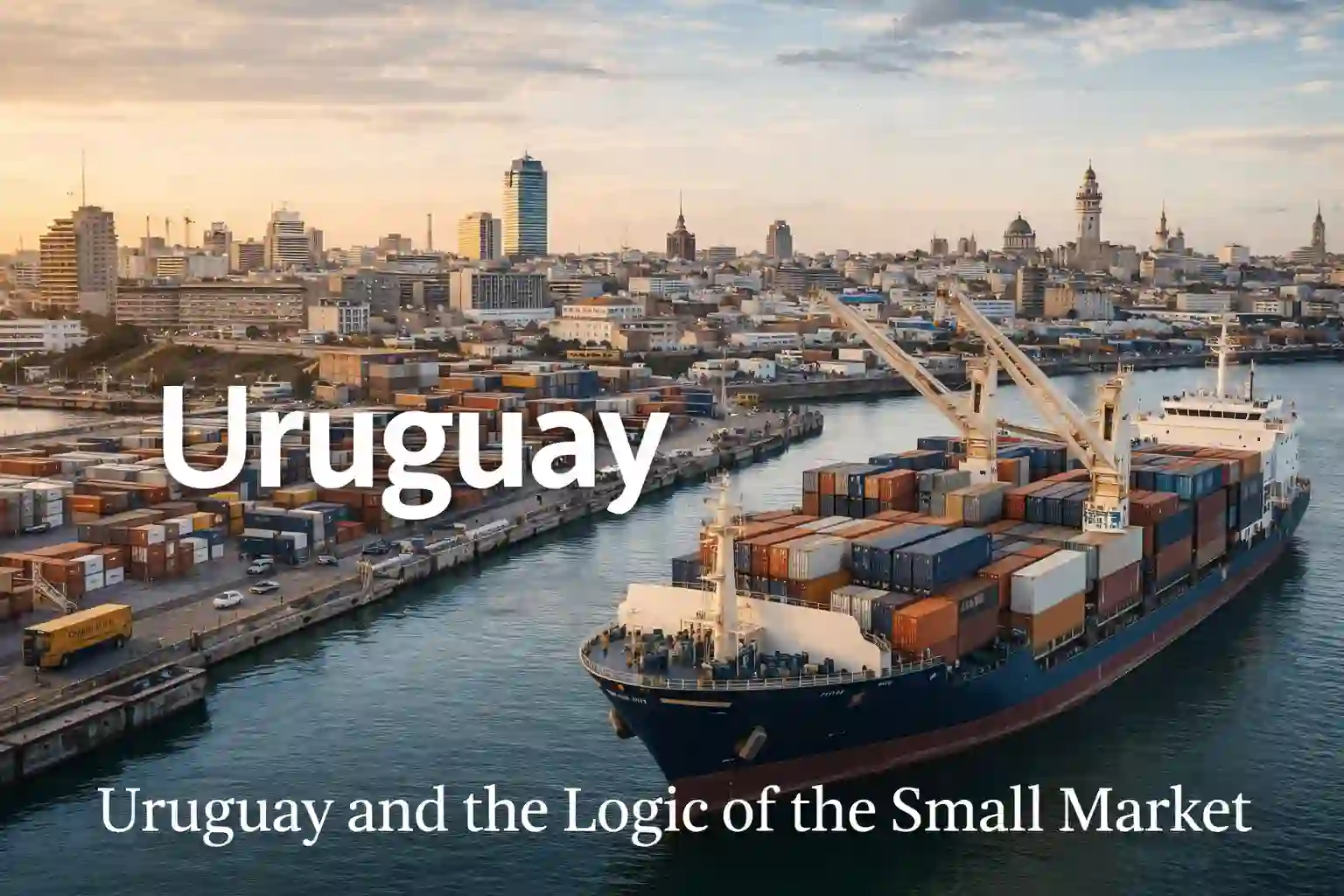
Uruguay matters because it can function as a small, stable platform inside Mercosur.
Its domestic market is limited, but that is not the full strategic question. For companies looking toward Brazil or Argentina, Uruguay can offer a lower-risk environment to test products, distribution, compliance, partnerships and regional logistics before taking on the full complexity of larger markets.
For broader context, see the Uruguay market profile and Uruguay market insights.
Core market reading:
Uruguay is often dismissed because it is small. But in a volatile region, smallness can become strategic when it is combined with legal certainty, institutional continuity, operational predictability and access to larger neighboring markets.
Uruguay is the other way.
The country is not the obvious first answer for companies that want South American scale. Brazil has the population, industrial base and domestic demand. Argentina has market depth, talent and sector opportunities. Uruguay has neither Brazil’s scale nor Argentina’s volatility. That is exactly why it deserves a different reading.
As a market-entry question, Uruguay belongs to the same wider Southern Cone logic tracked in Econosur’s Cono Sur analysis: the region functions through country roles, not only through country size. Uruguay’s role is the small, stable, predictable node in a system where larger markets often carry higher friction.
What Structurally Distinguishes Uruguay
In a region known for political volatility, currency risk, and regulatory unpredictability, Uruguay is an exception — and a measurable one. In the Corruption Perceptions Index 2024, Uruguay ranks 13th globally and 1st in the Americas — ahead of both the United States and Canada. The World Justice Project's Rule of Law Index 2024 places Uruguay 24th out of 142 countries, and again 1st in Latin America.
These are not soft image statements. They are indicators that feed directly into investment decisions: legal certainty, contract enforcement, regulatory stability.
According to Uruguay XXI, the country's state investment promotion agency, 88% of foreign investors rated the Uruguayan investment climate as satisfactory or very satisfactory in 2024. The source warrants transparency — it is an official promotion body — but the consistency of that figure with external rankings suggests it is not simply promotional.
The Gateway Logic in Practice
As a Mercosur member, Uruguay offers tariff-free access to a market of over 284 million people with a combined GDP of USD 2.64 trillion. Including the free trade agreement with Mexico, that access extends to 400 million people — representing 76% of Latin American GDP.
"Uruguay allows companies to test export strategies, product lines, and distribution models in a predictable environment — before the full risk weight of the larger markets comes into play."
Brazil has 215 million inhabitants, but also one of the most complex tax structures in the world. Argentina offers market scale, but structural currency risk. Uruguay offers neither the size nor the risks — and that is precisely the point.
The gateway logic is not that Uruguay replaces Brazil. It does not. The logic is that Uruguay can reduce the cost of learning before a company enters Brazil directly. That matters for product-market fit, distributor selection, regional compliance, import structure, logistics routes and the timing of investment decisions.
For companies evaluating Brazil, the relevant comparison is the Brazil market profile. For those weighing Argentina as an alternative or parallel market, the relevant contrast is the Argentina market profile.
Uruguay is strategically useful when the question is not market size, but sequencing.
A company can use Uruguay to test regional assumptions, build relationships, structure logistics and understand Mercosur constraints before accepting the full operational weight of Brazil or Argentina.
Why This Market Is Systematically Underestimated
Uruguay's GDP stood at an estimated USD 79.7 billion in 2024 — with one of the highest per capita incomes in Latin America. For a market of 3.5 million people, that is a remarkable figure. It signals that Uruguay is not a subsidy-dependent frontier market, but a high-purchasing-power, stable domestic economy that simultaneously functions as a platform into the broader Mercosur region.
In 2024, the EU-Mercosur agreement reached political agreement after more than two decades of negotiations. That framework further strengthens Uruguay's position as a distribution hub between European and South American markets.
The systematic error is to read Uruguay only by population. In that reading, it looks too small. But a market can be small and strategically useful at the same time. Uruguay’s value lies in the combination of institutional quality, regional access, purchasing power, service capacity and manageable operational scale.
This same logic appears in other Uruguay analyses on Econosur. The Uruguay export map shows how the country’s market role depends on external connections, while Uruguay’s digital bet points to the country’s attempt to convert stability and infrastructure into a platform position.
What This Means for Investors
The logic is straightforward, but it is rarely applied consistently: anyone looking to scale in a new market needs an environment where mistakes are manageable. Uruguay offers exactly that — legal certainty, greater monetary predictability than most neighboring markets, functioning infrastructure, and direct market access across the entire Mercosur region.
The road to Brazil does not have to be direct. Those who take it through Montevideo often get further.
Uruguay should be evaluated as a platform, not only as a domestic market.
The relevant questions are practical: where can a company test its offer, reduce uncertainty, build a distributor base, structure regional contracts, operate from a stable environment and prepare for larger-market complexity?
For wider country and sector context, see Uruguay market profile, Uruguay insights and South America Market Briefs.
For logistics and regional route context, see logistics and waterways in South America.
From small-market logic to market-entry strategy
Uruguay is not only a small market. It is a test environment, a regional platform and a strategic entry point into a larger Mercosur system where Brazil and Argentina carry greater scale and greater friction.
Econosur prepares custom market analysis for companies, analysts and institutions evaluating Uruguay, Mercosur platform strategies, Brazil entry routes, regional distribution, export testing and country-specific operating risks.
Explore custom market analysisFAQ
Why does Uruguay matter for Mercosur market entry?
Uruguay matters because it offers a smaller and more predictable operating environment inside Mercosur. For companies evaluating Brazil or Argentina, Uruguay can function as a lower-risk platform for testing distribution, compliance, regional partnerships and export strategy.
Why is Uruguay often underestimated?
Uruguay is often underestimated because its domestic market is small. That reading misses its strategic role as a stable gateway, logistics and service platform inside a volatile regional system.
Is Uruguay a substitute for Brazil?
No. Uruguay is not a substitute for Brazil's market size. Its value lies in predictability, testability and regional access before companies commit to the full complexity of larger Mercosur markets.
What does the small-market logic mean?
The small-market logic means that a smaller, stable country can be strategically useful because mistakes are more manageable, regulation is more predictable and regional operations can be tested before scaling into larger markets.