
Bolivia · Bioceanic Corridors · Capricornio · South American Logistics · Infrastructure Geopolitics
Bolivia Wants Back Onto the Bioceanic Map
Bolivia is trying to recover a central role in South American logistics through more than one corridor option: reviving the Bioceánico Central rail concept while also seeking a future connection into the more advanced Capricornio system.
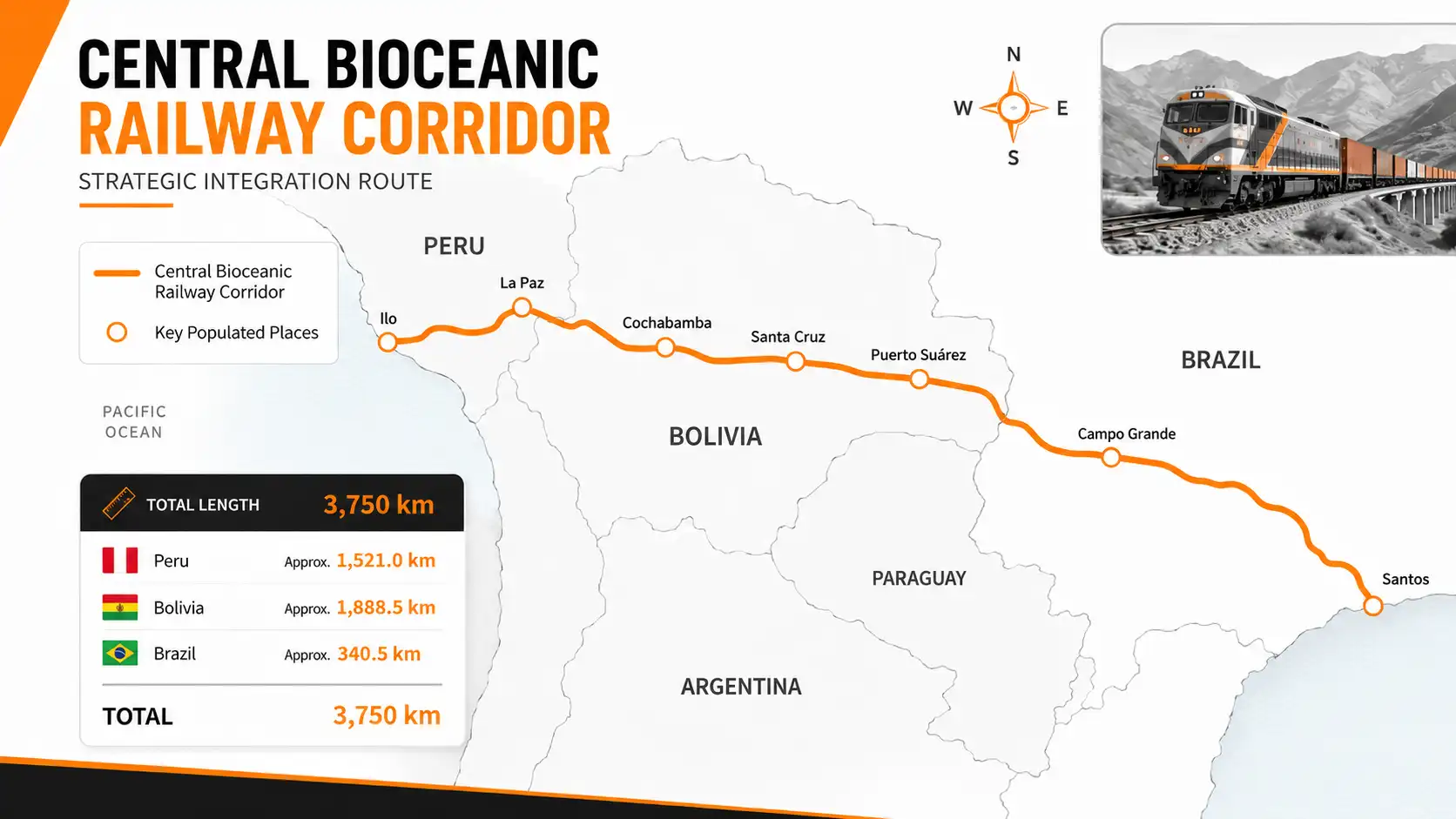
Bolivia is trying to recover corridor relevance through more than one route option.
The renewed Bioceánico Central discussion remains important, but the 2026 evidence no longer supports a simple Central-versus-Capricornio story. On March 16, Bolivia and Brazil jointly expressed interest in creating conditions for Bolivia’s future inclusion in the Corredor Bioceánico Vial Capricornio while also reaffirming cooperation on the Corredor Ferroviario Bioceánico de Integración.
Bolivia is therefore pursuing corridor optionality: improve and connect its own rail and multimodal systems, preserve a Bolivia-centered Pacific route logic and seek access to the more advanced Capricornio network where commercially useful.
What is what?
Bioceánico Central / CFBI: a Bolivia-centered rail and multimodal integration logic intended to connect Brazil through Bolivian territory toward Pacific outlets in Peru and Chile.
Corredor Bioceánico de Capricornio: the more advanced road-corridor system whose current core alignment links Brazil, Paraguay, northern Argentina and northern Chile.
Why the distinction matters: Bolivia is not currently on Capricornio’s core alignment, but the March 2026 Bolivia–Brazil declaration explicitly put future Bolivian inclusion on the bilateral agenda. The strategic question is therefore how Bolivia connects into several corridor systems, not only which corridor defeats the other.
Capricornio remains the more advanced implementation system, but it is not yet a finished transcontinental freight corridor.
It combines active road sections, financed works, cross-border coordination and the physically connected Paraguay–Brazil bridge. Paraguay’s PY15 works are moving into paving phases, while access roads, border infrastructure and end-to-end operating performance still remain decisive.
Bolivia’s corridor options are earlier-stage. The governments are discussing the CFBI, a possible connection between Bolivia’s eastern and western rail networks and future inclusion in Capricornio, but public evidence still does not show a fully financed national delivery program or an operating timetable for a Bolivia-centered transcontinental route.
The 2026 corridor map is becoming more connected and more complex.
On the Bolivian side, the March 16 Bolivia–Brazil joint declaration reaffirmed cooperation on the CFBI and explicitly expressed interest in creating conditions for Bolivia’s future inclusion in the Capricornio road corridor. Separately, Bolivia’s Ministry of Public Works said in February that it is studying how to connect the eastern and western rail networks, with a possible missing link of roughly 400–550 kilometres and Tarija among the alternatives under review. These are planning signals, not evidence of a financed construction program.
On the existing Capricornio alignment, the Paraguay–Brazil Bioceanic Bridge was physically connected on July 15. Paraguay’s MOPC reported the bridge at close to 90% overall progress on July 23. Farther west, PY15 Lote 3 reached 40% physical progress on August 3 and was preparing for asphalt works, while Lote 4 toward Pozo Hondo entered asphalt paving in August.
The implication is clear: Capricornio is converting more of its map into contracted and constructed infrastructure, while Bolivia is trying to ensure that its own rail and road systems can connect to the emerging network rather than remain outside it.
For the current project-by-project status on the Paraguay–Brazil axis, see Econosur’s analysis of Paraguay’s Bioceanic Corridor readiness.
Bridge completion is still different from corridor operation
ITAIPU’s October 15 update reports structural adjustments, cable work and finishing on both sides of the Bioceanic Bridge. It does not announce the start of freight operations. Separately, Paraguay’s MOPC reported on September 29 that the Carmelo Peralta access works had reached 23% overall progress at the end of August. That percentage concerns the access project, not the bridge or the entire corridor.
The July physical connection was therefore an engineering milestone. Commercial route assessment still requires road access, border facilities, customs arrangements and demonstrated freight performance. Bolivia’s proposed connections remain a separate planning question from the construction progress on Capricornio’s four-country core alignment.
The story is not only that a train is back in the news
Bolivia’s bioceanic railway debate has returned after years of uncertainty. In March 2026, Bolivian officials discussed reviving the Bioceánico Central, and the Bolivia–Brazil presidential declaration went further: it reaffirmed work on the CFBI and expressed interest in creating conditions for Bolivia’s future inclusion in the Capricornio corridor. The official language signals a broader integration strategy; it still does not establish a financed delivery structure or an operational timetable.
That is the surface story. The more important story is why the idea returns now.
Bolivia is reacting to a South American logistics map that is already moving. Atlantic-Pacific corridors are no longer only abstract integration dreams. They are becoming overlapping road, rail and port systems in which countries can compete for cargo while also seeking additional connections into neighboring routes.
Why now? Bolivia’s corridor push is also domestic
The timing matters. Bolivia’s corridor language is not emerging from a position of calm economic strength. It appears while the country is dealing with dollar shortages, fuel shortages, declining gas production, rising living costs and growing political tension.
Reuters reported in 2025 that Bolivia had become more dependent on energy imports as domestic gas production declined, while shortages of dollars and fuel created pressure on the subsidy system. In 2026, protests and road blockades widened under President Rodrigo Paz, with unions, miners, transport workers and rural groups pressing the government over austerity, fuel supply and living costs.
This context changes the reading of the Bioceánico Central. The corridor is not only an infrastructure ambition. It is also a development narrative for a country that needs new sources of relevance, transit value, regional bargaining power and economic confidence after the weakening of its old gas-export model.
The old Bioceánico Central idea was built around Bolivia
The Bioceánico Central was always more than a transport line. It was a geopolitical idea: place Bolivia between Brazil’s Atlantic-facing production system and Pacific outlets in Peru and Chile.
Older project descriptions framed the route as a Brazil-Bolivia-Pacific railway connection. IIRSA reported that the corridor would connect Brazil, Bolivia and Pacific ports in Peru and Chile over thousands of kilometers, linking Brazil’s Atlantic side with Peru’s port of Ilo on the Pacific.
Bolivian reporting in March described a multimodal route using existing infrastructure from Corumbá to Puerto Suárez and Santa Cruz and then extending westward through Bolivia toward Pacific outlets. A separate official Ministry of Public Works statement in February said the government is studying how to connect the country’s eastern and western railway networks, with Tarija among the possible alignments.
This matters because Bolivia currently operates two separated rail systems. Connecting them would be a national logistics project in its own right and could support several corridor configurations rather than only one fixed historic route.
The Bioceánico Central is a corridor claim.
It says that Brazilian trade should cross Bolivia on the way to the Pacific. That is an infrastructure claim, but also a geopolitical claim.
The numbers show how large the ambition is
The cost and capacity figures attached to the old discussion show the scale of the ambition. In the 2016 Bolivia-Peru context cited by CorreodelSur, the Bolivian section was discussed at around US$7 billion, while the full route was discussed at around US$10 billion.
The same reporting recalled projections of more than six million passengers and 9.9 million tonnes of annual cargo.
Those figures should not be read as a current investment plan. They should be read as a signal of the project’s political scale. Bolivia is not talking about a minor rail upgrade. It is trying to recover a central position inside the continent’s future logistics geography.
Why Brazil is the essential piece
Bolivia’s corridor idea only becomes regionally meaningful if Brazil is part of it.
Brazil provides the Atlantic-side economic weight: agricultural exports, industrial production, inland logistics demand and the scale needed to justify a transcontinental route. Without Brazilian cargo logic, Bolivia’s corridor remains a national aspiration. With Brazil, it becomes a continental proposal.
This is why the renewed Bolivia–Brazil conversation matters. It is not only bilateral diplomacy. Brazil and Bolivia are discussing both railway integration and conditions for future Bolivian inclusion in Capricornio, which means Brazil can evaluate Bolivia as an additional connection rather than only as a rival route.
The question is not whether Bolivia wants to be a logistics node. The question is whether Bolivia can turn its location and existing networks into connections that Brazilian cargo owners and logistics operators actually need.
Capricornio is both the benchmark and a possible connection
The Corredor Bioceánico de Capricornio matters to Bolivia because it is the region’s clearest current implementation benchmark. Its core geography connects the center-west of Brazil with northern Chile through Paraguay and northwest Argentina, supported by active road works, a regional master-plan process and four-country coordination.
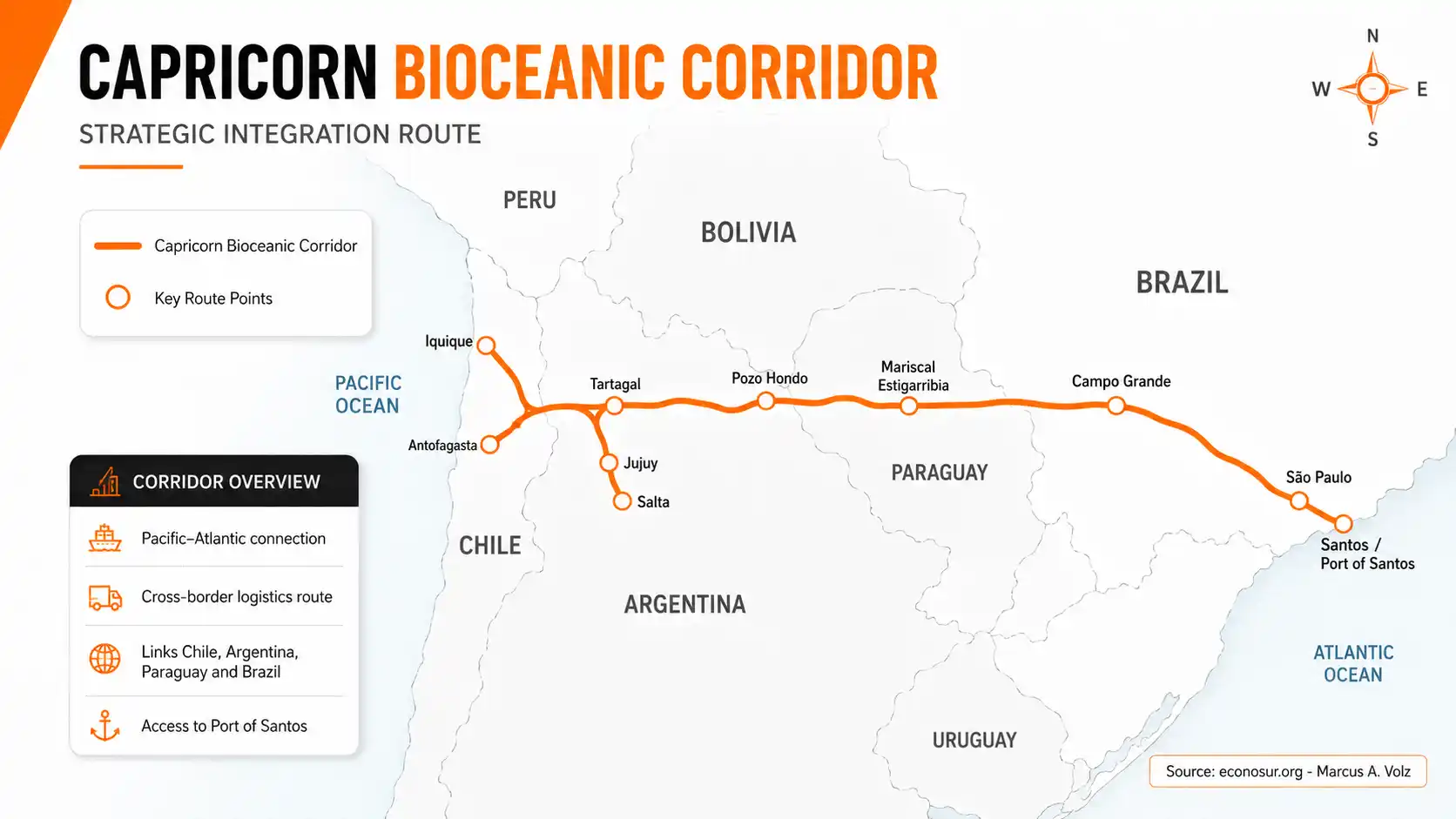
That distinction changes the strategic reading. The corridor still strengthens Paraguay and northern Argentina as inland platforms, but Bolivia’s response is no longer limited to proposing a separate route. It can also seek feeder links, rail interconnection and future institutional inclusion in the Capricornio system.
This is why the Bolivian debate should be read as optionality. Bolivia wants to preserve a central rail logic while avoiding a situation in which the most advanced regional corridor develops without usable Bolivian connections. The current operational readiness of the Capricornio corridor shows how far implementation has progressed and which links remain incomplete.
"For Bolivia, Capricornio is no longer only a competing map. It is also a network Bolivia may try to plug into."
Neither corridor is a finished system
The comparison should not be simplified into “Capricornio is real, Bolivia is a dream.” That would overstate the maturity of one route and understate the strategic value of the other.
Capricornio has visible advantages: road segments, active cross-border forums, a master-plan process, financed projects and the physically connected Paraguay–Brazil bridge. It also fits current subnational cooperation among Brazil, Paraguay, Argentina and Chile.
But a corridor is not complete because a bridge is connected or a road segment exists. A functioning bioceanic system requires reliable end-to-end cargo movement, completed approaches, customs coordination, border capacity, port integration, predictable travel times and private-sector usage at scale.
Bolivia’s own corridor agenda is less mature as an implementation system, but it answers a real strategic question: how can the country connect its eastern and western networks, attract Brazilian cargo and gain usable access to Pacific-facing routes while Capricornio develops around it?
Corridors create hierarchies even when they can connect
Bioceanic corridors are integration projects, but they also redistribute logistics relevance. The current Capricornio alignment strengthens Paraguay and northwest Argentina because traffic, investment and border infrastructure are being organized through those territories.
Bolivia can respond in two ways at once: build stronger internal east–west connectivity and seek connections into the more advanced regional corridor. A future Bolivian branch or feeder connection would not erase the existing Capricornio geography, but it could reduce the risk that Bolivia remains peripheral to the cargo flows it wants to attract.
The core insight is therefore not that South America must choose one map. It is that corridor networks create different levels of access, leverage and commercial relevance depending on which links are actually built and used.
Bolivia’s problem is not geography alone
Bolivia’s geography is both an opportunity and a constraint.
On the map, Bolivia looks like a natural central connector. It sits between Brazil and Pacific-facing routes. It can imagine itself as a bridge between the Atlantic production base and Pacific ports.
But corridors are not built by geography alone. They require political continuity, financing, customs coordination, border reliability, technical standards, operational governance, port agreements and credible delivery capacity.
That is where Bolivia’s challenge becomes harder. A central location does not automatically create a central logistics role. A country must convert position into functioning infrastructure.
Capricornio is not only a road; it is a platform strategy
The Capricornio corridor gives Paraguay a different kind of opportunity.
Paraguay does not need to become a large final market to benefit. It can become a logistics and industrial platform between Brazil, Argentina and Chile. That fits with broader patterns around maquila, Brazilian investment, energy competitiveness and cross-border industrial behavior.
For northern Argentina, the corridor also changes the map. Provinces in the NOA are no longer only peripheral inland territories. They become part of an Atlantic-Pacific corridor narrative connected to Chilean ports and Brazilian demand.
This is why Bolivia’s renewed corridor language matters. It is a reaction to a corridor geography that makes other inland territories more relevant.
South America’s inland regions are competing for corridor relevance while also building interconnections.
Bolivia, Paraguay and northern Argentina are not only transport spaces. They compete for cargo, services and investment, but the most valuable position may be the ability to connect several routes rather than depend on a single corridor.
What this means for companies and investors
For companies, the practical lesson is not to bet on a corridor. It is to map exposure to each corridor geography.
A machinery supplier should ask where future road, rail, port and border investments could create demand for equipment, maintenance, storage, fuel systems, weighing technology, customs infrastructure or construction services.
A logistics firm should ask which border crossings, dry ports, inland cities and industrial zones could become useful staging points before the full corridor is complete. The relevant signal is not only a final inauguration. It may be a bridge, a financed road segment, a customs upgrade, a port agreement or repeated cargo movement.
An agribusiness exporter should compare whether a Paraguay-northern Argentina-northern Chile route or a Bolivia-Pacific route could change transport time, port optionality and access to Brazilian cargo flows. A mining supplier should look at which corridor better connects inland production zones with Chilean, Peruvian or Brazilian logistics nodes.
For investors, the signal is not only which project wins. It is where corridor expectations already change land value, public works pipelines, warehouse demand, fuel distribution, truck flows, customs capacity and political attention.
The business implication is corridor optionality
South American corridor planning should be read as optionality, not as a single fixed map.
Bolivia wants to recover centrality. Paraguay wants to turn location into platform value. Northern Argentina wants corridor access to matter for its inland provinces. Chilean and Peruvian ports want to anchor Pacific-side cargo. Brazil wants faster, cheaper and more diversified routes to the Pacific.
Those objectives overlap, but they are not identical. This is why companies should not wait for one final map. They should monitor which corridor pieces become operational first and which territories begin to attract cargo, warehouses, service companies and public investment.
The result is a competitive and increasingly interconnected infrastructure landscape. Companies evaluating the region need to track not only national market size, but also corridor position: which route improves access, which route changes costs, which links are actually funded and which nodes can connect more than one logistics system.
Bolivia wants back onto the map because the map is changing
The renewed Bioceánico Central debate should therefore be read carefully.
It does not prove that Bolivia’s corridor will be built quickly. It does not mean the old railway dream has suddenly become bankable. And it does not erase the operational challenge of turning fragmented infrastructure into a functioning transcontinental route.
But it does show that Bolivia understands the risk of being weakly connected to the routes that are moving fastest.
Capricornio is already creating concrete infrastructure and contractor ecosystems in Paraguay and neighboring countries. Bolivia’s response is broader than reviving one historic railway concept: it is also studying domestic rail interconnection and seeking a possible future place inside Capricornio.
For Bolivia, the strategic objective is therefore corridor optionality — enough internal connectivity and external links to remain relevant whichever Atlantic–Pacific route attracts the strongest commercial traffic.
Companies and Operators Behind the Corridor Map
Public corridor plans become commercially meaningful through the companies that operate existing networks and the contractors already executing funded projects. These actors are named because they shape current logistics capacity or project delivery; they are not presented as Econosur clients or partners.
Business Questions for Companies Evaluating the Corridors
Which bioceanic corridor is more likely to attract cargo, logistics investment and supplier demand first?
Capricornio is currently the more advanced route. It has active road projects, financed works, four-country coordination and the physical Paraguay–Brazil bridge connection. That gives it a stronger near-term position for logistics services, border infrastructure, warehousing and supplier demand than the revived Bioceánico Central.
That lead is not yet permanent. The route still has to prove that freight can move consistently across borders and reach Pacific ports without delays or operating restrictions wiping out the expected time and cost advantage. The first corridor to deliver reliable commercial traffic will matter more than the first one to complete a landmark project.
What would Bolivia need to prove for either a revived Bioceánico Central or a connection into Capricornio to become commercially relevant?
Bolivia needs to turn corridor optionality into deliverable infrastructure and operating rules. That means a credible path to connect the eastern and western rail networks, financing for missing links, Brazilian cargo interest, functioning border arrangements and agreements with Pacific-facing logistics partners.
The key test is not the name of the corridor. It is whether exporters, rail and trucking operators, ports and investors can see a realistic sequence from planning to regular cargo movement — and whether Bolivia can connect into the route that proves commercially strongest.
What should companies verify before choosing a bioceanic route, logistics location or supplier strategy?
The route has to be tested against the company’s actual cargo and operating requirements. Relevant factors include origin and destination, total transport cost, border times, road and weight restrictions, port access, trucking capacity, warehousing, fuel and maintenance services, and the reliability of each link in the chain.
For industrial suppliers, the question is different: which road, border, terminal and logistics projects are actually funded; who awards the contracts; which companies are already positioned; and what local service or qualification requirements apply. A corridor can be strategically important without yet creating an addressable supplier market.
Official announcements and project documents are useful for tracking routes, financing and construction. They rarely answer the questions that determine whether a company should commit resources, approach a buyer or rely on a route now.
- which exporters and logistics operators are actively preparing to use each route;
- current freight quotes and realistic door-to-port cost comparisons;
- normal border-processing times under commercial traffic;
- available trucking, warehousing, maintenance, fuel and inspection capacity at emerging nodes;
- which infrastructure packages are moving into tendering or procurement;
- which contractors, suppliers and operators are already positioned around funded projects;
- where cargo commitments are strong enough to support new logistics or industrial investment;
- which corridor claims are still political ambitions rather than current business demand.
"Bolivia is not simply reviving an old railway dream. It is trying to keep several routes open as South America’s corridor map becomes operational."
Research Services for Bioceanic Corridors and Logistics
Marcus A. Volz can investigate a defined market, company, project, buyer or supplier question through source analysis, targeted interviews and verification.
Compare actual origins, destinations, border restrictions, freight quotes and door-to-port operating conditions.
Separate bridge works, access roads, customs facilities and repeatable commercial freight service.
Identify exporters, logistics firms, warehouses, service nodes, contractors and purchasing responsibilities.
Test route-use plans, service availability and commercial demand with relevant corridor participants.
See Custom Market Analysis South America or discuss a research question.
Published information establishes the documented context. It does not by itself establish current purchasing needs, supplier positions, confidential contracts, complete qualification requirements or commercial accessibility. Project announcements, approvals, financing, awards, construction and operations remain separate milestones. The scope of any direct research is agreed around the specific question.
Sources and evidence
Source review: October 16, 2026. Reporting periods and the status of proposals, approvals, construction and operations are identified separately. Company statements remain attributable to the issuer.
- Bolivia Ministry of Foreign Affairs: Bolivia–Brazil joint presidential declaration, March 16, 2026 — CFBI cooperation and interest in future Bolivian inclusion in the Capricornio corridor.
- Bolivia Ministry of Public Works: study to connect the eastern and western railway networks, including a possible 400–550 km link, February 18, 2026.
- Paraguay MOPC: PY15 Lote 3 reaches 40% physical progress and prepares for asphalt works, August 3, 2026.
- Paraguay MOPC: asphalt paving begins on PY15 Lote 4 toward Pozo Hondo, August 10, 2026.
- Ferroviaria Andina: company view on its role in a future interconnection of Bolivia’s railway networks, April 2026.
- Paraguay MOPC: Bioceanic Bridge near 90% overall progress after the July 15 structural connection. July 23, 2026.
- Paraguay MOPC: Carmelo Peralta road-access works connecting the bridge with Paraguay’s road network. July 23, 2026.
- Corredor Bioceánico de Capricornio: official corridor platform.
- Corredor Bioceánico de Capricornio: Qué es el Corredor.
- Official Capricorn Bioceanic Corridor platform: corridor geography, four-country structure and eight subnational territories.
- Meeting of national coordinators: modernization of border controls and cross-border logistics, May 2026.
- Capricorn Bioceanic Corridor news record: physical connection of the Carmelo Peralta–Porto Murtinho bridge, July 24, 2026.
- Bioceanic Bridge update: structural connection, remaining access works and border infrastructure, July 2026.
- IIRSA: Corredor Bioceánico Central and earlier Santos-Ilo project references.
- IIRSA: Eje de Capricornio reference document.
- Government of Salta: review of the Corredor Bioceánico de Capricornio master plan. December 2025.
- FONPLATA: Capricornio corridor program in Salta, Argentina. Approved July 2025.
- ITAIPU, October 15: bridge structural adjustments and finishing work; no freight-opening announcement.
- Paraguay MOPC, September 29: Carmelo Peralta access works at 23% overall progress at end-August; separate from bridge progress.
Reporting provides context and attributed statements. Official decisions and company filings are used for the corresponding formal milestones.
- CorreodelSur: Tren bioceánico vuelve al debate tras diez años. March 2026.
- Unitel: Bolivia y Brasil reflotan el proyecto del corredor bioceánico central. March 2026.
- Brújula Digital: Bolivia y Brasil hablan de retomar el corredor bioceánico central. March 2026.
- ATB Digital: Fernando Romero assumes Bolivia’s Ministry of Development Planning. November 2025.
- Reuters: Bolivia turns to crypto for energy imports amid dollar and fuel shortages. March 2025.
- Reuters: Bolivians tighten belts as inflation, fuel and dollar shortages bite. April 2025.
- Reuters: What is behind Bolivia’s widening protests? May 2026.
Need to know which corridor is becoming commercially relevant?
Econosur can research the companies, cargo flows, procurement routes, suppliers, project status and local operating conditions behind Bolivia’s corridor options and the Capricornio system.
Assignments focus on corridor and logistics risk analysis, operator/buyer/supplier mapping and commercial validation with targeted field research where public information is not enough.
Discuss a custom market analysisFAQ
Why is Bolivia trying to revive the Bioceánico Central?
Bolivia is trying to recover a central role in South American logistics. A Bolivia-centered corridor would connect Brazilian production with Pacific ports through Bolivian territory and reduce the risk that alternative routes bypass the country.
What is the Bioceánico Central?
The Bioceánico Central is a long-discussed corridor concept linking Brazil and Bolivia with Pacific port options in Peru and Chile, historically associated with a railway connection from Brazil's Atlantic side through Bolivia toward Pacific ports, with Bolivia positioned as the central transit country.
What is the Corredor Bioceánico de Capricornio?
The Corredor Bioceánico de Capricornio is a regional corridor initiative that connects the center-west of Brazil with northern Chile’s Pacific ports through the Paraguayan Chaco and northwest Argentina.
Does the Capricornio route currently run through Bolivia?
No. Its current core alignment runs through Brazil, Paraguay, Argentina and Chile. However, the March 16, 2026 Bolivia–Brazil joint declaration explicitly expressed interest in creating conditions for Bolivia’s future inclusion in the corridor.
Is Bolivia choosing between the Bioceánico Central and Capricornio?
Not necessarily. The 2026 evidence points to corridor optionality: Bolivia is discussing railway integration and the CFBI while also seeking conditions for a future connection into the Capricornio corridor.
Why is Brazil so important in the corridor debate?
Brazil provides the export base and cargo scale that can make a corridor economically meaningful. Without Brazilian cargo demand, a bioceanic corridor remains a national or diplomatic idea rather than a continental logistics route.
Is the Corredor de Capricornio already fully operational?
The reviewed evidence does not establish a complete end-to-end freight corridor. ITAIPU’s October 15 update still describes bridge finishing work, while MOPC’s September report records the separate Carmelo Peralta access works at 23% at end-August. Physical bridge connection, access completion, border readiness and reliable commercial freight service are different milestones.
What is the main business implication?
Companies should treat bioceanic corridors as competing route options and map their exposure to each route: likely demand points, bottlenecks, border crossings, ports, service hubs and decision triggers such as financed road segments, customs upgrades or repeated cargo movement.
Which bioceanic corridor is more likely to attract cargo, logistics investment and supplier demand first?
Based on the implementation evidence summarized here, Capricornio currently has the stronger near-term position because it combines active road sections, cross-border coordination, financed projects and the physically connected Paraguay–Brazil bridge. It is still not a finished end-to-end freight system, so commercial leadership depends on border performance, port integration and recurring private-sector use.
What would Bolivia need to prove for its corridor options to become commercially relevant?
Bolivia would need to convert political interest into deliverable infrastructure and operating systems: financing, a workable link between the eastern and western rail networks, Brazilian cargo commitment, border and customs coordination, port agreements and repeatable freight demand.
What should companies verify before choosing a bioceanic route, logistics location or supplier strategy?
Companies should verify actual cargo origins and destinations, freight costs, border-processing performance, route restrictions, port access, trucking and service capacity, project and financing status, warehouse and fuel infrastructure, supplier and procurement demand, and whether repeated commercial freight flows support the route assumptions behind the decision.
About this analysis
The Bioceánico Central is treated here as a revived strategic option rather than a financed current project. The Capricornio route has a deeper implementation structure, including active road sections, bridge construction, border-coordination work and specific financed segments.
Historical cost and cargo figures from the 2016 debate are not presented as current budgets, financing commitments or operating traffic.
The July 15, 2026 bridge connection is a material construction milestone. MOPC reported the bridge near 90% overall progress on July 23. Neither milestone is equivalent to a fully operational Atlantic-Pacific trade corridor; access roads, border facilities, customs coordination, port integration and repeated cargo use remain decisive.
This page connects with Econosur’s Bioceanic Corridor readiness analysis, the Logistics and Waterways industry analysis, the Paraná–Paraguay Waterway analysis and the Paraguay River Economy.