
Chile · China · Copper · Lithium · Critical Minerals · Trade Diversification
Chile’s China Connection: Copper, Lithium and the Limits of Diversification
China is not only a buyer of Chilean copper and lithium. It is part of the industrial system that turns Chile’s resource exports into global supply-chain power. Chile is now building alternative links with India, the United States, Europe and neighbouring mineral producers, but diversification depends on processing, finance, infrastructure and scalable buyers.
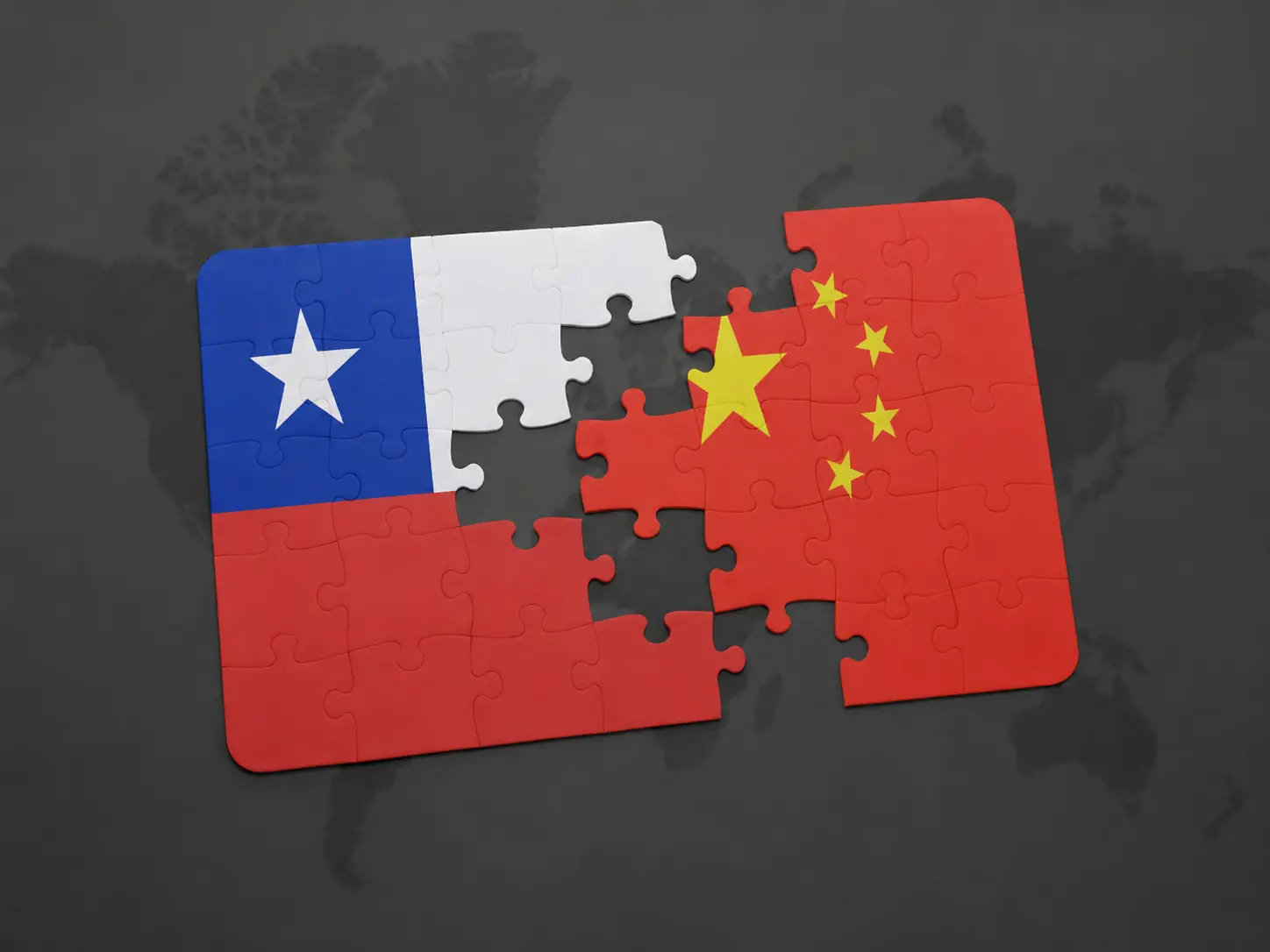
Chile’s China connection is a resource, industry and infrastructure relationship — not only a bilateral trade story.
China is Chile’s largest trade partner and a central demand anchor for copper and lithium-related exports. But the strategic issue is deeper: China is also tied to processing capacity, battery supply chains, energy infrastructure, industrial demand and the regulatory context around lithium supply.
For Chile, diversification is possible. But it cannot be reduced to finding alternative buyers. It requires more domestic processing, stronger non-China demand, reliable energy systems, credible project execution and industrial partners that can scale beyond symbolic agreements.
For broader context, see Chile market insights, the Chile market profile, Econosur’s Southern Cone analysis and South America’s Strategic Resource Advantage in a Fragmenting World Economy.
Core market reading:
Chile can diversify trade partners, but it cannot diversify away from the industrial system that currently absorbs, processes and scales much of its critical-mineral relevance.
The Market Signal
Chile’s China connection shows a recurring pattern in South American resource economies: formal trade diversification can coexist with deep industrial concentration.
Chile has one of the broadest trade-agreement networks in the region, but its most strategic exports are still pulled by the industrial demand of a few large economies.
That makes Chile different from a simple commodity exporter. It is a Pacific-facing, agreement-rich, institutionally stable resource economy whose main strategic minerals feed into China-centered manufacturing, electrification and battery ecosystems.
At the same time, diversification is becoming more concrete. In August, Chile and India reported that most chapters of their Comprehensive Economic Partnership Agreement negotiations were already closed, with market access and critical minerals among the remaining priorities and a target to conclude negotiations before the end of 2026. On 28 August, Chile also signed a strategic-minerals declaration with Argentina, Bolivia and Peru aimed at developing more reliable regional supply chains and attracting responsible investment.
These initiatives matter because they move diversification from general diplomacy toward specific buyer, finance and value-chain alternatives. Their commercial importance will still depend on whether they generate binding offtake, investment, processing capacity and project execution.
This distinction matters for market analysis. A company evaluating Chile should not ask only whether Chile has copper, lithium or trade agreements. It should ask where demand is concentrated, who controls processing capacity, which buyers can scale, which infrastructure is already China-linked and where Chile can realistically move up the value chain.
"Chile can diversify its partners, but it cannot diversify away from the industrial system that currently absorbs, processes and scales much of its critical-mineral relevance."
China Is Not Just a Destination Market
China is often described as Chile’s largest customer. That is correct, but incomplete. The deeper issue is that China is a demand system, processing system and industrial reference point at the same time.
SUBREI’s first-half 2026 trade data confirms China as Chile’s leading export market, taking 33.9 per cent of goods exports, equivalent to US$20.488 billion. The relationship remains heavily anchored in minerals, metals and industrial inputs even as Chile expands trade with other markets.
In practice, this means that Chile’s external trade architecture is broad, while the China relationship remains structurally anchored in minerals, metals and industrial inputs.
This is why the Chile-China relationship should not be read only through diplomacy. It should be read through industrial dependency.
The midstream concentration is especially important for copper. The IEA’s 2026 Critical Minerals Outlook estimates that China’s share of global copper-smelting capacity rose from around 15% in 2005 to about 50% in 2025 and that China accounted for more than 90% of the growth in global copper smelting over that period. That does not mean Chilean copper is physically processed only in China, but it explains why changing the geography of mine supply is easier than changing the industrial system that processes it.
Copper feeds grids, construction, power infrastructure and electrification. Lithium feeds batteries and storage systems. Energy infrastructure supports mining and industrial scale. These are not isolated sectors; they are linked by the physical requirements of the energy transition.
Chile’s export model is not China-exclusive, but China remains structurally central where copper, lithium and industrial minerals meet global manufacturing demand.
The Codelco-SQM / Nova Andino structure shows that lithium is now a governance, supply and value-chain question, not only a production question.
If Chile exports critical minerals but higher-value processing and battery ecosystems scale elsewhere, diversification remains limited even when trade partners multiply.
Copper Is the Deeper Connection
Lithium receives much of the strategic attention, but copper remains the deeper Chile-China story. SUBREI reports that Chilean copper exports reached US$35.605 billion in January–July 2026, equivalent to roughly half of all goods exports in the period. Copper therefore remains the core export anchor behind Chile’s resource position.
Copper matters because it is not a narrow mining product. It is a grid metal. It is needed for power transmission, electrification, construction, industrial equipment, transport systems and renewable-energy infrastructure.
For China, copper demand is linked to the physical backbone of industrial activity. For Chile, copper is the revenue and relevance base that makes the country strategically visible in global supply chains.
This is why a Chile-China analysis that focuses only on lithium misses the larger structure. Lithium is the battery symbol. Copper is the industrial depth.
The capital side of that system is examined separately in Econosur’s Chile’s Mining Investment Pipeline: Where Copper and Lithium Capital Is Going, which maps the scale and composition of Chile’s current copper- and lithium-led investment cycle.
Market analysis point:
Copper keeps Chile relevant even when lithium prices move through boom-and-bust cycles. For suppliers, investors and industrial buyers, Chile’s copper base is the more stable reference point for long-term mining infrastructure, power demand, water stress, port logistics and supplier ecosystems.
Lithium Is Where the Sovereignty Question Becomes Visible
Lithium changes the Chile-China relationship because it brings state coordination, corporate governance and downstream expectations into the same arena.
Chile’s institutional lithium framework seeks stronger public coordination and domestic value creation while still requiring capital, technology and buyers able to scale production and processing.
The Codelco-SQM partnership is now embodied in Nova Andino Litio SpA, formally established in December 2025 after completing the required legal and regulatory reviews in Chile and abroad. Its first board meeting was held on 29 December 2025, turning the governance model from a proposed structure into an operating corporate framework for Salar de Atacama development through 2060.
This confirms a broader Econosur thesis: Chile, Argentina and Bolivia share lithium geography but follow different investment logics.
China enters this lithium story in several ways. SUBREI reports that China absorbed 67 per cent of Chilean lithium exports in 2025, followed by South Korea with 22 per cent. In January-April 2026, Chile’s exported lithium volume was 43 per cent higher than a year earlier, while export value reached US$3.713 billion in January–July.
Codelco confirmed in November 2025 that China’s State Administration for Market Regulation approved the Codelco-SQM partnership. The approval was the final international regulatory condition needed to materialise the joint venture. The broader point remains important: Chinese regulatory and customer-market relevance extends beyond simple export purchasing.
That is the strategic point: Chile has increased public coordination of the governance structure, but Chinese demand and supply-chain power still influence the market conditions under which Chilean lithium becomes globally relevant. The concentration is easing at the margin, but it remains structurally high.
Energy Infrastructure Makes the Connection Broader Than Mining
Chile’s China connection is also an infrastructure question. Chinese capital and companies are not only relevant in mineral demand. They are also visible in energy and network assets, including electricity distribution and transmission-related positions.
InvestChile presents State Grid Corporation of China as a major electricity transmission and distribution company operating in Chile. Following its acquisitions of Chilquinta and CGE, InvestChile states that State Grid reached about 57 per cent of Chilean electricity-distribution customers. That makes the China connection relevant not only to mineral demand but also to the power system on which mining, lithium and industrial expansion depend.
In Chile, resource strategy and energy strategy are not separate files.
The same logic appears in Econosur’s Energy and Infrastructure in South America sector page: Chile links energy directly to mining, copper, lithium, transmission bottlenecks, renewable buildout, storage and the need to connect northern generation with central demand.
For international companies, the implication is practical. A Chile market assessment should include energy infrastructure, grid exposure, mining demand, water conditions, port geography and critical-mineral policy. Looking only at export values gives an incomplete view of the market.
Why Diversification Is Harder Than It Looks
Chile has a strong diversification base. It has trade agreements, Pacific access, mining depth, food exports, services, institutional credibility and a clearer international profile than many South American economies.
But diversification becomes difficult when the most strategic products are absorbed by a dominant industrial system.
For copper and lithium, the key question is not only who buys the raw material. It is who can process it, finance projects, absorb volumes, provide technology, integrate battery or grid demand and tolerate long project timelines.
In this sense, China is not easy to replace because it is not only a customer. It is an industrial ecosystem.
That does not mean Chile is trapped. It means Chile’s diversification has to be industrial, not only diplomatic.
New partners matter when they can create processing capacity, offtake agreements, technology transfer, energy solutions and downstream demand. Without those elements, diversification remains a headline.
Several alternatives are now visible. Chile and the United States signed a joint declaration on critical minerals and rare earths in March 2026. The European Union’s Global Gateway initiative for Chile and Argentina focuses on critical-raw-material value chains, processing, infrastructure, skills and business-to-business cooperation. India is negotiating deeper market access with critical minerals explicitly on the agenda. The August regional declaration with Argentina, Bolivia and Peru adds a South American cooperation layer.
A secondary market signal points in the same direction: Reuters reported in August that India’s Hindustan Copper was preparing to market Chilean copper concentrate to Indian smelters and was discussing deeper cooperation with Codelco. The reported talks are not equivalent to a completed long-term supply chain, but they show what real diversification could look like when trade policy is linked to industrial demand.
| Layer | China’s role | Chile’s exposure | Why it matters |
|---|---|---|---|
| Copper | Large-scale industrial demand for grids, construction and manufacturing. | High export concentration around copper and mining revenues. | Copper is the structural base of Chile’s China connection. |
| Lithium | Battery supply-chain demand, regulatory relevance and downstream market power. | Chile’s institutional framework favors stronger public-private coordination and more domestic value creation. | Lithium turns trade dependency into a governance and value-chain question. |
| Energy infrastructure | Chinese companies are present in electricity and network-related assets. | Mining and lithium expansion depend on energy reliability and transmission capacity. | Resource development cannot be separated from the power system. |
| Trade architecture | China is the leading bilateral trade partner. | Chile has many agreements, but strategic exports remain China-sensitive. | Formal diversification does not automatically reduce industrial dependency. |
| Industrial upgrading | China has scale in processing, batteries and manufacturing systems. | Chile seeks more domestic value addition but still needs executable industrial projects, technology and scalable demand. | The real diversification test is downstream capacity, not export geography alone. |
Chile’s diversification problem is increasingly a control-layer problem.
Export destinations are only one layer. Strategic value also sits with the buyer, the smelter or chemical processor, the financier, the grid and water infrastructure, the technology provider and the long-term offtake relationship.
China remains difficult to replace because it occupies several of those layers at the same time. The emerging alternatives with India, the United States, Europe and neighbouring South American producers become commercially relevant when they create comparable depth: finance, processing, scalable demand, infrastructure and binding commercial relationships.
This is why Chile’s position should be read as part of the wider South America’s Strategic Resource Advantage in a Fragmenting World Economy: owning the resource creates leverage, while the distribution of processing, finance, infrastructure and offtake determines where the strategic value is captured.
What Is the Business Implication?
For mining suppliers, energy companies, industrial manufacturers, logistics firms, engineering providers and commercial strategy teams, Chile cannot be evaluated only as a stable resource country.
It has to be evaluated as a market where Chinese demand, Chinese industrial capacity and Chinese infrastructure presence shape the competitive environment.
This creates opportunities and constraints at the same time. European, North American, Brazilian or regional companies can still participate in Chile’s copper, lithium, energy and services ecosystem.
But they need to understand whether they are competing against Chinese firms, complementing China-centered supply chains, supplying Chilean operators, or helping Chile diversify away from a single demand structure.
This is where Econosur’s Chile country profile for copper, lithium and trade positioning becomes important. Chile should be read as a Pacific resource economy with global exposure, not as a secondary appendix to Mercosur. Its China relationship is one of the reasons why.
How Should Chile’s China Connection Be Framed?
The weak framing is to ask whether China is good or bad for Chile. That leads to political slogans and misses the market structure.
The stronger framing is to ask which parts of Chile’s economy are China-dependent, China-enabled, China-competing or China-adjacent.
Copper exports are demand-dependent. Lithium governance is supply-chain-sensitive. Energy infrastructure is partially China-linked. Diversification policy is shaped by the challenge of finding partners that can match China’s industrial scale.
This framing keeps the analysis practical. It allows companies to ask better questions before selecting partners, allocating sales resources, building supplier visibility or evaluating Chile as a platform for critical minerals and industrial services.
Three business questions that require deeper research
Public trade data and project announcements show the strategic structure, but they do not provide the complete commercial map. Three questions matter most for companies deciding where to allocate sales, partnership and research resources.
Where are Chinese companies, technologies, financing relationships or installed suppliers already shaping procurement — and where is there still room for international suppliers?
Answering this requires project-level mapping of owners, EPC and engineering structures, incumbent vendors, qualification requirements, equipment packages, local sourcing expectations and the role of Chinese-linked actors in each procurement chain.
Which Chilean copper and lithium investments are most likely to convert announced capex into actionable tenders, orders and construction packages?
This requires tracking environmental approvals, FID, financing, engineering maturity, contractor appointments, long-lead orders, water and power dependencies and evidence that a project is moving from portfolio status into executable procurement.
Which non-China partnerships can actually change where processing, technology and value creation occur — rather than simply diversify export destinations?
The answer depends on whether announced processing plants, technology partnerships, offtake agreements and infrastructure projects receive financing, reach construction and develop enough industrial scale to alter Chile’s existing China-linked value chain.
Public sources show the strategic relationship, but not the full commercial relationship.
Trade statistics, corporate announcements and project portfolios do not reveal complete vendor lists, tender calendars, incumbent relationships, qualification barriers, buyer preferences or which diversification initiatives are progressing from policy language into operating industrial capacity.
Research services for Chile’s copper, lithium and China-linked market structure
Econosur can structure custom research around a specific project, supplier category, competitor set, procurement question or China-linked market relationship. Typical assignments include:
The Strategic Conclusion
Chile’s China connection is not a temporary trade pattern. It is a structural relationship built around minerals, industrial demand, energy systems and global processing capacity.
Chile has more room for diversification than many South American economies. It has institutional credibility, trade agreements, high-value exports and strategic resources.
But the hard part is not finding additional partners. The hard part is building alternative industrial pathways that can match China’s ability to buy, process, finance and scale.
For international companies, the opportunity lies in understanding this gap. Chile does not only need demand. It needs execution capacity around energy, mining services, processing, logistics, water, environmental technology and industrial coordination.
That is where diversification becomes a market opportunity rather than a diplomatic slogan.
Research boundary
Export concentration is not the same as processing concentration. China’s share of Chilean exports measures destination exposure; it does not by itself show where every tonne is ultimately refined, transformed or consumed.
Announced diversification is not completed diversification. Trade negotiations, joint declarations, MOUs and reported corporate talks become commercially material only when they produce financing, binding offtake, processing capacity, construction or recurring trade flows.
Infrastructure ownership requires careful interpretation. InvestChile’s State Grid case study states that the Chilquinta and CGE transactions gave the company about 57% of electricity-distribution customers. This is useful ownership context, but it should not be treated as a newly audited 2026 market-share calculation.
Econosur interpretation: Chile is diversifying more actively, but China remains structurally important because its role spans demand, processing and industrial scale. The relevant question is whether alternative relationships can develop comparable commercial depth.
Project, trade, regulatory and company-status claims are anchored in Chilean government, regulatory and company-primary sources where available.
- SUBREI / Banco Central de Chile — first-half 2026 foreign-trade report: China share of Chilean goods exports and H1 trade structure.
- SUBREI — January–July 2026 export update, 13 August 2026: US$35.605bn copper exports and US$3.713bn lithium exports.
- SUBREI — Fourth report on the international lithium market, July 2026: China received 67% of Chilean lithium exports in 2025; Korea 22%; 2026 volume growth through April.
- Codelco — Chinese regulatory approval of the Codelco-SQM partnership, 10 November 2025.
- Codelco — Nova Andino Litio governance begins, 29 December 2025.
- InvestChile — State Grid in Chile: ownership context following the Chilquinta and CGE acquisitions.
- SUBREI — Chile–India CEPA negotiations, 26 August 2026: most chapters closed, with market access and critical minerals among remaining priorities.
- Chile Ministry of Foreign Affairs — Chile–U.S. critical-minerals joint declaration, 12 March 2026.
- Chile Ministry of Mining — strategic-minerals declaration with Argentina, Bolivia and Peru, 28 August 2026.
- Cochilco — copper-market outlook 2026–2027: China forecast to account for roughly 58% of global refined-copper demand in 2026.
Institutional and journalistic sources are used for global processing concentration, diversification pathways and independent reporting on emerging commercial relationships.
- International Energy Agency — Global Critical Minerals Outlook 2026: China’s share of global copper-smelting capacity, refining concentration and the strategic importance of midstream processing.
- European Commission — Global Gateway critical-raw-material value chains for Chile and Argentina: processing, infrastructure, skills, R&D and business-to-business cooperation.
- Reuters — Hindustan Copper and Chilean copper-supply discussions, 10 August 2026: reported Indian industrial demand and potential deeper cooperation with Codelco.
- Evidence note: official trade figures are not used as proxies for ownership, refining location or final consumption. Reported negotiations and MOUs are treated as developing signals until binding commercial execution is visible.
Need project- or supplier-level Chile research?
Public data can establish the structure. Project-level commercial research can test where procurement is opening, which suppliers and competitors are already positioned, and which investment or diversification claims are becoming executable.
Econosur prepares custom market analysis for companies, analysts and institutions evaluating Chile, China-linked supply chains, copper, lithium, energy infrastructure, mining suppliers and South American commercial strategy.
Explore custom market analysisFAQ
Why is China so important for Chile?
China is Chile’s leading trade partner and the central demand anchor for several resource exports, especially copper and lithium-related products. The relationship matters because Chinese industrial demand shapes Chile’s export structure, investment logic and diversification options.
Is Chile too dependent on China?
Chile has a diversified trade architecture, but its resource economy remains strongly exposed to Chinese industrial demand. China took 33.9 per cent of Chile’s goods exports in the first half of 2026 and 67 per cent of Chilean lithium exports in 2025. The exposure is not only diplomatic; it is embedded in copper demand, lithium supply chains, energy infrastructure and processing capacity.
Why does copper matter more than lithium in the Chile-China relationship?
Lithium receives more strategic attention, but copper remains the deeper export anchor. Copper is tied to power grids, construction, electrification, industrial production and energy transition infrastructure, making it central to China’s long-term industrial system.
What does lithium change in Chile’s China connection?
Lithium turns the relationship from a commodity-export question into a governance and value-chain question. Chile’s institutional framework now combines stronger public coordination through Codelco and Nova Andino Litio with continued exposure to Chinese demand, investment interests and supply-chain power.
Can Chile diversify away from China?
Chile can diversify partners, markets and industrial projects, and current initiatives with India, the United States, Europe and neighbouring mineral producers show that this process is active. Real diversification requires processing, technology, finance, infrastructure and scalable alternative buyers, not only additional trade agreements.
Why is this relevant for international companies?
International companies evaluating Chile need to understand where China is a buyer, investor, infrastructure actor, competitor or regulatory factor. Supplier strategy, partner selection, commercial positioning and risk assessment all depend on this China-linked market structure.