
Company Insight · Uruguay · Pulp · Forestry · Free Zones · River Logistics
Montes del Plata: Uruguay’s Integrated Pulp, Port and River-Logistics Platform
Montes del Plata is a 50/50 Arauco–Stora Enso company whose Punta Pereira platform combines Eucalyptus forestry, company-reported annual pulp production of about 1.4–1.44 million tonnes, a direct industrial port, M’Bopicuá river logistics, biomass power and Uruguay’s free-zone export model.
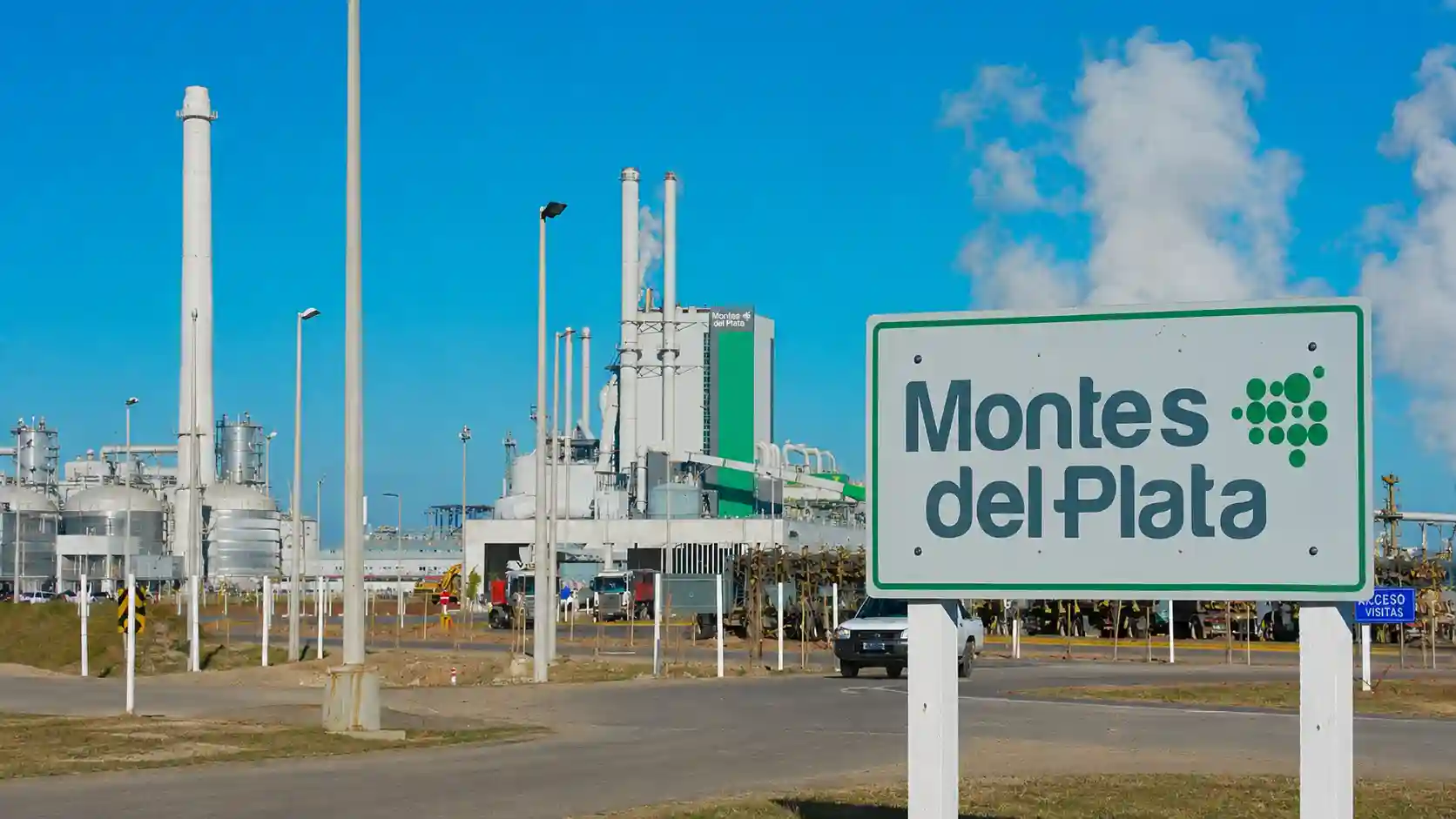
Montes del Plata is Uruguay’s direct-port and river-logistics pulp platform.
The company is owned 50/50 by Arauco and Stora Enso. Its Punta Pereira complex integrates pulp production, biomass power and a dedicated port, while the M’Bopicuá system adds river-barge logistics for wood supply.
The analytical value lies in the operating model: unlike UPM’s Paso de los Toros rail corridor and Montevideo terminal, Montes del Plata combines its mill and export port at one industrial site.
Core market reading:
Montes del Plata is a vertically integrated export platform. Its strategic value lies in the direct connection between plantation supply, river logistics, pulp processing, biomass power and an ocean-export terminal inside the Punta Pereira complex.
Data update · October 4, 2026
The company’s 2025 sustainability disclosure, published June 12, 2026, reports more than 1.44 million tonnes of prime-quality pulp, 608 direct employees and more than 2,100 supplier companies, 81% Uruguayan. Its logistics mix was 51% river and 49% land transport.
These indicators describe the 2025 reporting period. They replace the older undated workforce and supplier figures on this page. The historical 1.3-million-tonne design capacity and first-full-year electricity figures remain historical references; neither is presented as 2026 realized output.
For commercial analysis, a larger reported supplier base indicates an established industrial ecosystem, not an automatically accessible market. Supplier registration still needs to be distinguished from qualification, participation in a procurement process and an awarded contract.
Why Montes del Plata matters for Uruguay
Montes del Plata matters because it makes Uruguay’s pulp economy visible as an industrial system rather than a commodity category. The company is rooted in forestry, but its real market signal reaches into infrastructure, energy, logistics, certification, land use, free zones and export concentration.
The company also fits Uruguay’s small-market logic. In a large economy, one pulp mill is one industrial asset among many. In Uruguay, one project can alter export composition, regional employment, logistics flows, electricity supply and the public debate around the development model.
The Colonia location is central. Punta Pereira, near Conchillas, gives Montes del Plata direct access to a purpose-built industrial complex and port terminal. The company’s wood supply comes from plantations distributed across many departments, while the finished pulp is exported to Europe and Asia.
Montes del Plata is a single company case with national-scale signals.
Its pulp output, energy generation, direct port terminal and river logistics show how one industrial platform can influence Uruguay’s trade structure and infrastructure map.
Company profile: Arauco, Stora Enso and Punta Pereira
Montes del Plata was founded in Uruguay in 2009 and is jointly owned 50/50 by Chilean forestry group Arauco and Finnish-Swedish forest-industry group Stora Enso. The company produces bleached Eucalyptus pulp and operates an integrated forestry, industrial, energy and logistics system.
The company’s pulp is produced in a high-technology industrial complex located near Conchillas, in the department of Colonia. Montes del Plata states that the wood processed there comes from forest plantations distributed across 16 departments of Uruguay.
The company’s map extends beyond Punta Pereira. In Río Negro, it has a nursery, a forest technology center, a logistics terminal on the Uruguay River and Bioparque M'Bopicuá, a native-fauna reserve. In Colonia, it operates the Conchillas office and Punta Pereira industrial complex; additional offices appear in Montevideo, Durazno, Paysandú and Río Negro.
Production platform: reported output, original design and current scale
Montes del Plata’s 2025 disclosure reports more than 1.44 million tonnes of prime-quality pulp produced during that year. It is a dated company-reported operating result, not an independent capacity measurement or a forecast of 2026 production.
The original project documentation used a different reference point. The Inter-American Development Bank described a plant designed for 1.3 million tonnes per year, together with a 160 MW biomass-based power-generation unit and dedicated port and barge infrastructure.
Keeping those categories separate matters. Historical design capacity explains the investment decision; current company-reported production describes how the operating platform is presented today.
| Layer | Montes del Plata signal | Why it matters |
|---|---|---|
| Forestry | Eucalyptus plantations distributed across many departments. | Turns land use and wood supply into an export-industry base. |
| Pulp production | Approximately 1.4–1.44 million tonnes of annual production, company-reported; original project design was 1.3 million tonnes. | Makes pulp a central component of Uruguay’s export structure. |
| Port infrastructure | Direct export through Punta Pereira terminal. | Connects industrial production to ocean-going export flows. |
| River logistics | Wood arrives by barge from the Río Negro logistics terminal. | Reduces truck dependence and places the company inside Uruguay’s waterway system. |
| Energy | Biomass residues supply the complex and generate surplus electricity. | Adds an energy-infrastructure role to an export-industry project. |
How the Punta Pereira platform was financed
The financing history shows the scale and institutional structure behind the operating platform. In 2011, the Inter-American Development Bank approved a USD 200 million loan for Celulosa y Energía Punta Pereira S.A. and Zona Franca Punta Pereira S.A.
The IDB also expected to mobilize approximately USD 250 million from commercial banks. At the time, the industrial project was described at roughly USD 2 billion and included the pulp mill, biomass power generation, river-port infrastructure, barge terminals, wood yards and chipping facilities.
Evidence boundary:
These are historical project and financing values. They do not represent the current enterprise value of Montes del Plata, the present replacement cost of the assets or a current financing requirement.
Port and river logistics: the Punta Pereira model
The strongest Econosur angle is logistics. Montes del Plata exports its pulp from the Terminal Portuaria de Punta Pereira, located inside the industrial complex. The terminal has an 800-meter access channel, 200 meters wide, connecting it to the Canal Martín García.
The port has two docks: one for barges and another for ocean vessels. This allows the company to receive raw material and inputs while exporting pulp directly to final destinations.
The fluvial dock receives wood from the M’Bopicuá logistics terminal in Río Negro. The system was developed around four barges and two tugboats. Each barge can carry about 5,000 tonnes, which the company compares with approximately 170 loaded trucks.
Montes del Plata has described a wood-logistics system capable of moving up to four million tonnes per year, with roughly half transported by river and half by road. Around two million tonnes of wood can therefore move through the river system in a typical full-scale logistics plan. These are company-reported operating and design indicators.
Montes del Plata is Uruguay’s pulp model in physical form: plantations, barges, mill, power island, port and export corridor.
Energy layer: generation capacity, annual energy and grid supply
Montes del Plata’s energy role requires a clear distinction between power and energy. The original project was designed with a 160 MW biomass-based power unit. Montes del Plata currently presents 142 MW as an average generation indicator.
Annual energy delivered to the grid is better expressed in gigawatt-hours. Stora Enso reported that in the mill’s first full production year it generated 1,148 GWh, consumed 636 GWh and sold roughly 500 GWh of surplus electricity to Uruguay’s national grid.
Those figures establish the system logic: the mill is self-sufficient in electricity and heat and can become a relevant grid supplier. They should not be read as proof that the same annual surplus is delivered every year.
Forestry, pulp, power generation, port access and barge logistics are built into one industrial system.
The project’s economics depend on global pulp cycles, Asian and European demand, shipping conditions and buyer concentration.
Uruguay’s forestry model remains politically sensitive because of land use, monoculture concerns, water debates and free-zone benefits.
Free-zone and large-investment logic
Montes del Plata belongs to Uruguay’s wider large-investment model. The Punta Pereira complex operates inside a framework where free zones, port infrastructure, foreign capital and export orientation are central.
This is why the company is useful for reading Uruguay’s development strategy. The country has used institutional stability, investment-promotion rules, free-zone instruments and export infrastructure to host projects whose output is directed mainly abroad.
That model creates measurable export capacity. It also creates debate. A single project can increase exports, jobs and infrastructure quality, while concentrating strategic value in foreign-owned platforms and preferential regimes. Montes del Plata therefore works as a company case for both sides of the Uruguayan model: credibility for investors and a recurring debate over public value, land use and sovereignty.
Sustainability tension: certification and independent monitoring
Montes del Plata reports FSC and PEFC certification, chain-of-custody controls, protected natural areas and monitoring programs across forestry and industrial operations. These are relevant market-access and management signals, but they remain company- or shareholder-reported claims.
Uruguay’s Ministry of Environment provides the independent regulatory layer. The ministry states that Montes del Plata has been subject to continuous environmental control since operations began in 2014. The framework includes inspections, audits, final-effluent sampling, periodic environmental-performance reports and continuous transmission of selected effluent and air-emission data.
For Montes del Plata, the ministry reports continuous data feeds at ten-minute intervals for parameters such as effluent flow, pH, conductivity, temperature and suspended solids, together with particulate matter, NOx, SO₂ and total reduced sulfur at air-emission points. A state-led monitoring commission also covers the pulp mill, power plant and port installations.
Certification supports market access and documentation. Regulatory monitoring tests operating compliance. Neither alone proves the absence of environmental or land-use impacts, which is why plantation expansion, water, biodiversity and free-zone benefits remain part of the public debate.
| Dimension | Company-side signal | Market-structure tension |
|---|---|---|
| Certification | FSC, PEFC and chain-of-custody claims for forestry operations. | Certification supports buyer access but does not remove public scrutiny. |
| Environmental monitoring | Monitoring of water, air and soil with many parameters and sampling points. | Monitoring is central because pulp projects remain politically visible. |
| Native forest | Company and shareholder reporting describes protected natural areas, including more than 10,000 hectares of native forest in recent communications. | Forestry expansion remains linked to land-use and biodiversity debates. |
| Community impact | Local employment, community programs and dialogue mechanisms. | Large projects change towns, road systems, labor demand and local politics. |
| Free-zone framework | Export platform under Uruguay’s investment and free-zone architecture. | Public debate focuses on how much national value is retained locally. |
Risk map: demand cycles, logistics and legitimacy
The first risk is global pulp exposure. Montes del Plata sells into world markets where prices, demand, inventories and freight conditions shift. Asia and Europe are central destinations, so the company is exposed to global paper, packaging, hygiene-product and textile-related pulp demand.
The second risk is logistics. The company’s infrastructure is a strength because it has a dedicated port terminal and barge system. It also creates operational dependencies: river conditions, terminal performance, dredging, channel access, barge reliability and ocean-shipping conditions matter for export continuity.
The third risk is social license. Forestry and pulp projects in Uruguay have a long public history. The sector’s legitimacy depends on certification, monitoring, environmental performance, community relations, public trust and the perceived balance between foreign investment and domestic value creation.
| Risk layer | What it means for Montes del Plata | Why it matters for market analysis |
|---|---|---|
| Pulp cycles | Export revenue depends on global pulp demand and pricing. | Uruguay’s export totals can shift with external commodity cycles. |
| Logistics execution | Wood, barges, port access and ocean shipping must operate reliably. | The company’s advantage is infrastructure-heavy and execution-dependent. |
| Land use | Plantation forestry uses large areas across many departments. | Land concentration and monoculture concerns remain politically relevant. |
| Environmental performance | Water, air, soil and industrial emissions are continuously scrutinized. | Certification supports access but public legitimacy requires performance. |
| Policy framework | Free zones and investment incentives are part of the operating context. | Political changes or public pressure can affect future investment conditions. |
Supplier-market signal
Montes del Plata is also useful as a supplier-market signal. A project of this type creates demand for forestry equipment, nursery systems, harvesting services, transport technology, barge logistics, port equipment, industrial automation, chemical recovery, boilers, turbines, maintenance, safety systems, environmental monitoring and certification support.
The company’s scale also creates demand for services beyond the mill. Contractors, local employment programs, road maintenance, training, biodiversity monitoring, supplier portals, health and safety systems and community programs are part of the operating environment.
For international firms evaluating Uruguay, Montes del Plata shows that the country can host complex industrial platforms. The opportunity extends to equipment suppliers, logistics providers, environmental-service firms, engineering companies, digital monitoring providers, training companies and certification specialists.
The company provides an official supplier portal. Registration can create visibility in the procurement system, but it is not evidence of technical qualification, participation in a tender or an awarded contract.
Why this company case matters for Uruguay
Montes del Plata matters because it shows Uruguay’s industrial-export strategy in one operating platform. The company connects land, forestry, pulp, foreign capital, free zones, port infrastructure, energy generation and international buyers.
The case also explains why Uruguay’s export map is territorial. Colonia’s numbers are shaped by industrial platforms and free-zone exports. Río Negro matters because of logistics and forestry technology. The interior matters because plantations feed the system. Montevideo matters through corporate, financial and institutional functions.
For Econosur’s wider Uruguay coverage, Montes del Plata belongs next to UPM, the pulp and cellulose sector, the export map, the logic of small markets and the country’s infrastructure-dependent trade model.
Montes del Plata is Uruguay’s forest-industrial model in company form: land, pulp, port, barges, energy and public legitimacy.
Marcus A. Volz perspective
Montes del Plata’s value as a company case lies in how the assets connect: wood supply, river transport, mill, energy system and export port. That integration reduces some dependencies while creating others, including maintenance requirements, river conditions, forest supply and concentration in international pulp demand.
A foreign supplier should therefore identify the relevant technical package and contracting route before interpreting national export scale as a sales opportunity. An existing plant may offer recurring maintenance and service needs, while a new capital project requires separate evidence of scope and funding. The company’s sustainability report helps define the platform; procurement validation needs a more specific question.
Research services for Uruguay’s pulp companies and industrial supplier platforms
Econosur can turn a defined business question into a sourced brief or a scoped research assignment.
- Company reports: Examine ownership, operating assets, supplier interfaces and company-reported indicators with their reporting periods.
- Sector briefs: Compare direct-port and rail-terminal pulp models and their maintenance, logistics and service ecosystems.
- Custom analysis: Assess a defined equipment or service fit, procurement route and the information required to validate commercial access.
Public research is the starting point. Direct verification, interviews or additional datasets can be scoped where they are necessary and feasible; they are not implied by this article. The proposal defines deliverables, timing and evidence limits.
Company sources are used for ownership, operating assets, reported production, workforce, suppliers, logistics and sustainability commitments. Historical financing is drawn from the IDB. Environmental control is grounded in Uruguay’s Ministry of Environment.
Primary, institutional and company sources
- Montes del Plata — current company indicators and supplier access.
- Montes del Plata — ownership, workforce, supplier base and operating geography.
- Montes del Plata — pulp, power, Punta Pereira port and barge logistics.
- Inter-American Development Bank — historical project cost, loan, commercial-bank mobilization and original design values.
- Stora Enso — 50% ownership and reported annual electricity generation, consumption and grid sales.
- Uruguay Ministry of Environment — inspections, samples, audits and continuous emissions and effluent monitoring.
- Uruguay Ministry of Environment — monitoring commission for the mill, energy unit and port installations.
- Montes del Plata — 2025 sustainability disclosure; published June 12, 2026. Production, workforce, supplier companies and logistics mix.
Industry and secondary sources
Evidence boundary: Company-reported indicators describe the company’s own operations and claims. They do not independently establish environmental performance, market leadership or future output.
Montes del Plata raises practical questions for pulp buyers, forestry suppliers, logistics operators, equipment manufacturers, energy analysts, environmental-service firms and investors evaluating Uruguay’s export model.
- How much of Uruguay’s export performance depends on a small number of large industrial platforms?
- How do free zones shape pulp, cellulose and large-scale manufacturing exports?
- What does Punta Pereira show about Uruguay’s port and river-logistics capacity?
- How does biomass energy from pulp production affect Uruguay’s industrial energy profile?
- Which supplier markets are created by forestry, pulp production, barges, port terminals and environmental monitoring?
- How should investors read certification claims alongside land-use and monoculture criticism?
- What does Montes del Plata reveal when compared with UPM’s pulp investments in Uruguay?
FAQ
Who owns Montes del Plata?
Montes del Plata is jointly owned 50/50 by Arauco and Stora Enso.
How much pulp does Montes del Plata produce?
The company reported more than 1.44 million tonnes of prime-quality pulp produced in 2025. Its original project design was 1.3 million tonnes per year; realized output and design capacity are different measures.
How does the Punta Pereira logistics system work?
Wood reaches Punta Pereira by road and by river barge from the M’Bopicuá logistics terminal. Finished pulp is loaded directly onto ocean-going vessels at the integrated Punta Pereira port.
What is the energy role of Montes del Plata?
The pulp process generates biomass electricity. The project was designed with a 160 MW unit, Montes del Plata reports a 142 MW average generation indicator, and Stora Enso reported roughly 500 GWh of surplus electricity sold to the grid in the mill’s first full production year.
How was the Punta Pereira project financed?
The IDB approved a USD 200 million loan and expected to mobilize approximately USD 250 million from commercial banks for a historical industrial project described at around USD 2 billion.
How is Montes del Plata environmentally monitored?
Uruguay’s Ministry of Environment applies inspections, audits, sampling, periodic reporting and continuous transmission of selected effluent and air-emission data. The regulatory framework has operated since the plant began production in 2014.
How does Montes del Plata differ from UPM in Uruguay?
Montes del Plata integrates its pulp mill and direct export port at Punta Pereira and uses river barges for part of its wood supply. UPM’s Paso de los Toros system relies on the Ferrocarril Central and a specialized terminal in Montevideo.