
Uruguay Export Map:
Trade Structure
and Market Position
Uruguay’s exports follow a clear territorial logic. Beef, pulp, soy, rice, dairy and industrial products come from different production regions — and those regions shape China exposure, EU-Mercosur opportunities and the country’s market position.
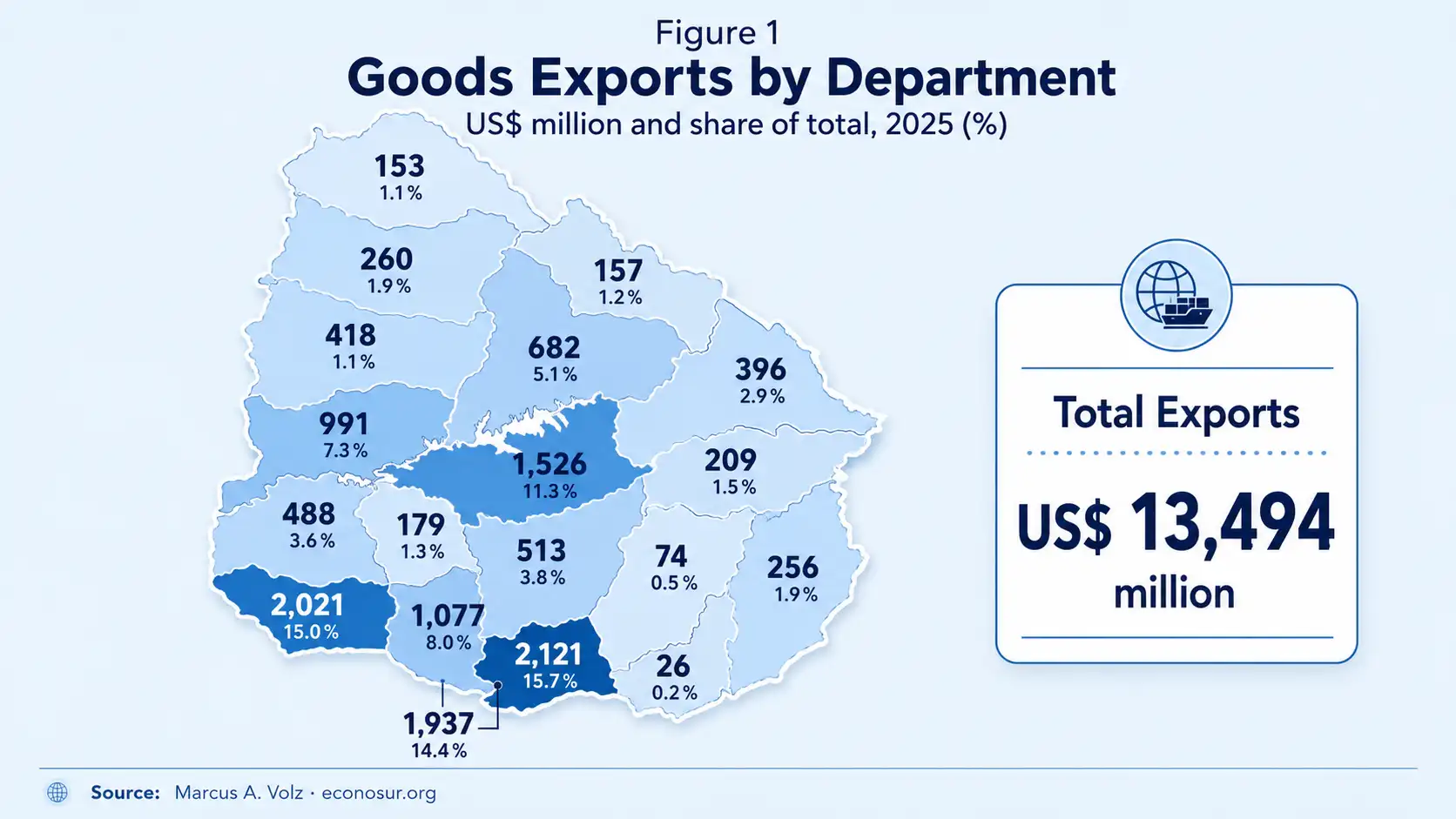
Uruguay’s export map shows that the country is not one uniform supply base.
Beef, pulp, soy, rice, dairy and industrial products are tied to different departments, infrastructure systems and buyer relationships. Canelones, Colonia and Montevideo accounted for 45% of goods exports in 2025, but the remaining export structure is distributed across highly specialized production regions.
The practical market question is where each product comes from, which buyer market it depends on and which logistics or compliance layer makes the export flow possible.
Uruguay exports through a set of territorial production systems. Rice comes from the east, soy from the west, beef from the north, cellulose from the interior and dairy from the San José corridor. This geography is central to understanding the country’s trade logic.
The export map belongs inside the wider Uruguay market context. It explains why the country can be small in population but highly visible in specific trade categories, from beef and pulp to rice quotas, soy exports and dairy flows.
Market reading: Uruguay’s export position is territorial. Each production region has its own product logic, infrastructure, buyer exposure and quota strategy. The export map therefore works as a practical guide to market position, trade risk and sourcing opportunity.
Uruguay’s export story is often told in national aggregates: total export value, top products and main destination markets. Those numbers are useful, but they hide the operational structure of the country’s trade economy. The relevant question is where each product comes from, which global buyer it reaches and which infrastructure makes the flow possible.
In 2025, Uruguay’s goods exports reached US$13.49 billion, the highest level of the past decade. Behind that national figure lies a patchwork of regional specializations: a beef-dominant north, a cellulose-producing interior anchored in free trade zones, a soy-growing west, a rice-exporting east and a dairy corridor around San José. Three departments — Canelones, Colonia and Montevideo — carried 45% of the national total between them. The remaining 55% was distributed across 16 other departments, each with its own product logic.
Reading Uruguay through that territorial lens changes how the country’s trade flows, China dependence, EU-Mercosur positioning and exposure to market shocks should be interpreted. It also complements the broader argument developed in The Logic of the Small Market: Uruguay’s scale makes the structure easier to read, but the strategic logic is more complex than population size suggests.
Three departments, 45% of the total
The geographic concentration of Uruguay’s exports is striking even by the standards of a small, open economy. Canelones, Colonia and Montevideo together accounted for nearly half of total goods exports in 2025. Each of the three operates on a different model.
Canelones led national exports with a 16% share. Beef accounts for 57% of its departmental total — the highest absolute volume of beef exports in the country. Canelones is also the most industrially diversified department outside the capital, with significant pharmaceutical and plastics output complementing its agricultural base.
Colonia ranked second at 15%, and its export logic is built on free trade zone infrastructure. More than 70% of Colonia’s exports originate in its free zones, driven by cellulose and beverage concentrates. The department’s headline numbers are heavily shaped by the operations of large industrial plants rather than dispersed agricultural production.
Montevideo, at 14%, is the most diversified exporter of the three. Vehicles lead its basket at 20% of the departmental total — a significantly smaller dominance than the leading product in almost every other department. The capital functions as Uruguay’s industrial and logistics hub for manufactured and processed goods, with vehicles, plastics, margarines and oils all playing meaningful roles.
Uruguay is an archipelago of production regions, each with its own product logic, destination markets and competitive positioning.
Reading the production map
Beyond the top three, Uruguay’s export geography follows a clear spatial logic that reflects the country’s agricultural and industrial structure.
The interior departments of Durazno and Río Negro are defined by cellulose. Durazno allocates 65% of its departmental exports to pulp production, Río Negro 62%. Both departments host large pulp mill facilities in free trade zones, whose output is attributed to the department of production rather than Montevideo’s port. These two departments together channel a significant share of Uruguay’s cellulose exports toward the EU and China. This connects directly with the separate Econosur analysis of Uruguay’s pulp and cellulose sector.
The west — Soriano in particular — is Uruguay’s soy corridor. Soriano allocates 72% of its exports to soybeans, the highest concentration of any single product in any department. Paysandú and Flores follow the same pattern, each with soy as their primary export product. Together these departments feed into Uruguay’s agricultural trade relationship with China.
The north and northeast are beef country. Tacuarembó and Salto each direct more than 60% of their departmental exports toward beef, while Cerro Largo allocates 51%. The livestock-raising tradition of Uruguay’s interior is concentrated in these departments, which supply the processing plants — primarily in Canelones — that dominate the country’s beef export volumes.
The east is rice. Treinta y Tres sends 71% of its exports as rice — one of the most specialized departmental profiles in the country. Rocha reaches 43% and Artigas 49%. This eastern rice belt is a long-established agricultural system with strong institutional capacity, high compliance with sanitary standards and a well-developed supply chain oriented toward international buyers.
San José completes the picture as Uruguay’s dairy hub. The department leads dairy exports nationally, accounting for 60% of total Uruguayan dairy sales abroad. Its specialization in milk powder, cheese and processed dairy products is reflected in a departmental export basket where dairy accounts for 52% of the total.
Market structure point: Uruguay’s production regions have different buyer bases, price exposures, infrastructure needs and geopolitical risk profiles. A cellulose department exposed to EU and Chinese pulp demand is not the same market system as an eastern rice department competing for EU quota access.
Uruguay’s export map is also a company map. The country’s trade structure becomes easier to read when the main product regions are connected to the firms and institutions operating inside them.
China as a structural factor
China remained Uruguay’s largest export destination in August 2026, but purchases fell sharply from a year earlier. Uruguay XXI reported US$245 million of sales to China, down 46% year on year, mainly because of lower soybean shipments.
The product and regional concentration inside that relationship remains the key issue. A drought-related reduction in the soy harvest hit the western production system particularly hard, while beef and cellulose followed different demand cycles. This is why China exposure should be read through Uruguay’s product geography rather than through the destination total alone.
The wider destination mix also shifted. Brazil bought US$182 million in August, up 30% year on year; the European Union reached US$165 million, down 11%; and the United States reached US$125 million, up 15%. China remained the largest single destination, but the divergence between markets reinforces the value of treating Uruguay’s exports as a portfolio of regional production systems.
The structural risk nevertheless remains. A weak soy harvest, lower pulp prices or a change in Chinese beef demand can hit specific production regions directly. Uruguay’s territorial export map therefore remains the most useful way to see where destination-market shocks actually land.
EU-Mercosur: the quota race begins
The EU-Mercosur trade agreement entered provisional application on 1 May 2026. In the weeks that followed, Uruguay demonstrated how territorial specialization can translate directly into competitive advantage.
Within the first weeks of the agreement, Uruguay captured 63% of the total Mercosur EU rice quota of 6,667 tonnes for 2026. The quota operates on a first-come, first-served basis, and Uruguay moved quickly enough to secure most of the first-year allocation. Official Uruguayan sources point to the sector’s professionalization, product quality, organization and coordination as important foundations of that result. The commercial advantage was built before the quota opened and became measurable once preferential access was available.
Uruguay’s acting foreign minister acknowledged at the time that the first-come, first-served mechanism would force the Mercosur partners to negotiate an internal distribution framework. The rice episode has already generated diplomatic tension. The beef quota, covering 99,000 tonnes at a 7.5% preferential tariff, represents a much larger commercial prize and will involve much fiercer competition from Brazil and Argentina.
For Uruguay’s northern beef departments, the EU-Mercosur quota is a meaningful opportunity. Canelones, Tacuarembó and the interior livestock zones already send significant volumes to the EU and the US. The agreement’s phased quota expansion gives those regions a structured path toward higher European market access, provided sanitary and traceability requirements are maintained.
By late July, the agreement had moved beyond the initial rice-quota signal. Uruguay XXI reported that during the first twelve weeks of provisional application, from 4 May to 26 July, Uruguayan goods worth US$13.8 million and weighing 6,413 tonnes entered the EU under preferential conditions across 26 tariff lines and 11 member states. The estimated tariff saving was US$2.1 million, equivalent to 15.6% of the value entering under the preferences.
Beef accounted for 41% of the value exported under preferences and 77% of the estimated tariff saving. That is a more useful commercial signal than quota headlines alone: the agreement is beginning to change the effective cost of access for specific products, while the scale of preferential trade remains small relative to Uruguay’s overall exports.
Uruguay captured 63% of the Mercosur EU rice quota because the eastern rice system had built compliance capacity before the quota opened.
August 2026: a monthly signal read through the map
The August 2026 report from Uruguay XXI provides the latest monthly view of the territorial export system. Goods exports, including free-zone operations, reached US$1.121 billion, down 16% year on year.
Beef remained the main product at US$214 million, down 12%. Cellulose followed at US$205 million, down 9%, while soy reached US$86 million and fell 70% year on year. Dairy products totaled US$64 million, down 29%, while beverage concentrates rose 31% to US$63 million. Uruguay XXI identified the drought-related reduction in the soybean harvest as the largest negative contribution to the monthly result.
The destination side was equally uneven. China remained first at US$245 million but fell 46% year on year. Brazil reached US$182 million and grew 30%, the European Union totaled US$165 million and fell 11%, while the United States reached US$125 million and grew 15%. Read through the map, August is a useful example of why the national export total can conceal sharply different regional production and buyer cycles.
This analysis answers practical market questions for companies, investors and analysts evaluating Uruguay’s export structure.
- Why does Uruguay’s export geography matter?
- How does Colonia’s export model differ from Canelones?
- Why is the EU-Mercosur quota story a territorial production story?
- What does China concentration mean for trade resilience?
- What should companies understand about Uruguay’s regional production systems?
- Which companies and institutions help explain Uruguay’s export systems?
What the map means for trade strategy
Uruguay’s territorial specialization has practical implications for anyone operating in, sourcing from or analyzing the country’s trade flows.
For EU importers and investors, the EU-Mercosur agreement creates a new layer of relevance. The agreement is about quota categories, sanitary compliance, traceability and the ability to move quickly when quotas open. Uruguay’s production infrastructure — particularly in rice and beef — makes it a credible and already-active counterpart in those categories.
For companies evaluating Uruguay as a supply base, the map provides a more useful starting point than national statistics. Sustainable forest products and cellulose derivatives point toward Durazno, Río Negro and Colonia’s free zone infrastructure. Premium beef with traceability documentation points toward the northern livestock departments and Canelones processing capacity. Specialty dairy products point toward San José and Florida.
For international companies: the export map is a starting point for more specific research on suppliers, buyers, companies, production regions and logistics dependencies. Econosur can extend the public analysis through Market Briefs, Company Reports and Custom Market Analysis.
Uruguay’s export geography also connects to the wider Paraná-Paraguay logistics system through Nueva Palmira, located at kilometre zero of the Hidrovía. The port combines bulk, transit and transshipment functions for cargo moving between inland South America and Atlantic-facing routes. Deeper loading at Gran Rosario could change the economics of downstream completion loading and transshipment without eliminating Nueva Palmira’s broader regional role. See Econosur’s analysis of how a deeper Paraná River could reshape Mercosur trade.
For market analysts, Uruguay’s territorial structure shows how small-country trade data can conceal important operational differences. August’s 16% export decline combined a 70% fall in soy exports and a 46% decline in sales to China with very different movements in beef, cellulose, Brazil and the United States. Each movement belongs to a different region, product system and buyer relationship.
The same logic helps connect Uruguay’s export structure to other country-position themes, including Uruguay’s tourism market, Uruguay’s digital positioning and the country’s logistics exposure to regional corridors covered under Logistics & Waterways.
Conclusion
Uruguay’s export map is one of the most legible territorial trade structures in South America. The regional production systems are real, persistent and operationally significant. They explain why Uruguay punches above its weight in specific EU-Mercosur quota races. They explain why China concentration is structural. And they explain why monthly trade data, read without the geographic lens, can mislead as often as it informs.
In a trade landscape shaped by quota mechanisms, sanitary compliance, bilateral agreements and geopolitical diversification pressures, the export map is primary analytical infrastructure. It shows what Uruguay can do as a global trade actor, where the risks sit and where the opportunities are located.
My reading is that Uruguay’s export resilience is easier to understand geographically than through the national total.
August makes this especially visible. Overall exports fell 16%, but that national figure combines very different systems: soy exports fell 70%, China-bound sales fell 46%, while Brazil increased purchases by 30% and the United States by 15%. Beef, pulp, dairy and soy therefore moved through different production and demand cycles.
The EU-Mercosur agreement adds another layer. Uruguay’s early use of 63% of the first-year rice quota did not emerge because the agreement suddenly created an export industry. It rewarded a production system that already had organization, quality, compliance capacity and the ability to act quickly when preferential access opened.
For companies and analysts, Uruguay should therefore be read as a portfolio of export systems rather than as one small national market: beef, pulp, dairy, soy and rice each have different regions, buyers, infrastructure and access conditions.
Current trade figures are anchored in Uruguay XXI and official Uruguayan sources. The European Commission is used for the wider EU-Mercosur framework, while Uruguay’s National Ports Administration provides the official logistics context for Nueva Palmira.
- Uruguay XXI — Monthly Foreign Trade Report, August 2026: US$1.121 billion in monthly goods exports, down 16% year on year; beef US$214 million, cellulose US$205 million, soy US$86 million, China US$245 million and Brazil US$182 million.
- Uruguay XXI — Exports of Goods by Department 2025: Canelones, Colonia and Montevideo together at 45% of national goods exports and the territorial production profiles used in this analysis.
- Presidency of Uruguay — Uruguay completed 63% of the Mercosur EU rice quota, 21 May 2026: official confirmation of Uruguay’s share of the first-year quota.
- Uruguay MGAP — rice-sector commercial result, 21 May 2026: official attribution of the result to sector professionalization, product quality, sustainability and coordination.
- Uruguay XXI — Mercosur–European Union Agreement Portal: tariff phase-outs, rules of origin, quotas, export requirements and company guidance.
- Uruguay XXI — Tariffs and Quotas: preferential access and first-come-first-served quota mechanics.
- European Commission — EU-Mercosur trade agreement: official EU framework for the agreement.
- Uruguay National Ports Administration — Nueva Palmira: official description of the port as kilometre zero of the Paraná-Paraguay Waterway and a major bulk-cargo gateway.
- Uruguay ANP and Paraguay CAFYM — Hidrovía logistics cooperation, 20 March 2026: transshipment, completion-loading services, Nueva Palmira and Uruguay-Paraguay logistics integration.
- Montevideo Portal — Uruguay exports, July 2026: secondary reporting on the July Uruguay XXI data and the early EU-Mercosur preference-use signal.
- GTS Uruguay — Foreign Trade, July 2026: secondary breakdown of the first twelve weeks of EU-Mercosur preference use.
- MercoPress — Uruguay rice quota, 23 May 2026: secondary reporting on Uruguay’s early quota use; exclusivity claims about sanitary compliance are not treated here as established official fact.
- Evidence note: official sources establish the trade figures, quota use and access rules. The interpretation that Uruguay’s resilience is best understood through distinct territorial export systems — and that its early EU-Mercosur advantage reflects pre-existing production and compliance capacity — is Econosur analysis.
- Econosur analysis updated 6 September 2026.
From export data to market interpretation
Uruguay’s export structure cannot be read through national totals alone. Product origin, department-level specialization, buyer concentration, quota access, free trade zones, company layers and logistics systems determine where the country’s real trade advantages and risks sit.
Econosur prepares market briefs and custom analysis for companies, analysts and institutions evaluating South American countries, export systems, sourcing opportunities, trade risks and market-access questions. Possible scopes include Uruguay export geography, beef, pulp, soy, dairy, rice, China exposure, EU-Mercosur quotas, free trade zones, logistics corridors or company-specific sourcing questions.
Explore custom market analysisFrequently asked questions
What is Uruguay’s export map?
Uruguay’s export map refers to the territorial distribution of the country’s export production. Different regions specialize in different products: beef in the north, cellulose in the interior, soy in the west, rice in the east and dairy around San José. Understanding these regional production systems is key to reading Uruguay’s trade logic.
Which department exports the most in Uruguay?
In 2025, Canelones was Uruguay’s leading export department with a 16% share of total goods exports, driven mainly by beef. Colonia ranked second at 15%, supported by cellulose and beverage concentrates from its free trade zones. Montevideo came third at 14%, with a more diversified basket led by vehicles.
Why did Uruguay dominate the Mercosur EU rice quota in 2026?
Uruguay captured 63% of the 2026 Mercosur EU rice quota after provisional application began on 1 May 2026. Official Uruguayan sources point to the rice sector’s quality, professionalization, organization and ability to use the first-come-first-served quota quickly. The country’s eastern departments — Treinta y Tres, Rocha and Artigas — account for the bulk of that output.
How dependent is Uruguay on China as an export market?
China remained Uruguay’s largest export destination in August 2026, receiving US$245 million, while sales were 46% below August 2025. Uruguay XXI attributed much of the decline to lower soybean shipments, reinforcing the link between destination exposure and Uruguay’s territorial production systems.
What does Uruguay’s export geography mean for EU-Mercosur?
Uruguay’s territorial specialization gives it a competitive advantage in specific EU-Mercosur quota categories. Its eastern rice regions are already capitalizing on the agreement. Beef regions in the north and cellulose departments in the interior are positioned to benefit from the agreement if compliance and market access conditions remain favorable.
Which companies help explain Uruguay’s export map?
UPM and Montes del Plata help explain the cellulose export system; Conaprole helps explain dairy; SAMAN is relevant to rice; Marfrig and Frigorífico Tacuarembó are useful beef-sector references; Nordex helps illustrate Montevideo’s industrial-export layer.
What should companies understand about Uruguay’s regional production systems?
Companies sourcing from Uruguay, investing in the country or building trade partnerships should understand that Uruguay is not one uniform supply base. Each regional production system has its own product logic, infrastructure, market connections and competitive strengths.