
Company Insight · Uruguay · Buquebus · Ferry Transport · Tourism · Electric Mobility · Port Infrastructure
Buquebus: Uruguay’s Electric Ferry Infrastructure Test
China Zorrilla reached Uruguay on 10 September 2026 aboard the heavy-lift vessel Black Marlin. The 130-metre battery-electric ferry is now entering the float-off, transfer and commissioning stage before regular Buenos Aires–Colonia service, turning the project from a shipbuilding story into an operating test of port power, charging, passenger flows, tourism distribution and cross-border infrastructure.
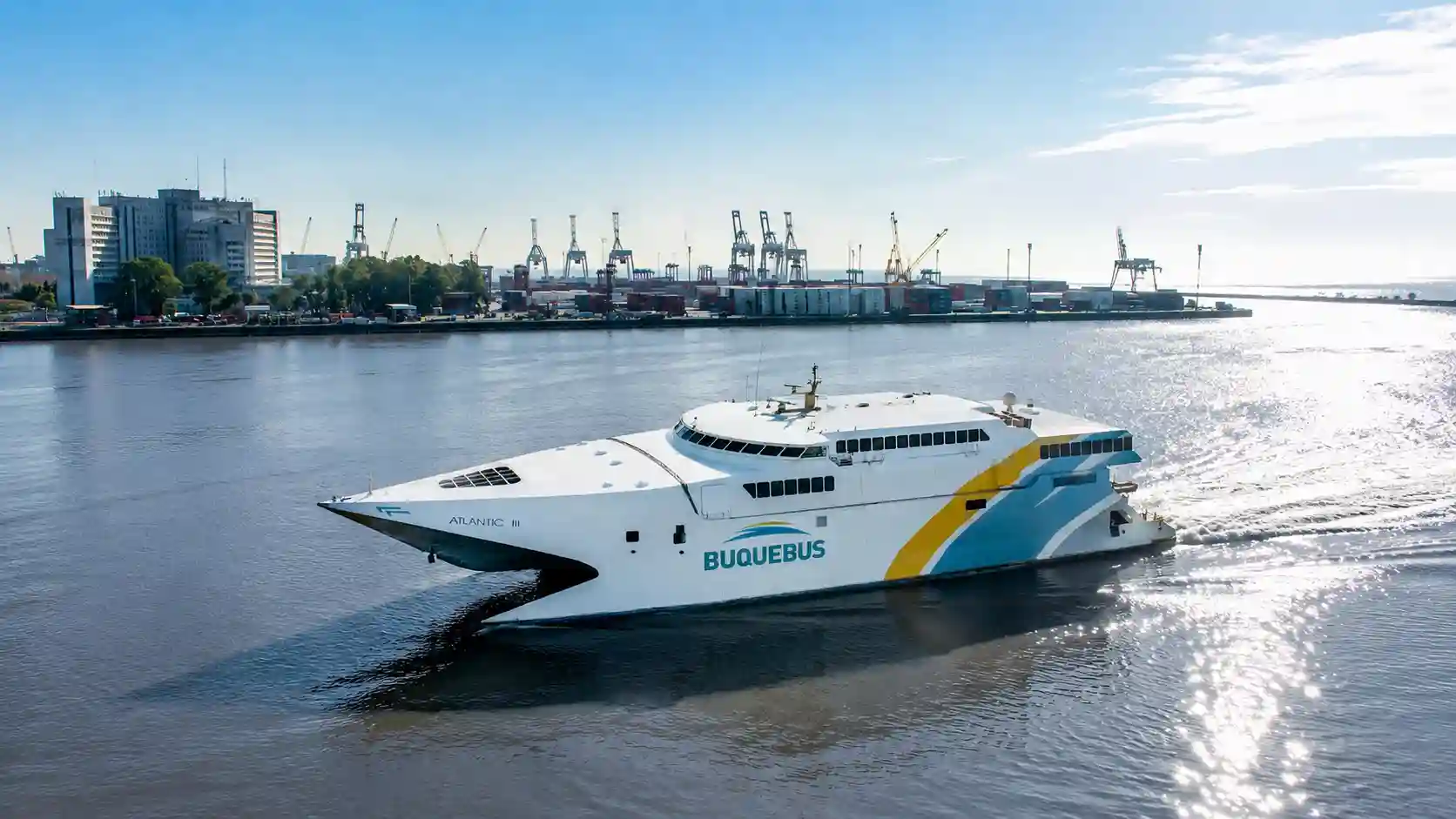
Buquebus has moved from electric-ferry construction into physical arrival, float-off preparation, commissioning and infrastructure execution.
China Zorrilla reached the Nueva Palmira area on 10 September 2026 aboard the heavy-lift vessel Black Marlin, completing its transport from Tasmania to Uruguay. ANP had originally scheduled the special float-off operation for 12 September subject to weather; local reporting on 11 September now points to the operation taking place over the weekend, with Sunday 13 September cited as the expected float-off date.
The Colonia terminal has already been upgraded under an ANP–UTE agreement. ANP states that the port has 15 MW of electrical capacity. UTE separately documents an expansion of the Colonia transmission station and roughly 9 km of new underground network to the new port connection point, alongside terminal works for the passengers and vehicles of large vessels such as China Zorrilla.
No official source reviewed by Econosur confirms that regular commercial passenger service has begun. The next evidence milestones are successful float-off, transfer to Colonia, commissioning and entry into scheduled Buenos Aires–Colonia operations.
Core market reading:
Buquebus is entering the stage where the operating system around China Zorrilla becomes more important than the vessel specification alone: terminal access, charging power, turnaround time, route capacity, tourism demand, booking control and public-grid coordination will determine the commercial effect of the project.
Latest status: China Zorrilla has reached Uruguay
On 5 August 2026, Incat confirmed that Hull 096 had left the River Derwent in Tasmania aboard the heavy-lift vessel Black Marlin. Incat said the voyage to South America would take around 40 days, after which the ferry would be unloaded, commissioned and prepared for the Buenos Aires–Colonia route.
The ferry reached the Nueva Palmira area on 10 September 2026. ANP had announced the arrival two days earlier and scheduled the special unloading operation from Black Marlin for 12 September, subject to weather conditions. Reporting from Uruguay on 11 September confirms the arrival and indicates that the float-off is now expected over the weekend, with Sunday 13 September cited by local port reporting.
After float-off, the ferry is expected to move to Colonia for the final preparation and commissioning phase before joining the Buquebus fleet. The choice of Nueva Palmira is also commercially relevant: ANP explicitly links the operation to the port’s depth and its strategic position on the Paraná–Paraguay waterway system.
Incat’s current-fleet page presently lists 15 September 2026 as the delivery date for China Zorrilla. Because that date has not yet been reached, Econosur treats it as Incat’s currently listed delivery date rather than a completed delivery event.
Verified: China Zorrilla has been built, completed harbour trials, crossed from Tasmania aboard Black Marlin and reached the Nueva Palmira area on 10 September 2026.
Current float-off status: ANP originally scheduled the unloading operation for 12 September, weather permitting; local reporting on 11 September now points to the float-off taking place over the weekend, with Sunday 13 September cited as the expected date.
Currently listed by Incat: delivery on 15 September 2026.
Not yet verified: completed float-off and transfer to Colonia, commissioning, first commercial passenger sailing, final operating timetable, regular charging performance, load factors or commercial performance on the Buenos Aires–Colonia route.
Why Buquebus matters now
Buquebus matters now because the company sits on a narrow but strategic corridor: Buenos Aires–Uruguay passenger mobility. The route is small in geographic distance and large in economic meaning. It connects Argentina’s largest urban market with Uruguay’s tourism, real estate, business and short-stay travel economy.
The China Zorrilla adds a second layer. Buquebus is no longer only a ferry operator in the visible travel market. It is now part of a larger infrastructure question: how electric maritime transport works when a private vessel needs high-power charging, port adaptation, public electrical infrastructure and reliable energy on both sides of a binational route.
That makes Buquebus a useful company case for Uruguay. It links tourism, transport, energy infrastructure, finance, ports and the Río de la Plata’s cross-border market structure.
Buquebus is a transport company with corridor power.
Its strategic value comes from the route layer: ferry capacity, port terminals, passenger booking, car transport, duty-free retail, tourism packages and the position between Argentina’s demand base and Uruguay’s visitor economy.
Company profile: ferry operator, tourism seller, corridor intermediary
IFC describes Buquebus as a leading river transport and tourism company in Argentina, Uruguay and the Southern Cone, with high-speed vessels crossing the Río de la Plata between Argentina and Uruguay. The same IFC source states that the company connects Buenos Aires with Colonia del Sacramento and Montevideo, with daily connections to destinations such as Carmelo, Punta del Este, Piriápolis and La Paloma.
That description is important because Buquebus should be read through three revenue layers. The first is passenger and vehicle transport. The second is tourism distribution: hotels, flights, excursions and transfers. The third is terminal and onboard commercial value, including retail and duty-free activity.
IFC’s financing announcement identifies Buquebus together with Los Cipreses S.A. and quotes Juan Carlos López Mena as president of Buquebus. For this article, the corporate point is simple: Buquebus is the visible brand, while Los Cipreses S.A. is relevant in the formal financing documentation for China Zorrilla.
Route platform: Buenos Aires, Colonia and Montevideo
The Buquebus platform is built around the Río de la Plata. Buenos Aires provides the demand base. Colonia del Sacramento provides the short crossing, the day-trip logic and the gateway into Uruguay. Montevideo provides the capital-city and business-travel layer. Punta del Este and other destinations extend the tourism product beyond the port landing point.
The company’s role in Uruguay tourism is therefore stronger than a simple transport label suggests. A traveler who buys the ferry, a hotel, a transfer and a destination product through the same ecosystem enters Uruguay through a privately coordinated corridor. That has implications for visitor distribution, booking visibility, pricing power and the way Argentine demand reaches Uruguayan destinations.
This corridor role also explains why Buquebus belongs inside a tourism-market analysis. Argentina remains the dominant source market for Uruguay’s inbound tourism. Buquebus is one of the companies that turns that structural dependence into daily passenger flows.
| Route layer | Company relevance | Market reading |
|---|---|---|
| Buenos Aires–Colonia | Short ferry corridor across the Río de la Plata and the intended China Zorrilla route. | High relevance for day trips, short stays, car transport and Colonia’s role as Argentina-facing gateway. |
| Buenos Aires–Montevideo | Capital-to-capital ferry connection and business/tourism corridor. | Important for urban tourism, institutional travel and the broader Argentina-Uruguay mobility relationship. |
| Tourism extensions | Connections and packages to Punta del Este, Piriápolis, La Paloma and other destinations. | Buquebus can shape demand beyond the port through packaging, transfer logic and booking visibility. |
| Terminal and retail layer | Passenger terminals, onboard services, duty-free retail and waiting-time economics. | The company captures value from the crossing itself and from the controlled travel environment around it. |
China Zorrilla: the visible asset
The China Zorrilla is the visible reason Buquebus now matters beyond tourism. Incat lists Hull 096 as a 130-meter vessel for the Buenos Aires–Colonia route, operated by Buquebus. Incat’s specification page lists 2,100 passengers, 225 cars, 41.2 MWh of energy storage, two 8 MW DC chargers, eight 2,400 kW electric motors and eight Wärtsilä WXJ 1100 waterjets.
The vessel is no longer in the shipyard phase. Its departure from Tasmania on 5 August moved the project into physical delivery. The September unloading operation in Nueva Palmira, subsequent transfer to Colonia and commissioning process are now the bridge between technical completion and commercial service.
Buquebus’s own electric-vessel page also presents the China Zorrilla as a 2026 launch with 2,100 passenger capacity, 225 vehicles, zero-emission propulsion and the Buenos Aires–Colonia route. The official company page is useful for route and product positioning, while Incat is stronger for technical specifications.
The project history matters. The vessel was originally linked to LNG/diesel logic and was shifted during construction to full battery-electric operation. That makes China Zorrilla a technology conversion case as well as a fleet-renewal case.
| China Zorrilla element | Verified project detail | Why it matters |
|---|---|---|
| Builder | Incat Tasmania, Hull 096. | Places Buquebus inside a global high-speed electric ferry technology case. |
| Route | Buenos Aires, Argentina – Colonia, Uruguay. | Connects the vessel directly to the most important short-crossing passenger corridor. |
| Capacity | 2,100 passengers and 225 cars. | Increases capacity per crossing and changes terminal, boarding and charging requirements. |
| Energy system | 41.2 MWh energy storage system listed by Incat; Corvus describes more than 40 MWh. | Turns the vessel into a grid-connected infrastructure asset rather than a standalone ship. |
| Propulsion | Eight Wärtsilä WXJ 1100 waterjets and eight electric motors listed by Incat. | Shows the shallow-water, high-speed technical logic of the Río de la Plata route. |
The China Zorrilla is the asset. The charging system, port works and electricity supply are the market structure behind it.
Financing structure: blue finance and private transport
The financing structure is one of the strongest sources in this case. IFC announced a partial credit guarantee of USD 67 million to Buquebus / Los Cipreses S.A. for the China Zorrilla, linked to a USD 107 million loan from Banco Santander Uruguay. IFC described the deal as the first blue operation in Uruguay and the first in the maritime and electric transport sector worldwide.
The public financing sources use different scopes. IFC’s project disclosure estimates the ferry project cost at approximately USD 170 million, with around USD 107 million financed through the Santander loan and up to USD 67 million covered by IFC’s partial credit guarantee. IFC’s 2024 press release separately said Buquebus would invest another USD 14 million in two charging stations and transmission infrastructure. The World Bank later framed the wider investment at USD 184 million, effectively combining the ferry investment with that early charging-and-transmission estimate. ANP subsequently cited approximately USD 20 million for the electrical infrastructure developed in Colonia, reflecting a later and differently scoped infrastructure figure rather than a number that should simply be added again.
| Figure | Source context | How to read it |
|---|---|---|
| USD 107 million | Banco Santander Uruguay loan described by IFC. | Loan amount for the ferry financing structure. |
| USD 67 million | IFC partial credit guarantee. | Risk-sharing element that enables the financing package. |
| Approx. USD 170 million | IFC project disclosure. | Estimated ferry project cost before separately stated charging and transmission works. |
| USD 14 million / approx. USD 20 million | IFC 2024 planning figure / later ANP reporting. | Different-stage estimates for charging, transmission and Colonia electrical infrastructure; not figures to add on top of each other without scope adjustment. |
The Buquebus case is a blue-finance case with public infrastructure exposure.
The financing narrative is built around maritime decarbonization. The operating reality depends on chargers, grid capacity, port works and the allocation of public infrastructure to support a private vessel.
Grid and port infrastructure: the real story behind the ferry
The most important infrastructure layer is the grid. In its 8 September update, ANP states that the Port of Colonia has been upgraded to 15 MW of electrical capacity under an agreement with UTE signed in 2024. UTE documents the physical works behind that figure: an expansion of the Colonia transmission station and roughly 9 km of underground network to the new connection point inside the port. ANP compares the port power level with more than half of the electricity consumption of the city of Colonia and also reports terminal works for the passenger and vehicle flows of large vessels such as China Zorrilla.
For the full land-side infrastructure analysis, see Econosur’s Buquebus electric-ferry infrastructure analysis, which separates vessel technology from grid connection, shore charging, port works, financing and Uruguay’s renewable-power context.
Earlier ANP reporting placed the dedicated electrical works for the project at approximately USD 20 million and described high-power charging infrastructure in Colonia. ANP also cites roughly 40 minutes for the operational recharge window during passenger and vehicle turnaround. Econosur does not treat that figure as evidence of a full 0–100% recharge of the vessel’s more-than-40-MWh battery; it is an operational turnaround statement whose real-world performance will only be measurable once scheduled service begins.
The cross-border energy issue is equally important. Uruguay’s electricity mix gives the Colonia side a strong renewable-power story. On the Buenos Aires side, IFC’s environmental review states that EDESUR is to provide a new grid connection to the ferry terminal, including roughly 600 metres of underground line. What remains to be verified publicly is the final completion, commissioning and regular operating performance of that connection. A zero-local-emission vessel on a binational route still depends on the emissions profile and reliability of the grids that charge it.
In August 2026, ANP received an honorable mention in the Inter-American port-industry awards for the China Zorrilla project and the electrification of the Port of Colonia. ANP highlighted an electricity system with approximately 98 percent renewable generation and projected an 84% reduction in the journey’s overall carbon footprint. IFC separately estimates annual emissions savings equivalent to 37,545 tCO₂e. Both are project estimates, not measured operating results. The full cross-border emissions picture will still depend on actual charging and electricity use in regular service.
The Colonia works show that port electrification can be executed for a high-power passenger ferry in Uruguay.
The route depends on chargers, grid capacity, port works, terminal management and operating discipline between crossings.
The vessel has no onboard fossil-fuel propulsion during electric operation, but the emissions reading depends on the electricity used in Uruguay and Argentina.
Market-structure issue: corridor power, access and competition
Buquebus also raises a market-structure question. The politically charged label “monopoly” appears in criticism of the company, including ANCCOM’s 2022 article “El buquepolio”. That source is useful as a criticism reference, but it should be treated as positioned journalism rather than neutral market data.
The more useful analysis is concrete: terminal access, Dársena Norte, vessel capacity, route frequency, booking control, pricing, duty-free retail, port concessions and the presence of competing operators such as Colonia Express. A market can have competition and still show strong concentration around one operator if infrastructure, capacity and consumer defaults are concentrated.
For Uruguay tourism, this matters because the ferry corridor is not only a transport service. It is one of the ways Argentine demand enters Uruguay. When an operator controls a large part of the travel interface, it can influence the destinations, packages and booking environments that become visible to travelers.
| Market-structure layer | Question to ask | Why it matters |
|---|---|---|
| Terminal access | How are Dársena Norte and Colonia terminal rights structured? | Terminal control shapes who can operate efficiently and at what scale. |
| Capacity | How much capacity does one vessel add per crossing? | China Zorrilla increases passenger and vehicle capacity, with direct effects on peak flows. |
| Competition | How does Colonia Express constrain or discipline the market? | The existence of a competitor weakens simple monopoly language but does not remove concentration questions. |
| Retail and packaging | How much value is captured before, during and after the crossing? | Ferry transport becomes a booking and retail ecosystem rather than a seat-only service. |
| Public infrastructure | Which public investments support private corridor operations? | The China Zorrilla case shows how electrification can shift value and cost across private and public layers. |
Risk layer: timing, infrastructure, market concentration and reputation
Buquebus’s risk layer has four parts: delivery timing, charging readiness, market-structure scrutiny and public narrative.
The first risk is commissioning and start-up timing. Earlier public schedules moved repeatedly, including IFC documentation that once expected operation in October 2025. The vessel has now left Tasmania and the ANP has published a concrete September 2026 unloading schedule, but commercial passenger service still requires successful unloading, transfer to Colonia, commissioning and route preparation.
The second risk is infrastructure readiness. A battery-electric ferry requires the vessel, the chargers, the port works and the grid connection to function as one operating system. A problem in any layer can affect the route.
The third risk is market-structure scrutiny. Buquebus is a highly visible private operator on a public-facing corridor. Questions around port concessions, terminal access, competition and public infrastructure will remain part of the company’s economic context.
The fourth risk is credibility. The environmental narrative is powerful, but the cross-border grid reality needs careful wording. The strongest claim is zero local emissions from the vessel during electric operation. Wider emissions claims require electricity-mix context on both sides of the Río de la Plata.
The China Zorrilla gives the company international recognition and a strong sustainability narrative.
Commercial success depends on vessel reliability, charging speed, port operations, border processes and passenger throughput.
The more public-grid and port investment supports the route, the more the company will be judged as part of a shared infrastructure system.
Supplier-market signal
Buquebus creates supplier-market demand across ferry technology, port infrastructure, electrical systems, tourism distribution and terminal operations.
The vessel layer creates demand for battery systems, waterjets, power electronics, fire safety, marine evacuation systems, ship interiors, software, maintenance and high-speed catamaran expertise. The port layer creates demand for chargers, cables, substations, grid studies, civil works, passenger-flow systems and terminal redesign. The tourism layer creates demand for booking systems, hotels, transfers, insurance, destination packages, payment systems and multilingual visitor communication.
China Zorrilla turns Buquebus into a more infrastructure-dependent corridor platform.
The strategic effect comes from combining vessel capacity, terminal access, booking and tourism distribution with charging infrastructure and grid capacity. If those layers work reliably together, Buquebus can increase throughput on the Buenos Aires–Colonia corridor while strengthening the operational system around its core route.
The competitive implication is more important than the technology headline alone. A larger electric ferry backed by dedicated terminal and charging infrastructure can change capacity, turnaround requirements and the economics of the corridor. The relevant comparison is therefore not only vessel against vessel, but operating system against operating system.
The public-private boundary also deserves attention. Uruguay’s side of the project shows how private transport investment can depend on public ports and state electricity infrastructure. That creates economic value, but it also makes infrastructure allocation, access conditions and market concentration legitimate analytical questions.
The next decisive evidence will be operational: the first commercial sailing, actual turnaround and charging performance, timetable, pricing, passenger and vehicle loads, and the response of competing operators.
Three business questions
1. What changes once China Zorrilla enters regular service?
Capacity per crossing, frequency, vehicle flows, terminal operations and tourism distribution will determine whether the new vessel changes the economics of the corridor.
2. Which infrastructure layers are open to suppliers?
Charging, grid systems, terminal technology, maintenance, marine systems, passenger processing and tourism technology represent different procurement routes. Public project visibility does not prove that a specific tender or RFQ is open.
3. How does electrification affect competition?
The answer depends on terminal access, route rights, charging infrastructure, operating costs, pricing and the ability of competitors such as Colonia Express to respond with capacity or technology of their own.
Research Boundary
Verified: Hull 096 / China Zorrilla is a 130-metre battery-electric ferry built by Incat for Buquebus; it completed the shipyard and harbour-trial phase, departed Tasmania aboard Black Marlin on 5 August and reached the Nueva Palmira area on 10 September 2026.
Verified: technical specifications include 2,100 passengers, 225 cars and 41.2 MWh of energy storage; IFC and World Bank documentation establish the main financing structure; Uruguay has invested in dedicated Colonia port and electrical infrastructure.
Current float-off status: ANP originally scheduled the unloading operation for 12 September subject to weather. Local reporting on 11 September now points to the float-off over the weekend, with Sunday 13 September cited as the expected date. Incat continues to list 15 September 2026 as the delivery date.
Verified infrastructure signal: ANP states that the Port of Colonia now has 15 MW of electrical capacity. UTE documents an expanded transmission station and roughly 9 km of underground network to the port connection point. IFC’s environmental review states that EDESUR is to provide a new Buenos Aires terminal connection including roughly 600 metres of underground line.
Unresolved: the date of the first commercial passenger sailing, final timetable, fare structure, load factors, regular charging times and energy use, confirmation that the Buenos Aires-side connection is fully commissioned for service, market-share effects and the response of competitors.
Analytical boundary: the supplier fields identified in this page are implied by the operating model. They are not evidence of open Buquebus procurement packages, current RFQs or supplier qualification opportunities.
Risk map: the company insight behind Buquebus
Buquebus sits in a structurally attractive corridor. Argentina supplies a large demand base, Uruguay supplies tourism, real estate and short-stay destinations, and the Río de la Plata creates a route where high-speed ferry travel is economically meaningful.
The electric ferry project raises the stakes. Buquebus gains a global technology reference, but also becomes more exposed to infrastructure execution, electricity supply, public financing narratives, grid emissions and scrutiny over who pays for the systems that make the route work.
That is why Buquebus is a strong company insight. It shows how South American transport companies can become infrastructure platforms when tourism demand, ports, energy systems and climate finance meet in one corridor.
Buquebus is the private face of a public-private corridor: vessel, port, grid, passenger flow and tourism demand in one operating system.
- ANP Uruguay — planned China Zorrilla arrival and Nueva Palmira operation, 8 September 2026: original 10 September arrival plan, weather-dependent unloading schedule, subsequent transfer to Colonia, 15 MW Colonia port capacity and the logistics role of Nueva Palmira.
- Incat Tasmania — Hull 096 begins journey to South America, 5 August 2026: departure aboard Black Marlin, transit and post-arrival commissioning plan.
- Incat Tasmania — Current Fleet: China Zorrilla / Hull 096 currently listed with 15 September 2026 delivery date, Buquebus as operator and South America as region.
- Incat Tasmania — Hull 096 / China Zorrilla specifications: dimensions, 2,100-passenger and 225-car capacity, battery system, chargers, motors and waterjets.
- Buquebus — China Zorrilla electric vessel page: company-side route, capacity and product positioning.
- IFC — Buquebus, Banco Santander and IFC financing: USD 107 million loan and USD 67 million IFC partial credit guarantee.
- World Bank — China Zorrilla project: wider USD 184 million framing that includes charging and transmission infrastructure alongside the ferry investment.
- UTE — ANP–UTE agreement for Colonia port works: expansion of the Colonia transmission station and approximately 9 km of underground network to the port connection point.
- IFC Environmental & Social Review Summary — Buquebus: project structure and Buenos Aires-side EDESUR connection, including approximately 600 metres of underground line.
- ANP Uruguay — Colonia–Buenos Aires electric ferry infrastructure: port works, electrical infrastructure and public-private implementation context.
- ANP Uruguay — port-industry recognition, 4 August 2026: electrification of Colonia and approximately 98 percent renewable generation in Uruguay’s electricity system.
- Corvus Energy — China Zorrilla battery system: supplier-side technical context for the marine energy-storage system.
- Baird Maritime — China Zorrilla vessel review, March 2026: independent specialist maritime context for the vessel and operating concept.
- El Telégrafo — arrival at Nueva Palmira, 11 September 2026: confirms the vessel reached Uruguay and reports the current weekend float-off plan.
- ANCCOM / Universidad de Buenos Aires — “El buquepolio”: positioned criticism of Buquebus’s market role, used only as a scrutiny source rather than neutral evidence of monopoly.
- Evidence note: Econosur uses ANP, Incat, Buquebus, IFC and World Bank documentation for core project status, technical specifications, infrastructure and financing. Secondary sources are used for specialist context or to document criticism, not to establish current operating status.
Buquebus raises practical questions for transport companies, tourism operators, port authorities, energy utilities, infrastructure suppliers, financiers and policy observers watching Uruguay and Argentina.
- When will the China Zorrilla complete commissioning and begin regular commercial service on the Buenos Aires–Colonia route?
- Can Colonia and Buenos Aires handle the passenger, vehicle and charging rhythm required by a 2,100-passenger electric ferry?
- How will Buquebus price and package a higher-capacity, high-visibility vessel?
- Will public charging and port infrastructure strengthen Buquebus’s competitive position?
- How much of the emissions reduction depends on Uruguay’s renewable-heavy grid versus Argentina’s electricity mix?
- Does the China Zorrilla improve Uruguay’s tourism access or mainly concentrate flows through one operator?
- How will Colonia Express respond to Buquebus’s fleet and infrastructure upgrade?
- Can the project become a reference case for electric ferry corridors elsewhere in South America?
Assess the corridor behind the vessel
China Zorrilla connects a private ferry investment with port power, grid capacity, passenger throughput, tourism distribution and competition on the Buenos Aires–Colonia corridor.
Econosur can extend the public analysis into company-specific work on route economics, competitors, infrastructure, suppliers, port access, tourism flows, procurement structures and direct local verification.
Explore custom market analysisFAQ
What is Buquebus?
Buquebus is a passenger ferry and tourism operator connecting Argentina and Uruguay across the Río de la Plata. Its visible services link Buenos Aires with Colonia del Sacramento and Montevideo, with tourism connections to other Uruguayan destinations.
Why does Buquebus matter for Uruguay?
Buquebus matters because it sits at the intersection of Argentina-Uruguay passenger mobility, short-stay tourism, port infrastructure, duty-free retail, booking flows and the new electric-ferry infrastructure around the China Zorrilla.
What is the China Zorrilla?
The China Zorrilla is Incat Hull 096, a 130-meter battery-electric Ro-Pax catamaran built for Buquebus. Incat lists capacity at 2,100 passengers, 225 cars, 41.2 MWh energy storage, two 8 MW DC chargers and eight Wärtsilä waterjets.
How was the China Zorrilla financed?
IFC announced a partial credit guarantee of USD 67 million for Buquebus / Los Cipreses S.A. linked to a USD 107 million Banco Santander Uruguay loan. IFC’s project disclosure estimates the ferry project cost at approximately USD 170 million. IFC separately cited USD 14 million for charging and transmission infrastructure, while later ANP reporting puts the Colonia electrical works at approximately USD 20 million. The World Bank’s USD 184 million figure uses the earlier, broader ferry-plus-infrastructure framing.
Has China Zorrilla entered commercial service?
No. China Zorrilla reached the Nueva Palmira area on 10 September 2026, but regular commercial passenger service has not yet been verified. The ferry still needs to complete float-off, transfer to Colonia and commissioning before scheduled Buenos Aires–Colonia operations begin.
What is the main infrastructure issue behind the electric ferry?
The electric ferry requires high-power charging infrastructure and sufficient grid capacity on both sides of the route. ANP says the Port of Colonia has been upgraded to 15 MW; UTE documents roughly 9 km of new underground network to the port connection point, while IFC’s environmental review describes a new EDESUR connection for the Buenos Aires terminal.
Is Buquebus a monopoly?
The word monopoly is politically contested because Colonia Express also operates in the market. The market-structure question is better framed through terminal access, route capacity, frequency, port concessions, booking control and the role of Dársena Norte and Colonia in the ferry corridor.