
Company Insight · Paraguay · Petropar · Fuel Imports · State Company · River Logistics
Petropar: Paraguay’s Fuel Import and Logistics State Company
Petropar is the state company at the center of Paraguay’s liquid-fuel system. Its market signal is the contradiction inside Paraguay’s energy model: a country with major hydroelectric strength remains structurally dependent on imported hydrocarbons, storage assets, river logistics, fuel pricing decisions and biofuel blending.
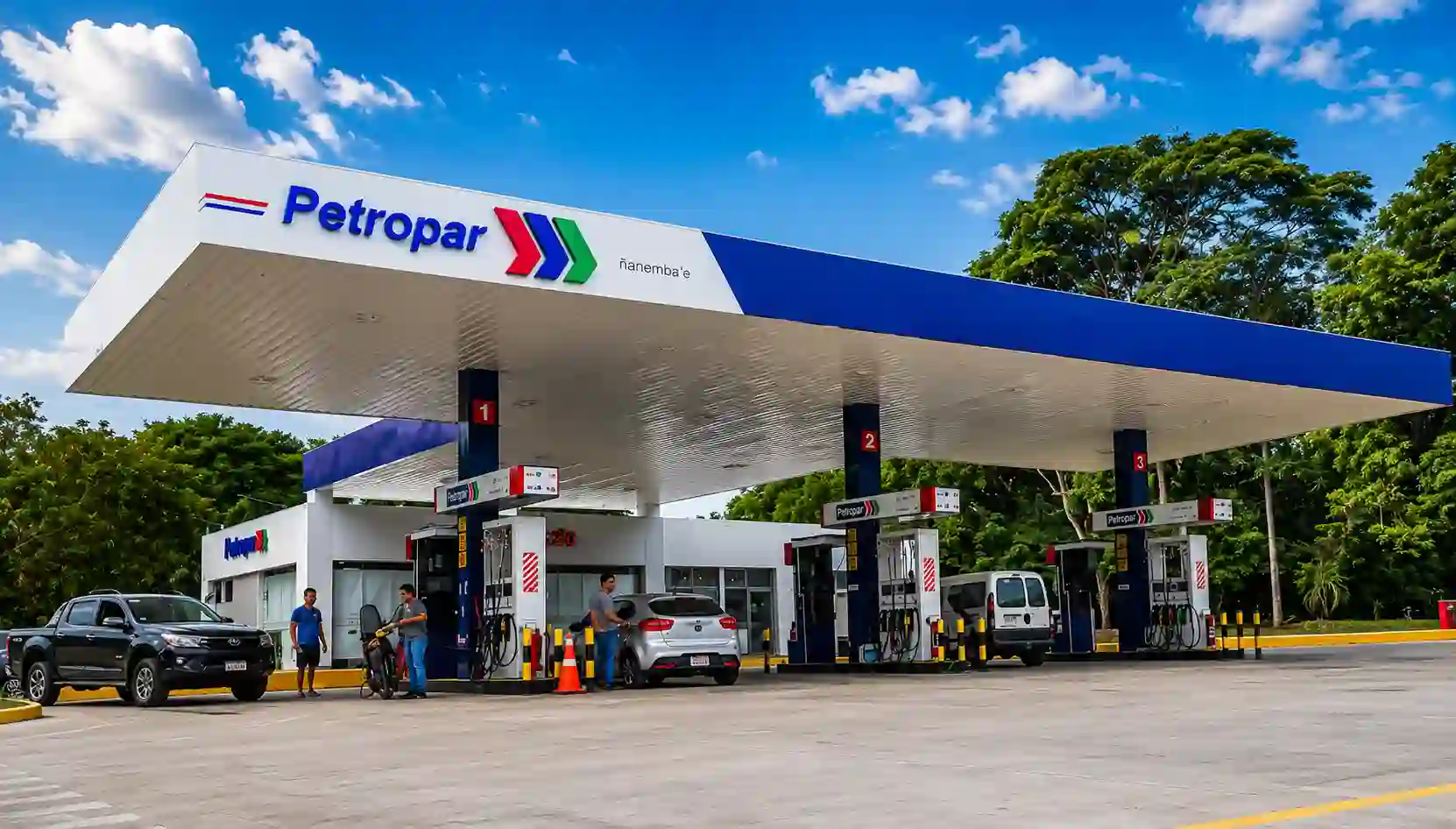
Petropar is the state company that reveals Paraguay’s liquid-fuel dependency — and its attempt to turn that dependency into a broader state distribution platform.
Paraguay is often described through hydroelectric strength, especially Itaipú and Yacyretá. Petropar shows the other side of the energy system: the country remains a landlocked net importer of hydrocarbons, dependent on imported fuels, storage assets, fluvial logistics, procurement processes, price decisions and biofuel blending.
On September 3, 2026, Petropar added a new layer by launching imported JET A1 and AVGAS under its own brand at five airport supply points. The move does not reduce import dependency, but it broadens the company’s role from road-fuel supply toward a wider state-backed fuel-distribution platform.
The company’s infrastructure pages list Villa Elisa’s nominal distillation unit and large tank farm, the Mauricio José Troche alcohol plant, Hernandarias storage capacity and Calera Cué on the Paraguay River. For current market analysis, however, Petropar is best read as an import, storage, blending, distribution and fuel-policy platform rather than as a domestic refining story.
For broader context, see Econosur’s Paraguay river economy, Paraguay’s role in Mercosur, Energy Infrastructure and South America Company Reports.
Core market reading:
Petropar is not just a fuel retailer. It is Paraguay’s state instrument for a strategic import system: hydrocarbons bought abroad, moved through river and land logistics, stored domestically, blended partly with biofuels and used through price and supply decisions. Its September 2026 entry into aviation fuel shows that this platform is expanding into additional distribution segments.
Why Petropar matters now
Petropar matters because it exposes one of Paraguay’s central energy contradictions. The country is structurally strong in electricity because of hydropower, but liquid fuels remain an import dependency. Trucks, buses, agricultural machinery, construction fleets, logistics companies and private vehicles still depend on diesel, gasoline, GLP and related fuel infrastructure.
That makes Petropar more than a state company. It is a strategic interface between global fuel markets and Paraguay’s domestic economy. When international prices move, when river freight is disrupted, when procurement fails, when the guaraní shifts, or when government wants to influence pump prices, Petropar becomes part of the policy mechanism.
The company is also a good Paraguay infrastructure case because its assets are spatially distributed: Villa Elisa near Asunción, Calera Cué on the Paraguay River, Hernandarias near Ciudad del Este and Mauricio José Troche in Guairá. This is a national distribution architecture for a landlocked fuel importer.
The latest operating signals reinforce that platform role. Petropar reported a 20.8 percent share of Paraguay’s national fuel market in June 2026, citing official Ministry of Industry and Commerce data. That was lower than the 29 percent share reported for April, showing that Petropar’s market share is a moving competitive indicator rather than a fixed structural number.
On September 3, 2026, the company launched JET A1 and AVGAS under the Petropar brand at five airport supply points. Both products are imported. The expansion therefore does not change Paraguay’s hydrocarbon dependency; it extends Petropar’s procurement and distribution infrastructure into aviation.
Paraguay has abundant electricity, but not liquid-fuel autonomy.
Petropar is the company case that makes this visible: state ownership, import procurement, storage, river logistics, ethanol blending, retail pricing and strategic supply management.
Company profile: from refinery concession to state fuel company
Petropar’s historical background reaches back to the fuel-distribution role of ESSO and Shell in Paraguay in the 1950s and to the development of a domestic refinery project in the 1960s. Petropar’s historical page describes the concession granted to Bolivian Oil Company and the later creation of REPSA, Refinería Paraguaya S.A., after the 1966 start of the country’s first oil refinery.
In 1981, Petróleos Paraguayos was created as a mixed-economy entity with 60 percent state participation and 40 percent REPSA participation. In 1985, the government acquired the private shares and the Paraguayan state became Petropar’s sole owner. The company then became an autarchic entity with legal personality and its own assets.
The company’s legal and historical documents define functions that go beyond retail fuel sales: industrialization of petroleum and derivatives, commercialization, transport and distribution of hydrocarbons and derivatives, and prospecting and exploitation of petroleum deposits.
Import dependency: the core analytical point
The most important market point is Petropar’s own statement that Paraguay is a landlocked net importer of hydrocarbons. That sentence should frame the company insight. Paraguay’s fuel system is not primarily an upstream story, nor a refining story. It is an import, logistics, storage, blending and distribution story.
Petropar says the hydrocarbons it supplies come from wholesale purchases abroad and that its fuels require complex logistics, purchase procedures, transport and service coordination before reaching tanks. That operational description is the key to the company’s role in Paraguay’s economy.
Nominal refinery capacity should therefore be treated carefully. Petropar’s Villa Elisa page lists an atmospheric distillation and naphtha-stabilization unit with nominal capacity of 7,500 Bbl/day, or 1,200 m³/day. But for current market analysis, the stronger and safer framing is import dependency: imported hydrocarbons, tank farms, river and road logistics, procurement and retail supply.
Publication note:
Do not describe Villa Elisa’s nominal 7,500 Bbl/day capacity as current domestic refining output without checking the latest energy-authority documentation. The article should frame Petropar as Paraguay’s import, storage, distribution and fuel-policy company.
Infrastructure: Villa Elisa, Calera Cué and Hernandarias
Petropar’s infrastructure is the physical map of Paraguay’s fuel dependency. Villa Elisa is the central historical and industrial site. Petropar lists a 64-hectare industrial plant on the left bank of the Paraguay River in Villa Elisa, 15 km from Asunción, and its infrastructure page lists 42 crude-oil and liquid-fuel tanks with nominal total capacity of 320,000 m³.
Calera Cué adds a clearer river-logistics signal. Petropar describes it as a reception, storage and dispatch plant in Asunción, located on the Paraguay River in the Ita Pytã Punta area. It has two diesel tanks, one of 10,400 m³ and another of 12,400 m³, plus a pier for barge reception and product unloading.
Hernandarias shows the eastern-distribution layer. The plant is located 22 km from the center of Ciudad del Este and has four tanks with nominal total capacity of 26,000 m³, truck-loading bays, truck-reception positions, offices, workshops, laboratory and warehouses.
| Asset layer | Petropar signal | Why it matters |
|---|---|---|
| Villa Elisa | Historical industrial site, tank farm and nominal distillation infrastructure near Asunción. | Central to Petropar’s legacy and storage/distribution role. |
| Calera Cué | Diesel storage and barge-reception infrastructure on the Paraguay River. | Directly connects Petropar to river logistics and imported-fuel flows. |
| Hernandarias | Storage and dispatch plant near Ciudad del Este with 26,000 m³ nominal capacity. | Supports eastern Paraguay and cross-border regional distribution geography. |
| Mauricio José Troche | Alcohol plant using sugarcane as feedstock for gasoline blending. | Links hydrocarbons policy to domestic agriculture and biofuel blending. |
| Retail network | Petropar reported 300 stations nationwide in May 2026. | Gives the state a visible role in pump prices and consumer-facing fuel supply. |
Biofuel layer: Mauricio José Troche
Petropar’s Mauricio José Troche plant gives the company a link to domestic agriculture. The plant produces alcohol from sugarcane, used in gasoline blends sold by Petropar under Paraguay’s legal framework for alcohol fuel and absolute alcohol consumption.
Petropar states that the plant’s infrastructure dates from the 1970s and that it has been operated by Petropar since 1989. The asset is not merely historical: on August 13, 2026, Petropar reported that after 82 days of the 2026 harvest the plant had processed 197,023 tonnes of sugarcane and produced 10,397,914 liters of alcohol.
The modernization story is less settled. Petropar has pursued a new milling line for Troche, but the process has also involved contractual and procurement problems. In March 2026, after protests by sugarcane producers, Petropar committed to complete the 2026 harvest, purchase the crop of registered producers and continue efforts to install a new milling plant for the September 2026 harvest while proceeding with the termination of the earlier EISA contract.
This makes Troche both an operating biofuel asset and an execution case. Biofuel is the domestic counterweight inside Paraguay’s fuel-import model, but increasing output depends on industrial modernization, procurement discipline and the relationship with local sugarcane producers.
The regulatory layer has also moved. Paraguay’s Ministry of Industry and Commerce issued new liquid-fuel specifications in January 2026 and revised the mandatory biofuel blend for Gasoil Tipo III again in July 2026. Petropar therefore operates inside a broader state blending policy that connects imported petroleum products with domestically produced alcohol and other regulated biofuels.
Petropar is where Paraguay’s hydrocarbon import dependency meets domestic sugarcane, river logistics and state price policy.
Price and market role
Petropar’s station network gives the company a political and market role that goes beyond infrastructure. In May 2026, Petropar reported 82,945,024 liters sold in April, equal to 29 percent of the national market, and 300 stations nationwide. By June, Petropar said its market share had moved to 20.8 percent, citing official Ministry of Industry and Commerce data, while remaining in first place.
The price path in July and August shows the limits of state pricing. Petropar cut Diésel Porã from G. 8,200 to G. 7,990 per liter in July, but the price in force from August 17 rose to G. 8,290 per liter. The company therefore has room to use price decisions as a consumer-facing policy signal, but it cannot detach domestic pump prices from international product costs, exchange rates and replacement costs.
For market analysis, Petropar is best understood as a state price-and-supply instrument operating inside a competitive imported-fuel market. Its public role matters, but the underlying economics remain exposed to the same external costs that shape private distributors.
Petropar combines import procurement, storage infrastructure, fuel dispatch, retail presence and biofuel blending.
Fuel imports expose Petropar to tender processes, global price movements, exchange rates, river freight and political pressure.
Nominal refinery infrastructure should not be confused with current domestic refining output without energy-authority verification.
Aviation fuel: a new distribution layer in 2026
Petropar entered Paraguay’s aviation-fuel market on September 3, 2026 with JET A1 and AVGAS under its own brand. According to the company, both products are imported and the first stage covers five airport supply points.
The significance is not domestic production. It is platform extension. Petropar is applying its state-backed procurement, quality-control, storage and distribution logic to an additional fuel segment linked to national and international connectivity.
Petropar’s strategic role is broadening. The company is still built around Paraguay’s dependence on imported liquid fuels, but the move into JET A1 and AVGAS shows an attempt to use the same procurement and distribution platform in additional markets.
The relevant question is therefore no longer only how Petropar buffers Paraguay’s import dependency, but how far the state company can extend that infrastructure into commercially viable new segments. Aviation fuel strengthens the platform logic, while the June market-share decline and the August pump-price increase show that scale and state ownership do not remove competitive or external-cost pressure.
E&P mandate: strategic ambition without production autonomy
Petropar also has an upstream mandate. The company states that in November 2014 it was designated by the Executive Branch as the company responsible for carrying out, on behalf of the Paraguayan state, prospecting, exploration and exploitation of hydrocarbons in blocks assigned to it.
The same page notes that Petropar is not positioned as a permit holder or concessionaire in the normal private sense, but as the Paraguayan state’s oil-operations company when the state decides to use it for E&P. It also states that, because exploration costs and risks are high, Petropar decided to execute such activities through specialized international companies.
Analytically, this is a long-term strategic layer rather than a present solution to import dependency. The important point is that Paraguay has tried to give Petropar a broader hydrocarbon-chain role, while the country’s current fuel reality remains import-based.
Risk map: imports, procurement, waterway and politics
The first risk is import exposure. Since Petropar itself frames Paraguay as a net importer of hydrocarbons, global prices, exchange rates, shipping, barge availability and supplier contracts directly affect the company’s operating environment.
The second risk is procurement. Petropar’s import function depends on tenders, contracts, delivery schedules and public-sector controls. Fuel procurement can become politically sensitive because it affects transport costs, agricultural costs and household budgets.
The third risk is infrastructure and interpretation. Villa Elisa’s nominal distillation capacity is part of Petropar’s history and infrastructure, but the market case should not be built on a domestic refining assumption without current operational confirmation. Petropar’s live importance is stronger as import, storage, river-logistics and retail-price infrastructure.
The fourth risk is execution. Troche’s 2026 production proves that the alcohol plant is operating, but the new milling-line process also shows how procurement disputes, contract termination and producer politics can delay modernization. Petropar’s expansion into aviation fuel creates another execution test: the company must turn new airport supply points into reliable commercial operations without confusing wider distribution reach with greater fuel autonomy.
| Risk layer | What it means for Petropar | Why it matters for market analysis |
|---|---|---|
| Import dependency | Hydrocarbons are bought abroad and moved into a landlocked market. | Petropar is exposed to global price, supplier, freight and exchange-rate conditions. |
| River logistics | Calera Cué and the Paraguay River show how fluvial access matters for fuel movement. | Low water, barge constraints or port delays can affect supply-chain resilience. |
| Public procurement | Fuel purchases and freight require public-sector tendering and oversight. | Procurement failures can become economic and political events. |
| Price politics | Station prices are consumer-facing and politically visible. | Petropar can function as a price-signal or relief instrument for government. |
| Infrastructure status | Nominal refining capacity needs current operational verification. | Analysts should avoid overstating domestic refining autonomy. |
| Troche modernization | The alcohol plant is operating, but the new milling-line process has faced procurement and contract execution problems. | Biofuel output depends on industrial execution as well as agricultural feedstock. |
| Commercial expansion | JET A1 and AVGAS extend Petropar into airport fuel supply. | New segments broaden the platform but create additional operational and commercial requirements. |
Supplier-market signal
Petropar is also useful as a supplier-market signal. A company of this type creates demand around fuel storage, tank maintenance, pumps, metering systems, terminal automation, truck loading, barge unloading, environmental controls, fire safety, laboratory equipment, cybersecurity, fleet systems, procurement platforms and retail-station infrastructure.
The Mauricio José Troche alcohol plant adds another supplier layer: sugarcane logistics, milling equipment, boilers, distillery systems, effluent treatment, automation and industrial modernization. The 2026 harvest confirms active production, while the new milling-line process keeps plant modernization and procurement execution on the supplier agenda.
Aviation fuel adds airport-storage, hydrant or mobile-refuelling systems, quality assurance, filtration, metering, safety systems and aviation-specific operating procedures to the potential supplier map.
For international firms evaluating Paraguay, Petropar is a practical case of how fuel-market infrastructure works in a landlocked country: imported hydrocarbons, fluvial reception, tank farms, inland dispatch, state pricing, public procurement and biofuel blending.
Why this company case matters for Paraguay
Petropar matters because it prevents a simplified reading of Paraguay as an energy-rich country. Paraguay is rich in electricity generation, but liquid fuels remain an import challenge. That difference matters for agriculture, logistics, buses, trucking, consumer prices, public budgets and inflation pressure.
The company also connects energy to river infrastructure. Paraguay’s fuel supply is not only a question of suppliers and prices. It is also a question of barges, terminals, tanks, trucks, storage buffers, procurement calendars and distribution geography.
For Econosur’s wider Paraguay coverage, Petropar connects directly to the river economy, Mercosur logistics, energy infrastructure, public-sector companies, state-market interaction and the strategic vulnerabilities of a landlocked economy.
Petropar is Paraguay’s liquid-fuel dependency in company form: imports, river logistics, storage, biofuel blending and state price policy.
Company primary sources. Petropar’s official historical, legal, operational, infrastructure, E&P, pricing and news pages are used for company history, assets, operating figures, product launches and management statements.
- Petropar — Funcionamiento — Paraguay as a landlocked net importer of hydrocarbons and Petropar’s import-logistics role.
- Petropar — Villa Elisa — nominal distillation infrastructure and 320,000 m³ tank capacity.
- Petropar — Mauricio José Troche — alcohol production, sugarcane feedstock and modernization rationale.
- Petropar — Zafra 2026 — 197,023 tonnes of sugarcane processed and 10,397,914 liters of alcohol after 82 operating days.
- Petropar — June 2026 market share — 20.8 percent national market share, citing MIC data.
- Petropar — Current fuel prices — Diésel Porã at G. 8,290 per liter from August 17, 2026.
- Petropar — Aviation fuel launch — JET A1 and AVGAS at five airport supply points from September 3, 2026.
- Petropar — Troche producer agreement — 2026 harvest commitments, new milling-line process and EISA contract termination.
Government and regulatory primary sources. The Ministry of Industry and Commerce is used to verify the structure of Paraguay’s fuel market and the current regulatory framework rather than relying only on Petropar’s own interpretation.
- MIC — Fuel Market Observatory — official framework for import volumes, supplier shares, fuel sales, origin prices and service-station data.
- MIC — Fuel and biofuel legal framework — 2026 fuel specifications and resolutions governing mandatory biofuel blending.
Secondary sources. No secondary source is required for the core factual updates in this revision; the main operational and regulatory claims are supported by Petropar and MIC primary material.
Econosur interpretation. The analytical conclusion is Econosur’s: Petropar is best understood as a state-backed import and distribution platform whose role is broadening into additional fuel segments, while remaining exposed to world-market costs, logistics constraints, procurement execution and domestic price politics.
Petropar raises practical questions for fuel suppliers, logistics firms, terminal-equipment providers, biofuel suppliers, public-procurement advisers, risk analysts and companies exposed to Paraguay’s fuel-cost structure.
- How exposed is Paraguay’s fuel supply to river logistics, barge freight and imported product availability?
- How much price-setting influence does Petropar have through its retail network?
- What infrastructure upgrades are needed in storage, dispatch, safety and terminal automation?
- How does ethanol blending link fuel policy to sugarcane production and domestic agriculture?
- What does Petropar’s E&P mandate mean in a country still dependent on imported hydrocarbons?
- How should analysts treat Villa Elisa’s nominal refinery capacity versus current fuel-import reality?
- Which private suppliers can serve Petropar’s terminal, biofuel, logistics, safety and compliance needs?
From fuel imports to market structure
Petropar is not only a state fuel company. It is a company-level view of Paraguay’s liquid-fuel dependency: imported hydrocarbons, river terminals, tank farms, ethanol blending, retail stations, state pricing and procurement exposure.
Econosur prepares custom market analysis for companies, analysts and institutions evaluating Paraguay, fuel imports, river logistics, energy infrastructure, public-sector companies, supplier markets and Southern Cone energy risk.
Explore custom market analysisFAQ
What is Petropar?
Petropar, or Petróleos Paraguayos, is Paraguay’s state-owned hydrocarbons and fuel company. It is an autarchic state entity with roles in fuel imports, storage, distribution, biofuels and energy infrastructure.
Why does Petropar matter for Paraguay market analysis?
Petropar matters because Paraguay is a net importer of hydrocarbons. The company sits at the intersection of fuel import dependency, state pricing policy, storage infrastructure, river logistics and biofuel blending.
How is Petropar linked to river logistics?
Petropar operates fuel storage and dispatch infrastructure linked to the Paraguay River, including Calera Cué in Asunción and the Villa Elisa complex near Asunción.
Does Paraguay produce its own hydrocarbons?
Petropar itself states that Paraguay is a landlocked net importer of hydrocarbons and that hydrocarbons come from wholesale purchases abroad.
What is the key analytical point about Petropar?
The key analytical point is that Paraguay can be a major hydroelectricity producer while remaining structurally dependent on imported liquid fuels. Petropar is the state company at that junction.
Why did Petropar enter aviation fuel in 2026?
Petropar launched imported JET A1 and AVGAS under its own brand on September 3, 2026, initially through five airport supply points. The move broadens the company’s distribution role but does not reduce Paraguay’s dependence on imported liquid fuels.