
Uruguay · Pharmaceuticals · Manufacturing · R&D · Regional Distribution
Megalabs: How Uruguay Became a Regional Pharmaceutical Platform
Megalabs uses Uruguay for more than drug production. Its Parque de las Ciencias campus combines manufacturing, regional R&D, quality control and corporate functions, while Uruguay’s free-zone and logistics system connects the group to larger Latin American markets.
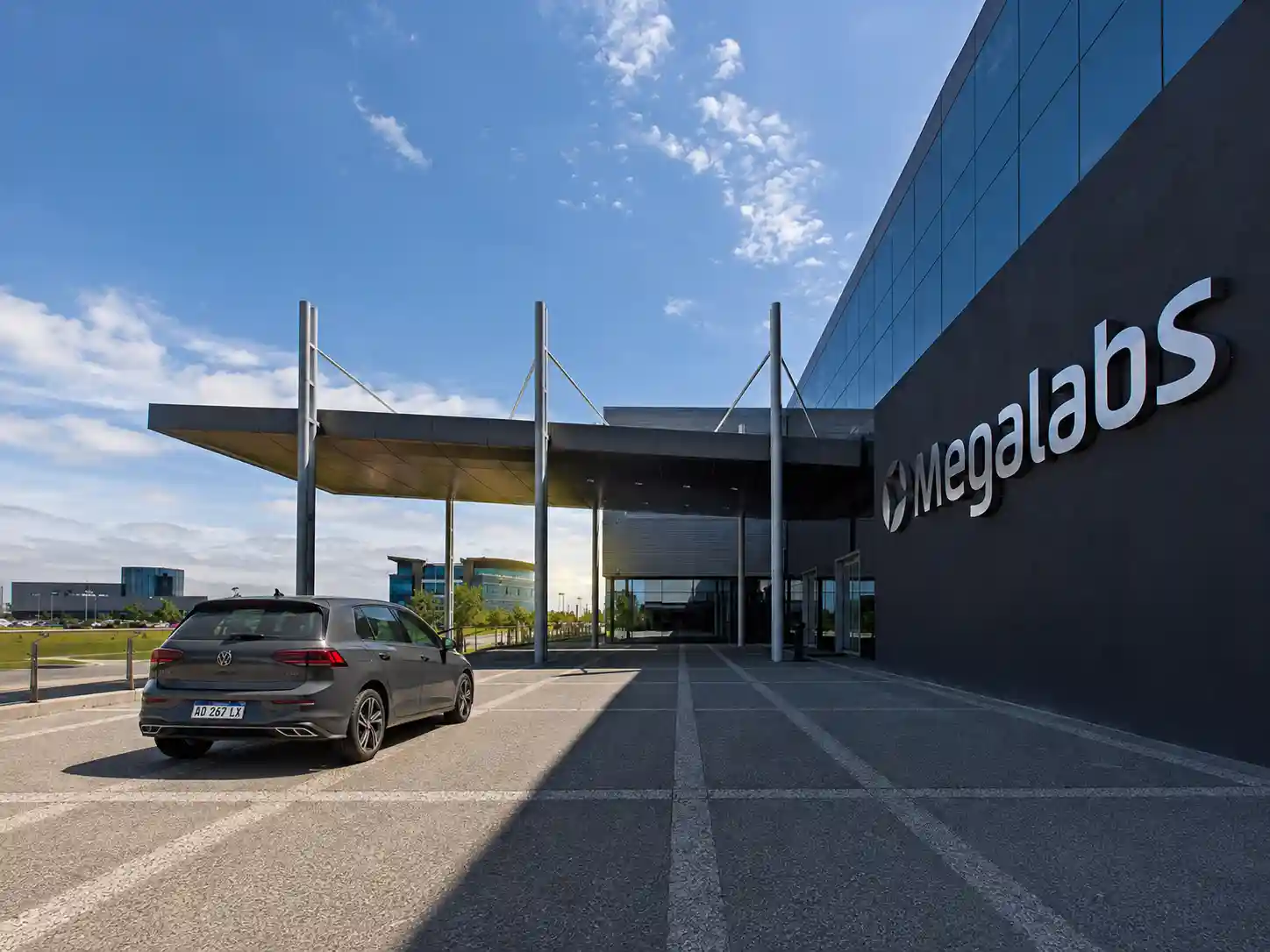
Megalabs shows why Uruguay can matter to pharmaceutical companies even though its domestic medicines market is small.
Uruguay XXI describes Megalabs as a regional pharmaceutical group with 17 manufacturing plants and 7 R&D centres in Latin America. Its Uruguay complex in the Parque de las Ciencias free zone combines a pharmaceutical plant, regional development centre, quality-control laboratory and corporate centre serving operations across Latin America.
Uruguay therefore functions as a multi-layer platform: manufacturing + R&D + quality + corporate functions + regional logistics. That model is reinforced by a national pharmaceutical transit system that handled US$969 million in pharmaceutical flows in 2025, largely connecting global production centres with bigger destination markets such as Argentina and Brazil.
Megalabs is consequently less a story about selling medicines to 3.5 million Uruguayans than about using Uruguay as infrastructure for a much larger Latin American business.
The strategic value of Megalabs in Uruguay comes from combining several functions in one jurisdiction. Manufacturing alone would make Uruguay a production location. Manufacturing plus regional R&D, corporate services, local acquisitions and cross-border distribution makes it a regional operating platform.
Why Put a Regional Pharmaceutical Platform in Uruguay?
Uruguay is not the largest pharmaceutical demand market in the Southern Cone. Argentina and Brazil are far larger. Its attraction lies in a different combination: institutional stability, free-zone structures, export logistics, regional service functions and the ability to centralize operations that serve several countries.
Uruguay XXI explicitly describes the country as a location for regional headquarters, shared-service functions, trade, procurement, supply-chain management and pharmaceutical distribution. In pharmaceuticals, these functions often coexist with manufacturing and R&D rather than operating as isolated back-office services.
Megalabs is one of the clearest examples. The group’s Uruguay operation links a physical manufacturing asset to development, quality control and corporate functions for Latin America.
Parque de las Ciencias Is the Core Asset
Megalabs’ Uruguay campus is located in Parque de las Ciencias in Canelones. The company’s own current infrastructure page describes a 22,000 m² production plant, a regional development centre, quality-control activities and a corporate centre.
Uruguay XXI describes the same complex as including a pharmaceutical plant, a development centre carrying out R&D projects for the entire region, a quality-control laboratory and a corporate centre handling administrative, financial and technological functions linked to Megalabs’ Latin American operations.
That combination is the central analytical point. The value chain does not stop when a medicine leaves the production line. Development, regulatory support, quality systems, finance, technology and regional coordination sit around the factory and make the site more important to the group than a standalone plant would be.
A large pharmaceutical production plant serving regional markets from Uruguay.
Regional development projects and quality-control capability embedded in the campus.
Administrative, financial and technology functions tied to Latin American operations.
The Uruguay Bet Was a US$110 Million Industrial Investment
Uruguay’s Presidency documented the inauguration of the Mega Labs pharmaceutical plant in Parque de las Ciencias in 2016. The government reported an investment of US$110 million and around 350 jobs associated with the facility.
This matters because Megalabs’ Uruguay role was not created as a light commercial office. The platform rests on a substantial industrial asset that was designed from the outset to support regional expansion.
The company today describes the Uruguay plant as approximately 22,000 m², while Uruguay XXI materials have elsewhere used a slightly larger facility figure. Econosur does not treat the difference as a contradiction because the sources may measure different parts of the campus or built area. The analysis therefore uses the company’s 22,000 m² figure only as a company-reported current facility measure.
Uruguay Sits Inside a 17-Plant Latin American Network
Uruguay XXI’s 2026 life-sciences report and Megalabs’ current structure describe the group as operating 17 manufacturing plants and 7 R&D centres in Latin America.
Megalabs’ corporate website states that it is present in around 20 countries. The exact network count varies across public materials: CEO Gianclaudio Broggi described 18 plants and 12 R&D centres in a November 2025 interview. Econosur uses the 17/7 figures because they are aligned between the current company infrastructure material and Uruguay XXI’s 2026 report.
The difference between network counts is treated as an unresolved reporting difference, not silently harmonized. It may reflect timing, acquisition integration or different definitions of R&D facilities. The published analysis therefore uses the current 17-plant / 7-centre figure and does not infer why the interview count was higher.
Megalabs Also Consolidated Uruguay’s Local Pharma Base
Uruguay XXI identifies Celsius, Spefar, Iclos and Haymann as Uruguayan laboratories acquired by Megalabs. These companies develop and manufacture products for the domestic and regional markets.
The acquisitions give the Uruguay story a second dimension. Megalabs did not simply establish one greenfield campus and export from it. The group also incorporated local pharmaceutical capabilities into its broader regional structure.
Iclos is particularly relevant because it adds specialized oncology, immunosuppressive and biotechnology-related development capabilities. Megalabs describes Iclos as a high-technology unit within the group.
Megalabs also states that Iclos manufactures mycophenolate mofetil for Europe under an EMA-related approval. Econosur has not identified a direct EMA, EU Community Register or EudraGMDP record sufficient to independently verify that specific claim. It is therefore not used as a factual pillar of this analysis.
IDB Invest Financed the Next Regional Expansion Stage
IDB Invest approved long-term financing for Mega Pharma Holding Uruguay S.A. and related Megalabs companies. The facility provides a loan of up to US$70 million with a ten-year tenor.
The financing covers 14 investment projects across eight countries: Argentina, Bolivia, Chile, Colombia, Ecuador, Peru, Dominican Republic and Uruguay. The program includes expansion of existing pharmaceutical plants, new or upgraded antibiotic capacity, distribution and logistics infrastructure, machinery, equipment and improvements linked to Good Manufacturing and Good Laboratory Practices.
The financing therefore reinforces the role of Uruguay at the holding and regional coordination level. The money is not a US$70 million investment in the Uruguay plant alone; it supports a multi-country expansion program anchored through a Uruguay holding structure.
| Platform layer | Evidence | Commercial meaning |
|---|---|---|
| Uruguay manufacturing | Parque de las Ciencias pharmaceutical plant | Physical production base for regional supply |
| Regional R&D | Development centre and 7-centre regional network | Product development and adaptation across markets |
| Corporate functions | Administrative, financial and technology functions in Uruguay | Regional coordination beyond manufacturing |
| Local consolidation | Celsius, Spefar, Iclos and Haymann | Integration of Uruguayan capabilities into the group |
| Regional investment | IDB Invest financing for 14 projects in 8 countries | Uruguay-linked holding structure supporting multi-country growth |
US$969 Million in Pharma Transit Explains the Logistics Advantage
The strongest evidence that Uruguay functions as a regional pharmaceutical platform comes from trade flows beyond Megalabs itself.
Uruguay XXI reported US$969 million in pharmaceutical transit flows through Uruguay in 2025. The goods originated mainly in Europe and the United States and were destined primarily for larger Latin American markets, especially Argentina and Brazil.
These transit flows are not Uruguay’s pharmaceutical exports. They are goods moving through the country as part of regional supply chains. The distinction is essential.
Uruguay XXI separately reported about US$255 million in human-use pharmaceutical exports in 2025, with approximately 40 active manufacturers and 32 exporting companies. It also reported that 93% of those exports were concentrated in five companies.
For Megalabs, the broader logistics system matters because a company can centralize inventory, supply-chain management and regional functions in Uruguay while selling into much larger neighboring markets.
“Uruguay’s pharmaceutical value is larger than its domestic medicine demand because the country functions as a production, service and logistics node for larger regional markets.”
The Strüngmann Ownership Link Is Relevant — but Must Be Attributed
Megalabs is privately held. In a November 2025 interview, CEO and chairman Gianclaudio Broggi stated that the Strüngmann family acquired 100% of Megalabs in 2018.
The Strüngmann family is widely known in the pharmaceutical industry for its healthcare investments and its role as an early major investor in BioNTech. The relationship is relevant because it places Megalabs inside a much broader healthcare-investment context.
Econosur does not infer any operational relationship between BioNTech and Megalabs from common investor ownership. Nor does this analysis present a detailed current shareholder structure, because a current public corporate filing with a complete Megalabs cap table has not been identified.
The correct formulation is therefore: according to Megalabs CEO Gianclaudio Broggi, the Strüngmann family acquired 100% of Megalabs in 2018.
What the Evidence Does — and Does Not — Prove
Megalabs’ Uruguay platform is unusually well documented, but several boundaries remain important.
- 17 plants / 7 R&D centres: current group/network reporting; not a plant-by-plant production audit.
- US$110 million: historical investment associated with the 2016 Uruguay plant inauguration; not current replacement value.
- US$969 million transit: total pharmaceutical goods moving through Uruguay in 2025; not Megalabs revenue or exports.
- US$255 million human-pharma exports: Uruguay-wide sector exports, not Megalabs exports.
- Strüngmann ownership: attributed to CEO Broggi’s 2025 statement; no current public cap-table filing was identified.
- Iclos / Europe: the specific mycophenolate-mofetil EMA-related claim remains company-reported and is not used as a verified regulatory anchor.
- ISO 13485:2016: applies to the defined artificial-tears manufacturing, packaging and conditioning scope at the Uruguay plant; it is not a blanket certification of all pharmaceutical manufacturing activities.
The Econosur Reading
Megalabs gives Uruguay a different role in the Mercosur pharmaceutical system from Argentina, Brazil or Paraguay. Uruguay does not need to reproduce Brazil’s scale or Argentina’s biologics ecosystem to be economically relevant.
Its role is to combine a stable regional operating base with physical production, development, quality systems, corporate coordination and logistics. Megalabs then connects that base to a much larger network of plants, subsidiaries and demand markets.
This is why Megalabs fits directly into Econosur’s Mercosur Pharma Futures analysis. Regional pharmaceutical integration can develop without a single integrated regulatory market if companies build operational structures that bridge national markets themselves.
The cost is complexity. Manufacturing, registrations, distribution rights and regulatory requirements still remain country-specific. The platform works because the company manages that fragmentation across a regional network rather than because Mercosur has removed it.
“Megalabs shows how a small country can capture pharmaceutical value through functions that sit around the market itself: production, development, coordination and regional supply.”
This analysis prioritizes Uruguay XXI, the Uruguayan Presidency and IDB Invest for market structure, historical investment and financing. Megalabs sources are used for current facility descriptions, organization and certification scope. Ownership is attributed to CEO Gianclaudio Broggi’s public statement.
- Uruguay XXI — Business Case Ciencias de la Vida 2026
- Presidencia de Uruguay — Mega Labs plant investment and employment at inauguration
- IDB Invest — Megalabs regional investment program
- Megalabs — Uruguay campus, manufacturing and R&D infrastructure
- Megalabs — corporate offices, production plant and development centre in Uruguay
- Megalabs — regional presence and Uruguay campus
- Megalabs — ISO 13485:2016 scope at Parque de las Ciencias
- Megalabs — current executive committee
- PharmaBoardroom — Gianclaudio Broggi interview on ownership and regional scale, November 2025
Uruguay Pharmaceutical and Regional Platform Analysis
Econosur prepares custom analysis for companies evaluating pharmaceutical production, regional headquarters, distribution models, investment structures, local partners and market-entry conditions in Uruguay and South America.
Analysis can map manufacturing assets, ownership, logistics structures, regulatory exposure, free-zone operations, regional distribution and potential partners.
Explore custom market analysisFrequently Asked Questions
What is Megalabs’ role in Uruguay?
Megalabs uses its Parque de las Ciencias campus in Uruguay for pharmaceutical manufacturing, regional R&D, quality control and corporate functions serving its Latin American operations.
How large is Megalabs’ Latin American industrial network?
Uruguay XXI and Megalabs currently describe a network of 17 manufacturing plants and 7 R&D centres in Latin America. A 2025 CEO interview cited higher counts, so Econosur uses the current figures shared by the company infrastructure material and Uruguay XXI.
How much did Megalabs invest in its Uruguay plant?
Uruguay’s Presidency reported a US$110 million investment associated with the pharmaceutical plant inaugurated at Parque de las Ciencias in 2016, along with around 350 jobs.
Why is Uruguay relevant for pharmaceutical distribution?
Uruguay XXI reported US$969 million in pharmaceutical transit flows through Uruguay in 2025. These goods originated mainly in Europe and the United States and moved toward larger Latin American markets, particularly Argentina and Brazil.
Who owns Megalabs?
CEO Gianclaudio Broggi stated in November 2025 that the Strüngmann family acquired 100% of Megalabs in 2018. Econosur attributes the ownership claim to that statement because a current public cap-table filing has not been identified.
Which Uruguayan laboratories has Megalabs acquired?
Uruguay XXI identifies Celsius, Spefar, Iclos and Haymann as local laboratories acquired by Megalabs.