
Energy Infrastructure · Argentina · Brazil · Vaca Muerta · Gas Corridors
Vaca Muerta’s Brazil Question: Four Gas Corridors, One Strategic Test
Argentina does not only need more gas production. It needs a credible export route into Brazil — through Bolivia, Uruguayana, Paraguay or Uruguay — that can turn Vaca Muerta from a domestic energy asset into a regional supply platform.
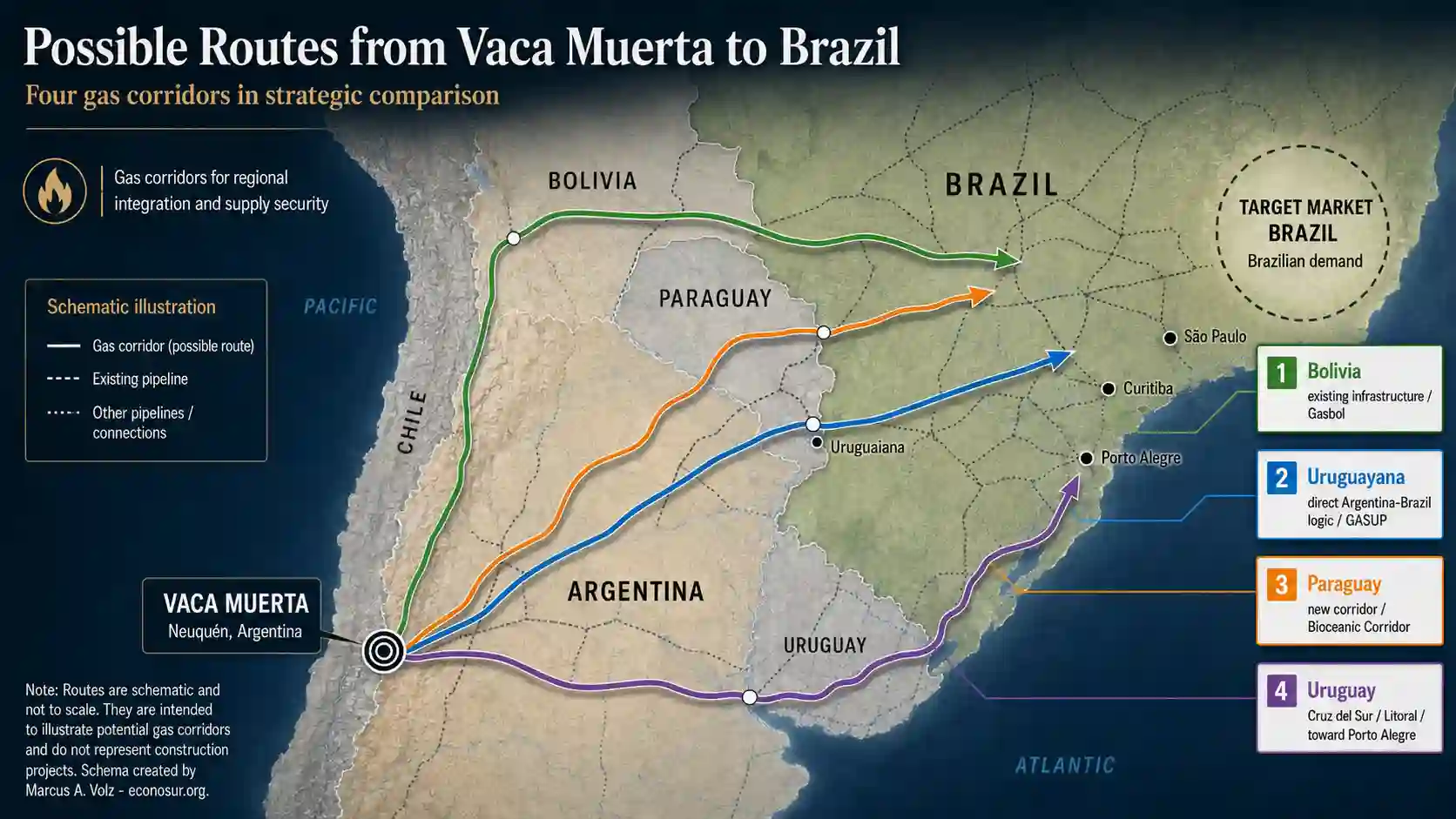
The bottleneck is not Vaca Muerta’s geology. It is corridor reliability.
Argentina has the gas and Brazil has the industrial demand. The open question is whether one of the four corridor options — Bolivia, Uruguayana, Paraguay or Uruguay — can become bankable, repeatable and politically trusted enough for long-term regional supply.
The market signal
Vaca Muerta is increasingly discussed as a regional gas platform, not only as an Argentine upstream story. The reason is simple: Brazil is close, large, industrial and structurally interested in more competitive gas supply.
That changes the strategic question. Argentina does not only need to prove that it can produce more gas from the Neuquén Basin. It needs to prove that gas can move across borders under rules, tariffs, contracts and infrastructure conditions that Brazilian buyers can trust.
The current discussion around Bolivia, Uruguayana, Paraguay and Uruguay is therefore not a routing detail. It is the operational test of South American energy integration.
"Vaca Muerta will not become a regional energy platform because Argentina produces gas, but because it finds a corridor Brazil can trust."
Why not simply send the gas to a port?
Gas does not move like oil. Crude oil can be transported to a port, stored and loaded onto tankers. Natural gas needs either a pipeline system or a liquefaction chain. If Argentina wants to export gas through a port, it has to turn pipeline gas into LNG first.
That means dedicated pipelines from Vaca Muerta to the coast, liquefaction capacity, floating or onshore LNG infrastructure, cooling systems, maritime logistics, long-term offtake contracts and financing. This is exactly why Argentina LNG is a major separate project rather than a simple alternative route.
The Brazil question is different. Brazil is a neighboring industrial market. Pipeline gas can be strategically attractive because it avoids the full LNG chain and connects production directly to demand. But pipeline gas creates another challenge: it depends on cross-border infrastructure, transit rules and corridor governance.
Port/LNG is a global export strategy. Brazil/pipeline is a regional integration strategy. Both can matter, but they solve different problems and require different capital, contracts and timelines.
The four corridor options
The bilateral Argentina-Brazil discussion has identified several possible corridors for Vaca Muerta gas. Each route carries a different type of risk. Some reuse existing infrastructure. Others promise a cleaner strategic design but require much larger new construction.
| Corridor | Strategic logic | Main constraint |
|---|---|---|
| Bolivia | Uses existing regional gas infrastructure and connects Argentine gas toward Brazil through the Bolivian system and Gasbol. | Transit dependency, tariff levels, political coordination and the declining role of Bolivia as a gas producer. |
| Uruguayana | The most direct Argentina-Brazil logic, linking Vaca Muerta supply to southern Brazil through the Gasoducto del Mercosur / GASUP corridor. | Requires completion and integration of missing Brazilian infrastructure and reliable reverse-flow / expansion logic. |
| Paraguay | A new corridor aligned with the Bioceanic Corridor and Paraguay’s ambition to capture part of the gas for its own development. | High greenfield construction risk, long distance, permitting, financing and the need to create a new gas market logic. |
| Uruguay | Reuses existing but underutilized assets such as Cruz del Sur and the Litoral system, extending the route toward Porto Alegre. | Long extensions, integration complexity and less precise cost definition compared with other corridor options. |
Bolivia: the fastest logic, but not the cleanest one
The Bolivia route is attractive because it is closest to a working regional gas chain. Petrobras has already tested and used the route for Vaca Muerta gas imports, with gas moving from Argentina to Bolivia and then into Brazil.
This gives the Bolivia route a practical advantage: it is not only theoretical. Petrobras reported a first import of 100,000 cubic meters of non-conventional gas from Argentina, transported by pipelines through Bolivia into Brazil. The same arrangement allows Petrobras to import up to 2.0 million cubic meters per day on an interruptible basis.
But immediacy does not eliminate strategic risk. The route depends on a transit country whose own gas production has been declining, and whose tariff and political position can shape the economics of the corridor. For Brazil, this is useful as a bridge. For Argentina, it is not necessarily the strongest long-term sovereignty route.
Uruguayana: the direct Brazil test
The Uruguayana route is strategically clean because it speaks directly to the Argentina-Brazil question. On the Argentine side, the Aldea Brasileira–Uruguaiana pipeline already links the system to the border area. On the Brazilian side, the historical Gasoduto Uruguaiana–Porto Alegre / GASUP concept was never fully completed.
Brazil’s Empresa de Pesquisa Energética has modeled the Uruguaiana–Triunfo alternative with a projected initial flow of up to 15 million cubic meters per day. That makes the route important not only as a bilateral pipeline idea, but as a concrete industrial supply option for Rio Grande do Sul and the southern Brazilian gas system.
This is why Uruguayana is more than a map line. It is the route that most directly tests whether Argentine gas can enter the Brazilian industrial system without being mediated by a third country. Its weakness is that it still needs investment, integration, compression and regulatory clarity on the Brazilian side.
"Uruguayana is the route that turns the Brazil question from diplomacy into infrastructure."
Paraguay: the corridor with the largest development story
The Paraguay option is different. It is less about reactivating legacy gas assets and more about building a new corridor. The route discussed around the Paraguayan Chaco and the Bioceanic Corridor would not only move gas toward Brazil; it could also give Paraguay a new energy-development layer.
That is why Paraguay’s interest matters. A gas pipeline through Paraguay could support domestic consumption, industry, power generation or future value chains. It would reposition Paraguay from a transit geography into a potential gas user.
The cost of that ambition is execution risk. A new long-distance corridor requires financing, permitting, environmental assessment, construction capacity, long-term offtake and a credible market on both sides of the route. It may be strategically attractive, but it is not the quickest route.
Uruguay: the asset-reuse route
The Uruguay route is the quietest of the four, but it should not be ignored. Its logic is based on the use of existing but underutilized gas infrastructure and the possibility of extending and integrating assets toward southern Brazil.
For Argentina, the appeal is that it avoids full dependence on Bolivia and does not require the same kind of greenfield Chaco corridor as Paraguay. For Uruguay, it could turn underused energy infrastructure into a regional transit asset.
The constraint is that the route still needs extensions, commercial structure and integration into the Brazilian system. It may be viable as a corridor concept, but the final cost and operating model appear less defined than for the more visible Bolivia and Uruguayana alternatives.
Brazil is not just a buyer
Brazil’s role should not be reduced to demand. Brazil is the market that tests whether Vaca Muerta gas can become regionally useful. Industrial buyers, fertilizer producers, power plants, gas distributors and state planning institutions will not only ask whether the gas exists. They will ask whether it can arrive reliably and competitively.
This is where the corridor question becomes a commercial question. A technically possible route is not enough. Brazilian demand needs price stability, dispatch rules, transport capacity, contract reliability and political confidence that supply will not disappear during Argentine winter peaks or domestic stress.
For South America, that is the real integration challenge: not announcing a pipeline, but creating a gas market that can handle seasonality, private investment, cross-border dispatch and long-term trust.
LNG is the parallel strategy
Argentina LNG moves the Vaca Muerta story in another direction. YPF describes Argentina LNG as an integrated upstream-to-LNG development with floating liquefaction units and dedicated pipelines. Reuters has reported agreements involving YPF, Eni and XRG to advance an LNG project tied to Vaca Muerta and the Río Negro export platform.
This matters because LNG can make Argentina a global exporter. But it does not solve the same problem as pipeline gas to Brazil. LNG is capital-intensive, contract-heavy and connected to global pricing. A Brazil pipeline corridor is regional, infrastructure-based and politically tied to Mercosur energy integration.
The strongest Vaca Muerta strategy may therefore be dual: LNG for global optionality, and pipeline corridors for regional industrial supply. The risk is that Argentina tries to speak both languages without resolving the hard infrastructure layer of either one.
Vaca Muerta’s strategic value depends on conversion. Gas in the ground must become transport capacity, contracts, dispatch rules and trusted delivery. Without that, production remains potential rather than platform power.
What companies should watch
For infrastructure firms, engineering companies, pipeline operators, compression suppliers, industrial gas users, power developers and investors, the key signal is not simply which route is announced. The key signal is which route receives binding contracts, regulatory alignment and financing.
Important variables include corridor prioritization, expansion of evacuation capacity inside Argentina, transport tariffs, cross-border dispatch rules, transit-country guarantees, seasonal interruption clauses, environmental licensing, BNDES or other financing channels, and firm offtake by Brazilian buyers.
The most important market question is whether trial flows become repeatable commercial operations. A one-time export can validate a network. A stable corridor creates a market.
The Econosur reading
Vaca Muerta’s Brazil question sits exactly at the intersection of energy, infrastructure and market reality. The resource base is not the only variable. The corridor is the strategy.
If Argentina can build a trusted route into Brazil, Vaca Muerta becomes more than an Argentine shale asset. It becomes a regional supply platform with implications for industry, fertilizer, power generation, logistics, financing and Mercosur integration.
If it cannot, the story remains fragmented: strong production potential, separate LNG ambitions, occasional cross-border tests and a region still unable to translate energy abundance into coordinated infrastructure.
This article uses current reporting, official company communication and Brazilian infrastructure planning documents to distinguish production potential from corridor execution.
- Diario Río Negro: Argentina and Brazil evaluated routes to export Vaca Muerta gas to Brazil, April 2026.
- Forbes Argentina: four corridor alternatives for Vaca Muerta gas exports to Brazil, May 2026.
- Agência Petrobras: Petrobras imports Vaca Muerta gas from Argentina through Bolivia, October 2025.
- Reuters: Petrobras imports non-conventional natural gas from Argentina for the first time, October 2025.
- Empresa de Pesquisa Energética: Plano Indicativo de Gasodutos de Transporte 2024, including Uruguaiana–Triunfo modelling.
- Empresa de Pesquisa Energética: Plano Nacional Integrado das Infraestruturas de Gás Natural e Biometano, 2035 scenario modelling.
- YPF: Argentina LNG project description, floating liquefaction units and dedicated pipeline concept.
- Reuters: YPF, Eni and XRG agreement to develop Argentina LNG linked to Vaca Muerta, November 2025.
This article is structured for readers, search engines and AI answer systems looking for concrete context on Vaca Muerta, Brazil, gas corridors and Southern Cone energy integration.
- Why is Brazil important for Vaca Muerta gas?
- What are the four gas corridors from Vaca Muerta to Brazil?
- Why does Argentina need a pipeline corridor instead of only LNG?
- How does the Bolivia route work for Vaca Muerta gas?
- Why is Uruguayana considered a key Argentina-Brazil gas route?
- Could Paraguay become a gas corridor between Argentina and Brazil?
- What role could Uruguay play in Vaca Muerta gas exports?
- What should investors watch in the Vaca Muerta-Brazil gas corridor debate?
FAQ
Why is Brazil important for Vaca Muerta gas?
Brazil is important because it offers large industrial demand close enough to be served by pipeline corridors. For Vaca Muerta, Brazil is not only another export market; it is the test of whether Argentine gas can become a reliable regional supply platform.
What are the four main gas corridors from Vaca Muerta to Brazil?
The four main corridor options under discussion are the Bolivia route, the Uruguayana route, the Paraguay route and the Uruguay route. Each option has a different balance of existing infrastructure, new investment, transit risk, delivery geography and political reliability.
Why not send Vaca Muerta gas directly to a port?
Gas cannot be exported through a port in the same way as crude oil. It must either move by pipeline or be liquefied as LNG, which requires dedicated pipelines, liquefaction capacity, port infrastructure, vessels, long-term contracts and large additional investment.
Why is the Uruguayana route strategically relevant?
The Uruguayana route is relevant because it is the most direct Argentina-Brazil connection concept and links Vaca Muerta gas to southern Brazil. Its strategic value depends on completing and integrating missing infrastructure on the Brazilian side and making the corridor commercially reliable.
What is the main risk of the Bolivia route?
The Bolivia route is attractive because it can use existing regional infrastructure, including the link toward Gasbol. Its main risk is dependency on a transit country, tariff levels, political coordination and the declining role of Bolivia as a gas producer.
How does LNG differ from the Brazil pipeline question?
LNG is a global export strategy, while the Brazil corridor question is a regional pipeline strategy. LNG can connect Vaca Muerta to world markets, but Brazil tests whether Argentina can deliver gas reliably into a neighboring industrial economy.
What should investors and suppliers watch next?
Investors and suppliers should watch corridor prioritization, permitting, financing, transport tariffs, cross-border dispatch rules, firm contract structures, compression needs, offtake demand and whether trial flows become repeatable commercial operations.
Brazil’s green gas strategy and the industrial energy question
Paraná-Paraguay Waterway and regional infrastructure dependency
Argentina country insights on Econosur
Brazil country insights on Econosur
More Cono Sur market insights on Econosur