
Brazil Insight · Equatorial Margin · Amapá · Offshore Oil & Gas · Supply Chain
Brazil’s Equatorial Margin: Where Will the Offshore Supply Chain Be Built?
Petrobras’ Morpho discovery has moved the Foz do Amazonas debate beyond geology. The next commercial question is whether Amapá can support the ports, marine logistics, supplier capacity, emergency response and operating infrastructure required by a sustained offshore exploration program, while commercial field development remains unconfirmed.
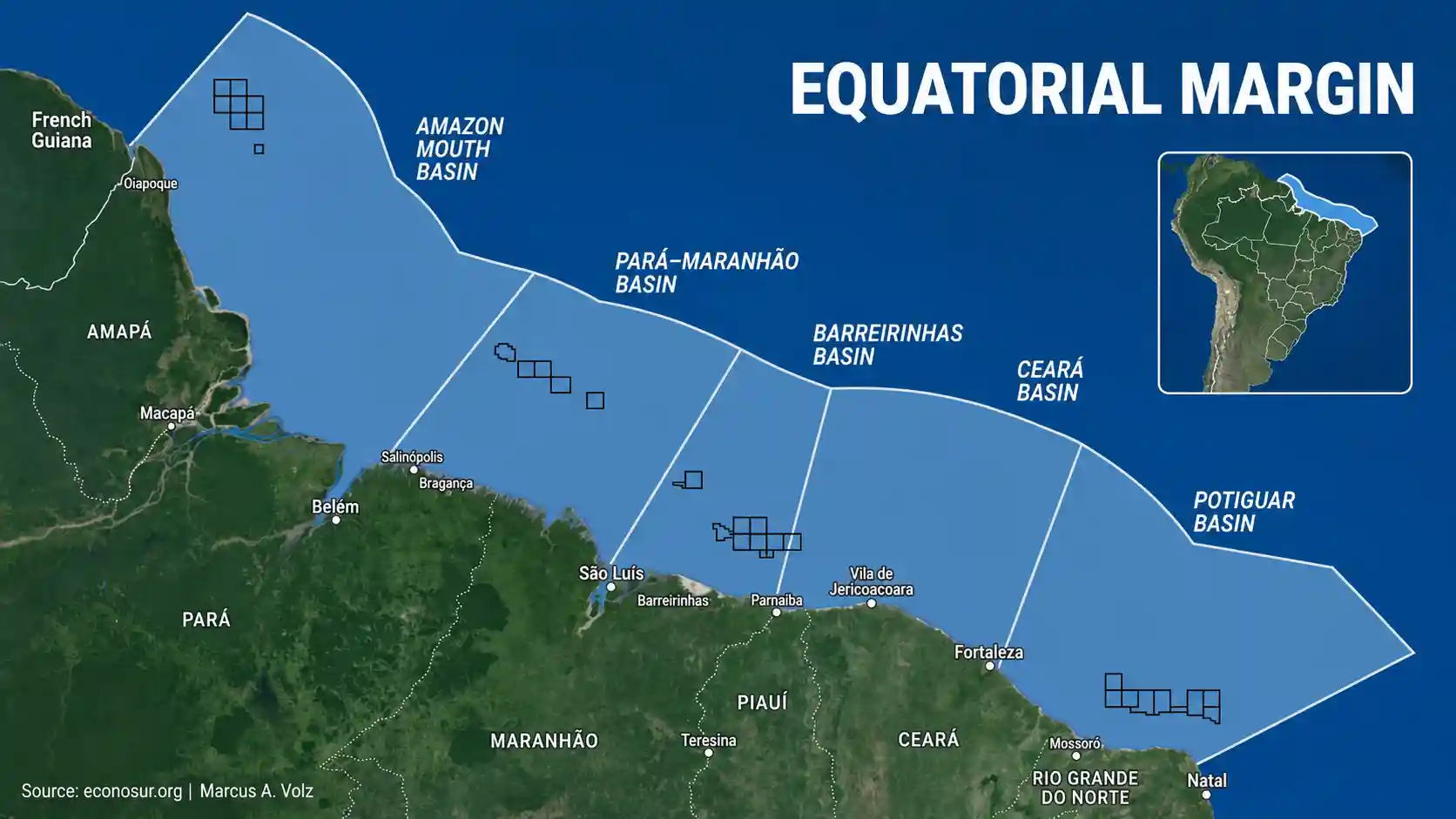
Brazil’s Equatorial Margin is still an exploration story—but it is already becoming a supply-chain and infrastructure story.
On August 14, 2026, Petrobras confirmed hydrocarbons in the Morpho exploration well in block FZA-M-59, about 175 km off Amapá in 2,886 meters of water. The company has not yet established the commercial size of the discovery. That distinction matters: Morpho is evidence of a working petroleum system, not yet a sanctioned field-development project.
At the same time, Petrobras’ 2026–2030 plan provides US$2.5 billion for the Equatorial Margin and 15 new wells. Transpetro has studied a possible logistics center, Santana and Calçoene have emerged publicly as candidate locations, and offshore-service companies are already assessing regional infrastructure. The commercial question is therefore no longer only whether oil exists. It is where the operating system around that oil would be built if exploration success continues.
For wider context, see Econosur’s Petrobras company analysis, oil and gas sector page, energy infrastructure coverage, Brazil market profile and South America’s Strategic Resource Advantage in a Fragmenting World Economy.
No commercial-field conclusion has displaced the core caution: Morpho is still an exploration discovery.
The most important change since the original August publication is regulatory. On September 3, IBAMA amended Operating License No. 1684 to include three contingent wells in FZA-M-59 — Manga, Crotalus and Morpho Extensão. Petrobras said it would plan the continuation of the campaign, complete Morpho and then move to the additional wells. This removes the immediate licensing uncertainty around those three wells, but it does not establish commercial reserves, a development concept or a production decision.
Exploration interest is also widening beyond the current well. On September 8, SLB and Shearwater launched the Amapá 3D multi-client seismic survey offshore the state, explicitly linking the project to increased exploration interest following Morpho. That is a basin-level market signal rather than proof of future production, but it strengthens the case for tracking supplier demand beyond a single Petrobras well.
The institutional operating system is also being reinforced. On August 20, Petrobras and the Brazilian Navy signed a cooperation protocol covering offshore logistics, maritime monitoring and protection, emergency response, search and rescue and explicit support for Equatorial Margin activities.
Amapá’s onshore infrastructure remains an active constraint rather than a solved problem. After bridge works and partial restrictions in late August and early September, DNIT issued a further notice on September 18 for partial traffic restrictions at km 212 of the BR-156/AP-Sul bridge over the Vila Nova River from September 21 to October 5. These are maintenance works, not evidence of systemic failure, but they reinforce the point that offshore logistics depends on land-side reliability as well as port capacity.
The acreage story remains long term. ANP continues to classify the 36 Foz do Amazonas blocks indicated in June as areas under evaluation for possible future Permanent Offer cycles; they are not part of the sixth concession cycle whose public offer session is scheduled for October 7, 2026.
Core market reading:
The near-term opportunity is not a guaranteed production boom. It is a staged build-out of exploration logistics, environmental response, marine support and supplier readiness around a frontier where commerciality remains unconfirmed. Suppliers need to distinguish between activity that exists now, capacity being prepared and demand that would only emerge after appraisal and development decisions.
Why the commercial question changed in August 2026
For years, Brazil’s Equatorial Margin was discussed mainly through two lenses: geological potential and environmental licensing. Morpho adds a third. Once hydrocarbons are confirmed in an active deepwater well, companies begin asking practical operating questions: how many wells follow, which ports can support them, where crews and equipment are based, how emergency response is organized, and which supplier categories need proximity to the basin.
Petrobras itself gives the scale of that transition. Its current plan calls for US$2.5 billion of investment and 15 new wells across the Equatorial Margin through 2030. That does not mean 15 development projects. It means a multi-year exploration program capable of creating recurring demand for drilling support, vessels, logistics, environmental services, technical equipment and shore-base capacity before any final investment decision on production.
This distinction is important for international suppliers. The Equatorial Margin should not yet be approached as another mature Santos Basin. It is a frontier where procurement, logistics geography and project sequencing are still being formed. That creates uncertainty, but it also means supplier positioning can be influenced before every operating pattern is locked in.
The strategic question is no longer only “Is there oil?” It is “Which parts of Brazil’s existing offshore system can be extended north—and which capabilities would have to be built locally?”
Morpho: a discovery signal, not yet a commercial field
Petrobras identified hydrocarbons in Morpho, formally 1-BRSA-1405-APS, in block FZA-M-59 in the Foz do Amazonas Basin. The company owns 100% of the block. As of September 19, 2026, public information still does not establish recoverable volumes or commerciality. The relevant change is that the exploration sequence has advanced: IBAMA has authorized three contingent wells in the same block.
That uncertainty should remain explicit in any market reading. A hydrocarbon-bearing interval can justify additional appraisal and exploration, but a commercial development requires much more: reservoir definition, recoverable volumes, well productivity, development concept, economics, environmental licensing, contracting and capital approval.
Morpho is already shaping the next exploration sequence. On September 3, IBAMA amended Operating License No. 1684 to include three contingent wells in FZA-M-59: Manga, Crotalus and Morpho Extensão. Petrobras subsequently said it would plan the continuation of the campaign, complete the Morpho well and then proceed to the additional wells. The change is commercially relevant because the immediate question is no longer whether those three wells can receive environmental authorization, but when they will be drilled and what they reveal about reservoir size, continuity and commerciality. For suppliers, that is a meaningful difference between a one-well campaign and a potentially sustained operating program.
Petrobras also states that infrastructure created for the FZA-M-59 campaign can support further Equatorial Margin activity. This includes environmental-response infrastructure associated with the campaign, including wildlife-response centers in Belém and Oiapoque. Petrobras is also pursuing environmental licensing for additional blocks including FZA-M-57, FZA-M-86, FZA-M-88, FZA-M-125 and FZA-M-127.
Research implication:
This matters because part of the operating system is becoming reusable across projects. The commercial question is therefore not only which services are required by Morpho, but which logistics, response, environmental and support capabilities could become shared regional infrastructure for repeated exploration campaigns.
Morpho has confirmed the presence of hydrocarbons, three contingent wells in FZA-M-59 are now environmentally authorized, and Petrobras’ five-year plan provides a wider drilling program across the Equatorial Margin.
Transpetro studies and market discussions point to Amapá, with Santana and Calçoene among the locations publicly discussed. A final long-term production-base decision has not been established.
Commercial reserves, production capacity, field-development design, project sanction and a production start date remain unresolved.
The real supply-chain question: extend Brazil’s offshore system or build a northern cluster?
Brazil already has a sophisticated offshore supply chain. Deepwater engineering, subsea equipment, flexible-pipe installation, offshore vessels, FPSO integration, inspection, maintenance and marine services are concentrated around established oil-and-gas centers in the Southeast and selected northeastern locations.
Amapá changes the geography. Morpho lies thousands of kilometers from the operational center of Brazil’s pre-salt system. Some high-value equipment can be mobilized nationally, but many operational functions become more sensitive to distance: vessel turnaround, fuel and consumables, warehousing, emergency response, waste handling, crew changes, maintenance, customs, heavy cargo and spare-parts availability.
The commercial issue is therefore not whether every supplier needs an Amapá office. It is which activities are economically and operationally difficult to serve from existing hubs. Marine-support vessels, shore-base logistics and emergency-response functions may require local or regional presence earlier than specialized engineering or equipment manufacturing.
Brazil’s offshore supplier system is also being pulled in the opposite direction. While the Equatorial Margin could create new exploration and development demand in the north, mature assets farther south are moving into retirement. That is creating a parallel offshore decommissioning supply chain around well abandonment, subsea recovery, marine services, ports, shipyards, dismantling and recycling. For suppliers, the important distinction is that frontier exploration and asset retirement rely on overlapping offshore capabilities, but they do not create the same procurement packages or buyer structures.
Santana, Calçoene or Oiapoque: where could the operating base emerge?
Oiapoque is already important to the exploration phase because of its proximity to offshore Amapá operations and Petrobras’ environmental-response infrastructure. But proximity alone does not make it the obvious long-term supply-base location. Reuters reported that environmental reserves and Indigenous lands around Oiapoque constrain the space available for a large logistics center.
Calçoene offers a different proposition. It is closer to other offshore blocks and has more room for greenfield development, but it begins with a much smaller urban and industrial base. A major offshore role would therefore require significant investment in access, utilities, accommodation, services, workforce and cargo-handling infrastructure.
Santana has the strongest existing logistics argument. It is part of the Macapá metropolitan area and already has port infrastructure. A municipal CDSA post published on May 30, 2025 reported a Bram Offshore technical visit focused specifically on port infrastructure and the feasibility of future offshore operations in Amapá. The municipal page itself is internally inconsistent on the exact visit date, so this analysis does not assign a precise date to the visit. The evidence nevertheless shows that an established offshore-support operator has evaluated Santana in practical terms.
| Location | Potential strength | Constraint | Commercial question |
|---|---|---|---|
| Oiapoque | Closest current onshore support point to Morpho operations and existing exploration-response infrastructure. | Limited space for a major industrial logistics complex and environmental/land-use constraints. | Can it remain an exploration support point without becoming the long-term production base? |
| Calçoene | Closer to several offshore blocks and more room for new infrastructure. | Small local economic base and major infrastructure requirements. | Would greenfield proximity outweigh the cost of building a new logistics cluster? |
| Santana | Existing port and metropolitan services near Macapá; already attracting offshore-industry interest. | Longer distance to northern offshore blocks and dependence on road and port upgrades for larger-scale operations. | Can existing infrastructure be expanded faster and more economically than a new northern base? |
Infrastructure is the constraint that turns geology into economics
The strongest case for treating the Equatorial Margin as an infrastructure story is the transport system behind the ports. Amapá has no road connection to the rest of Brazil, making maritime and air access structurally more important. Within the state, the BR-156 corridor connects Santana and Macapá with northern municipalities, but paving works are still incomplete.
DNIT continued paving and maintenance work on BR-156 through 2025 and 2026. Its January 2026 review reported more than R$185 million invested in Amapá federal roads during 2025 and a further 2026 programme intended to keep multiple paving fronts active. Operational reliability is still incomplete: DNIT imposed partial restrictions near Oiapoque between late August and September 12 for bridge revitalization and additional restrictions on the southern trunk from September 11–18 for corrective bridge maintenance.
These restrictions are not evidence that the road is unusable. They are evidence that land-side reliability remains a live logistics variable. For offshore operations, the question is whether heavy, time-sensitive and high-value cargo can move predictably between ports, airports, storage areas and northern support points under year-round conditions.
Offshore frontier economics are already expensive before onshore inefficiencies are added. Poder360 reported that the Morpho drilling operation was costing around US$1 million per day and had accumulated approximately US$300 million after roughly 300 days. That figure is not a full field-development cost, but it demonstrates why minimizing logistics delays and operational downtime matters.
Petrobras’ August cooperation protocol with the Brazilian Navy adds another layer to the operating-system question. The stated cooperation areas include offshore logistics, maritime monitoring and protection, emergency response, search and rescue and support for Equatorial Margin activity. For suppliers, this reinforces the importance of safety, response capability and marine coordination alongside conventional drilling and port services.
The winning logistics location will not necessarily be the closest point on a map.
The decision will depend on total operating economics: port depth and berth capacity, vessel turnaround, road reliability, heavy-cargo capability, environmental requirements, workforce, available land, fuel supply, warehousing, emergency response and the cost of integrating the base with Petrobras’ wider Brazilian offshore system.
Which supplier categories could move first?
If the Equatorial Margin remains in exploration and appraisal, the earliest commercial demand is likely to stay concentrated in services that support wells rather than production systems. That means the supplier opportunity should be read in phases.
| Phase | Likely demand categories | What remains uncertain |
|---|---|---|
| Exploration now | Drilling support, offshore vessels, marine logistics, environmental monitoring, emergency response, crew logistics, aviation, fuel, consumables and technical services. | Duration of campaigns, exact procurement packages, incumbent suppliers and local sourcing requirements. |
| Appraisal / pre-development | Reservoir services, well testing, engineering studies, subsea surveys, metocean, geotechnical work, concept engineering, port planning and expanded logistics. | Whether Morpho and adjacent prospects justify development and what field concept would be selected. |
| Development | Subsea systems, flexible pipes, installation vessels, FPSO-related packages, production equipment, inspection, maintenance, major logistics and long-term shore-base services. | Commercial reserves, project sanction, production design, local-content structure and contracting schedule. |
Brazil’s existing supplier system provides a useful benchmark. DOF and TechnipFMC, for example, operate a long-established Brazilian PLSV structure serving Petrobras. That illustrates the scale and specialization already present in the country. Amapá does not need to reproduce every part of that ecosystem, but it would need to connect reliably to it.
For international suppliers, the most important question is therefore not simply whether they sell equipment used offshore. It is whether their product or service sits in a category where Petrobras and its prime contractors need additional capacity, local support, faster response, specialized technology or a new logistics solution.
The first strategic asset in a frontier basin is the operating system around exploration.
Morpho does not yet justify a production-cluster narrative. It does justify a closer look at the capabilities that become reusable if drilling continues: offshore logistics, emergency response, environmental services, aviation, warehousing, marine support, inspection, port handling and time-critical maintenance.
The localization question should therefore be capability-specific. High-value engineering and manufactured equipment can continue to come from established Brazilian hubs, while response-time-sensitive services may need an Amapá or northern-Brazil presence much earlier.
This is the offshore version of South America’s Strategic Resource Advantage in a Fragmenting World Economy: resource potential becomes strategically valuable when infrastructure, logistics, regulation, suppliers and operating capability can convert geology into reliable activity.
The supplier market could become wider than Petrobras
Petrobras is the immediate anchor, but the Foz do Amazonas Basin is not a single-company story. In the fifth cycle of Brazil’s Permanent Offer concession process, ANP reported 19 contracted blocks in the Foz do Amazonas Basin. In those 19 Foz do Amazonas blocks specifically, the contracted groups are Chevron with CNPC and Petrobras with ExxonMobil. That widens the long-term supplier question beyond a single Petrobras exploration campaign.
The acreage pipeline is wider still. In June 2026, ANP approved the indication of 36 additional Foz do Amazonas blocks for evaluation for possible future Permanent Offer concession cycles. These blocks are not yet offered acreage and remain outside the sixth cycle whose public offer session is scheduled for October 7, 2026. Their significance here is strategic rather than immediate: they show that the potential northern offshore market is being assessed at basin scale, not only around the current Petrobras campaign.
A separate market signal arrived on September 8, when SLB and Shearwater launched the Amapá 3D multi-client seismic survey. The companies described the survey as a response to growing exploration interest following Morpho. Multi-client seismic does not imply that the surveyed acreage will become producing fields, but it is evidence that commercial exploration-data investment is expanding around offshore Amapá.
That matters because infrastructure economics improve when a port, service base or supplier cluster can support multiple operators. A logistics investment built around one exploration campaign is difficult to justify. A basin with several active exploration programs has a stronger case for shared marine services, warehousing, maintenance, emergency response and specialist contractors.
There is still a long distance between contracted acreage and producing fields. But the presence of multiple operators changes the strategic question from “What does Petrobras need?” to “Could northern Brazil become a multi-operator offshore service market?”
At the national level, this would sit alongside another growing offshore market: decommissioning of mature Brazilian assets. Together, the two cycles show why Brazil’s offshore supplier market cannot be read only through new production projects. Exploration, operations, maintenance and decommissioning create different but connected demand across the same broader industrial ecosystem.
What to watch next:
The most commercially relevant signals will be completion and interpretation of Morpho, execution and results of the three newly authorized contingent wells, licensing progress on additional blocks, a clearer logistics-base decision, port and BR-156 investment, supplier mobilization into Amapá, and evidence that procurement is shifting from one-off exploration support toward repeatable regional capacity.
Three business questions that require deeper research
Public sources establish exploration activity, announced investment and broad logistics constraints. They do not provide the project-level commercial detail required to decide where a supplier should allocate commercial resources. Three questions matter most.
Which offshore supplier and contractor categories would need a physical presence in Amapá, and which can continue serving the Equatorial Margin from established Brazilian hubs?
Answering this requires mapping response-time requirements, vessel and port dependencies, warehousing, maintenance, crew logistics, emergency response, cargo flows, incumbent suppliers and the cost of serving northern operations from Rio de Janeiro, Espírito Santo, the Northeast or other existing bases.
Which location offers the strongest commercial case for a long-term offshore logistics base: Santana, Calçoene, Oiapoque or another northern Brazilian port?
The answer depends on more than distance to the wells. Research must compare port capacity, land availability, road access, heavy-cargo handling, workforce, utilities, environmental constraints, expansion costs, vessel turnaround and access to the broader Brazilian supplier network.
When do Equatorial Margin opportunities become commercially actionable for international equipment and service suppliers, and what qualification barriers must they clear?
This requires tracking Petrobras and contractor procurement, vendor-registration requirements, tender packages, technical standards, local-content expectations, contracting models, incumbent relationships and the point at which appraisal activity converts into development-related demand.
Where Published Information Stops
Public sources show the direction of the Equatorial Margin program, but not the full commercial map.
Petrobras disclosures establish Morpho’s exploration status, the US$2.5 billion five-year investment frame and the planned drilling program. September reporting confirms that IBAMA has expanded the FZA-M-59 operating licence to three contingent wells. SLB and Shearwater provide a separate primary-source signal of new basin-level seismic investment. Reuters and local-government sources establish that logistics-base studies and port discussions are real, while DNIT documents current transport constraints.
They do not provide a complete supplier list, procurement calendar, vendor-qualification path, logistics cost model, port-capacity gap analysis, preferred long-term base, contractor shortlist, project-level local-content requirements or evidence that Morpho will become a commercial development.
Those gaps are where supplier interviews, procurement checks, infrastructure comparison, contractor mapping and project-status verification become necessary.
Research Services for Brazil’s Equatorial Margin and offshore supply chain
Econosur can structure custom research around a specific offshore project, supplier category, logistics location or procurement question. Supplier, competitor and procurement questions linked to the Equatorial Margin can also be researched and validated through ROG.e 2026 in Rio de Janeiro on September 21–24. Petrobras’ supplier portal states that its ROG.e presence includes a Supplier Space with sessions on supplier relations, procurement and technical and operational challenges.
Typical assignments include:
Research boundary
A discovery is not a reserve or a field-development decision. Morpho confirms hydrocarbons in FZA-M-59, while recoverable volumes, economics, development concept, production capacity and project sanction remain unresolved.
Exploration investment is not development capex. Petrobras’ US$2.5 billion and 15-well Equatorial Margin plan supports a multi-year exploration programme. It should not be presented as committed production infrastructure.
Port interest is not a final base decision. Santana, Calçoene and Oiapoque have different operating advantages, while no definitive long-term production logistics base has been publicly selected.
Future ANP acreage is not current awarded acreage. The 36 Foz do Amazonas blocks indicated in June 2026 remain under evaluation for possible future Permanent Offer cycles and are not part of the sixth concession cycle whose public offer session is scheduled for October 7, 2026.
Econosur interpretation: the commercially relevant near-term market is exploration support and reusable operating capability. Development-stage supplier demand should remain conditional on appraisal, licensing and project-sanction evidence.
Discovery status, exploration plans, licensing, acreage, road conditions and operator cooperation are anchored in company, regulator and government-primary sources where available.
- Petrobras — Morpho discovery, 14 August 2026: hydrocarbons in FZA-M-59, approximately 175 km offshore and 2,886 m water depth; drilling and exploratory evaluation continued.
- Petrobras — Equatorial Margin programme: US$2.5bn planned investment and 15 new wells under the 2026–2030 business plan.
- Petrobras — FZA-M-59 exploration licence, 20 October 2025: environmental licensing for exploratory drilling and the distinction between exploration and production.
- Petrobras — cooperation protocol with the Brazilian Navy, 21 August 2026: offshore logistics, maritime monitoring, emergency response, search and rescue and Equatorial Margin support.
- ANP — fifth Permanent Offer concession cycle, 5 December 2025: contracted Foz do Amazonas acreage and operator groups.
- ANP — future Equatorial Margin blocks, 26 June 2026: 36 Foz do Amazonas blocks indicated for evaluation for future cycles.
- ANP — sixth Permanent Offer cycle, 6 August 2026: October 7 auction structure; the 36 June Foz do Amazonas blocks are not part of this cycle.
- Prefeitura de Santana / CDSA — Bram Offshore technical visit: direct local evidence that an offshore-support operator assessed Port of Santana infrastructure.
- DNIT — Amapá road investment review, 20 January 2026: BR-156 construction and maintenance programme and 2026 works.
- DNIT — BR-156/Oiapoque bridge works, 31 August 2026: temporary traffic restrictions for bridge revitalization.
- DNIT — BR-156 southern-trunk maintenance, 10 September 2026: corrective bridge maintenance and partial traffic restrictions.
- DNIT — BR-156/Vila Nova bridge maintenance, 18 September 2026: partial traffic restrictions scheduled from September 21 to October 5 at km 212 of BR-156/AP-Sul.
- SLB / Shearwater — Amapá 3D multi-client seismic survey, 8 September 2026: primary-source confirmation of a new offshore Amapá seismic campaign launched after the Morpho discovery.
- Petrobras Supplier Channel — ROG.e 2026 and supplier events: Petrobras lists ROG.e 2026 for September 21–24 and a Supplier Space focused on supplier relations, procurement and technical and operational challenges.
Secondary reporting is used for logistics-base discussions, supplier interest, cost context and independent interpretation where operator or regulator disclosures do not provide the full commercial picture.
- Reuters — Amapá logistics-base study, 30 October 2025: Transpetro studies, Santana and Calçoene discussion and reported engagement with offshore-service companies.
- Reuters via Money Times — IBAMA authorization for three additional FZA-M-59 wells, 4 September 2026: confirms authorization for Manga, Crotalus and Morpho Extensão and the role of the wells in testing commercial viability.
- Broadcast / Estadão via UOL — Morpho drilling sequence, 8 September 2026: reported Petrobras’ plan to complete Morpho and subsequently move the FZA-M-59 campaign to the three contingent wells.
- Poder360 — Morpho commercial uncertainty and drilling-cost context, August 2026.
- Folha de S.Paulo — Petrobras management comments on follow-up wells and commercial uncertainty, 17 August 2026: historical context predating the September authorization of the three contingent wells.
- Folha de S.Paulo — Amapá road and logistics constraints, 17 August 2026.
- DOF — Brazilian PLSV contract extensions, 3 November 2025: benchmark for Brazil’s established offshore-service ecosystem.
- Evidence note: discovery, investment-plan, licensing, acreage and public-infrastructure claims are anchored in primary sources. Secondary sources are used for reported commercial discussions, supplier positioning, cost estimates and contextual interpretation.
Turn Equatorial Margin headlines into a supplier and infrastructure map
Public announcements show where Petrobras is drilling and how much it plans to invest. Custom research can test where supplier demand is actually forming, which ports and logistics locations are viable, how procurement and qualification work, and which project signals justify commercial attention.
Econosur researches suppliers, contractors, ports, logistics, procurement, competitors, infrastructure constraints and project status across Brazil and South America.
Discuss an Equatorial Margin research questionFAQ
What did Petrobras discover at the Morpho well?
Petrobras identified hydrocarbons in the Morpho exploration well in block FZA-M-59, around 175 km off the coast of Amapá in 2,886 meters of water. The well is part of the Foz do Amazonas Basin in Brazil’s Equatorial Margin.
Is Morpho already a commercial oil field?
No. Hydrocarbons have been confirmed, but commercial volumes, reservoir performance, development economics and a production concept still need to be established. Morpho should therefore be treated as an exploration discovery, not a sanctioned production project.
How much is Petrobras planning to invest in the Equatorial Margin?
Petrobras states that its 2026–2030 business plan provides US$2.5 billion for the region and 15 new wells over five years.
Where could a future offshore logistics base in Amapá be located?
Public reporting identifies Santana and Calçoene as likely candidates for a longer-term logistics center, while Oiapoque is supporting the exploration phase. No definitive long-term production-base location has been publicly established.
Which supplier categories could benefit if exploration advances?
Potential demand spans marine logistics, offshore vessels, drilling support, environmental and emergency-response services, inspection, maintenance, engineering, subsea support, warehousing, heavy cargo and other offshore operating services. The timing differs significantly between exploration, appraisal and field development.
Why is the Equatorial Margin strategically important before commercial reserves are proven?
A sustained frontier exploration programme can create reusable logistics, environmental-response, marine-support and port infrastructure before any field reaches development. Strategic value therefore begins with the operating system around exploration, while commercial production remains unconfirmed.
Which parts of the supply chain would need a local Amapá presence?
That is not established by public sources. It requires comparing response times, port and vessel requirements, logistics costs, maintenance needs, workforce, emergency-response obligations and the feasibility of serving operations from established Brazilian offshore hubs.
What should international suppliers verify before committing resources?
They should verify procurement timing, vendor qualification, contracting routes, technical standards, local-content expectations, incumbent suppliers, logistics requirements and whether exploration success is converting into repeatable appraisal or development demand.