
Energy Infrastructure · Argentina · Brazil · Vaca Muerta · Updated October 2, 2026
Vaca Muerta Gas to Brazil: Four Corridors and Their Real Status
Argentina and Brazil have evaluated routes through Bolivia, Paraguay, Uruguay and a direct connection through Uruguaiana. None has yet become a fully financed firm export corridor. The decisive question is what already operates, what is only indicative and what infrastructure is still missing inside Argentina and Brazil.
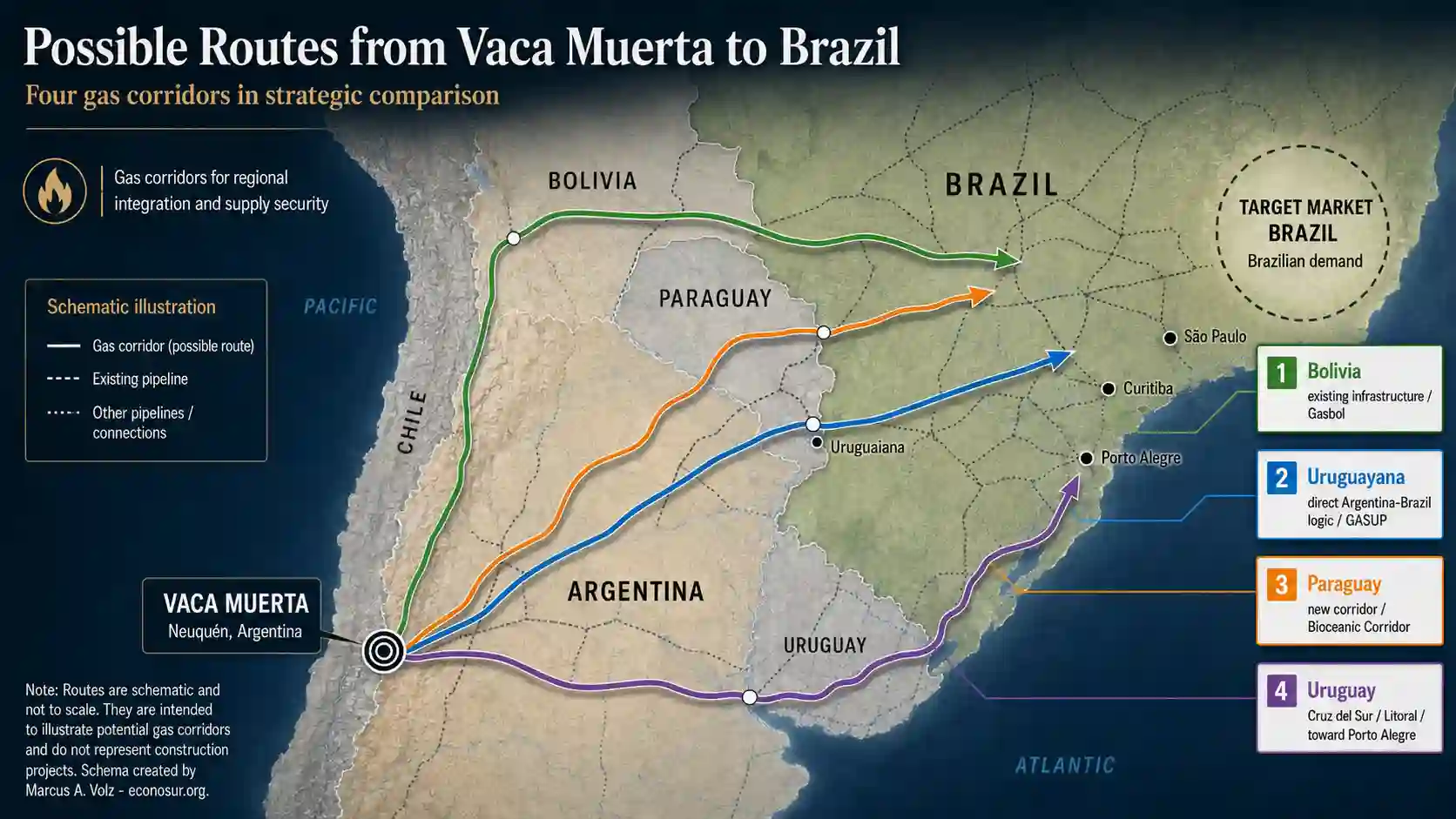
No Vaca Muerta–Brazil gas corridor has yet been selected and completed as a firm long-term export route.
The official April 2026 bilateral report evaluated routes through Bolivia, Paraguay, Uruguay and a direct connection. Bolivia is the only route already tested operationally, but the first Petrobras transaction was small and interruptible. The direct Uruguaiana route has the clearest bilateral logic, but the missing Uruguaiana–Triunfo infrastructure remains an indicative Brazilian project.
Every option also depends on more evacuation capacity inside Argentina. That layer is now moving on two tracks: TGS has begun construction of the Perito Moreno pipeline expansion, designed to add 14 million m³/day from Tratayén to Salliqueló by winter 2027, while TGN on September 17 presented the proposed 753-kilometre Gasoducto Manuel Belgrano from Tratayén to La Carlota plus wider TGN-system expansions. The TGN proposal is strategically relevant for northbound and export flows, but it is not yet equivalent to an approved or under-construction corridor.
Brazil’s receiving market has also changed. ANP reported 220.55 million m³/day of Brazilian gas production in August 2026, but only 69.41 million m³/day was made available to the market. In September, Petrobras also signed two long-term U.S. LNG agreements totaling about 1.6 mtpa. Argentine pipeline gas therefore competes not only with Brazilian production, but with a more diversified Petrobras supply portfolio in which reliability, timing and delivered cost matter.
The route debate therefore begins in Vaca Muerta and the Argentine trunk system before it reaches a border. The capital behind that build-out is mapped separately in Econosur’s Vaca Muerta Investment Map.
See the wider Oil & Gas in South America industry analysis, the Añelo operating analysis and the Argentina Company Insights.
Core market reading:
A technically possible interconnection becomes a gas market only when upstream supply, Argentine evacuation capacity, border infrastructure, Brazilian transport, firm contracts and creditworthy demand are aligned.
What the 2026 Argentina–Brazil report established
The bilateral technical group concluded its work on April 15, 2026. The official summary identified Brazil as a market with strong potential for expanding industrial gas demand and described Argentina as a possible long-term regional supplier.
The report evaluated routes through Bolivia, Paraguay, Uruguay and a direct connection. It did not choose one corridor or announce a final investment decision. It also stated that every alternative requires new transport infrastructure in Argentina to move larger volumes out of Vaca Muerta.
This finding changes the corridor debate. The foreign transit route is only one layer. Argentina must first create sufficient internal capacity and assign it under contracts that support exports without undermining domestic obligations.
Brazil is the demand opportunity. Argentine evacuation capacity is the first infrastructure threshold.
The full infrastructure chain begins before the border
Vaca Muerta production
Operators need sustained gas volumes beyond seasonal peaks and short-term opportunity sales.
Neuquén evacuation capacity
Gathering, treatment, compression and trunk access determine how much gas can leave the basin.
Argentine trunk system
TGS, TGN, reassigned capacity and additional pipeline works shape the route toward each border.
Border or transit connection
Bolivia, Paraguay, Uruguay and Uruguaiana require different physical links, tariffs and regulatory arrangements.
Brazilian transport and demand
Gas must reach industrial users, distributors or power plants under firm commercial and dispatch rules.
Argentina’s first constraint is already moving into construction
The April bilateral report was explicit that all Brazil-route options require additional transport capacity inside Argentina. Since then, one of the most relevant domestic projects has moved further into execution.
TGS is expanding the Gasoducto Perito Francisco Pascasio Moreno between Tratayén and Salliqueló. The project is designed to add 14 million m³/day of transport capacity, lifting the pipeline from roughly 21 million to 35 million m³/day. Construction includes three new compressor plants plus additional compression at Tratayén.
Argentina approved the project under RIGI in May 2026 with a declared total investment of US$550 million. TGS says construction is already under way and targets operation by the winter of 2027. In parallel, TGS is expanding its regulated downstream system by another 12 million m³/day from Salliqueló toward Greater Buenos Aires and the Litoral.
A second, newer transport proposal changes the map further. On September 17, 2026, TGN presented the Gasoducto Manuel Belgrano: a proposed 753-kilometre line between Tratayén in Neuquén and La Carlota in Córdoba, plus a new compressor plant in Neuquén. TGN estimates US$1.5 billion for the new pipeline and up to US$700 million for complementary expansions of the existing TGN system, for an integrated investment of around US$2.2 billion.
TGN explicitly links the proposal to higher Vaca Muerta transport capacity toward central, northern and Litoral markets and to new export possibilities. That makes Manuel Belgrano particularly relevant to the Bolivia and Paraguay corridor debate. Its status, however, must remain separate from the TGS works already under construction: TGN has presented an investment project, not a completed financing, construction start or operating asset.
The Brazil corridor question is not waiting only on a foreign route.
Argentina is already spending capital on the internal transport layer that must exist before larger firm exports can be allocated across domestic demand, regional exports and LNG. For suppliers, this is also where corridor strategy becomes compressors, piping, controls, valves, electrical systems, construction and long-term operating demand.
See also Econosur’s RIGI Energy Execution analysis and Vaca Muerta Investment Map.
Four route families, four different evidence levels
Bolivia route
Gas moved from Argentina through Bolivia into Brazil in October 2025.
- 100,000 m³ first test volume
- Up to 2m m³/day under an interruptible arrangement
- Uses existing regional infrastructure
- Not a firm long-term corridor
Direct route via Uruguaiana
The most direct bilateral option uses the existing border connection and requires the missing Uruguaiana–Triunfo link.
- Approximately 593 km in EPE modelling
- 24-inch conceptual design
- Up to 15m m³/day
- No confirmed construction start
Paraguay route
Paraguay now promotes a defined Bioceanic gas-pipeline concept that would combine transit with future domestic industrial use.
- About 1,050 km of missing corridor in the promoted macro-project
- About 530 km would cross Paraguay, alongside the Bioceanic road corridor
- Promoted capacity above 30m m³/day
- No FID, financing or construction start confirmed
Uruguay route
Existing regulated gas infrastructure provides a physical starting point, but not a completed Brazil corridor.
- Gasoducto Cruz del Sur remains an active regulated asset
- No confirmed end-to-end Porto Alegre connection
- No defined final capacity or project company
- Commercial structure remains unresolved
| Route | What is evidenced | What is not evidenced |
|---|---|---|
| Bolivia | A completed test import and an interruptible contractual ceiling. | Firm long-term delivery, guaranteed repeated flows or fixed export volumes. |
| Direct / Uruguaiana | Existing border assets and an indicative EPE design for Uruguaiana–Triunfo. | Final investment decision, financing, construction or operating capacity. |
| Paraguay | Official bilateral evaluation plus a Paraguayan-promoted Bioceanic concept with an indicative 1,050 km alignment, including about 530 km in Paraguay, and capacity above 30m m³/day. | Final investment decision, financing, full environmental approval, construction and firm cross-border offtake. |
| Uruguay | Existing Argentina–Uruguay pipeline infrastructure with a current tariff framework. | A confirmed extension and integrated transport path into the Brazilian market. |
Bolivia: the only route already tested operationally
Petrobras and Pluspetrol completed the first import of unconventional Argentine gas through Bolivia on October 3, 2025. The operation moved 100,000 cubic metres produced by POSA and Pluspetrol from Argentina into Bolivia and onward to Brazil.
The transaction tested the commercial and operational structure. The contract allows Petrobras to import up to 2 million cubic metres per day on an interruptible basis, with additional transactions depending on commercial opportunities.
This makes Bolivia the most operationally advanced route, but not a firm corridor. Interruptible supply can validate dispatch, balancing, tariffs and coordination. It does not provide the certainty required by industrial users that need guaranteed long-term volumes.
Regional work has continued in 2026. OLACDE reported further Argentina–Bolivia–Brazil coordination around technical standards, operations and tariff conditions, with the stated objective of moving progressively from seasonal exchanges toward more fluid and sustained regional gas trade. That improves the institutional path, but it does not by itself create firm transport rights or long-term Brazilian offtake.
Tested flow ≠ firm transport.
A first transaction proves that the chain can move gas. A firm market requires repeatable volumes, committed capacity, stable pricing and contractual priority.
Direct connection: Uruguaiana is the bilateral infrastructure test
The direct route is the cleanest Argentina–Brazil concept because it avoids a transit country. Existing infrastructure already links the Argentine system to Uruguaiana through the Aldea Brasilera–Uruguaiana pipeline and the Brazilian border segment.
The missing strategic link is Uruguaiana–Triunfo. EPE’s indicative planning model describes approximately 593 kilometres of new 24-inch pipeline, up to 15 million cubic metres per day, three compressor stations and four planned delivery points in Rio Grande do Sul.
These figures describe a conceptual infrastructure option, not an approved investment budget. The EPE estimate is a planning value with a wide accuracy range. Larger volumes moving beyond Rio Grande do Sul could also require additional reinforcement, compression or flow changes in the wider Brazilian system.
Uruguaiana is the route that turns bilateral diplomacy into a concrete missing-link decision.
Paraguay: a strategic possibility without a complete project
Paraguay has moved beyond presenting itself only as one of several generic route options. Its government is actively promoting a Gasoducto Bioceánico concept that would follow the wider Bioceanic corridor and connect Argentine gas with Brazil while creating a domestic gas platform inside Paraguay.
Official Paraguayan material describes a missing corridor of about 1,050 kilometres: roughly 110 km in Argentina, 530 km in Paraguay and 410 km in Brazil. The promoted concept has capacity above 30 million m³/day. Paraguay argues that the flat Chaco terrain, the road corridor and an existing right-of-way could reduce execution complexity.
The domestic-demand case is also becoming more concrete. In September 2026, Paraguay proposed a fertilizer hub at Carmelo Peralta using Argentine gas in a first phase, linking the gas route with agriculture, the Paraguay–Paraná waterway and Brazilian demand in Mato Grosso and Mato Grosso do Sul.
The status distinction remains essential. The Bioceanic route now has a promoted alignment and industrial logic, but no final investment decision, complete financing package, full cross-border environmental approval, construction start or firm end-to-end offtake has been confirmed. It should therefore be described as a defined and promoted greenfield concept, not as an operating or financed corridor.
Uruguay: existing assets without an end-to-end Brazil corridor
The Uruguay option starts from a stronger physical base than a completely new route. Gasoducto Cruz del Sur is an existing regulated transport asset linking Argentina and Uruguay, and Uruguay maintained a tariff framework for firm and interruptible services in 2026.
That does not establish a full Argentina–Uruguay–Brazil corridor. An extension into southern Brazil, integration with other assets, final capacity, operating responsibility and commercial contracts remain unresolved.
Uruguay is therefore an asset-reuse concept with existing infrastructure, not a confirmed export route to Porto Alegre.
Brazil is the buyer and the receiving infrastructure problem
Brazil’s role cannot be reduced to demand. The decisive question is where Argentine gas would enter the Brazilian transport system and how it would reach industrial users, distributors, power plants and fertilizer demand.
The Bolivia route connects toward Gasbol. The direct route targets Rio Grande do Sul and Triunfo. The Paraguay and Uruguay options would enter through different geographic and regulatory interfaces. Each alternative therefore serves a different demand geography and requires a different combination of pipelines, compression, dispatch rules and tariffs.
Brazilian buyers also distinguish between interruptible opportunity gas and firm supply. Industrial processes, distribution contracts and some power-generation obligations require reliability that cannot be based on occasional cross-border availability.
The latest Brazilian production data sharpen that demand-side question. ANP reported 220.55 million m³/day of natural-gas production in August 2026, but only 69.41 million m³/day was made available to the market. The gap reflects reinjection, operational use, processing and transport constraints and shows why gross production is not the same as deliverable commercial supply.
Petrobras has also strengthened its imported-gas portfolio. In September it signed 0.8 mtpa for 20 years with Sempra Infrastructure and 0.8 mtpa for 22 years with Cheniere Marketing. The combined 1.6 mtpa does not remove the case for Vaca Muerta gas, but it raises the commercial threshold: Argentine pipeline supply must compete on delivered price, reliability, timing and flexibility against Brazilian domestic gas and long-term LNG.
Brazil pipeline routes and Argentina LNG solve different market problems
YPF, Eni and XRG are developing Argentina LNG for global seaborne demand. The current first integrated development is based on two FLNG units with combined capacity of 12 MTPA, six MTPA each. The wider platform is designed to scale beyond that first phase.
The project submitted a US$51 billion RIGI application in August 2026. It has not yet reached final investment decision. On October 2, 2026, Eni said after a meeting between CEO Claudio Descalzi and Argentine President Javier Milei that FID is expected by the end of the year. Eni also says tenders are progressing for major EPC packages and financing and marketing work is continuing. That status distinction matters: Argentina LNG is materially advancing, but it remains pre-FID.
The San Matías Pipeline is at a different regulatory stage. Resolution 873/2026 approved its RIGI application in June 2026. The project is designed as an approximately 480-kilometre, 36-inch pipeline with 27 million m³/day of capacity from Tratayén to San Antonio Oeste for gas destined for liquefaction and export.
The distinction is therefore between an approved dedicated pipeline project and the larger integrated LNG development that is still moving toward FID. Neither status should be confused with completed construction, commissioning or LNG exports.
Brazil’s own LNG strategy now matters to the comparison as well. Petrobras’ Sempra and Cheniere contracts total about 1.6 mtpa of long-term U.S. LNG. Those contracts give Brazil a flexible seaborne alternative while pipeline integration is still being developed. For Vaca Muerta, the commercial case therefore depends on whether regional pipeline gas can offer a durable delivered-cost and reliability advantage rather than simply geographic proximity.
| Market layer | Brazil corridors | Argentina LNG |
|---|---|---|
| Target market | Brazilian industrial, power and distribution demand. | Global seaborne LNG buyers. |
| Transport logic | Transit or direct cross-border pipelines. | Dedicated Atlantic pipeline plus liquefaction. |
| Existing infrastructure | Parts of the Bolivia, Uruguaiana and Uruguay chains already exist. | A new dedicated export chain is required. |
| Current evidence | Bolivia tested on an interruptible basis; Paraguay now has a defined promoted Bioceanic concept; direct and Uruguay options remain planning or asset-reuse cases. | RIGI application for the integrated LNG project; San Matías pipeline separately RIGI-approved; Eni still targets FID by end-2026. |
| Commercial threshold | Firm cross-border transport and Brazilian offtake at a delivered cost competitive with domestic gas and LNG. | FID, liquefaction construction, commissioning, shipping and long-term LNG contracts. |
Who produces, transports, plans and buys?
Petrobras
Petrobras participated in the first tested import, represents Brazilian demand and system integration, and now also holds 1.6 mtpa of long-term U.S. LNG contracts that create a supply benchmark for Argentine pipeline gas.
Petrobras company insight →Pluspetrol and POSA
Pluspetrol and Petrobras subsidiary POSA supplied gas used in the first operational test through Bolivia.
Pluspetrol company insight →YPF
YPF leads Argentina LNG development and connects upstream supply with dedicated pipeline and liquefaction plans.
YPF company insight →TGS and TGN
Argentina’s licensed transport companies determine how larger Vaca Muerta volumes reach each corridor. TGS is building the Perito Moreno expansion, while TGN has proposed the 753-km Manuel Belgrano pipeline and complementary system expansions.
TGM
Transportadora de Gas del Mercosur operates the Argentine border connection associated with the direct Uruguaiana route.
EPE
Empresa de Pesquisa Energética models the missing Brazilian infrastructure, demand geography and reinforcement requirements.
For European industrial suppliers, these actors are not interchangeable buying points. Econosur’s European Suppliers in Vaca Muerta report maps how suppliers reach demand through operators, transport companies, EPC and engineering structures, integrators, distributors, project companies and local service platforms rather than through one single Vaca Muerta market.
What would show that a corridor is becoming real?
Announcements and bilateral reports create direction, but they do not create an operating market. The next decisive evidence must appear in project, transport and customer documents.
The relevant distinction is not pipeline versus no pipeline.
It is tested versus firm, indicative versus financed, approved versus under construction, and connected versus commercially integrated.
The most important corridor is not automatically the one with the shortest map line.
Brazil can absorb additional Argentine gas, but a commercially durable corridor has to connect five separate markets at once: upstream production, Argentine transport capacity, cross-border infrastructure, Brazilian transport and a buyer willing to pay for firm delivery. A weak link in any one of those layers can stop the corridor even when the geology and the border connection are attractive.
The Bolivia route has the strongest operating proof because gas has already moved through it, but interruptible test volumes do not provide the certainty required for large industrial demand. The direct Uruguaiana route has a cleaner bilateral logic, but the missing Brazilian infrastructure still has to move from planning into investment. Paraguay has become more concrete through its promoted Bioceanic alignment and industrial-use proposals, while Uruguay remains primarily an asset-reuse concept.
The strongest change since the first version of this analysis is now on both sides of the border. Inside Argentina, Perito Moreno is under construction and TGN has proposed Manuel Belgrano as a second major transport path. In Brazil, Petrobras has added 1.6 mtpa of long-term U.S. LNG and ANP’s August data again show a large gap between gross gas production and market availability. The Brazil question is therefore becoming a competition between infrastructure pathways, delivery reliability and future Vaca Muerta capacity rather than a simple question of whether the resource exists.
For suppliers, the commercial opportunity sits below the corridor headline. Compressors, treatment systems, pipeline equipment, metering, automation, engineering and maintenance become addressable only when a particular route, owner and procurement package moves into execution.
Commercial, Infrastructure & Investor Questions
The four corridors can be compared technically, but companies and investors need a second layer: which route is closest to a repeatable market, where new infrastructure must still be procured, and which milestones would turn an announced corridor into a bankable system.
Which Vaca Muerta gas corridor to Brazil is closest to commercial operation?
Bolivia has progressed furthest operationally because a cross-border test flow has already taken place, but the current structure is interruptible rather than firm long-term supply. The direct Uruguaiana route has a clearer bilateral infrastructure logic, yet the missing Uruguaiana–Triunfo connection remains an indicative Brazilian project. Paraguay now has a defined promoted Bioceanic concept but still lacks FID and financing, while Uruguay remains an asset-reuse concept. None of the four routes should therefore be treated as a completed, fully financed firm export corridor.
What infrastructure must be built before firm Vaca Muerta gas exports to Brazil can scale?
Scaling starts before the international border. Sustained production must be matched by treatment and compression, additional Neuquén evacuation capacity and Argentine trunk-pipeline access. The selected route then needs border or transit infrastructure, Brazilian transport integration and reliable delivery to industrial, distribution or power-sector buyers. For suppliers, that creates potential demand across compression, treatment, pipeline equipment, valves, metering, control systems, engineering, construction and monitoring — but only where projects progress into defined procurement packages.
What would make a Vaca Muerta–Brazil gas corridor bankable for investors and industrial suppliers?
Bankability requires several conditions to align: a defined route and sponsor, firm transport rights, workable cross-border regulation and tariffs, financing, construction progress, creditworthy Brazilian offtake and repeatable delivery. A physical connection or interruptible test proves technical possibility; it does not by itself establish the revenue certainty, capacity rights or procurement visibility required for a mature infrastructure market.
Government reports, regulatory filings and company announcements can identify routes, modelled capacities, approvals and named infrastructure. They rarely show the current procurement status of individual packages, incumbent supplier positions, buyer priorities, qualification requirements or whether a commercially attractive entry point is still open.
That gap matters most when a company must decide whether to pursue a corridor, which buyer or contractor to approach and when to enter the specification or qualification process.
Vaca Muerta–Brazil Gas Corridor Research Services
Marcus A. Volz provides custom and primary market research for international companies evaluating energy and infrastructure opportunities in Argentina, Mercosur and the Southern Cone. The work moves beyond the public project record to test commercial access, project reality and the actors controlling execution.
Investment and project-stage mapping
Separate announced capital, RIGI applications, approved projects, financing, construction and operating assets across the gas-export system.
Buyer and offtake mapping
Identify industrial buyers, distributors, traders, power-sector demand and the commercial structures that could support firm cross-border volumes.
Project and corridor verification
Verify whether a route or infrastructure package is indicative, approved, financed, contracted, under construction or already supporting repeatable commercial flows.
Procurement and supplier research
Identify relevant buyers, transport companies, EPC and engineering gatekeepers, qualification routes, incumbent suppliers and potentially open procurement points.
Interviews and market checks
Use structured interviews and direct market checks to test buyer requirements, project priorities, supplier positioning and commercial assumptions that are not visible in public filings.
Local verification in the Southern Cone
Where required, research can include supplier or distributor checks, industry-event observation and project-specific field verification in Argentina and the Southern Cone.
Where research identifies a concrete commercial fit, Econosur can also support B2B connections in South America. This is separate from the analytical work: a documented project or target account is not presented as an introduction opportunity unless there is a relevant and verifiable fit.
Typical research questions:
- Which corridor or project package is moving closest to procurement?
- Who controls specification, qualification and purchasing for the relevant equipment category?
- Which suppliers are already positioned, and where could a new entrant still compete?
- Do Brazilian buyers require firm capacity before contracting long-term volumes?
- Which regulatory, financing or infrastructure milestone would materially change the commercial case?
Route status, infrastructure specifications and regulatory milestones are anchored first in government, regulator and company-primary sources.
- Argentina Secretariat of Energy, April 15, 2026 — Argentina–Brazil bilateral gas-integration report : four route families and the need for additional Argentine transport infrastructure.
- TGN, September 17, 2026 — Gasoducto Manuel Belgrano : proposed 753-km Tratayén–La Carlota pipeline, US$1.5bn new-line investment and up to US$700m in complementary TGN-system expansions.
- Paraguay MOPC — Gasoducto Bioceánico : promoted 1,050-km corridor concept, including about 530 km in Paraguay and capacity above 30m m³/day.
- Paraguay Vice Ministry of Mines and Energy, September 3, 2026 — Carmelo Peralta fertilizer proposal : domestic industrial-demand concept linked to Argentine gas, the Bioceanic corridor and the Paraguay–Paraná waterway.
- Brazil Ministry of Mines and Energy — full bilateral technical report : Brazilian-side route, demand and infrastructure assessment.
- Petrobras — first Argentine gas import through Bolivia : 100,000 m³ test volume and up to 2 million m³/day under an interruptible arrangement.
- EPE — Uruguaiana–Triunfo planning alternative : 593 km, 24-inch concept, three compressor stations and 15 million m³/day modelled capacity.
- Argentina Ministry of Economy — Resolution 676/2026 : RIGI approval for the Perito Moreno expansion, US$550 million total investment and +14 million m³/day capacity.
- TGS, February 9, 2026 — Perito Moreno construction and open seasons : work under construction, winter-2027 target and parallel 12 million m³/day downstream expansion.
- Argentina Ministry of Economy — Resolution 873/2026 : RIGI approval for the 480 km, 36-inch San Matías export pipeline with 27 million m³/day capacity.
- Eni, August 14, 2026 — Argentina LNG RIGI application : two FLNG units, 12 MTPA initial capacity and FID targeted by end-2026.
- Eni, October 2, 2026 — Argentina LNG status update : two 6-MTPA FLNG units and FID expected by end-2026.
- Brazil ANP, October 1, 2026 — August gas production : 220.55m m³/day gross gas production and 69.41m m³/day made available to the market.
- Petrobras, September 14, 2026 — Sempra LNG agreement : 0.8 mtpa for 20 years from Port Arthur LNG.
- Petrobras, September 29, 2026 — Cheniere LNG agreement : 0.8 mtpa for 22 years and Petrobras’ stated strategy of reducing spot-market exposure and increasing flexibility.
- OLACDE, 2026 — Argentina, Bolivia and Brazil gas coordination : continued work on technical, operational and tariff conditions to move beyond seasonal exchanges.
- YPF — Argentina LNG project platform : integrated upstream-to-LNG chain, 12 MTPA first development and potential scaling toward 18 MTPA.
- Uruguay Decree 35/026 : 2026 tariff framework for Gasoducto Cruz del Sur.
- EPE — The natural-gas industry in Argentina: outlook and opportunities for Brazil : Brazilian demand, regional supply diversification and infrastructure context.
- Reuters, September 9, 2025 — commercial competitiveness of Argentine gas in Brazil : TotalEnergies argued delivered gas needs to remain below roughly US$10/MMBtu to compete in Brazil.
- Reuters, February 5, 2026 — Vaca Muerta export and infrastructure context : Argentina’s growing energy surplus and the role of pipeline expansion in future gas exports toward Brazil.
- Reuters, August 13, 2026 — Argentina LNG RIGI application : independent confirmation of the US$51 billion application.
- Evidence note: no official announcement identified through October 2, 2026 selects one Brazil corridor, finances Uruguaiana–Triunfo or converts the Bolivia test arrangement into firm long-term supply. What has changed is the surrounding infrastructure and competitive context: TGN has proposed Manuel Belgrano, Paraguay is promoting a more defined Bioceanic corridor, Petrobras has added 1.6 mtpa of long-term U.S. LNG and Brazil has published newer gas-availability data.
Need to verify the market behind a Vaca Muerta–Brazil gas corridor?
Public documents show route concepts, capacity assumptions, approvals and named infrastructure. Custom and primary research can investigate what they do not: current procurement status, buyer requirements, supplier positioning, qualification routes and whether a commercially realistic entry point remains open.
Marcus A. Volz conducts project, company, competitor and procurement research for international companies evaluating Argentina, Mercosur and Southern Cone infrastructure markets.
Discuss a research questionFrequently asked questions
Why is Brazil important for Vaca Muerta gas?
Brazil combines large industrial demand with geographic proximity. It is the main regional test of whether Argentine gas can move from production into firm cross-border supply rather than occasional or interruptible transactions.
What did the 2026 Argentina–Brazil technical report conclude?
The bilateral report identified Brazil as a market with strong industrial demand potential and evaluated routes through Bolivia, Paraguay, Uruguay and a direct connection. It also concluded that every option requires additional transport infrastructure inside Argentina to evacuate larger volumes from Vaca Muerta.
Has one Brazil corridor already been selected?
No. The bilateral work evaluated alternatives but did not announce a final route, completed financing, a firm offtake structure or a final investment decision for one corridor.
Is the Bolivia route already operating as a firm corridor?
No. Petrobras and Pluspetrol completed a 100,000-cubic-metre test import through Bolivia in October 2025. Their contract allows up to 2 million cubic metres per day on an interruptible basis, which is different from firm long-term supply.
What is the direct route through Uruguaiana?
The direct concept uses the existing Argentina–Brazil border connection and would require the missing Uruguaiana–Triunfo link and wider Brazilian integration. EPE modelled an indicative 593-kilometre, 24-inch connection with capacity of up to 15 million cubic metres per day.
Is Uruguaiana–Triunfo under construction?
No. It is an indicative Brazilian infrastructure project used in EPE planning. Its modelled capacity and cost are planning values, not evidence of a final investment decision or active construction.
How developed is the Paraguay route?
Paraguay now promotes a defined Bioceanic gas-pipeline concept rather than only a generic route option. Official Paraguayan material describes a 1,050-kilometre missing corridor, including about 530 kilometres in Paraguay, with capacity above 30 million cubic metres per day. It still lacks a final investment decision, financing, full environmental approval, construction and firm end-to-end offtake.
What is the status of the Uruguay route?
The Gasoducto Cruz del Sur is an existing regulated asset between Argentina and Uruguay, but an end-to-end extension into the Brazilian market remains an asset-reuse concept under evaluation rather than a confirmed export corridor.
How does Argentina LNG differ from the Brazil routes?
Argentina LNG is a global seaborne export strategy requiring a dedicated pipeline, liquefaction, marine infrastructure, shipping and long-term LNG contracts. The Brazil routes are regional pipeline strategies built around cross-border transport and Brazilian industrial demand.
What should companies watch next?
The decisive signals are construction of additional Argentine evacuation capacity, progress on TGN’s proposed Manuel Belgrano pipeline, route-specific financing, firm transport rights, cross-border tariff and regulatory agreements, Brazilian offtake and whether seasonal or interruptible flows become repeatable firm supply. Petrobras’ new long-term U.S. LNG contracts also create a clearer delivered-cost and flexibility benchmark for Argentine gas.
Which Vaca Muerta gas corridor to Brazil is closest to commercial operation?
Bolivia remains the most operationally advanced because a Petrobras–Pluspetrol test flow has already occurred and regional coordination is continuing, but supply remains interruptible rather than firm long-term. The direct Uruguaiana route has clearer bilateral infrastructure logic, while Uruguaiana–Triunfo remains indicative. Paraguay now has a more defined promoted Bioceanic pipeline concept, but it is still pre-FID and unfinanced. Uruguay remains an asset-reuse concept.
What infrastructure must be built before firm Vaca Muerta gas exports to Brazil can scale?
Scaling firm exports requires sustained production, treatment and compression, additional Neuquén evacuation capacity, expansion of the Argentine trunk system, border or transit infrastructure, Brazilian transport integration and reliable industrial, distribution or power-sector offtake. TGS is building the Perito Moreno expansion, while TGN has proposed the 753-kilometre Manuel Belgrano pipeline from Tratayén to La Carlota plus wider system expansions.
How do Petrobras’ long-term U.S. LNG contracts affect the Vaca Muerta–Brazil corridor case?
Petrobras signed 0.8 mtpa for 20 years with Sempra Infrastructure and 0.8 mtpa for 22 years with Cheniere Marketing. The contracts do not eliminate the case for Argentine pipeline gas, but they give Petrobras more supply flexibility and create a clearer commercial benchmark for price, reliability and timing. Argentine gas therefore has to compete as a deliverable regional supply option, not only as a nearby resource.
What would make a Vaca Muerta–Brazil gas corridor bankable for investors and industrial suppliers?
A bankable corridor requires a defined route and sponsor, firm transport rights, a workable regulatory and tariff framework, financing, construction progress, creditworthy Brazilian offtake and repeatable delivery. A technically possible route or interruptible test flow is not the same as a commercially integrated corridor.