
Paraguay · Agroforestry · Sustainable Finance
Paraguay’s Agroforestry Financing: Can US$109.75 Million Build Sustainable Value Chains?
Paraguay has expanding plantations, export markets and processing businesses that need dependable raw material. New financing could connect these activities, provided smaller producers can participate and environmental safeguards work in practice.
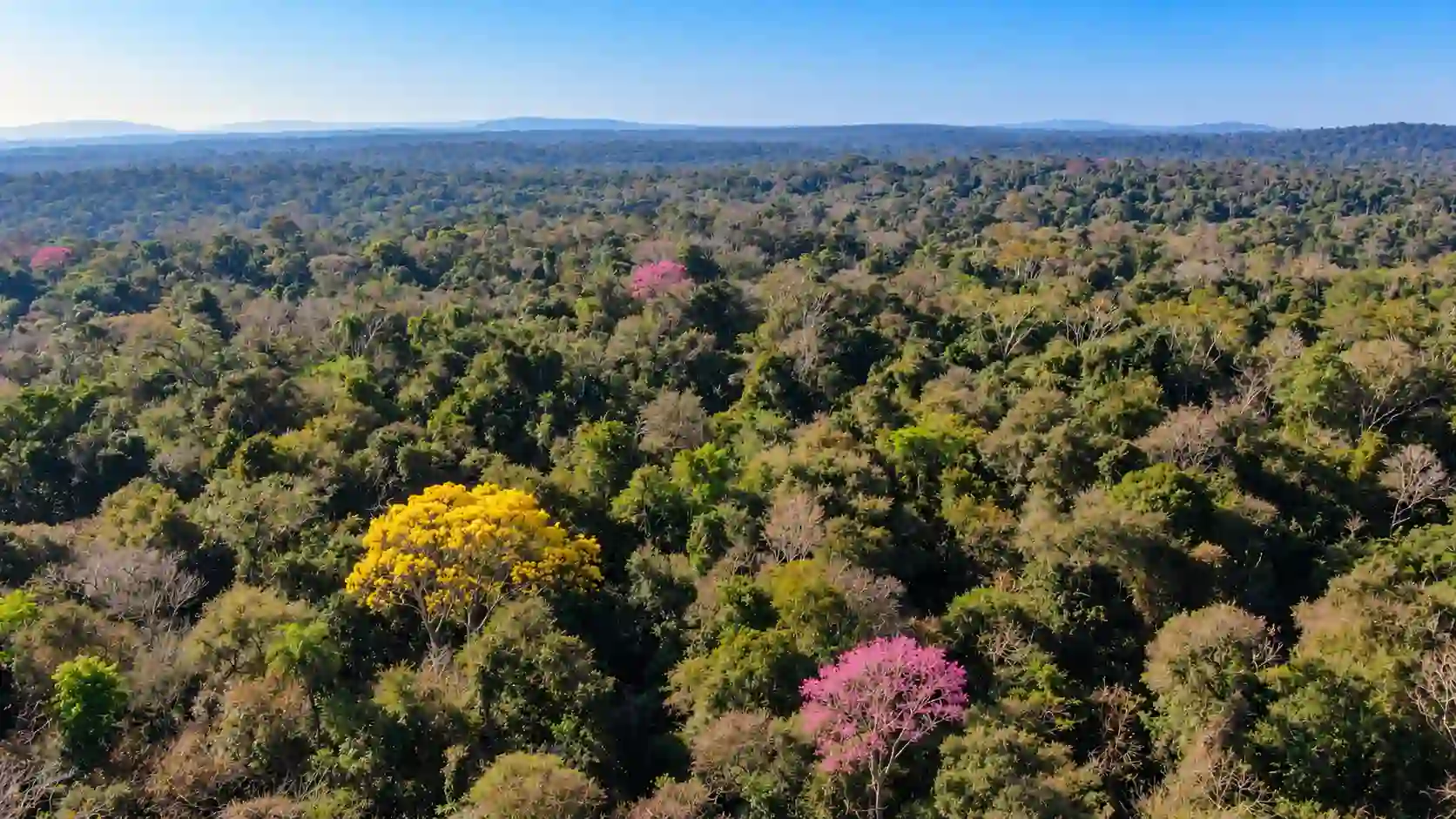
The financing could address a real industrial constraint: connecting suitable wood supply with processing capacity and dependable customers.
Success depends on more than expanding the planted area. Projects need appropriate financing terms, commercially useful output, workable producer contracts and environmental controls that can be checked over time.
The central test is whether the programme creates viable relationships between landholders, developers, processors and buyers, with measurable benefits for local businesses and the landscape.
Sources: [P1], [P8], [S2] and [S3]. Historical sector indicators are not results of the new programme.
What Has Been Agreed?
The World Bank approved the project on April 30, 2026. AFD reported that the financing agreements were signed on October 6 and said effectiveness remained subject to congressional approval and the conditions in those agreements. [P1] [P2]
The package combines a US$100 million IBRD loan with a US$9.75 million grant from the Livable Planet Fund. Both AFD’s announcement and the appraisal document identify the fund. [P1] [P3]
| Allocation | IBRD loan | LPF grant |
|---|---|---|
| Credit component | US$79.25 million | US$9.75 million |
| Forestry Investment Fund | US$20 million | — |
| Project management and capacity building | US$0.50 million | — |
| Capitalized front-end fee | US$0.25 million | — |
| Total | US$100 million | US$9.75 million |
Source: Project Appraisal Document, component and financing tables [P3]. Expected private cofinancing is additional and is not treated here as already mobilized.
Approval, signature, effectiveness, intermediary lending and investment by a final borrower are separate stages.
The retrieved World Bank financing record lists project P504535, loan IBRD99680, as approved and does not display a disbursed amount. This register observation requires its reporting date and subsequent updates to be preserved. [P5]
An Expanding Forestry Base with Supply Constraints
Paraguay’s plantation area increased from 204,631 hectares in 2022 to 339,866 hectares in 2024, according to INFONA data cited by UGP. That represents growth of approximately 66%. [S2]
Planted area and industrial feedstock are different measures. Processors require trees of suitable age, dimensions and quality, available within an economical transport distance. New plantations do not immediately resolve a shortage of harvestable material.
In preliminary figures presented at Expo Madera 2025, INFONA described approximately 500 installed forestry industries operating at around half of installed capacity, mainly because of raw-material shortages. [P7]
These are dated, preliminary sector estimates rather than a verified utilization rate for October 2026 or a measurement of every processing segment. They nevertheless identify a specific question for investment: can additional suitable supply improve the use of existing assets?
Exports show an existing market for processed products
Radio Nacional reported INFONA’s 2025 figures of US$101.3 million FOB in forest-product exports, covering 197,118 tonnes. [P8]
La Nación’s account of the annual figures reports plywood growth of 24% in both volume and FOB value, with 95% of the raw material for that product coming from eucalyptus plantations. [S3]
The 95% figure concerns plywood’s feedstock. It should not be extended to all forest exports or Paraguay’s entire forestry resource base.
These figures strengthen the commercial rationale for examining local processing. They do not show that every processor has sufficient demand, a positive margin or access to the new financing.
Credit and Institutional Capital Address Different Needs
The programme combines a credit channel, a Forestry Investment Fund and support for implementation and environmental and social management. [P2]
Lending needs a repayment schedule supported by project cash flow. Equity investment needs a viable return, governance arrangements and an eventual exit. Both require confidence in land, production, customers and operating conditions.
AFD’s existing PROFORESTAL product explains the established intermediation route. Its published conditions are not automatically the final terms of the new programme. [P6]
September 2026 reporting described an announced US$200 million forestry investment involving J.P. Morgan Natural Capital and Grupo Robinson. [S4]
It illustrates the interest of institutional capital in Paraguay’s forestry sector. It is a separate initiative and does not establish an investment in the programme’s Forestry Investment Fund.
For Econosur’s analysis, the distinction is essential: announced investor interest, capital committed to a specific vehicle and money spent on projects are different types of evidence.
How Smaller Producers Could Participate
Access to forestry finance has historically been difficult. The World Bank’s earlier sector study, A Forest’s Worth, described limited PROFORESTAL uptake and financial institutions’ perception of forestry as a high-risk activity. [P9]
That study provides historical context, not a current count of loans or proof that earlier conditions still apply unchanged.
The current appraisal expects borrowers predominantly to be developers and cooperatives aggregating smallholders. Its silvopastoral model allows smallholders to receive lease income without borrowing directly. [P3]
Inclusion should therefore be assessed through contracts as well as loans. Landholders need clarity about payments, land use, responsibilities, access rights and what happens if production or the commercial relationship fails.
Plans need to account for establishment, maintenance, harvest timing, transport and uncertain future prices.
Tenure, lease arrangements and the allocation of obligations determine how producers participate.
Technical advice, certification and monitoring costs influence participation and the income retained locally.
Fire exposure, insurance availability, operational controls and recovery arrangements belong in project assessment.
A count of participating producers would be insufficient on its own. The distribution of income, obligations and risks would reveal more about whether the arrangement works for them.
Where Local Value Can Be Created
Paraguay’s existing processing base gives the financing a concrete industrial context. Matching suitable timber supply with underused equipment could improve output without requiring every participant to build a new factory.
The appraisal includes eligible downstream processing while excluding pulp-production expenditure. [P3] Supplier relevance therefore depends on the precise activity, financing route and buyer.
| Activity | Potential value | Required verification |
|---|---|---|
| Nurseries and establishment | Plant supply, site preparation and planting services. | Species, quality, survival requirements and planting schedules. |
| Management and monitoring | Technical services, maintenance and environmental records. | Contracted tasks, budgets and performance obligations. |
| Harvest and transport | Delivery of suitable material to processing customers. | Maturity, specifications, volume, distance and delivered cost. |
| Eligible processing | Additional transformation and product value retained locally. | Eligibility, equipment needs, customers and operating margins. |
These are areas for research, not confirmed procurement opportunities. A supplier needs an identifiable purchasing entity, specification, budget and contracting process.
Econosur’s Forestry, Pulp & Paper analysis provides industrial context. The Agriculture & Food Systems cluster connects the issue to mixed land use and agricultural production.
Paracel is a separate industrial case
IDB Invest describes Paracel’s forestry and infrastructure investment through a separate project record. [P11] Econosur’s Paracel company analysis provides further context.
Industrial demand can influence growers’ expectations. It does not establish a supply contract or participation in this programme. No separate reported PROFORESTAL credit to Paracel is used as evidence of a new-programme allocation here.
Biomass Demand Creates an Opportunity and a Risk
A 2025 presentation by the energy authorities identified the importance of fuelwood for industry and a sustainability deficit in energy-related forest production. It highlighted responsible supply, certification and traceability. [P10]
This strengthens the case for a better supply system. It also raises a distribution question: which material goes to energy use, and which can support higher-value processing?
More plantation output does not automatically reduce pressure on native forests. The evidence needs to show what it replaces, how it is sourced and whether demand or land-use changes create pressure elsewhere.
The World Bank identifies FSC certification as a baseline financing requirement and describes additional incentives for smallholder inclusion and conservation beyond legal requirements. [P2]
Certification is one source of evidence. Commercial plantations, agroforestry and native-forest restoration have different objectives and should retain separate production and ecological measures.
The appraisal classifies overall risk as substantial and provides for limits on further supported eucalyptus planting by water catchment. [P3] AFD’s earlier environmental review discusses spatial screening and cumulative effects. [P4]
Previous land use, species, planting design, water conditions, habitat connectivity and landscape concentration matter alongside planted area.
Carbon projections need their method, timeframe and assumptions. They do not establish verified removals or completed carbon-credit sales.
A related evidence question appears in Mombak’s Amazon restoration financing: how does capital translate into activity on the ground and outcomes that can be verified? The ecological and business models remain distinct.
Independent Scrutiny and Commercial Execution
Bank Information Center raises concerns about plantation expansion, biodiversity, water, land rights, participation and certification. These are attributed civil-society concerns rather than established findings about every future subproject. [S1]
Parts of its description retain an earlier planning stage. Criticism of the design should therefore be compared with later project documents and safeguards.
Commercial risks also remain after eligibility is established. Harvest delays, unsuitable timber specifications, weak customer demand and transport costs can undermine an otherwise plausible production plan.
The timing mismatch deserves particular attention. Processing businesses may need material now; newly established plantations provide it later. Financing must connect those different operating horizons.
This relates to Paraguay’s wider industrial expansion, power and logistics constraints and the role of transport and waterways in regional supply chains.
What Would Demonstrate Success?
- Finance reaching projects: effective agreements, participating institutions, approved borrowers and disbursements.
- Fair producer participation: understandable contracts and a workable distribution of income, obligations and risks.
- Useful industrial supply: timber matching customers’ timing, quality and delivered-cost requirements.
- Local value creation: stronger processing and services, with evidence of viable margins and employment quality.
- Environmental performance: documented land management, water and conservation outcomes against a defined starting point.
- Accountable implementation: monitoring, complaints procedures and corrective action.
Paraguay already has the beginnings of a forestry value chain: plantations, processors and export customers. The financing matters because those parts do not necessarily connect at the right time, scale or cost.
The most useful commercial question is whether suitable raw material can reach viable processing businesses while producers retain a worthwhile share of the value. That requires clear contracts and financing that reflects the production cycle.
Institutional investors and smaller landholders also participate from different positions. Their involvement should be assessed through the terms of each relationship, rather than through a single headline investment figure.
Environmental credibility is part of that commercial assessment. The programme’s contribution will become visible through the businesses it finances, the supply relationships it creates and the outcomes it can demonstrate over time.
Research Services for Paraguay’s Agroforestry Economy
Econosur investigates defined questions about companies, projects, financing and industrial supply chains in Paraguay and South America.
Verify implementing entities, funding stages, eligibility, investment claims and evidence of execution.
Identify producers, processors, developers, customers and the commercial relationships between them.
Research purchasing entities, technical needs, procurement timing and relevant business contacts.
Compare public statements with project records, sector data and clearly attributed independent assessments.
See Custom Market Analysis South America, South America Sector Briefs or Company Reports.
Evidence date: October 17, 2026. Historical market figures retain their original periods.
Market estimates: the 500-industry and 50% utilization figures were presented as preliminary in 2025. They are not a current census or an audited rate for all subsectors.
Financing: approval, signature, effectiveness, intermediary lending and final investment are distinct stages. Private-capital announcements are not counted as completed programme mobilization.
Environmental scope: plantations, agroforestry, conservation and native-forest restoration have different outcomes. Certification does not remove the need for project-specific checks.
Corporate scope: neither Paracel nor the J.P. Morgan–Robinson initiative is identified as a programme beneficiary without specific evidence.
Commercial scope: potential technical needs do not establish open tenders, approved purchasing budgets or contracts. This article does not establish individual investment returns.
Primary and Secondary Sources
- [P1] AFD, October 9, 2026: Agroforestry financing agreements . Package, grant source, signing date and effectiveness conditions.
- [P2] World Bank, April 30, 2026: Approval and programme mechanisms . Financing approach and sustainability incentives.
- [P3] World Bank, April 9, 2026: Project Appraisal Document PADHI00531 — P504535 . Complete allocation, participation model, eligibility and safeguards.
- [P4] AFD, October 2025: Reseña Ambiental y Social . Earlier environmental preparation and spatial screening.
- [P5] World Bank Finances One: Paraguay financing register . P504535 / IBRD99680; consult the applicable reporting date.
- [P6] AFD: PROFORESTAL . Existing product and intermediary-lending context.
- [P7] INFONA, Expo Madera 2025: Preliminary forestry-sector indicators . Installed industries and reported utilization constraints.
- [P8] Radio Nacional, January 12, 2026: INFONA’s account of 2025 forest-product exports . Official interview-based source for annual trade figures.
- [P9] World Bank: A Forest’s Worth: Policy Options for a Sustainable and Inclusive Forest Economy in Paraguay . Historical sector diagnosis, including finance and risk perception; not a current loan-portfolio statement.
- [P10] Vice Ministry of Mines and Energy, 2025: Forestry development and energy biomass . Industrial fuelwood use, sustainable supply and traceability.
- [P11] IDB Invest: Paracel forestry and infrastructure financing . Separate industrial-project context.
- [S1] Bank Information Center: Critical programme assessment . Attributed concerns; some descriptions retain an earlier planning stage.
- [S2] UGP, October 14, 2025: Plantation expansion and INFONA sector findings . Industry-association account of official historical data.
- [S3] La Nación, January 13, 2026: Forest-product export performance in 2025 . Plywood growth and product-specific eucalyptus sourcing.
- [S4] ABC Color, September 24, 2026: Announced J.P. Morgan Natural Capital–Grupo Robinson investment . Separate institutional-capital context.
Evidence treatment: programme commitments, sector data, private announcements and attributed criticism serve different purposes. Planned investment and outcomes are not presented as completed expenditure or achieved results.
Investigate a Defined Paraguay Market Question
Which businesses can participate? Where is demand? What has been financed, and which commercial conditions still need verification?
Econosur prepares focused research on companies, projects, financing and value chains in Paraguay and South America.
Explore custom market analysisFrequently Asked Questions
What does the US$109.75 million figure include?
A US$100 million IBRD loan and a US$9.75 million Livable Planet Fund grant. It does not represent completed producer expenditure.
Does signing mean the money is available to producers?
Not yet. Signature alone does not establish availability. Effectiveness, implementation arrangements and approval of eligible projects are separate requirements.
Why can plantations expand while processors lack timber?
Planted area does not measure immediately harvestable supply. Age, dimensions, quality, location and delivered cost determine whether trees meet a processor’s needs.
How could smaller landholders participate?
Participation can include contractual arrangements with developers and cooperatives. Benefits should be assessed through payment terms, responsibilities and the allocation of risks.
Are plantations equivalent to native-forest restoration?
No. Their objectives and ecological characteristics differ. Production, carbon and biodiversity outcomes require separate evidence.
Are Paracel and the Robinson investment part of this programme?
They are discussed as separate industrial and investment context. Programme participation would require specific evidence.
What would demonstrate a sustainable value chain?
Accessible finance, fair producer arrangements, suitable raw material, viable processing, dependable customers and verified environmental outcomes.