
Paraguay · Ferrosilicon · Manufacturing · October 2026
REM Industries and Paraguay’s Expanding Ferrosilicon Industry
The opening of REM’s plant in Limpio adds industrial capacity alongside Elkem’s existing operations. Investment, electricity costs, financing and export access will determine how much economic value this growing sector retains in Paraguay.
 Econosur · Paraguay
Paraguay has gained a second documented ferrosilicon production site in Limpio. REM Industries inaugurated an electricity-intensive plant there on 23 October 2026. The Ministry of Industry and Commerce (MIC) reports approximately US$45 million invested, one furnace with nameplate capacity of 20,000 tonnes a year, and power requirements of around 26 MW. [1]
The new capacity joins Elkem’s Limpio operation, which began production in March 2018 and has stated annual capacity of 11,000 tonnes. The next test for the industry is whether sustained output, competitive electricity costs and overseas market access can support a larger manufacturing base. [3]
What REM has built in Limpio
REM Industries combines Paraguayan, Brazilian and Argentine capital. Its plant is located in Limpio, in the Central department near Asunción. The MIC describes an industrial site of more than 70,000 square metres and a first-stage furnace designed for 20,000 tonnes of ferrosilicon annually. The government also reports a planned second furnace and a possible additional alloy facility in Concepción; those future facilities are not included in current operating capacity. [1]
The investment estimates changed as the project advanced. ANDE described an initial US$30 million proposal in June 2023. A December 2024 industry report estimated more than US$30 million of investment and separately forecast US$35 million in annual sales. At the March 2025 groundbreaking, InfoNegocios reported an initial investment of US$35 million. A June 2026 report put investment at around US$40 million; the October 2026 inauguration announcement described approximately US$45 million already invested in the first stage. These dated estimates refer to evolving plans and execution, so they should not be added together. [2] [19] [18] [20] [1]
An October 26 plant report quotes furnace operator Aldo Millán describing approximately 1,700 tonnes of production a month. That is a reported operating rate, not a verified twelve-month output series. The same report says the first stage directly employs more than 120 people and estimates about 480 indirect jobs. The company has separately announced a proposed US$30 million second-furnace investment, with commissioning targeted about 24 months after October 2026, around October 2028. [11]
| Item | Status reported by October 2026 | Interpretation |
|---|---|---|
| First furnace | Inaugurated 23 October; capacity 20,000 tonnes/year | Installed nameplate capacity, not audited annual sales |
| Monthly output | Approximately 1,700 tonnes according to a furnace operator | Interview-based operating figure; not a long-term average |
| Initial electricity demand | Approximately 26 MW according to MIC; 27 MW contracted according to an investor | Power requirement and contract quantity are not the same measurement |
| Second furnace | US$30 million proposed in October 2026; operation targeted around October 2028 | Two-year company target, subject to implementation |
| 45,000 tonnes/year | Capacity projected in December 2024 for the proposed industrial complex | Historical project forecast; the first operating furnace was described in October 2026 as 20,000 tonnes/year |
| Three furnaces / 100 MW | Longer-term plan discussed in December 2024 | Historic ambition, not current contracted or installed demand |
The December 2024 project documentation envisaged annual capacity of 45,000 tonnes, alongside ambitions for up to three furnaces and 100 MW over subsequent years. The 45,000-tonne figure belongs to the earlier plan; the 20,000-tonne figure is the nameplate capacity of the first furnace inaugurated in October 2026. Their difference must not be interpreted as an observed fall in actual production. [19] [15] [1]
Ferrosilicon production serves steelmakers and foundries
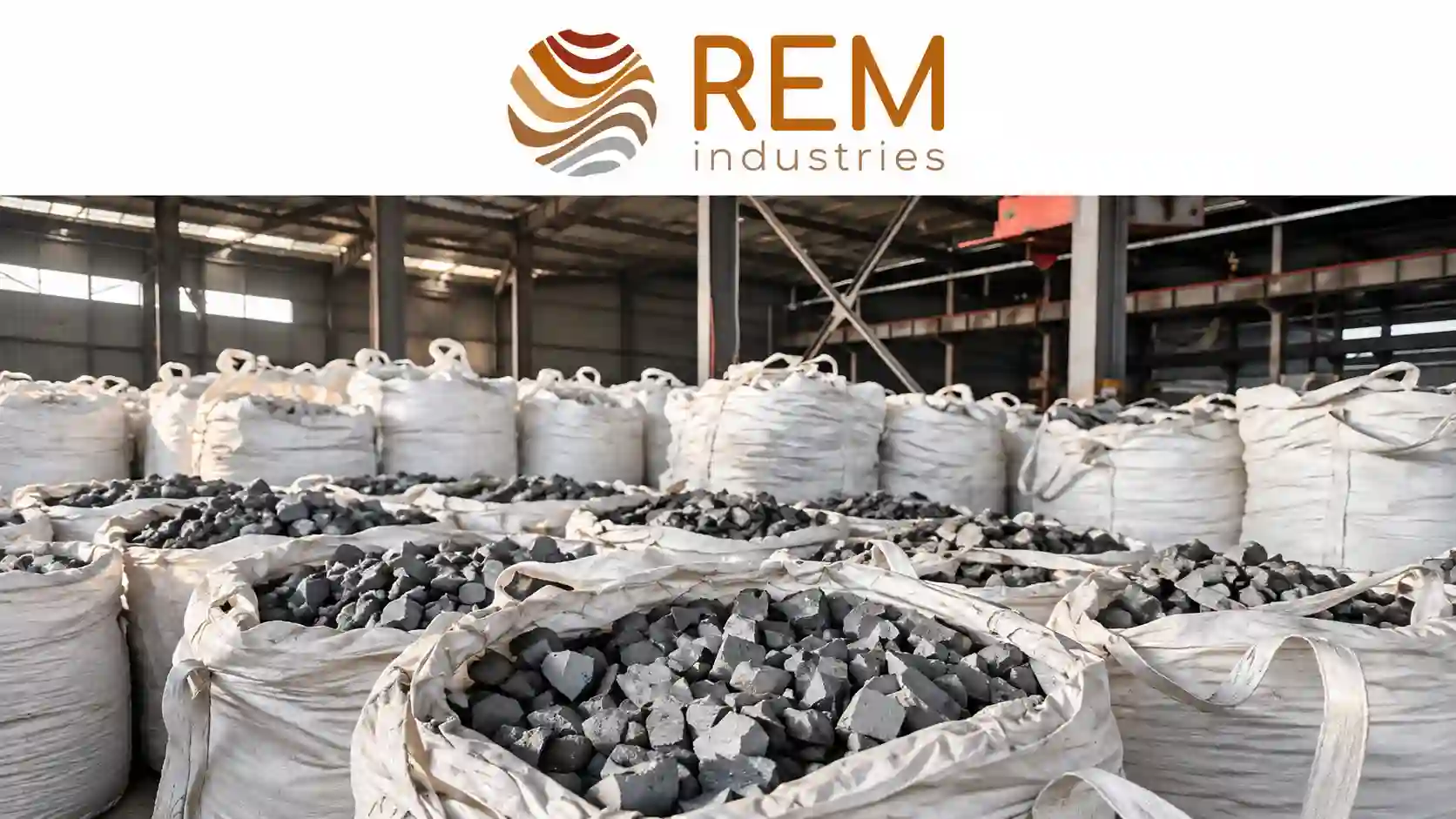
Ferrosilicon is an alloy of iron and silicon used primarily in steelmaking and foundries. In steel production it acts as a deoxidising and alloying agent. REM’s project documentation has identified FeSi75, a ferrosilicon grade containing approximately 75% silicon. The reported furnace process uses quartz, iron-bearing material and a carbon reductant. [13] [11]
Public statements about the project have sometimes connected its output to solar panels, semiconductors and displays. Such applications require additional processing and different product specifications. Ferrosilicon cannot be treated as equivalent to high-purity silicon or polysilicon. REM representatives have mentioned polysilicon as a possible future line, but the sources reviewed establish production of ferrosilicon, not operation of a semiconductor-material plant. [18] [1]
Current product: ferrosilicon for metallurgical applications.
Future idea: different silicon products or other alloys; no operating high-purity silicon production is established.
Commercial implication: steel and foundry demand, product qualification and ferrosilicon trade rules are the relevant near-term market tests.
Elkem shows that the sector existed before REM
Norwegian industrial group Elkem began operating its Limpio plant in March 2018. Its official site lists a single 11.5-MW arc furnace, annual capacity of 11,000 tonnes and around 100 employees. The plant uses mainly local raw materials and hydropower from Itaipú. These specifications establish a mature industrial reference point for evaluating REM’s newer furnace. [3]
In a 2018 site visit, InfoNegocios reported that Elkem routed production through Rotterdam for distribution into European and North American markets, with smaller flows into Argentina and Brazil. That was a description of its export structure at the time, not a verified distribution map for 2026. [16]
The two plants also create a useful comparison of production technology, reductants, electricity arrangements, company organisation and downstream customers. Their stated capacities can be compared as nameplate measures. They cannot establish national market share or utilisation without production records and shipment-level statistics.
Regional capital and the financing of industrial infrastructure
REM Industries is the project’s commercial name. A December 2024 report identifies REM Energías del Paraguay S.A. as the company established to operate the plant, and the state news agency uses the same name in October 2026. Perspectivas refers to Energías del Paraguay S.A. (EPSA); the sources reviewed do not explain whether that shorter name denotes the same registered entity. The project combines an international investor group with a Paraguayan industrial-property investment structure. ANDE’s 2023 meeting record names João Pimenta Camargo, Ary Fialho, Alejandro Zuccolillo and Sebastián Benítez Bittar among project participants. The MIC identifies João Pimenta Camargo as founder and chief executive; October 2026 inauguration reporting describes Sebastián Benítez Bittar as president of the metallurgical plant. These roles do not establish a complete, current shareholding table. [19] [2] [1] [10] [14]
A December 2024 InfoNegocios report describes CADIEM’s industrial-building investment fund as part of the property financing. It reported allocations of approximately US$3 million for land, US$7.5 million for construction and US$1.8 million for other costs, plus reported financing for equipment through Banco Itaú. Investors in the property vehicle were expected to receive rental income, not necessarily equity returns from REM’s metal production. These were project-financing plans reported at the time, not an independently audited final capital structure. [13]
Coverage published after the October 2026 inauguration confirms the importance of the investment-fund arrangement. It does not establish how much of the original proposal was ultimately drawn, the present ownership percentages or the realised investor return. [14]
Industrial projects frequently need substantial real estate, grid connections and specialist equipment before the first export sale. Separating the industrial property from the operating company can distribute funding commitments across different investors and financing instruments. In REM’s case, that structure is documented as a project arrangement; its final economics remain to be verified.
Electricity tariffs and grid access shape furnace economics
Ferrosilicon production is electricity-intensive. This makes Paraguay’s hydropower central to the industrial proposition, but electricity generation alone is not the full story. The cost of power, reliability of grid access, connection works and future tariff changes all affect furnace competitiveness. ANDE recorded negotiations over REM’s electrical infrastructure as early as June 2023, and October 2026 reporting identifies substation works serving the Limpio plant. [2] [11]
The clearest public tariff figure found for REM appears in the final section, “El proyecto de Limpio”, of a 30 September 2026 ABC Color interview primarily about the separate Araico data-centre project. Speaking as an Araico director and an investor in REM, Alejandro Zuccolillo said the REM first stage had contracted 27 MW under ANDE tariff schedule 21 at US$35 per megawatt-hour (MWh). The MIC’s later figure of about 26 MW describes consumption or power requirement, not the contracted quantity. Both figures can coexist. However, the signed agreement, demand profile and possible escalation terms have not been independently examined. [12] [1]
Paraguay’s wider energy debate adds a policy risk. In June 2026, the government withdrew separate decrees addressing special conditions for other electricity-intensive and energy-conversion activities. Their cancellation should not be represented as proof that REM’s reported industrial tariff was withdrawn. Econosur’s analysis of Paraguay’s grid regulation and its study of hydropower-based industrialisation address the broader trade-off between attracting energy-intensive projects and safeguarding the electricity system. [17]
An existing export industry faces changing international trade rules
Paraguay was exporting ferrosilicon before REM opened. World Bank WITS figures based on UN Comtrade record approximately 12,038 tonnes worth US$17.63 million under HS 720221 in 2025, and 2,416 tonnes worth US$3.67 million under HS 720229. Together these two six-digit ferrosilicon categories amount to approximately 14,454 tonnes and US$21.30 million in reported gross exports. The trade data are national totals, not audited production or company-specific sales. [5] [6]
This is an important historical baseline. REM’s 20,000-tonne annual capacity would be material relative to Paraguay’s reported 2025 ferrosilicon exports, but a simple capacity-to-export comparison does not prove future export growth. Domestic deliveries, inventories, product grades, operating time and any re-exports must be considered. Nor can all 2025 exports automatically be attributed to Elkem.
REM identifies Europe and the United States as principal target markets. Both have industry-specific trade rules. In March 2025, the US Department of Commerce issued final trade determinations concerning ferrosilicon from Brazil, Kazakhstan and Malaysia. Paraguay is not one of the origins named in those specific cases. That may affect competitive positioning, but it does not establish the full tariff treatment, commercial demand or profitability of a Paraguayan shipment. [1] [8]
On 18 November 2025, the EU introduced safeguards covering certain ferroalloys, including ferrosilicon in CN 7202 21 and 7202 29. The mechanism combines tariff-rate quotas with a variable out-of-quota duty tied to an established ferrosilicon price threshold of EUR 2,408 per tonne. Annex I includes Paraguay among developing-country WTO members and applies the ferrosilicon measure to the category of other developing countries. The quota available, tariff result and origin determination therefore have to be assessed for an actual shipment and period rather than described as blanket duty-free access. [7]
The EU’s Carbon Border Adjustment Mechanism (CBAM) is a separate instrument. In the cited EU CBAM regulation, ferrosilicon under CN 7202 2 is excluded from the covered iron-and-steel goods. That legal exclusion is distinct from the ferroalloy safeguard, and it should not be interpreted as an emissions certification. [9]
Nameplate capacity: the furnace’s stated maximum, not actual exports.
Actual production: quantity smelted over a defined period, with plant records.
Customs exports: the value and quantity traded under a specific product code and year.
Commercial market access: customer qualification, applicable trade rules, delivery economics and completed sales.
Hydropower, reductants and the carbon footprint of ferrosilicon
Both REM and Elkem use Paraguay’s hydropower advantage, but furnace emissions also depend on the carbon-containing materials used to reduce silica. The October REM site reporting identifies quartz, iron ore and coal or charcoal using the Spanish term carbón, without establishing whether REM’s reductant is exclusively fossil carbon, biomass-derived carbon or a mixture. There is no verified plant-level lifecycle carbon footprint in the reviewed sources. [11]
Elkem presents a more specific claim. Its official biocarbon statement says Limpio achieved 100% biocarbon as furnace reductant in 2019 and operates on Itaipú hydropower. That disclosure is useful evidence of a production difference, but Elkem also acknowledges that carbon dioxide emissions are inherent to smelting. The statement does not independently establish zero total lifecycle emissions. [4]
For industrial buyers evaluating carbon intensity, the next checks would include the origin and sustainability of reductants, direct furnace emissions, electricity sourcing, transport emissions, any certified product data and the methodology used for comparisons. The designation “green silicon” alone is not sufficient.
REM’s inauguration adds new manufacturing capacity to a sector established by Elkem in 2018. The new furnace demonstrates that regional investors see a commercial case for converting Paraguayan electricity and industrial raw materials into a tradable alloy.
The operating economics will be determined less by the inauguration budget than by electricity consumed per tonne, furnace availability, reductant costs, logistical performance and the final price achieved in destination markets. Public data currently document investment, nameplate capacity, selected tariff terms and an early operating-rate estimate. They do not yet document sustained profitability or annual utilisation.
The export opportunity also needs to be measured against the actual product. Ferrosilicon for steelmaking competes in a different market from high-purity silicon for solar or electronic applications. Future product diversification might alter that position, but it should not be counted before the relevant equipment and commercial output exist.
For Paraguay, the larger economic question is whether electricity-intensive production will develop an enduring industrial ecosystem: specialised labour, engineering capacity, stable energy contracts, locally processed inputs and recurring export relationships. That is measurable over time. REM and Elkem provide a concrete starting point for that assessment.
Econosur Research Services: Industrial Markets and Ferrosilicon
Econosur examines defined questions concerning South American companies, industries, investment projects and international business relationships. For electricity-intensive manufacturing, research must connect plant-level facts with energy, financing, trade and customer conditions.
Compare ownership, plant locations, output types, operating status, investment history and competitive positioning.
Examine tariff schedules, contracted power, connection infrastructure, commissioning evidence and staged expansion plans.
Assess destination markets, product specifications, trade measures, customer industries and documented commercial relationships.
Trace regional capital structures, financing vehicles, industrial-property arrangements and country-specific market conditions.
Research is structured around the decision at hand. See Custom Market Analysis South America, Company Reports and the Manufacturing and Industrial Cases hub.
Status date: 29 October 2026. First-stage investment and early production reports are separated from the proposed second furnace, which REM aims to commission about 24 months after October 2026 (around October 2028), and from earlier project forecasts.
Production: REM’s 20,000 tonnes and Elkem’s 11,000 tonnes are nameplate capacity. The reported REM monthly output is interview evidence, not audited annual production.
Electricity: The reported 27-MW and US$35/MWh tariff arrangement comes from an investor interview. The underlying ANDE agreement and later amendments have not been reviewed.
Trade and climate: National export data do not identify the individual producer. Regulations require shipment-level interpretation. No independently comparable plant-level carbon footprint or confirmed volume of REM sales into the EU or US was established.
Primary and Secondary Sources
- Ministerio de Industria y Comercio (MIC) — inauguration of REM Industries, 23 October 2026: Official inauguration announcement: one furnace, 20,000 tonnes/year nameplate capacity, approximately 26 MW and initial investment of about US$45 million.
- ANDE — REM Industries electricity-infrastructure discussions, 14 June 2023: Public utility record identifying the project, early investors and proposed electrical-infrastructure arrangements. Its construction dates were forecasts.
- Elkem — Limpio production site: Company description of the plant opened in March 2018, 11,000-tonne annual nameplate capacity and 11.5-MW arc furnace.
- Elkem — Biocarbon and the Limpio plant: Company statement that the Limpio furnace reached 100% biocarbon as reductant in 2019; this is a company claim, not a comparative lifecycle assessment.
- World Bank WITS / UN Comtrade — Paraguay 2025 ferrosilicon exports, HS 720221: Reported 2025 exports under HS 720221: 12,038 tonnes and US$17.63 million.
- World Bank WITS / UN Comtrade — Paraguay 2025 ferrosilicon exports, HS 720229: Reported 2025 exports under HS 720229: 2,416 tonnes and US$3.67 million.
- European Commission — Implementing Regulation (EU) 2025/2351: EU safeguards affecting ferrosilicon, tariff-rate quotas, treatment of developing-country origins and the EUR 2,408/tonne price threshold outside quota.
- US Department of Commerce — Ferrosilicon trade determinations, March 2025: Antidumping and countervailing determinations concerning Brazil, Kazakhstan and Malaysia; no company-specific US market-access guarantee follows.
- European Union — Regulation (EU) 2023/956, Annex I: Scope of the EU carbon border adjustment mechanism, with CN 7202 2 ferrosilicon excluded in the cited version of Annex I.
- Agencia IP / Medios del Estado — inauguration of REM Energías del Paraguay S.A., 23 October 2026: Government inauguration report identifying the operating company by its legal name, distinguishing the plant from the REM Industries commercial designation.
- InfoNegocios Paraguay — REM operating details and expansion, 26 October 2026: Plant-operator interview: approximately 1,700 tonnes per month, materials, employment figures and proposed second furnace.
- ABC Color — interview with Alejandro Zuccolillo, 30 September 2026: The article mainly examines the separate Araico AI data-centre project; REM’s 27-MW contract and reported US$35/MWh under ANDE schedule 21 appear in the final section headed “El proyecto de Limpio”. Zuccolillo spoke as an Araico director and REM investor; the REM contract itself was not independently reviewed.
- InfoNegocios Paraguay — CADIEM industrial-property fund, 27 December 2024: Explains the property-investment vehicle, projected rental returns, the historical 45,000-tonne annual capacity and US$35 million expected annual sales. The sales projection is distinct from investment spending.
- Perspectivas — REM inauguration and investment fund, 24 October 2026: Independent account of the opening, the industrial property-financing structure and the additional US$30 million expansion proposal.
- ABC Color — REM energy and expansion ambitions, 20 December 2024: Historical target of three furnaces and up to 100 MW over several years, not current operating capacity.
- InfoNegocios Paraguay — site visit to Elkem Limpio, 5 December 2018: Contemporary site reporting on Elkem’s operation, inputs and export channels through Rotterdam.
- ABC Color — power-tariff decrees withdrawn, 9 June 2026: Documents the cancellation of separate 2026 special-tariff decrees. Does not establish that REM’s schedule-21 contract was cancelled.
- InfoNegocios Paraguay — REM groundbreaking and investor interviews, 17 March 2025: Reports the US$35 million initial investment announced at groundbreaking, the early two-furnace plan and 900–1,000-tonne monthly production forecast, plus later-stage polysilicon ambitions.
- Revista PLUS — REM investment and production plan, 20 December 2024: Contemporary account of investment above US$30 million, a proposed 45,000-tonne annual capacity and US$35 million of projected annual sales; figures refer to early planning.
- InfoNegocios Paraguay — REM commissioning preparations, June 2026: Interim project report putting the investment at approximately US$40 million before the October inauguration.
Source method: Official government, company and statistical records establish disclosed facts and classifications. Interviews add details but remain statements by the people interviewed. Project forecasts, trade-law interpretation and Econosur’s analytical conclusions are explicitly distinguished from measured results.
Research Paraguay’s Industrial Markets
For a defined industry, company or cross-border market question, Econosur can assess competitors, operating projects, energy constraints, investment structures and commercial conditions with documented evidence.
Explore custom industrial market researchFrequently Asked Questions
Is REM Industries Paraguay’s first ferrosilicon producer?
No. Elkem has operated a ferrosilicon plant in Limpio since March 2018, with stated annual capacity of 11,000 tonnes. REM represents additional production capacity, not the beginning of the sector.
How much ferrosilicon can REM produce?
Paraguay’s industry ministry reports initial nameplate capacity of 20,000 tonnes per year from one furnace. An operator cited approximately 1,700 tonnes per month in October 2026. That reported monthly rate is not an audited annual production total.
What electricity tariff does REM pay?
In September 2026, investor Alejandro Zuccolillo told ABC Color that the initial REM project had contracted 27 MW under ANDE tariff schedule 21 at US$35 per MWh. The underlying contract and any later amendment were not independently reviewed.
What is the difference between ferrosilicon and polysilicon?
Ferrosilicon is an iron-silicon alloy primarily used in steelmaking and foundries. Semiconductor- or solar-grade polysilicon is a distinct, highly purified material produced through additional industrial processes. REM’s reported current product is ferrosilicon.
Do renewable electricity and biocarbon make ferrosilicon emissions-free?
No. Smelting still involves carbon-containing reductants and process emissions. Elkem reports full biocarbon use at Limpio since 2019, while the published material on REM does not establish the origin of its reductant or an audited product carbon footprint.
What does Econosur research in Paraguay’s industrial market?
Econosur undertakes focused company, competitor, energy and trade research, including project verification, capacity and ownership checks, export-market conditions and cross-border business relationships.
The wider Paraguayan context includes the country’s industrial investment model, Paraguay’s position within Mercosur and the debate over hydropower-based industrialisation. These are related market conditions, not evidence of commercial relationships with REM or Elkem.