
Brazil Insight · ROG.e 2026 · Offshore Oil & Gas · Supply Chain · Procurement
ROG.e 2026 and Brazil’s Offshore Supply Chain: Investment, Procurement and Market Access
Brazil’s offshore investment cycle is moving from project pipelines into procurement. As ROG.e 2026 approaches, the commercial question for international suppliers is no longer whether Brazil will invest, but where demand is emerging, who controls purchasing decisions and what it takes to participate.
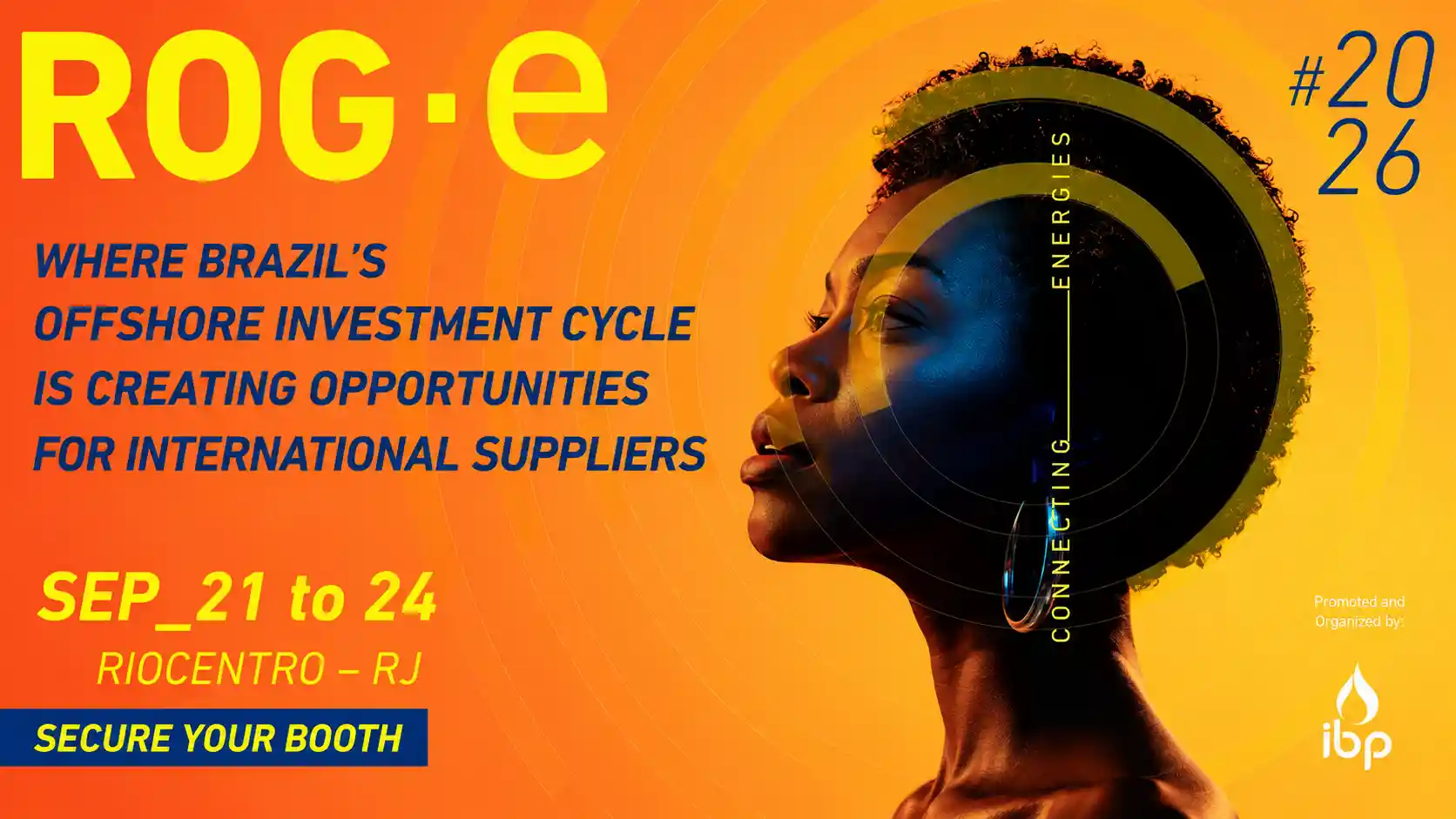
ROG.e 2026 arrives at a point when Brazil’s offshore story is increasingly a procurement story rather than only an investment story.
The event will take place from September 21 to 24 at Riocentro in Rio de Janeiro. In its latest pre-event update, IBP reports 117,000 m² of total event area, 22,000 m² of exhibition area, approximately 75,000 expected participants, more than 650 exhibitors and 13 international pavilions. The exhibition area is around 60% larger than in 2024.
More important for suppliers, ROG.e will feature a forum exclusively focused on the energy supply chain for the first time. That coincides with Petrobras planning US$69.2 billion in E&P investment in its 2026–2030 implementation portfolio, continued deepwater production-system deployment and new exploration activity on the Equatorial Margin.
For international suppliers, the opportunity is therefore real—but identifying market growth is only the first step. The practical questions concern procurement responsibility, contracting routes, vendor qualification, local-content requirements, incumbent suppliers and the need for Brazilian execution capacity.
Core market reading:
The commercial logic can be reduced to three levels: investment pipeline → procurement fields → market access. ROG.e is useful because these three layers converge at one event. Operators, prime contractors, technology providers, engineering companies, vessel operators and international suppliers are present at the same point in the investment cycle.
Why ROG.e 2026 matters now
ROG.e is not important simply because it is a large event. Its timing matters.
Brazil is simultaneously deploying new deepwater production systems, contracting long-duration offshore capacity and exploring frontier acreage. The result is a market in which procurement questions extend across FPSOs, subsea systems, vessels, drilling support, inspection, maintenance, engineering, automation, logistics and specialist industrial services.
IBP’s latest pre-event figures put ROG.e 2026 at more than 650 exhibitors and approximately 75,000 expected participants. The event will occupy 117,000 m² in total, including 22,000 m² of exhibition area, and will include 13 international pavilions. The exhibition area is around 60% larger than in 2024.
But the more significant signal for industrial suppliers is the event structure. For the first time, ROG.e will include a forum exclusively dedicated to supply-chain questions.
ROG.e is commercially relevant because it takes place while Brazil is moving from offshore investment plans into equipment, vessel, service and contractor decisions.
Petrobras anchors a US$69 billion E&P investment cycle
The scale of Brazil’s current offshore cycle is most visible in Petrobras .
The company’s 2026–2030 Business Plan provides for US$109 billion in total investment. Within its E&P implementation portfolio, Petrobras plans US$69.2 billion of investment over the five-year period.
Pre-salt projects remain the center of gravity, representing 62% of the E&P implementation portfolio. Petrobras also plans eight new production systems through 2030, seven of which were already contracted when the business plan was announced.
The same plan also makes the opposite end of the asset life cycle commercially important. Petrobras expects US$9.7 billion of expenditure on sustainable asset disposal and well abandonment between 2026 and 2030. Its published decommissioning portfolio includes 18 platforms scheduled for removal in 2026–2030, around 500 offshore wells requiring abandonment interventions and approximately 1,800 km of flexible lines to be recovered. A further 50 platform removals are identified for the period after 2031.
This means Brazil’s offshore supplier market is being pulled in two directions at once: new production and exploration create development demand, while mature assets create a parallel market for well abandonment, subsea recovery, marine services, dismantling, ports and recycling. Econosur examines this second cycle in Brazil’s Offshore Decommissioning Market .
That investment does not translate into one homogeneous supplier market. An offshore project is divided across multiple procurement layers: operator contracts, FPSO packages, subsea systems, shipyards, drilling contractors, engineering companies, marine services and specialist subcontractors.
For a foreign manufacturer, this distinction is fundamental. Petrobras may be the ultimate operator, but it is often not the company making the individual purchasing decision for a specific component.
Morpho adds a new exploration frontier to the discussion
On August 14, 2026, Petrobras confirmed hydrocarbons in the Morpho exploration well in block FZA-M-59 in the Foz do Amazonas Basin, approximately 175 km from the coast of Amapá in 2,886 meters of water.
Morpho should not yet be treated as a commercial oil field. Petrobras is continuing the exploratory evaluation and has not established commercial reserves or a field-development project.
The commercial relevance lies elsewhere. Exploration creates supplier demand well before production: drilling support, offshore vessels, environmental monitoring, marine logistics, emergency response, aviation, port services, technical equipment and specialist services enter before a final production investment decision.
Econosur examines the infrastructure and supplier implications of this frontier in greater detail in Brazil’s Equatorial Margin: Where Will the Offshore Supply Chain Be Built? Brazil’s Offshore Decommissioning Market: Where the Next Supplier Cycle Is Starting
Brazil already has a large deepwater operating base, contracted production systems and established subsea and vessel demand.
Morpho and additional exploration plans could expand demand for northern logistics, drilling support, marine services and environmental capacity.
Commercial reserves, field-development concepts, production systems and long-term project sanction remain uncertain.
Procurement is already visible: the DOF case
One of the clearest examples of Brazil’s current procurement cycle came in May 2026.
Norway’s DOF Group announced four 12-year charter and service contracts for new ROV Support Vessels to serve Petrobras’ Brazilian deepwater operations. The vessels are intended for subsea inspection, maintenance and repair activities and are expected to begin operations from 2030.
The combined contract value is close to US$2 billion.
The structure of the award is as important as its size. DOF is an international offshore contractor, but the Navship yard in Brazil is expected to construct the vessels and DOF Subsea Brasil will perform the contractual services.
International participation and Brazilian execution are often part of the same contracting model.
For foreign suppliers, the real question is therefore not simply whether Brazil buys foreign technology. It is how international technology, local manufacturing, Brazilian subsidiaries, domestic services and prime-contractor relationships are combined in the relevant procurement package.
Market access is more complicated than identifying demand
Petrobras’ supplier system demonstrates both the opportunity and the complexity.
The company states that its Goods and Services Supplier Registry includes both Brazilian and foreign companies interested in participating in contracting processes. Its Corporate Registry covers goods and services of greater complexity, scale or value and is available to Brazilian and foreign suppliers.
Registration, however, does not answer the commercial questions around a specific opportunity.
Brazil’s upstream contracts also contain local-content provisions. ANP defines local content as the proportion of goods produced and services provided in Brazil relative to expenditure used to execute exploration and production contracts.
In 2026, ANP also conducted a consultation concerning contractual provisions on equal opportunity and preference for Brazilian suppliers when domestic offers are equivalent or more advantageous in price, delivery and quality.
| Public signal | What it tells a supplier | What still needs research |
|---|---|---|
| Petrobras investment plan | Large multi-year offshore demand exists. | Which projects and packages match the supplier’s product and timing. |
| Petrobras Supplier Registry | Foreign suppliers can participate in relevant corporate registration categories. | Qualification requirements, tender route and actual purchasing responsibility. |
| Local-content framework | Brazilian industrial participation forms part of upstream procurement. | Whether local production, assembly, service or partnership is needed for the target package. |
| DOF contracts | International contractors continue to win large Brazilian offshore awards. | Which portions of the resulting supply chain are open to additional technology and equipment providers. |
ROG.e becomes explicitly a supply-chain event
The 2026 program makes the procurement focus unusually visible.
On September 21, ROG.e will hold its Supply Chain Forum at Riocentro. IBP describes it as the first ROG.e forum dedicated exclusively to supply-chain topics.
The published program includes discussions on financing and competitiveness in Brazil’s oil and gas supply chain, decarbonization, operational efficiency, decommissioning and other questions directly linked to supplier execution.
Decommissioning is particularly relevant this year. On September 21, the Supply Chain Forum includes “Decommissioning in Brazil: Pathways to Overcoming Challenges”, with Petrobras, Gerdau, Trident Energy and SBM Offshore. ANP also participates the same day in a session on integrated strategies and offshore decommissioning project management. This matters commercially because mature assets create demand for a different part of the supplier system: well abandonment, subsea recovery, vessels, ports, dismantling, waste handling and materials recycling. Econosur examines that market separately in Brazil’s Offshore Decommissioning Market: Where the Next Supplier Cycle Is Starting.
This is relevant because Brazil’s challenge is no longer simply to identify technically viable offshore projects. It must execute a large project portfolio while maintaining cost competitiveness, industrial capacity, supplier performance and local operating capability.
International participation will also be visible on the exhibition floor. VDMA and AHK Rio are supporting the German Pavilion and a European Area at ROG.e 2026. VDMA states that the available exhibition areas are located in immediate proximity to Petrobras’ stand.
Why this matters for international suppliers:
The event combines operators, engineering companies, vessel contractors, technology providers, industrial suppliers and regulators at a point when Brazil is actively contracting offshore capacity. For companies trying to understand procurement structures rather than simply collect contacts, that concentration has research value.
What international suppliers should watch at ROG.e 2026
A company can therefore attend ROG.e, collect dozens of business cards and still leave without understanding its realistic addressable market.
The commercially useful output is not a list of companies present. It is a map of who buys, when they buy, through which contracting structure, against which competitors and under what local conditions.
ROG.e is most useful when it is read as a map of procurement relationships rather than as a list of exhibitors.
Brazil’s offshore market now contains several demand cycles at the same time: new production systems in the pre-salt, exploration on the Equatorial Margin, long-duration subsea and vessel contracts, operating and maintenance demand, and a growing decommissioning cycle around mature assets.
For an international supplier, these cycles do not lead to the same buyer or the same route to market. The commercially relevant question is therefore where a specific product or service enters the chain: directly with an operator, through an FPSO contractor, subsea integrator, vessel owner, shipyard, engineering company, maintenance contractor or another specialist supplier.
This is why event research should connect project timing, procurement responsibility, local execution and supplier competition. Without that structure, a large investment number or a long exhibitor list says little about whether an individual supplier has an actionable opportunity.
Three business questions that require deeper research
Public sources establish the investment pipeline and broad procurement environment. They do not establish whether a specific foreign supplier has a commercially realistic opportunity.
Who actually controls the purchasing decision for the supplier’s equipment or service?
The answer may sit with Petrobras, an FPSO contractor, shipyard, subsea integrator, drilling contractor, engineering company or another tier of the supply chain. Mapping the buyer is often more important than identifying the operator.
What Brazilian presence is commercially or operationally required to compete?
This requires examining technical qualification, local-content exposure, maintenance and after-sales requirements, import economics, certification, local service capacity, distributors and potential industrial partners.
Which announced projects are close enough to procurement to justify commercial resources now?
Investment announcements, exploration campaigns, project sanction, equipment selection and purchase orders occur at very different stages. Suppliers need to distinguish headline opportunity from actionable demand.
Where Published Information Stops
Public information establishes the scale of Brazil’s offshore cycle, but not the complete commercial map.
Petrobras publishes investment plans, production-system schedules and supplier information. ANP publishes regulatory and local-content material. ROG.e publishes exhibitors and conference programming. Major contractors announce selected awards.
These sources do not provide a complete procurement calendar, buyer map, contractor shortlist, supplier evaluation, competitor position, project-specific qualification path, decision-maker map or assessment of how a particular foreign company would fit into a procurement package.
Those gaps require supplier interviews, direct market checks, competitor observation, procurement research and project-level validation.
Trade Fair & On-site Research at ROG.e 2026
Econosur can conduct targeted on-site research at selected South American industry events for international companies that need information from the market but cannot carry out the research themselves.
For ROG.e 2026, an assignment can be structured around a specific technology, supplier category, competitor group, procurement question or target-company list.
The objective is not generic event coverage.
An on-site assignment starts with a defined business question: a supplier category to investigate, competitors to observe, companies to approach or procurement assumptions to test. The event is used as a concentrated research environment.
Research services for offshore suppliers
Econosur can turn the broad market signals visible at ROG.e into a company-specific research scope. The objective is not to produce generic event coverage, but to answer a concrete commercial question before or after a supplier commits sales resources to Brazil.
A supplier brief can be used for market screening, ROG.e meeting preparation, target-account prioritization, partner research, competitor mapping and post-event follow-up. Custom Market Analysis is available for Brazil and other South American markets.
The core factual claims in this analysis are grounded in official event material, company disclosures, regulator information and contractor announcements.
- IBP, September 2026 — latest pre-event figures for ROG.e 2026: 117,000 m² total area, 22,000 m² exhibition area, approximately 75,000 expected participants, more than 650 exhibitors and 13 international pavilions.
- IBP, May 11, 2026 — ROG.e parallel events and confirmation of the first Supply Chain Forum.
- ROG.e — official Supply Chain Forum information for September 21, 2026.
- ROG.e 2026 — official program, including the September 21 decommissioning session with Petrobras, Gerdau, Trident Energy and SBM Offshore.
- ANP — official ROG.e 2026 agenda, including offshore decommissioning project-management and well-integrity/decommissioning sessions.
- Petrobras Business Plan 2026–2030 — US$109 billion total planned investment, US$69.2 billion in the E&P implementation portfolio and US$9.7 billion for sustainable asset disposal and well abandonment.
- Petrobras — published 2026–2030 decommissioning portfolio: 18 platforms for removal, around 500 offshore wells with abandonment interventions and approximately 1,800 km of flexible lines to recover; 50 additional platform removals are shown for 2031 and beyond.
- Petrobras, August 14, 2026 — hydrocarbons identified at the Morpho exploration well in FZA-M-59.
- DOF Group, May 5, 2026 — four new ROV Support Vessels for Petrobras under 12-year contracts valued at close to US$2 billion.
- Petrobras Supplier Channel — supplier registration framework for Brazilian and foreign companies.
- ANP — local-content framework for Brazilian oil and gas exploration and production contracts.
- ANP, May 15, 2026 — consultation on equal-opportunity and supplier-preference provisions.
- VDMA — German Pavilion and European Area at ROG.e 2026.
- Offshore Energy, May 6, 2026 — independent industry coverage of DOF’s four Petrobras RSV awards, vessel scope and Brazilian construction plan.
- Reuters, April 15, 2025 — reporting on delays in the P-32 dismantling project, used as context for execution risk in Brazil’s emerging decommissioning chain.
Event schedules, exhibitor participation and individual procurement timelines can change. The 75,000-participant and 650-plus-exhibitor figures are IBP pre-event expectations rather than final attendance counts. Petrobras investment and decommissioning figures describe a company portfolio, not a supplier-access guarantee. Morpho remains an exploration result rather than a sanctioned development project. Decommissioning activity is commercially relevant to ROG.e 2026, but individual contract timing, package structure and supplier eligibility require project-level verification.
Use ROG.e as a research environment—not just a trade fair
Public information shows where Brazil is investing. On-site research can test which suppliers are present, who controls relevant procurement decisions, how competitors are positioned and which market assumptions hold up in direct industry conversations.
Econosur can structure a ROG.e 2026 assignment around a defined supplier category, competitor set, target-company list or specific procurement question.
Discuss an on-site ROG.e research assignmentFAQ
When and where will ROG.e 2026 take place?
ROG.e 2026 will take place from September 21 to 24, 2026 at Riocentro in Rio de Janeiro, Brazil.
How large will ROG.e 2026 be?
IBP expects more than 650 participating companies, approximately 75,000 visitors, 13 international pavilions and around 117,000 m² of available event space. The exhibition area is expected to be around 60% larger than in 2024.
Why is ROG.e 2026 particularly relevant to offshore suppliers?
The event coincides with a major Brazilian offshore investment and procurement cycle. Petrobras plans US$69.2 billion of investment in its E&P implementation portfolio for 2026–2030, while new production systems, subsea activity, vessel contracts and exploration programs are generating demand across the supply chain.
Can foreign companies register as Petrobras suppliers?
Yes. Petrobras states that its Corporate Supplier Registry, covering higher-complexity, larger-scale or higher-value goods and services, is open to both Brazilian and foreign companies.
Does supplier registration guarantee access to Petrobras contracts?
No. Registration is one element of supplier qualification. Companies still need to understand the relevant procurement route, technical requirements, tender timing, contracting structure, local-content provisions and which company actually controls the purchase.
What did Petrobras discover at Morpho?
Petrobras identified hydrocarbons in the Morpho exploration well in block FZA-M-59 offshore Amapá. The well remains under evaluation, and the result should not yet be treated as a sanctioned commercial field.
Why is decommissioning relevant at ROG.e 2026?
ROG.e 2026 includes a dedicated Supply Chain Forum session on decommissioning in Brazil on September 21, with Petrobras, Gerdau, Trident Energy and SBM Offshore. ANP also participates in an offshore decommissioning project-management session the same day, reflecting the growing importance of well abandonment, subsea removal, dismantling and recycling in Brazil’s offshore supplier market.
What can Econosur research at ROG.e 2026?
Depending on assignment scope, research can cover target exhibitors, suppliers, competitors, technologies, possible partners, procurement signals, commercial positioning and pre-defined market questions. Findings can be delivered as a structured briefing or written report.