
Paraguay River Economy: Hidrovía, Dredging and Export Logistics
Paraguay is landlocked on the map but connected to global trade through the Paraguay–Paraná Hidrovía. The same river system that provides export scale also exposes the country to low-water, dredging, port-capacity and regional-governance risks.
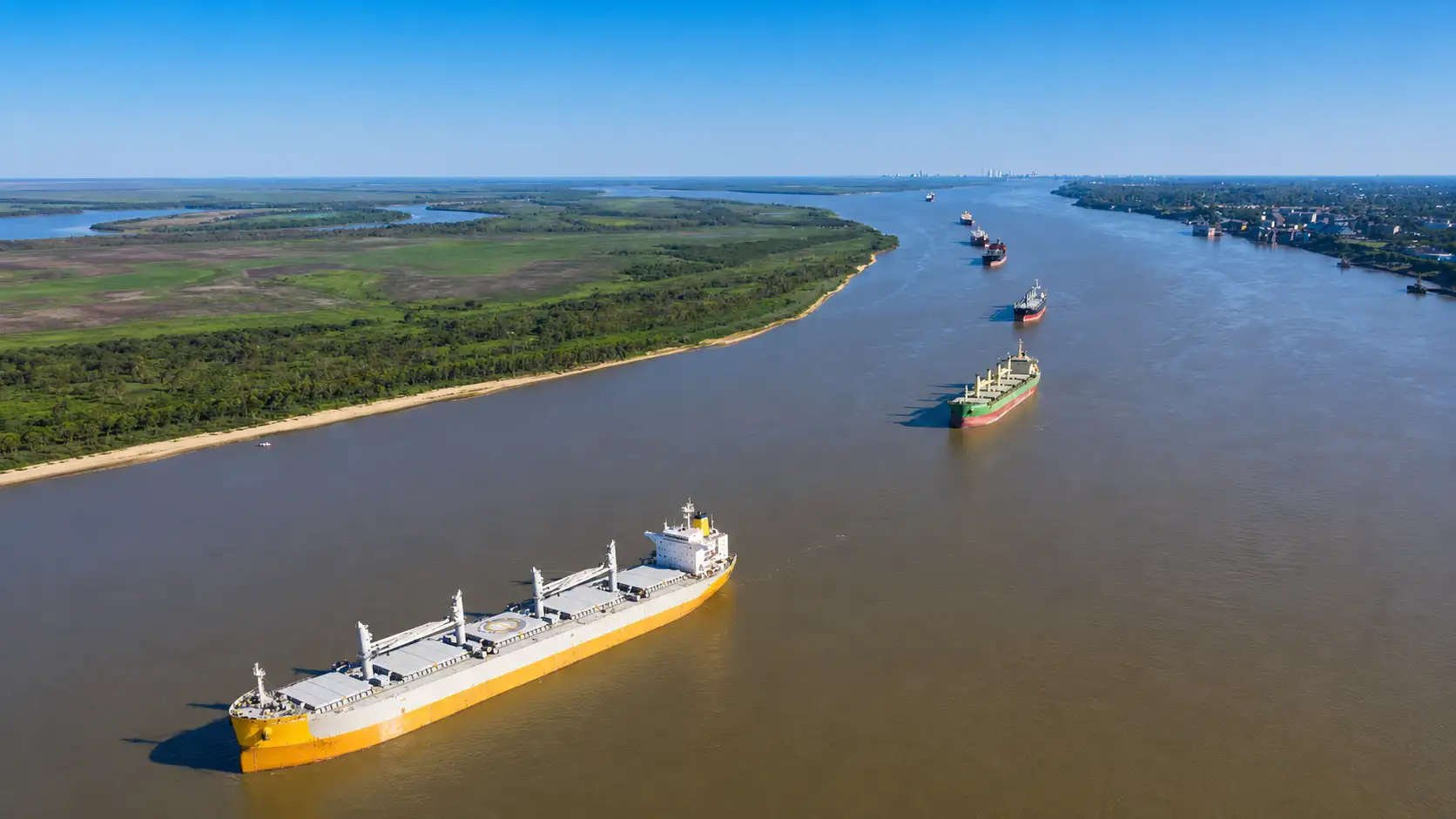
Paraguay is geographically landlocked but economically connected to world markets through the Paraguay–Paraná Hidrovía.
The waterway links production areas, storage facilities, ports, barge fleets, downstream terminals and ocean shipping routes. It carries much of Paraguay’s foreign trade and makes large-volume agricultural and industrial exports possible.
The same concentration creates risk. River depth, sedimentation, dredging, port capacity, barge availability and downstream regulation directly affect costs, timing and export reliability.
Paraguay is usually introduced as a landlocked country. That description is geographically correct, but economically incomplete. The more useful question is how the country organizes access to regional and global markets.
The answer is the logistics and waterway system built around the Paraguay–Paraná Hidrovía. The corridor links domestic production, river terminals, barge convoys, downstream hubs and Atlantic-facing shipping routes.
Market reading: Paraguay’s river economy converts inland production into export power. The Hidrovía is simultaneously a transport system, a cost structure, a market-access system and a source of concentrated operational risk.
2026 corridor update: concession execution, Paraguayan dredging and river levels
Argentina awarded the Vía Navegable Troncal concession to Jan De Nul–Servimagnus in June and signed the 25-year contract on July 7, 2026. The consortium formed the special-purpose company Vía Navegable Argentina S.A.; the new concession activated a 13.5% toll reduction and moved the trunk route from award into execution, including deepening and navigation-technology works.
On August 7, Argentina formalised the Vía Navegable Troncal Control Council, with Resolution 47/2026 published on August 10. The council adds a structured monitoring layer around concession performance, works, navigation and investment, while the National Ports and Navigation Agency retains the formal regulatory and contractual control function.
Paraguay is also strengthening its own operating capability. The Administración Nacional de Navegación y Puertos received the DRM-5 “Paraguay” dredger in June, with stated dredging capacity of about 1,500 cubic metres per hour. On August 3, ANNP reiterated the objective of a waterway capable of operating 24 hours a day, 365 days a year, while pointing to three dredgers in service, new dredging tenders and expanded navigation signaling.
Hydrology remains the immediate operating variable. Paraguay’s official river-level service reported Asunción at 1.41 m and Villeta at 1.82 m on August 18, both falling on the day. Concepción stood at 2.19 m. These readings do not by themselves imply a navigation emergency, but they reinforce why draft, dredging and water-level monitoring belong inside any commercial assessment of the corridor.
The useful question is not whether Paraguay is landlocked
Paraguay has no direct maritime coastline. Its economic connection to ocean trade instead runs through the Paraguay River, Paraná River and Río de la Plata.
The Hidrovía therefore performs the function that a maritime gateway performs elsewhere. It connects production areas with downstream ports, transshipment systems and global shipping networks.
Paraguay’s river economy includes farms, silos, roads, river terminals, barge operators, shipyards, storage facilities, customs services, dredging, navigation systems and downstream port connections.
Paraguay is landlocked on the map, but its export economy is river-connected in practice.
Five theses about Paraguay’s river economy
Thesis 1: The Hidrovía converts Paraguay’s inland production into export capacity.
Thesis 2: River logistics influence the cost structure of agricultural, industrial and energy-related trade.
Thesis 3: Low water is a capacity shock rather than only an environmental event.
Thesis 4: Ports, terminals, barge fleets and shipyards are strategic economic infrastructure.
Thesis 5: Paraguay’s trade reliability depends on regional conditions and decisions beyond Paraguay’s borders.
The route: Paraguay River, Paraná River and Río de la Plata
Cargo moves from Paraguay’s production and storage areas to river terminals. Barges transport the cargo downstream through the Paraguay and Paraná river system toward the Río de la Plata and Atlantic-facing trade routes.
The operational chain includes water levels, draft restrictions, convoy formation, terminal capacity, waiting times, customs procedures, downstream regulations and transshipment connections.
Under normal conditions, the river gives Paraguay a cost advantage for bulk cargo. During low-water periods or operational disruption, the same concentration exposes exporters to higher costs and uncertain delivery schedules.
The transport chain determines whether production reaches the market
A soy shipment does not move directly from a Paraguayan farm to an international buyer. It passes through production, storage, truck transport, river terminals, barge convoys and downstream shipping connections.
Each stage creates value and potential friction. Delays at terminals, limited draft, port congestion, customs bottlenecks or constrained downstream capacity can change the cost and timing of the entire shipment.
| Stage | Function | Market relevance |
|---|---|---|
| Farm, silo or processing facility | Production, storage and initial cargo aggregation. | Determines export availability and timing. |
| Road transport | Connects inland production with the river network. | Adds local transport cost and road dependency. |
| River terminal | Stores, loads and organizes cargo for fluvial transport. | Creates port-service value and potential bottlenecks. |
| Barge convoy | Moves bulk cargo downstream at scale. | Highly sensitive to water depth and navigability. |
| Downstream connection | Links river cargo to transshipment or ocean shipping. | Connects Paraguay with global markets. |
What moves through Paraguay’s river economy
Cargo flows associated with the Hidrovía include soybeans, soy derivatives, maize, fuels, fertilizers, iron ore, containers and other imported or exported goods.
Agricultural bulk cargo is especially sensitive to transport cost per ton. The river therefore influences the commercial viability of Paraguay’s principal export industries.
This connects directly with Paraguay’s soy model. Production volume alone does not determine export performance. The crop must also move through the corridor efficiently and predictably.
In Paraguay, logistics is part of the export equation rather than a secondary service after production.
Why precise Hidrovía percentages require caution
Statements about the percentage of Paraguayan trade carried by the Hidrovía vary according to the year, product category and whether the measure refers to volume, value, exports, imports or total foreign trade.
This analysis uses the Navios industry estimate of around 70 percent of exports and approximately 50 percent of imports. The figures demonstrate the scale of Paraguay’s river dependency without converting an industry estimate into an official universal statistic.
General formulation: The Hidrovía carries a large share of Paraguay’s foreign trade.
Source-specific formulation: A Navios industry study estimated that the corridor carries around 70 percent of Paraguay’s exports and approximately half of its imports.
Ports and terminals turn river access into economic structure
Paraguay’s river economy is organized through multiple ports, private terminals and logistics nodes rather than one maritime gateway.
The Asunción–Villeta corridor is one important area, while the wider system includes port operators, warehouses, barge companies, shipyards, customs services and industrial maintenance.
Fluvial shipping therefore supports more than cargo movement. It creates demand for vessels, repairs, equipment, storage, scheduling, trade finance, insurance and technical port services.
Water depth is a competitiveness variable
Low water reduces navigable draft. Lower draft reduces the cargo that each barge can carry. The resulting capacity loss may require additional rotations, create delays and increase transport costs per ton.
Reuters reported in April 2024 that low river levels were slowing Paraguayan soybean exports despite expectations for a strong crop. The case illustrates why production and export execution cannot be analyzed separately. The issue remains current: on August 18, 2026, Paraguay’s official hydrological service reported Asunción at 1.41 m (-3 cm day on day), Villeta at 1.82 m (-4 cm) and Concepción at 2.19 m (-1 cm).
Cost chain: Low water → lower draft → less cargo per barge → additional rotations or delays → higher cost per ton → export-timing risk.
Low-water episodes can affect farmers, traders, terminals, shipping operators, importers, insurers, lenders and public authorities. Hydrology becomes a commercial variable across the entire market.
The main risks in Paraguay’s river economy
| Risk | Mechanism | Economic effect |
|---|---|---|
| Low water | Reduced navigability and draft restrictions. | Lower cargo capacity, delays and higher unit costs. |
| Sedimentation | Riverbed changes create navigational constraints. | Greater dredging needs and potential bottlenecks. |
| Dredging and signaling | Maintenance affects safe and predictable navigation. | Changes operational reliability and cost certainty. |
| Customs and coordination | The corridor crosses jurisdictions and regulatory systems. | Creates administrative friction and timing risk. |
| Port congestion | Peak cargo periods place pressure on terminal capacity. | Causes waiting times and scheduling problems. |
| Climate variability | Rainfall and upstream water conditions affect navigation. | Increases uncertainty in logistics planning. |
Paraguay’s river economy depends on a regional corridor
Paraguay can invest in terminals, barge fleets, storage and domestic logistics, but it does not control the corridor alone.
Upstream rainfall and hydrological conditions influence navigability. Downstream regulations, dredging, port access and the Río de la Plata system influence Paraguay’s connection with Atlantic-facing shipping.
Argentina, Brazil, Uruguay and the wider river-basin system therefore affect Paraguay’s trade reliability. The Hidrovía is economic infrastructure and a regional governance system.
The river is Paraguay’s economic corridor, but it is not Paraguay’s sovereign infrastructure alone.
Paraguay as a logistics and service platform
Paraguay’s river economy creates opportunities beyond commodity exports. Port services, vessel repair, storage, fluvial transport, customs expertise, equipment supply and multimodal coordination form a wider service market.
Paraguay’s ambition to become a regional logistics-services platform reflects this structural opportunity. The value lies in the institutional and industrial system that makes the corridor usable.
The Hidrovía remains Paraguay’s established large-volume Atlantic corridor. The Bioceanic Corridor adds a road-based east–west option toward Brazil, northern Argentina and Pacific ports, but it is not yet a complete substitute for the river system. The bridge to Brazil is physically connected, while access roads, border infrastructure, customs coordination and the onward route to Chile remain decisive. See the current Bioceanic Corridor readiness analysis and Econosur’s broader Bolivia Bioceanic Map.
The opportunity remains dependent on predictable navigation, credible regulation, reliable port services and cross-border coordination.
What companies should watch
Companies using Paraguay as a production, sourcing or distribution base should treat the Hidrovía as part of their market and supply-chain analysis.
Relevant indicators include river levels, draft restrictions, dredging policy, terminal capacity, barge availability, export seasonality, customs procedures and downstream regulatory changes.
Several identifiable operators and cargo owners sit inside this logistics system. Navios South American Logistics operates terminals, barges and tanker vessels across the Hidrovía. Downstream, Jan De Nul and Servimagnus created Vía Navegable Argentina S.A. for the 2026 Argentine trunk-waterway concession. On the Paraguayan side, Paracel is a useful industrial case because its logistics concept combines a river terminal, barges and onward maritime shipment, while PETROPAR illustrates the importance of liquid-bulk imports, storage and river access. Paraguay company insights provide the wider company context.
Commercial questions around Paraguay’s river economy
Which business opportunities are emerging from Paraguay’s river logistics and Hidrovía economy?
The commercial opportunity extends well beyond moving soy and other bulk cargo. Paraguay’s river economy supports demand for port services, vessel repair, storage, fluvial transport, customs expertise, equipment supply and multimodal coordination. Terminals, barge fleets and downstream navigation infrastructure also create recurring requirements for maintenance, handling, monitoring, safety and operational support.
These are structural opportunity areas, not evidence that specific procurement packages are currently open. Commercial accessibility depends on the operator, terminal, concession structure, technical specification, maintenance cycle, incumbent suppliers and qualification route.
Which bottlenecks in the Paraguay–Paraná Hidrovía create the greatest operational and investment risks?
The most important bottlenecks are low-water events, sedimentation, dredging and signaling constraints, port congestion, customs coordination and climate variability. Each can reduce cargo capacity, lengthen transit times or raise logistics costs.
There is also a governance risk. Paraguay can invest in domestic terminals, fleets and storage, but critical downstream access depends on regulations, dredging, tolls and port conditions outside Paraguay. Argentina’s 2026 Vía Navegable Troncal concession therefore matters to Paraguay even though the concession itself is outside Paraguayan territory. The contract is now signed and the concession has entered execution; the commercial question is how quickly deepening, maintenance, signaling and technology improvements translate into measurable reliability and capacity.
What should international suppliers and logistics companies verify before committing resources to Paraguay’s river economy?
International suppliers should verify who actually buys their category, who controls technical specifications and vendor qualification, which incumbent suppliers are established, and what local service, stock or response capacity is expected. They also need to understand terminal ownership, barge and vessel maintenance cycles, customs procedures, corridor regulation, downstream bottlenecks and whether announced infrastructure activity is commercially addressable.
That information is rarely available in one public source. It requires company-level research, buyer and supplier checks, primary interviews and verification of how the logistics system works in practice.
Public sources can describe the corridor, cargo flows, major operators, concession structures, water-level risk and announced infrastructure plans. They are much weaker at showing the live commercial layer.
Paraguay Hidrovía and logistics market research
Econosur can move from public corridor analysis to targeted commercial verification for international suppliers, logistics companies, investors and institutions evaluating Paraguay and the wider Southern Cone.
- Which operators or cargo owners are realistic buyers for a specific technology or service, and who controls specification and vendor qualification?
- Which incumbent suppliers and local service partners are already positioned, and what stock, response-time or local-presence requirements matter?
- Which announced dredging, terminal, fleet or infrastructure activities are commercially accessible, and where do hydrology or downstream regulation change the case?
Conclusion: river-connected is the more useful description
Paraguay’s landlocked geography does not mean economic isolation. The Hidrovía connects domestic production with downstream ports and international markets.
The river system supports agricultural exports, fuel imports, industrial cargo, logistics services and regional trade. It also concentrates exposure to hydrological conditions, dredging, port capacity and cross-border governance.
Paraguay’s river economy is therefore one of the central systems connecting production, trade, costs and market risk.
From corridor structure to commercial verification
Public sources can show how the Hidrovía works, where the major operators sit and which infrastructure risks matter. They do not reliably show live procurement, incumbent supplier positions, qualification routes, buyer priorities or whether a specific opportunity is commercially accessible.
Econosur can investigate those questions through corridor-risk analysis, operator and procurement mapping, primary interviews and targeted field validation where useful.
Explore custom market analysisFrequently asked questions
What is Paraguay’s river economy?
Paraguay’s river economy is the logistics, port, shipping and export system built around the Paraguay–Paraná Hidrovía. It connects production areas, storage sites, river terminals, barge convoys and global markets.
Why is the Hidrovía important for Paraguay?
The Hidrovía provides landlocked Paraguay with a functional export corridor to downstream ports and Atlantic-facing shipping routes. A Navios industry study estimated that it carries around 70 percent of Paraguay’s exports and approximately half of its imports.
Which goods move through Paraguay’s river system?
Major cargo flows include soybeans, soy derivatives, maize, fuels, fertilizers, iron ore, containers and other traded goods.
How does low water affect Paraguay’s exports?
Low water reduces draft and cargo capacity, slows navigation, creates waiting times and can increase transport costs per ton.
Is Paraguay isolated because it is landlocked?
Paraguay is landlocked geographically but connected economically through the Paraguay River, Paraná River and Río de la Plata.
What are the main risks in Paraguay’s river economy?
The main risks include low-water events, sedimentation, dredging constraints, navigation bottlenecks, customs friction, port congestion, downstream dependency and climate variability.
Why is Paraguay’s river economy a geopolitical dependency?
Paraguay depends on a regional river corridor whose water conditions, navigation rules, dredging decisions and downstream access are not controlled by Paraguay alone. The emerging Bioceanic Corridor adds a second east–west logistics option, but it is not yet a fully operational substitute for the Hidrovía.
Which business opportunities are emerging from Paraguay’s river logistics and Hidrovía economy?
Paraguay’s river economy creates business demand beyond commodity transport, including port services, vessel repair, storage, fluvial transport, customs expertise, equipment supply and multimodal coordination. These are structural opportunity areas, not proof that specific procurement packages are currently open.
Which bottlenecks in the Paraguay–Paraná Hidrovía create the greatest operational and investment risks?
The main bottlenecks include low-water events, sedimentation, dredging and signaling constraints, customs coordination, port congestion, climate variability and downstream regulatory dependency. Paraguay can strengthen domestic infrastructure but does not control the entire corridor.
What should international suppliers and logistics companies verify before committing resources to Paraguay’s river economy?
Suppliers should verify the real buyers for their category, specification and qualification control, incumbent vendors, local service and stock expectations, maintenance cycles, regulatory requirements and whether announced infrastructure activity is commercially accessible.

Marcus A. Volz is a market analyst and founder of Econosur. Based in Argentina, he researches industrial markets, infrastructure and logistics corridors across Argentina, Paraguay and Mercosur. His work combines public-source analysis with operator and company research, procurement mapping, primary interviews, project verification and targeted field research where required. See research services.
About this analysis
This analysis describes Paraguay as a river-connected economy whose export scale depends on the Paraguay–Paraná Hidrovía, domestic terminals, barge fleets and downstream access.
The 70 percent export estimate, 50 percent import estimate and 26-million-tonne cargo figure are source-specific Navios industry estimates. They are not presented as universal official statistics.
The page separates national capabilities from regional dependency. Paraguay controls important domestic assets and is expanding dredging and signaling capacity, while downstream dredging, navigation rules, tolls and Atlantic access remain embedded in a multinational corridor. The current-status layer is updated through August 19, 2026 and should be distinguished from structural statistics based on older source periods.
The analysis connects with the Bioceanic Corridor readiness analysis, the Logistics and Waterways industry page, the regional Paraná–Paraguay Waterway analysis and the Paraguay market-insights hub.