
Company Insight · Argentina · Vicuña Corp. · Copper · Infrastructure · Suppliers
Vicuña Corp.: Ownership, Project Stages and Supplier Access
Created by BHP and Lundin Mining, Vicuña is turning Josemaría and Filo del Sol into a staged, binational copper system. The company is advancing engineering, early works, roads, supplier qualification and permitting, but it has not yet sanctioned full construction or begun commercial production.
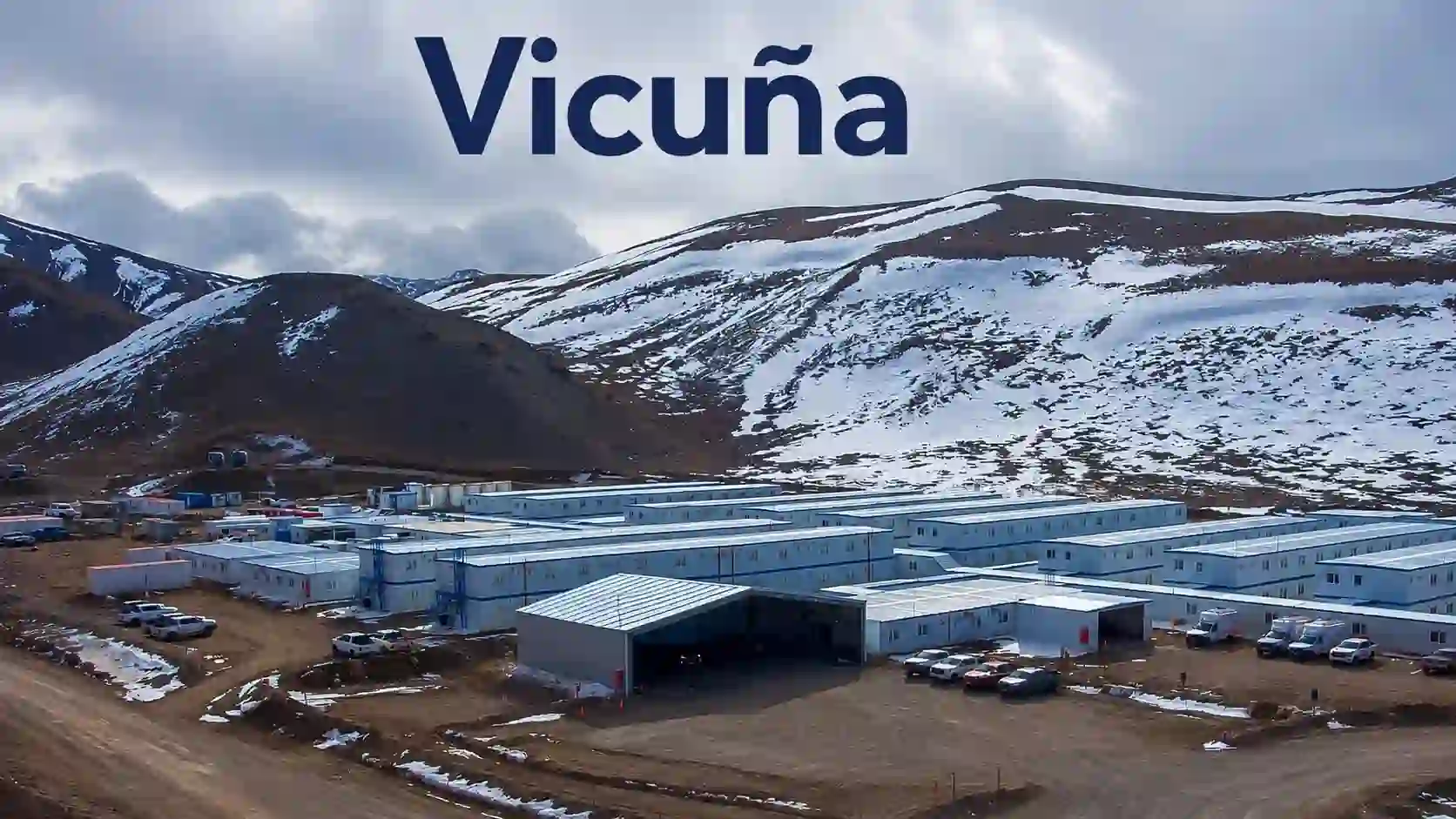
Vicuña Corp. is the independent 50/50 operating company created by BHP and Lundin Mining to develop Josemaría and Filo del Sol as one staged copper, gold and silver system.
The company is led by CEO Ron Hochstein and General Manager Dave Dicaire. Its February 2026 Preliminary Economic Assessment models three stages, beginning with a US$7.1 billion Josemaría mine and concentrator. The study estimates US$18.1 billion across all stages, but it is not a feasibility study, does not establish Mineral Reserves and does not represent a final investment decision.
Vicuña is already spending on detailed engineering, site preparation, roads, camp expansion, vehicles and supplier development. Full Stage 1 construction remains subject to sanction. Suppliers enter through the Achilles registry, but registration only creates eligibility for future opportunities.
For the market context, see Econosur’s analysis of Argentina’s copper economy, energy and infrastructure overview, Codelco company insight and Argentina market profile.
Core company reading:
Vicuña is already a functioning project company and procurement system. It is not yet a producing mining company. The commercial market currently comes from engineering, access roads, camps, power distribution, equipment, services and supplier preparation ahead of a possible Stage 1 sanction.
Three business questions for suppliers
Which supplier opportunities are already opening before Vicuña’s Stage 1 sanction?
The immediate market is in project preparation rather than full mine construction. Vicuña is already spending on detailed engineering, the Northern Corridor, camp expansion, plant-area preparation, equipment, transport, electrical systems and site services.
Resolution 1154/2026 now quantifies part of that pre-production investment window. The approved RIGI schedule assigns US$1.129 billion of computable assets to the period from 8 July 2024 through 31 December 2026, before the company’s planned first production in 2030. A further US$7.896 billion of computable assets is scheduled for 2027 through 2031.
That matters because suppliers do not need to wait for first copper to find commercial activity. The near-term opportunity set is concentrated in the systems that make a future construction decision executable: roads, camps, power distribution, earthworks, fleet support, logistics, safety, environmental services and contractor support.
The distinction is important: publicly visible activity shows where demand is forming, but it does not show that every category has an open tender or that a specific supplier can bid today.
Where are procurement and supplier decisions actually made within the Vicuña structure?
Not automatically at BHP or Lundin Mining. The two companies each own 50% of Vicuña, but Vicuña is the independent operator responsible for project development and management.
Depending on the package, procurement can therefore sit with Vicuña’s own purchasing teams, engineering firms, main contractors, infrastructure contractors or specialist project companies. The Northern Corridor illustrates this structure: Vicuña procures major packages, while awarded contractors can create a second layer of demand for local goods, services and subcontractors.
For suppliers, the practical question is not simply “Who owns the project?” but “Who controls this package, who qualifies vendors and who signs the purchase or subcontract?”
What should suppliers verify beyond Achilles registration before pursuing Vicuña contracts?
Achilles registration creates visibility; it does not establish a live commercial opportunity. Suppliers still need to know whether a package is active, who owns the procurement decision, which technical and documentary requirements apply, and whether the route is direct or through a contractor.
Other points to verify include local service capacity, safety and environmental requirements, incumbent suppliers, subcontracting needs, package timing, payment and financial requirements, and whether demand belongs to current early works, Stage 1 or a later development stage.
The RIGI framework adds another commercial question. Resolution 1154/2026 approves a list of goods and services eligible for import benefits and records that Vicuña submitted a supplier-development plan. Suppliers therefore need to verify whether a package is expected to be imported, sourced locally, subcontracted through a principal bidder or split across those routes.
This is where company-level research becomes more useful than a supplier portal alone: the portal shows the formal entry mechanism, while commercial research identifies the specific buying process behind it.
Current Status in October 2026
Vicuña is moving through detailed engineering, technical planning, site preparation and early works. Its own phased-development announcement says a sanction decision for Stage 1 is targeted toward the end of 2026. First production is planned for 2030 if the project receives approval and follows the proposed construction schedule.
Resolution 1154/2026, published on 30 July, formalized Vicuña’s admission to RIGI as a Long-Term Strategic Export Project. The resolution records a total investment plan of US$9.737 billion, of which US$9.025 billion is classified as computable assets. It assigns US$1.129 billion of computable assets to the period from 8 July 2024 through 31 December 2026 and US$7.896 billion to 2027 through 2031.
Those RIGI stages are a regulatory investment schedule, not the same thing as the PEA’s Stage 1, Stage 2 and Stage 3 development sequence. The resolution also approves a list of goods and services eligible for import benefits, records that Vicuña submitted a supplier-development plan and sets 31 December 2028 as the deadline for meeting the minimum computable-investment requirement. RIGI reduces part of the fiscal, customs and foreign-exchange uncertainty, but it does not replace the Stage 1 sanction decision, complete construction financing or remaining permits.
The project company reported more than 2,600 direct and indirect jobs by mid-2026. Reuters reported planned 2026 spending of around US$800 million after nearly US$400 million in 2025. That annual spending figure and the RIGI computable-asset schedule use different definitions and periods. Both nevertheless point to substantial project activity before commercial copper output.
Northern Corridor: on 11 September Vicuña awarded construction of sections A1 and A2, covering 63.6 kilometres between Angualasto and Junta La Palca, to the Contreras–BBC–Construmin joint venture. Vicuña describes these sections as the first part of an approximately 220-kilometre future access corridor.
Filo del Sol drilling: on 10 September Vicuña announced approximately 55,500 metres of diamond drilling for the 2026–2027 season, mainly at Filo del Sol, with up to eight rigs operating in Argentina and Chile. Boart Longyear Argentina and Hy-Tech Griffith Drilling Argentina were selected after a competitive tender.
Supplier systems: Vicuña is preparing to launch Coupa on 22 September for procurement, contracting, purchase orders, receipt of goods and services, and invoicing. Achilles remains the system for maintaining supplier information.
Workforce preparation: Vicuña and Fundación UOCRA announced training beginning in October in construction trades, electricity and instrumentation, welding, structural assembly and heavy road machinery for communities close to the project.
Roads, camp systems, earthworks, fleet deployment, technical design and supplier processes are already generating contracts and operating activity.
The proposed US$7.1 billion first stage has not yet become a final approved construction program.
Filo del Sol sulphides, desalination, concentrate transport and Chilean infrastructure depend on later studies, permits, financing and investment decisions.
Why BHP and Lundin Mining Created Vicuña
BHP and Lundin Mining announced the transaction in July 2024. They agreed to acquire Filo Corp. jointly and combine Filo del Sol with Josemaría. BHP also agreed to acquire 50% of Josemaría from Lundin Mining for approximately US$690 million.
The acquisition valued Filo Corp. at approximately C$4.1 billion in the original announcement, using C$33.00 per share. The offer represented a 32.2% premium to the 30-day volume-weighted average price before public transaction speculation. The transaction was completed in January 2025.
The industrial logic is proximity. Josemaría and Filo del Sol sit about ten kilometres apart. Their combination allows one project company to plan processing capacity, roads, camps, water, power, concentrate transport and later expansions across the two deposits.
Ownership, Governance and Operational Control
BHP and Lundin Mining each hold 50% of Vicuña and have equal voting rights. Carlos Ramirez chairs the board. Jack Lundin, Teitur Poulsen and Brandon Craig are also named as board members in Vicuña’s formation announcement.
Vicuña is the operator of Josemaría and Filo del Sol. The company states that it acts independently from BHP and Lundin Mining and is responsible for project development, operation and management. This distinction matters because shareholder ownership does not mean that procurement decisions automatically run through the two parent companies.
Ron Hochstein became chief executive officer in November 2025. Dave Dicaire remained general manager and reports to the CEO while retaining responsibility for integrated design, the execution plan and overall project development. The CEO role was created with a primary base in Argentina to strengthen stakeholder engagement and support critical workstreams.
Owners: BHP and Lundin Mining, each with 50% and equal voting rights.
Operator: Vicuña Corp., acting independently from both shareholders.
Executive leadership: Ron Hochstein as CEO and Dave Dicaire as General Manager.
Econosur reading: the Argentina-based CEO layer signals that permitting, infrastructure, communities and institutional coordination now require the same executive attention as technical design.
Josemaría and Filo del Sol Are Different Assets
Josemaría is located in San Juan, Argentina, at more than 4,200 metres above sea level. It is the more advanced asset and provides the proposed location for the initial mine, concentrator and much of the shared infrastructure.
Filo del Sol lies nearby and extends across the Argentina–Chile border. Its development model separates the oxide material from the deeper sulphide resource. The oxide stage would use heap leaching and SX/EW to produce copper cathode and gold doré. The later sulphide stage would feed an expanded concentrator and require additional cross-border infrastructure.
Vicuña Corp. should not be confused with the wider Vicuña District. Other regional assets such as Caserones, Los Helados and Lunahuasi have different owners and corporate structures. The company profiled here holds Josemaría and Filo del Sol.
| Asset | Location and role | Current development meaning |
|---|---|---|
| Josemaría | San Juan, Argentina; proposed initial open pit, concentrator and infrastructure base. | Foundation of Stage 1 and the current engineering, access and site-preparation program. |
| Filo del Sol oxides | Argentina–Chile border area; oxide layer above the sulphide deposit. | Stage 2 concept with heap leaching and SX/EW for copper cathode and precious-metal recovery. |
| Filo del Sol sulphides | Large deeper sulphide system extending across both countries. | Stage 3 concept requiring concentrator expansion, desalination and concentrate infrastructure. |
The Three-Stage Development Plan
The February 2026 Preliminary Economic Assessment provides the first integrated technical and economic model for Josemaría and Filo del Sol. Fluor led the independent consultant consortium, supported by Ausenco, Inti Mining Smart Solutions, Knight Piésold and SLR Consulting.
| Stage | Planned development | Estimated capital | Status boundary |
|---|---|---|---|
| Stage 1 | Josemaría open pit and sulphide concentrator with initial capacity of 175,000 tonnes per day. | US$7.1bn | Detailed engineering and readiness work; sanction decision remains outstanding. |
| Stage 2 | Filo del Sol oxide development with heap leach and SX/EW facilities. | US$3.9bn | Conceptual later stage inside the PEA. |
| Stage 3 | Filo del Sol sulphides, concentrator expansion to 293,000 tonnes per day and major Chile-linked infrastructure. | US$7.1bn | Long-term concept requiring further studies, permits and financing. |
The study models average annual production during the first 25 full years of about 395,000 tonnes of copper, 711,000 ounces of gold and 22.2 million ounces of silver. It models a mine life exceeding 70 years and total life-of-mine copper production of about 22.3 million tonnes.
These production figures are modelled outcomes. Vicuña does not currently produce copper, gold or silver. A long conceptual mine life cannot be treated as an operating forecast until later engineering, reserve conversion, permitting, financing and construction decisions are completed.
Mineral Resources Are Not Mineral Reserves
The integrated study reports 14 million tonnes of contained copper in Measured and Indicated Mineral Resources and 32 million tonnes in Inferred Mineral Resources. The resource scale is central to the project’s strategic importance, but the categories have different evidentiary weight.
The PEA includes Inferred Resources in its conceptual mine plan and economic model. Lundin Mining’s cautionary statement says the technical and economic viability of the project has not been demonstrated. Inferred Resources are too geologically speculative for economic considerations to establish viability.
Measured and Indicated Resources: higher-confidence geological estimates, but still not Mineral Reserves.
Inferred Resources: lower-confidence estimates that may never convert to higher categories.
Mineral Reserves: the integrated PEA does not establish that Vicuña’s reported resources are economically mineable reserves.
Interpretation: the PEA is a preliminary economic assessment and should not be presented as a feasibility study.
What Is Financed—and What Remains Open
Lundin Mining announced commitments to increase its credit facility to US$4.5 billion and said it was fully funded for its share of the initial construction phase. That statement describes Lundin Mining’s financing capacity. It does not confirm complete financing for Vicuña or approval of the full three-stage capital program.
The study still lists advancement of the financing structure within Vicuña as a next step. Access to portions of Lundin’s credit facility is connected to milestones, including project sanction. BHP’s own capital allocation also remains subject to its corporate approval process.
Stage 1 therefore combines strong shareholders and available corporate financing capacity with an unresolved project-level decision. Stages 2 and 3 sit further away and carry wider cost-estimate ranges. The PEA classifies Stage 1 more precisely than the later-stage estimates.
PEA development capital: US$7.1 billion for Stage 1 and US$18.1 billion across the three conceptual development stages.
RIGI investment plan: US$9.737 billion total, including US$9.025 billion of computable assets under Resolution 1154/2026.
RIGI timing: US$1.129 billion of computable assets from 8 July 2024 through 31 December 2026, followed by US$7.896 billion from 2027 through 2031.
Interpretation: the figures use different scopes and purposes. The RIGI schedule is evidence of a committed regulatory investment program, not a replacement for the PEA capital model or a declaration that all Stage 1 construction has been sanctioned.
Confirmed: BHP and Lundin Mining own Vicuña equally, Lundin has expanded corporate financing capacity, and Resolution 1154/2026 has approved Vicuña’s RIGI investment plan.
Planned: US$7.1 billion for Stage 1 and US$18.1 billion across three stages.
Outstanding: final Stage 1 sanction, Vicuña’s construction-financing structure and later-stage capital decisions.
Vicuña Is Also an Infrastructure Project
The project requires a long access system, high-voltage power, camps, process-water sources, concentrate logistics and later cross-border infrastructure. The engineering challenge comes from distance, altitude, weather and the separation between the Andean deposits and coastal infrastructure.
Northern Corridor
Vicuña now describes the Northern Corridor as an approximately 220-kilometre future access route through San Juan. On 11 September 2026, the company awarded sections A1 and A2 to a joint venture formed by Contreras, BBC (Boetto y Buttigliengo Constructora) and San Juan-based Construmin. The awarded scope covers 63.6 kilometres between Angualasto and Junta La Palca via Malimán and includes earthworks, embankments, excavation and blasting, drainage, retaining structures, signage and road-safety systems.
The award is commercially important for two reasons. It converts part of the access system from procurement into an awarded construction package, and the selected consortium emerged from a process in which Vicuña explicitly considered local participation. The road therefore functions simultaneously as enabling infrastructure and as a channel through which local subcontracting and supplier demand can develop.
Water and process infrastructure
Stage 1 is expected to use wellfields. The Josemaría environmental updates describe a multi-source water-management plan and an expected recovery of approximately 73% of process water. Later expansion changes the system substantially.
Stage 3 proposes a desalination plant on the Chilean coast with capacity of 2,000 litres per second, a mountain water pipeline, a concentrate pipeline and a concentrate-treatment plant. The PEA assumes that the desalination plant, water pipeline, concentrate pipeline and roaster would sit in a separate infrastructure company that finances their development.
The most important long-term procurement vehicle may not be the mine itself. Vicuña’s PEA introduces a separate infrastructure-company model for water and concentrate systems.
Early Works Are Creating a Market Before Sanction
Vicuña’s early-works program has moved beyond the initial fleet announcement. Lundin Mining reported that a 24-truck fleet was mobilized during the second quarter of 2026 and that 1.1 million tonnes of material were moved as Stage 1 early earthworks ramped up. The company’s earlier May update had described the first 21 trucks, 180 trained operators and round-the-clock activity around the future plant area and mine roads.
The September award of 63.6 kilometres of the Northern Corridor adds a larger civil-works package to that activity. At the same time, the new 55,500-metre Filo del Sol drilling program creates demand for specialist drilling capacity, high-altitude logistics and technical services. These are commercially real project-execution activities even though full Stage 1 construction remains unsanctioned.
Procurement activity broadened during July and August. Vicuña organized supplier meetings around tenders for a 33 kV distribution system and Phase II camp-power expansion, then announced a further business round linked to the upcoming site personnel transport tender. These processes show demand moving through enabling infrastructure and operating services before the full Stage 1 construction decision.
The terminology must remain precise. Site preparation, road works and early equipment deployment do not prove that Stage 1 has entered full construction. The distinction protects the article from converting project-readiness activity into an unsupported construction claim.
| Activity | Publicly visible status | Commercial meaning |
|---|---|---|
| Detailed engineering | Active during 2026. | Design, technical consulting, studies and package preparation. |
| Northern Corridor | Sections A1 and A2, covering 63.6 km, awarded on 11 September 2026 to Contreras–BBC–Construmin; further corridor works remain staged. | Road construction, drainage, bridges, explosives logistics and local subcontracting. |
| Filo del Sol drilling | Approximately 55,500 metres planned for the 2026–2027 season; Boart Longyear Argentina and Hy-Tech Griffith Drilling Argentina selected. | High-capacity drilling, high-altitude logistics, technical support, safety and associated services. |
| Camp expansion | Active preparation and contract activity. | Modular buildings, power, catering, cleaning, sanitation and transport. |
| 33 kV distribution and camp power | Supplier round held in July 2026 around active tenders. | Electrical materials, engineering, generators, rentals, safety services and local subcontracting. |
| Personnel transport | Business round announced for 10–11 August 2026 in connection with an upcoming site transport tender. | Passenger transport, fleet capacity, local subcontracting and site logistics. |
| Plant-area preparation | Early fleet and earthworks deployed. | Heavy equipment, operators, maintenance and site services. |
Supplier participation: company counts and commercial value
Vicuña’s first sustainability report, published September 21 and covering 2025, identifies 580 suppliers in Argentina, with 60% based in San Juan. These are company-reported supplier counts, not the share of procurement expenditure awarded locally.
The Ministry of Economy names Vicuña among the operators scheduled to discuss supplier development at the October 29 Rosario RIGI meeting. This is an announced event, not evidence of new awards.
Econosur’s RIGI investment projects and industrial suppliers analysis places Vicuña within the wider investment pipeline and examines why supplier numbers, payment shares and equipment origin require separate evidence.
How Suppliers Enter the Vicuña Value Chain
Vicuña directs companies to register through Achilles. The registration process is free. Optional Achilles memberships, services or certifications do not provide an advantage in Vicuña’s supplier evaluation. Registration allows a company to be considered for future opportunities.
Vicuña’s current Coupa portal describes bidding, purchase orders, goods and services receipt and invoicing. Achilles remains the registration, evaluation and prequalification platform. The company explicitly states that Achilles registration does not automatically authorize a supplier to operate in Coupa: onboarding is a separate process. Neither registration establishes an awarded contract.
Industry reporting stated that supplier registration became a mandatory entry requirement for future tenders from December 2025. After six months, the platform had more than 2,000 registered companies, although many registrations remained incomplete.
The supplier system collects legal, financial and operational information. It also examines policies and standards related to safety, environmental management, sustainability, diversity, inclusion and carbon measurement. Achilles has announced plans for risk management, performance evaluation and ongoing monitoring, as well as possible links to financial institutions for supplier credit.
Registration: makes the company visible inside the supplier system.
Qualification: depends on documentation, capacity, safety, environmental and tender-specific requirements.
Invitation: depends on an active package and Vicuña or contractor procurement decisions.
Contract: requires commercial and technical selection. Registration does not guarantee work.
What Vicuña was sourcing in July to September 2026
A July 2026 business round connected bidders for a 33 kV distribution system and Phase II camp-power expansion with potential local subcontractors. Publicly listed categories included:
- engineering services and industrial electrical materials
- generator, van and mobile-office rental
- freight and passenger transport
- industrial hardware and portable sanitation
- work clothing and personal protective equipment
- health, safety and environmental consulting
- towing and related field services
Eligibility required a current Achilles registration, updated legal, tax and accounting documentation, and evidence of compliance with Vicuña’s safety, hygiene and environmental standards.
On 28 July, Vicuña also announced a fourth business round linked to an upcoming tender for site personnel transport. The meetings were scheduled for 10 and 11 August in Iglesia and were designed to connect principal bidders with local suppliers and subcontractors. The company did not publicly disclose the eventual contract award in the source reviewed for this update.
Vicuña later reported that more than 90 companies from Iglesia and Jáchal participated. Six principal bidders met local transport companies, while additional firms presented services ranging from vehicle maintenance and electrical work to towing, catering, health and safety consulting and recruitment. Vicuña states that tender evaluation includes technical, commercial and social criteria, with bidders required to submit a Social Management Plan addressing local labour and supplier participation.
Local chambers and contractor routes
Vicuña’s procurement team has presented purchasing and contracting processes to CAPRESMI, CAPSEMIJA, CAESII, Tierra Minera and AITURIC. The Semisa–Terusi contractor team separately assessed local goods and services for the Northern Corridor contract.
This creates two access routes. Some suppliers contract directly with Vicuña. Others enter through EPCM firms, main contractors and specialist project companies. Identifying the controlling procurement route is more important than knowing the project name alone.
How Econosur can research Vicuña, suppliers and procurement
Published project information can show ownership, announced packages, supplier-registration rules, early works, RIGI investment schedules and formal project milestones. It usually does not show the full commercial picture: which packages are active now, which buyers or contractors control them, which suppliers are already positioned, where subcontracting demand exists, whether a requirement will be imported or sourced locally, or how qualification requirements are applied in practice.
Econosur can investigate those questions for companies evaluating Vicuña, Josemaría, Filo del Sol and the surrounding San Juan mining supply chain. The work is structured around a defined commercial question rather than a generic project summary, and can combine public-source analysis with direct regional verification where the evidence gap justifies it.
Typical research questions
- Which Vicuña procurement packages are active, upcoming or already awarded?
- Which packages are controlled directly by Vicuña and which sit with engineering or construction contractors?
- Who are the relevant buyers, procurement managers and contractor decision-makers for a specific product category?
- Which qualification requirements go beyond basic Achilles registration?
- Which incumbent suppliers or local partners are already positioned in the category?
- Which demand belongs to current early works, Stage 1 or later-stage infrastructure?
- Where could a foreign supplier require local service, representation or subcontracting capacity?
Permitting, Access and Stakeholder Risk
The project spans Argentina and Chile. Stage 1 has an exploitation environmental approval in Argentina, with updates in progress. Later components require additional hydraulic, blasting, water, easement, maritime, discharge and sectoral approvals. Chilean project elements must obtain environmental approval through the country’s assessment system.
Cross-border coordination improved institutionally in late August 2026, when Argentina and Chile revived the bilateral mining-integration framework and approved operational protocols for cross-border projects including Vicuña. That reduces part of the institutional friction around binational development, but it does not replace project-specific environmental, infrastructure and sectoral approvals on either side of the border.
Access has already produced an interprovincial dispute. In April 2026, a court in La Rioja ordered a temporary suspension linked to environmental assessment and road use. A San Juan court then protected continuity of the project, while Vicuña said activity continued through an alternative route.
The conflict shows that road access is a legal and political issue as well as an engineering package. Power supply moved forward materially in late July. Resolution 330/2026 authorized 260 MW of transport access for Josemaría Phase 1 and issued the public-convenience certificate for the Nueva San Juan, Rodeo and Chaparro expansion works, including the approximately 167-kilometre 500 kV Rodeo–Chaparro line. The decision reduces a major regulatory uncertainty, although construction, technical compliance, CAMMESA studies and commercial commissioning still remain execution dependencies.
BHP and Lundin bring capital, copper-development experience and long-term strategic interest.
Provincial authorities, national incentives, grid decisions, Chilean permits and community relationships affect the development sequence.
Resource size, modelled production and total capital estimates remain conditional on reserve conversion, sanction, financing and construction.
What Vicuña Means for the Market
Vicuña is one of the clearest examples of Argentina’s copper economy forming before copper production. The company already creates demand across engineering, roads, camps, electrical systems, transport, heavy equipment, safety, water studies and supplier qualification.
The timing differs by package. Current opportunities concentrate on project readiness and enabling infrastructure. Large concentrator, mine-development and processing packages depend more directly on sanction. Desalination, concentrate pipelines and the proposed roaster belong to a later stage with a different country, permitting and financing structure.
International suppliers therefore need a phase-specific view. A product may fit the final mine design while having no immediate procurement route. A less visible service such as camp power, road drainage, operator training or contractor documentation may be contractable much earlier.
Market Reality: Vicuña is already functioning as a project company, infrastructure program and supplier ecosystem before it becomes a producing mine. The September road award, the new Filo del Sol drilling campaign and the move to Coupa make that execution layer more visible.
Commercial signal: the strongest evidence is no longer the size of the resource alone. Awarded road packages, drilling contracts, active supplier rounds, grid approvals, workforce training and procurement-system changes show where expenditure is becoming operational.
Supplier implication: the relevant question is which package has moved from concept into specification, tender or award, who controls that package, and whether local participation is part of the evaluation. The 63.6-kilometre Northern Corridor award is a useful example because the contract itself creates a second layer of subcontracting and service demand.
Evidence boundary: these signals support a conclusion that project execution is deepening. They do not establish that Stage 1 has received final sanction or that every planned processing and infrastructure package is commercially open.
Marcus A. Volz examines Vicuña alongside Los Azules in “Argentina’s copper buildout: Where the supplier opportunity starts before production.” The article focuses on the same commercial timing issue visible in this company profile: engineering, early works, infrastructure and procurement create supplier opportunities years before first production.
The factual base is separated by source type. Primary sources establish ownership, project design, regulatory approvals, procurement systems and company-reported execution. Secondary sources are used for independent context, disputes and external reporting. Company statements are not treated as independent verification of their own performance claims.
Primary sources
- Vicuña — First Sustainability Report, published September 21, 2026; reporting period 2025 and supplier baseline.
- Argentina Ministry of Economy — October 14, 2026 announcement; Vicuña included in the October 29 supplier-development programme.
- BHP — Transaction announcement, 30 July 2024: Filo Corp. acquisition, 50/50 structure, Josemaría purchase and strategic rationale.
- BHP — Transaction completion, January 2025: completion of the Filo acquisition and creation of the joint venture.
- Vicuña — Joint-venture formation and governance: equal ownership, board structure and independent operating role.
- Lundin Mining — Ron Hochstein appointment: CEO role, Argentina base and Dave Dicaire’s continuing responsibilities.
- Lundin Mining — Vicuña Integrated Technical Study, 16 February 2026: PEA, resources, three-stage development model, capital estimates, production model and infrastructure assumptions.
- Lundin Mining — Q2 2026 results: US$74.4 million of Vicuña capital expenditure in the quarter, 24-truck early-works fleet and 1.1 million tonnes moved.
- Vicuña — Phased development plan: 2026 work program, proposed sanction timing and planned first production.
- Argentina Ministry of Economy — Resolution 1154/2026: approved RIGI plan, investment amounts and schedule, eligible imports and supplier-development-plan filing.
- ENReGE — Resolution 330/2026: 260 MW Josemaría Phase 1 access and approval of the associated 500 kV transmission expansion.
- Vicuña — Josemaría environmental updates: environmental status, water-management assumptions and road-system details.
- Vicuña — Early works fleet, 29 May 2026: initial trucks, operators, plant-area preparation and mine-road activity.
- Vicuña — Northern Corridor Section A award, 11 September 2026: 63.6 km awarded to Contreras, BBC and Construmin, including the scope of civil and road works.
- Vicuña — Filo del Sol drilling campaign, 10 September 2026: approximately 55,500 metres, up to eight rigs and selection of Boart Longyear Argentina and Hy-Tech Griffith Drilling Argentina.
- Vicuña — Value Chain Portal: supplier ecosystem, local supplier-development programs and contractor employment routes.
- Vicuña — Coupa Supplier Management Portal: planned 22 September 2026 launch, procurement and contracting functions, and continued use of Achilles for supplier information.
- Vicuña — Fourth Business Roundtable, August 2026: more than 90 local companies, six principal bidders and the social-management component of tender evaluation.
- Vicuña — Fundación UOCRA training agreement, 11 September 2026: construction trades, electrical and instrumentation skills, welding, structural assembly and heavy-road-machinery training beginning in October.
Secondary sources and external reporting
- Reuters — Vicuña 2026 investment plan: reported 2025 spending, planned 2026 spending and infrastructure context.
- Reuters — La Rioja and San Juan access dispute: temporary suspension, jurisdiction and alternative-route context.
- Reuters — Argentina and Chile revive cross-border mining framework, 27 August 2026: renewed bilateral framework and operational protocols relevant to cross-border projects including Vicuña.
- Panorama Minero — Northern Corridor award, 12 September 2026: independent sector reporting on the 63.6 km award and local participation.
- Panorama Minero — Vicuña infrastructure scale, 4 September 2026: road, power and high-altitude execution context.
- Diario Minero — Achilles supplier platform: reporting on supplier registrations and planned monitoring functions.
- Jáchal Magazine — Procurement and local chambers: local-company engagement and contractor-route context.
- Global Mining Review — “Argentina’s copper buildout”, 14 September 2026: external article by Marcus A. Volz on Vicuña, Los Azules and supplier timing. It is related analysis by the same author, not independent corroboration.
- Evidence limitation: the PEA is preliminary and conceptual. Company announcements support claims about announced programs and company-reported execution; they do not independently establish future construction, production or commercial outcomes.
- Econosur factual source base checked through 14 September 2026.
- Will BHP and Lundin Mining sanction Stage 1 toward the end of 2026?
- Which early procurement packages will move ahead before full sanction?
- How will Vicuña finance construction inside the joint venture?
- Which Mineral Resources can be converted into Mineral Reserves in later studies?
- How quickly will the approved 260 MW power-access and transmission package move from regulatory authorization into construction and commercial commissioning?
- Will the Northern Corridor remove the recurring access conflict with La Rioja?
- When will Chilean desalination, pipeline and maritime permitting enter formal assessment?
- Which registered suppliers can meet the documentation and performance standards required by Vicuña and its contractors?
Need to know where Vicuña procurement is actually moving?
Supplier registration shows the formal route into the system. It does not show which packages are live, who controls them, which contractors are buying, which suppliers are already positioned or when a category is likely to move.
Econosur researches companies, suppliers, buyers, procurement structures, project milestones and infrastructure packages for businesses evaluating opportunities around Vicuña, Josemaría and Filo del Sol.
Discuss a Research QuestionFrequently Asked Questions
Who owns Vicuña Corp.?
BHP and Lundin Mining each own 50% of Vicuña and have equal voting rights. Vicuña operates Josemaría and Filo del Sol independently from both shareholders.
Who leads Vicuña Corp. in September 2026?
Ron Hochstein is chief executive officer. Dave Dicaire remains general manager with responsibility for integrated design, execution planning and overall development. Carlos Ramirez chairs the board.
Is the Vicuña project under construction?
Vicuña is carrying out engineering, site preparation, road work, camp expansion and other early activities. The Stage 1 sanction decision remains outstanding, so those activities should not be described as full mine construction.
How much investment does the Vicuña study estimate?
The February 2026 PEA estimates US$7.1 billion for Stage 1, US$3.9 billion for Stage 2 and US$7.1 billion for Stage 3, or US$18.1 billion of modelled development capital. Separately, Resolution 1154/2026 approved a RIGI investment plan of US$9.737 billion, including US$9.025 billion in computable assets. The PEA stages and the RIGI investment schedule are different frameworks and should not be treated as equivalent figures.
Does Vicuña have Mineral Reserves?
The integrated study reports Measured, Indicated and Inferred Mineral Resources. It is a Preliminary Economic Assessment and does not establish that those resources are Mineral Reserves.
When could Vicuña begin production?
The current company plan targets first production in 2030 after a possible Stage 1 sanction toward the end of 2026. Both dates remain planned rather than confirmed operating milestones.
How can suppliers register with Vicuña?
Vicuña directs prospective suppliers to register and maintain their supplier information through Achilles. From 22 September 2026, Coupa is scheduled to manage procurement and contracting processes including tenders, purchase orders, receipt of goods and services, and invoices. Achilles registration does not guarantee qualification, an invitation to tender or a contract.
Which supplier opportunities are already opening before Vicuña’s Stage 1 sanction?
Publicly visible activity already includes detailed engineering, Northern Corridor road work, camp expansion, plant-area preparation, equipment, transport, electrical systems and site services. The exact opportunity set changes by package and contractor, so suppliers still need to verify which tenders are live and who controls them.
Where are procurement and supplier decisions actually made within the Vicuña structure?
Vicuña Corp. operates independently from BHP and Lundin Mining, so ownership does not mean procurement automatically runs through the two shareholders. Depending on the package, decisions can sit with Vicuña procurement teams, engineering firms, main contractors or specialist project companies.
What should suppliers verify beyond Achilles registration before pursuing Vicuña contracts?
Suppliers should verify whether a package is active, who owns the procurement decision, qualification criteria, documentation requirements, local service needs, contractor routes, incumbent suppliers and the timing of Stage 1 versus later-stage demand. Achilles registration creates visibility but does not establish a commercial opportunity.
What is the difference between Vicuña Corp. and the Vicuña District?
Vicuña Corp. owns and develops Josemaría and Filo del Sol. The wider Vicuña District includes other assets with different ownership structures, including projects outside Vicuña Corp.