
Chile · Mining · Copper · Seawater · Desalination · Regulation · Infrastructure
Seawater Is Becoming Chile’s Mining Infrastructure
Chile’s copper industry is rebuilding water supply around coastal desalination, pipelines into the desert and Andes, high-capacity pumping and reliable electricity. Updated project disclosures show how environmental authorization, construction, operating capacity and supplier access can follow different timetables.
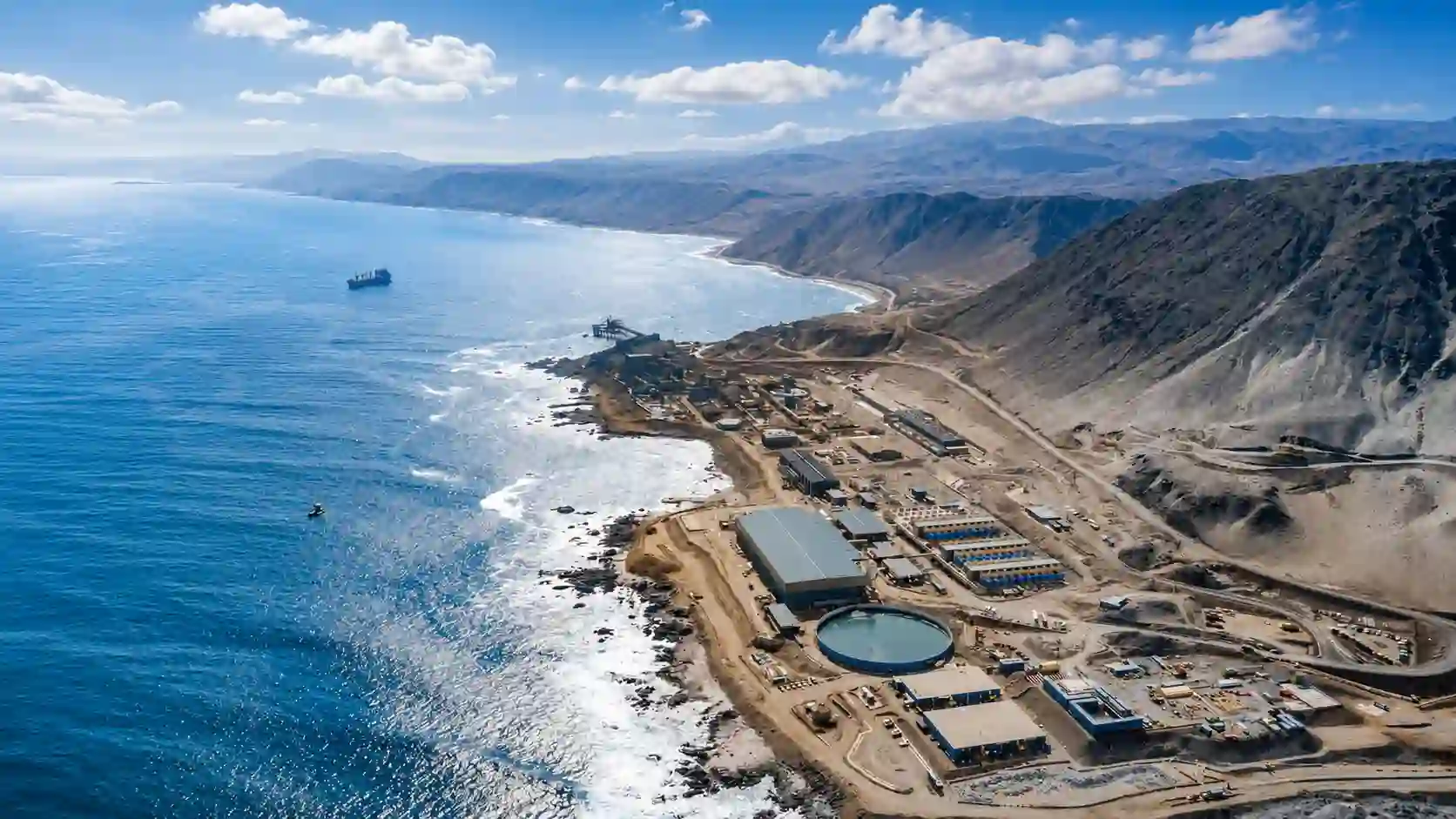
Chile’s copper industry is turning seawater into core mining infrastructure.
The shift includes coastal intakes, desalination plants, pipelines into the desert and Andes, pumping stations, reservoirs, electricity connections and environmental monitoring. These assets increasingly determine whether production can continue or expand.
Cochilco, Chile’s national copper commission, projects seawater at 67.6% of copper-mining water consumption by 2034. This includes desalinated and directly used seawater, rather than desalination alone.
Project progress varies. Los Pelambres is expanding capacity, Aguas Horizonte continues to publish Distrito Norte construction updates, and Collahuasi’s desalination system faces an authorization issue identified in Anglo American’s 2026 disclosures. Environmental approval, installed capacity and water delivered to a mine are different measures.
Supporting infrastructure also matters. Antofagasta’s logistics expansion illustrates industrial land, maritime works and service demand around northern Chile’s mining economy. The Chile Power Grid analysis explains the electricity constraints behind continuous treatment and pumping.
Chile’s copper industry is building a coast-to-mine infrastructure layer. Water treatment, conveyance, electricity and operating authorization jointly determine whether that system can support reliable production.
Chile’s mining story is usually told through copper reserves, lithium, investment and global demand. Water often appears as a background constraint. In northern and central Chile, it increasingly determines the design, location and operating conditions of mining projects.
The transition includes desalinated seawater and direct seawater use. Both require infrastructure outside the ore body: coastal access, water conveyance, pumping, electricity, maintenance and monitoring. Desalination additionally requires treatment systems and management of concentrated saline discharge, commonly called brine.
The operating geography therefore stretches from the Pacific coast to desert and mountain mine sites. Water systems connect coastal communities, infrastructure developers, utilities, engineering firms and mining operators within the same production chain.
This connection is visible in Econosur’s Chile mining investment analysis. Replacement plants and mine expansions depend on supporting infrastructure as well as mine-site capital. The Kimal–Lo Aguirre project, a major north-to-central-Chile electricity connection, provides a separate example of the transmission investment occurring around this wider industrial system.
The Cochilco forecast: seawater becomes the dominant source
Cochilco’s 2025–2034 water-demand outlook projects copper-mining water use increasing from 18.5 cubic metres per second in 2024 to 20.6 in 2034. The more substantial change is the composition of supply.
Seawater’s projected share rises from 40.7% in 2024 to 67.6% in 2034. This is a sector forecast based on operating and project assumptions. It does not measure capacity already built or guarantee that every planned system will operate on schedule.
Electricity requirements reinforce the infrastructure implications. Cochilco projects copper-mining electricity use rising from 27.6 terawatt-hours in 2025 to 33.2 in 2034, a 20.2% increase, compared with projected copper-production growth of 8.3% over that period. Concentration and seawater-related demand contribute to the increase.
The transition is already physical, but project status must remain specific. Los Pelambres’ August results confirm work on expanded desalination capacity. Aguas Horizonte’s project page includes a September 4 construction-progress update. Collahuasi’s latest reviewed half-year disclosure describes continued use of alternative water sources while the desalination authorization issue is addressed.
Water supply is becoming a production system that combines treatment, transport, electricity and permission to operate.
Law 21.813: a new framework with transitional provisions
Law 21.813, published in May 2026, establishes a dedicated desalination framework covering national strategy, concessions, technical review and easements. The Dirección General de Aguas, Chile’s water authority, receives an expanded role. Qualifying projects may face a public-interest water contribution of up to 5%.
The general commencement is deferred for eighteen months after publication, into November 2027. The National Desalination Strategy title has a separate mechanism linked to its regulation. Existing concessions retain their granted conditions during their remaining term, subject to specified transitional provisions.
Developers and suppliers need to establish the rules applicable to each project, its concession dates and planned modifications. A general statement that every existing system switches to an identical new regime would overlook the law’s transition arrangements.
Escondida: the baseline for large-scale mining desalination
Escondida, BHP’s major copper operation in northern Chile’s Antofagasta Region, is a reference case for the use of desalinated seawater at mining scale. Its supply system links coastal treatment with inland production through pumping and conveyance infrastructure.
The commercial lesson extends beyond treatment capacity. Reliable supply requires pumps, pipelines, power, corrosion control, maintenance and the ability to manage interruption risks along the whole route.
Escondida also demonstrates the environmental geography of the transition. Lower pressure on inland water sources does not remove coastal responsibilities. Intake structures, saline discharge, marine monitoring, energy demand and local communities remain part of the operating system.
The project map: operating systems, expansion and approval risk
The cases below illustrate different infrastructure and purchasing models. The October 3 review uses dated disclosures and distinguishes project design from confirmed operation. Sierra Gorda was added on October 8 using KGHM’s October 2 announcement. A published capacity or earlier commissioning description does not by itself establish current water delivery.
| Project / company | Status and evidence reviewed | Water-infrastructure signal | Commercial meaning |
|---|---|---|---|
| BHP / Escondida Antofagasta Region |
Established operating system | Large-scale desalinated-water supply connects coastal infrastructure with copper production. | Reference for operating reliability, maintenance and the full coast-to-mine equipment chain. |
| Antofagasta Minerals / Los Pelambres Coquimbo Region |
Operating base + expansion August 13, 2026 half-year results |
The 400 litres-per-second base plant is being expanded to 800, with associated infrastructure. | Expansion packages and production-continuity work require different screening from an entirely new project. |
| Teck / Quebrada Blanca Tarapacá Region |
Operating | Desalinated seawater serves production processes through a coastal-to-inland system. | Water treatment, conveyance, electricity and maintenance form one operational chain. |
| Codelco / Aguas Horizonte Tocopilla–Calama, Antofagasta Region |
Construction progress published September 4, 2026 project update |
Phase-one design capacity of 840 litres per second; nominal flow of 630; more than 160 kilometres of conveyance. | A separately financed and operated district system; design capacity does not confirm commercial water delivery. |
| Collahuasi C20+ Patache–mine corridor, Tarapacá Region |
Authorization issue Anglo American, July 30, 2026 |
Project design includes a 1,050 litres-per-second desalination plant and high-altitude pumping. July reporting describes alternative water supply while plant restart is pursued. | Physical completion and commissioning descriptions cannot replace current legal and operating-status checks. |
| CRAMSA / Aguas Marítimas Antofagasta Region |
Environmental approval announced May 27, 2026 company disclosure |
Proposed capacity of up to 700,000 cubic metres per day, with a regional water-conveyance and electricity network. | Approval supports development but does not establish financing, construction contracts or commercial operation. |
Codelco’s Distrito Norte system demonstrates why capacity labels matter. Aguas Horizonte gives 840 litres per second as phase-one design capacity and 630 as nominal flow. Its later-stage design is up to 1,956 litres per second, with nominal flow of 1,630. These figures describe the planned system rather than water already delivered.
Aguas Horizonte, founded by Marubeni and Transelec, uses a build, own, operate and transfer arrangement. It finances and operates the infrastructure before eventual transfer to Codelco. For suppliers, that ownership model is commercially relevant: purchasing decisions need not follow the same route as mine-owned equipment.
At Los Pelambres, Antofagasta’s August 13 results confirm progress toward 800 litres per second. The disclosure also identifies repair requirements following July’s severe weather in Coquimbo. This illustrates the difference between capacity expansion and resilience work on infrastructure already supporting production.
Collahuasi’s status needs particular care. Anglo American reported that the May environmental tribunal ruling set aside the desalination authorization. Its July half-year report describes continued alternative water supply and efforts to restart the plant. The earlier “pre-commissioning / commissioning” description is therefore insufficient as a current operating-status label.
The Aguas Marítimas proposal represents a multi-user model rather than a dedicated mine-only system. Its approved design combines water production with long-distance conveyance and electricity infrastructure. A supplier still needs evidence of financing, customer contracts, engineering appointments and actual package release before treating it as an accessible tender opportunity.
Sierra Gorda: existing seawater infrastructure supports expansion
KGHM reports that Sierra Gorda uses seawater conveyed from the Mejillones area and renewable electricity. Its US$725 million expansion is designed to make fuller use of existing water and power assets. The disclosure does not specify an additional water-flow requirement. Read the Sierra Gorda analysis.
The case connects mine expansion with the reliability and capacity of an established water corridor. It does not establish a new desalination-plant contract.
Antofagasta: coastal infrastructure also creates a logistics market
Antofagasta is a city and a mining region in northern Chile. Coastal water infrastructure and inland mines require transport, storage, fabrication, spare parts and specialist services. That supporting industrial market extends beyond the desalination plant itself.
Econosur’s Antofagasta logistics analysis examines Puerto Antofagasta’s maritime investment and the La Negra industrial logistics zone. The port is tendering dredging works with technical bids scheduled for October 20 and financial bids for October 27, 2026. Its La Negra development offers industrial land for logistics and services supporting regional production.
These developments provide context for mining infrastructure suppliers. Large pumps, electrical equipment, pipe sections and treatment components need physical handling, storage and delivery arrangements. Fabrication and maintenance providers may also serve several mining or infrastructure customers from an industrial location.
Connections must be verified project by project. Puerto Antofagasta’s dredging tender is not evidence of a contract to supply a particular desalination plant. Patache, Tocopilla and other coastal sites have their own operating and procurement structures. A regional infrastructure concentration does not establish a common buyer.
Antofagasta’s Logistics Expansion: Mining, Port Infrastructure and New Supplier Demand
Maritime works, industrial land and the commercial routes connecting northern Chile’s mining economy with transport and supplier services.
Why this changes the mining value chain
A copper project can require much more than a mine, concentrator and tailings facility. Coastal intake, treatment, saline discharge, high-pressure pumping, reservoirs, electrical connections and pipeline maintenance can become conditions for production.
These systems affect both capital costs and operating costs. They also change the organizations involved. A mine owner, water developer, engineering contractor, utility and logistics provider can each control different parts of the infrastructure.
The commercial consequence is that supplier research needs to follow asset ownership and package responsibility, rather than stopping at the mining company’s name. The specification owner, purchaser and final user may be different organizations.
Water infrastructure can determine whether mineral capacity becomes productive capacity.
Reserves and processing equipment need an authorized, powered and reliable water system. Delays at the coast or along the conveyance corridor can affect a mine located far from the original infrastructure problem.
Environmental authorization and coastal legitimacy
Desalination reduces reliance on inland freshwater, but environmental responsibilities remain. Marine intake, saline discharge, fisheries, coastal land use, pipeline routes and electricity infrastructure all require assessment and continuing management.
Academic research on desalination in Chile’s mining regions examines how this technological response can change the location and character of water-related conflict. Relief for inland water systems does not automatically establish acceptance of coastal infrastructure.
The contrast between Collahuasi and Aguas Marítimas is useful. One case shows that authorization can remain contested after extensive physical investment. The other shows that environmental approval alone does not establish construction or operation.
For suppliers and investors, the sequence should remain explicit: project design, environmental approval, sector permissions, financing, contracting, construction, commissioning and reliable delivery. Progress at one stage does not establish completion of the next.
Mining companies and water developers need to manage both the inland production system and the coastal environment. A water strategy that succeeds at reducing freshwater use can still require substantial work on marine monitoring, local engagement and operating conditions.
What this means for suppliers
Chile’s mining-water transition creates demand for marine works, intake systems, pretreatment, reverse osmosis, pumps, pipelines, drives, substations, automation, sensors, corrosion management, reservoirs and monitoring. Long-term maintenance and emergency-response services are part of the same infrastructure market.
Foreign suppliers need to establish the applicable technical standards, qualification process, installed equipment base and support requirements. Spanish-language documentation, relevant references and reliable service arrangements help buyers assess equipment for coastal, desert and high-altitude conditions.
The electrical layer deserves separate attention. Pumping and treatment depend on transformers, substations, protection, controls and transmission connections. The Kimal–Lo Aguirre procurement analysis provides a separate example of specialist electrical equipment and international participation in Chilean infrastructure.
The logistics layer creates another set of questions: where equipment arrives, how it is stored, who transports it, which local firms provide fabrication or service, and whether the project has contracted those activities already. The Antofagasta case helps place those questions in their regional industrial context.
The supplier market consists of several different purchasing systems.
Operating mine-owned assets, separately financed water systems, expansion projects and multi-user networks create different entry conditions. Useful research identifies who sets specifications, who purchases, what is already contracted and whether an equipment or service category remains open to new suppliers.
Key business and investor questions
Construction progress is a useful starting point, but it does not prove an unawarded contract exists. Los Pelambres’ expansion and Distrito Norte’s published construction activity justify package-level research. Collahuasi requires an authorization and execution check before assuming restart work is available. Aguas Marítimas requires verification of financing, customers, engineering and procurement milestones beyond its environmental approval.
Relevant categories extend across the complete system. Treatment technology, pumping, pipelines, electrical equipment, monitoring, maintenance and logistics each have their own buyers and qualification requirements. A practical assessment identifies the specific package, local support needs, incumbent suppliers and purchasing authority.
Watch the conversion from an authorized design into financed, contracted and operating infrastructure. Customer agreements, contractor appointments, grid availability, commissioning and sustained delivery matter alongside environmental and legal conditions. Published capacity should remain separate from demonstrated operating performance.
Seawater supply becomes part of copper competitiveness
Chile’s copper competitiveness depends increasingly on the infrastructure that moves water from the coast into production. Ore bodies and processing plants remain central, but their performance can be constrained by water conveyance, electricity, authorization and reliability.
This creates a wider industrial market. Water developers, utilities, contractors, equipment suppliers and logistics firms contribute to the same production system while operating through different purchasing and contractual structures.
The commercial task is to connect those structures to a concrete question: which project, which asset, which buyer and which package is relevant to a supplier’s products or services? That is the level at which broad infrastructure demand becomes a assessable business opportunity.
Need the market behind the public project data?
Public disclosures show project design, capacity, approvals and construction signals. Commercial research establishes purchasing responsibilities, supplier requirements, incumbent positions and the evidence that a project is moving into executable contracts.
Econosur provides custom research on South American companies, projects, competitors and suppliers, combining public-source analysis with primary interviews and targeted verification. Assignments can focus on one water project, one equipment category or one unresolved commercial question.
Commission custom researchSources
Updated October 8, 2026. The analysis uses the dated disclosures below. Forecasts, design capacities, environmental approvals and operating status are distinguished throughout. Undated project pages provide design context; they do not independently confirm commercial commissioning.
- KGHM, October 2, 2026 — Sierra Gorda expansion.
- Biblioteca del Congreso Nacional de Chile — Law 21.813, including concessions, strategy, technical review and transitional provisions.
- Diario Oficial — May 12, 2026 edition referenced for publication of Law 21.813.
- Cochilco — Copper-mining water-demand outlook 2025–2034.
- Cochilco — projected seawater share of copper-mining water use.
- Cochilco — Copper-mining electricity-demand outlook 2025–2034.
- BHP — resource and operating context, including Escondida.
- Antofagasta plc — Q2 2026 production and Los Pelambres development context.
- Antofagasta plc, August 13, 2026 — Los Pelambres desalination expansion and weather-related infrastructure repairs.
- Teck — Quebrada Blanca operation and seawater infrastructure.
- Collahuasi — C20+ project design and infrastructure scope.
- Anglo American, May 18, 2026 — Collahuasi environmental authorization ruling.
- Anglo American, July 30, 2026 — half-year report, alternative water supplies and desalination restart context.
- Aguas Horizonte — ownership model, design capacity, nominal flows and district water system.
- Aguas Horizonte — construction-progress series, including September 4, 2026.
- Codelco — Distrito Norte desalination project.
- CRAMSA — Aguas Marítimas project design.
- CRAMSA, May 27, 2026 — announcement of Aguas Marítimas environmental approval and proposed capacity.
- Puerto Antofagasta, September 21, 2026 — dredging tender and October bid-opening timetable.
- Puerto Antofagasta, September 25, 2026 — industrial logistics land and regional supplier activities.
Academic research provides environmental and social context. Project figures and dated status statements use the institutional and operator sources above.
FAQ
Why is seawater becoming important for Chilean mining?
Many Chilean copper mines operate in arid regions where inland water access is constrained. Seawater supply, desalination, pipelines and pumping systems help sustain production while reducing dependence on freshwater sources.
How much of Chilean copper mining water could come from the sea by 2034?
Cochilco projects seawater at 67.6% of total copper-mining water consumption by 2034. This includes desalinated and directly used seawater. It is a sector forecast, not installed capacity or a guaranteed outcome.
Which mining companies are central to Chile’s seawater infrastructure shift?
Relevant cases include BHP’s Escondida, Antofagasta Minerals’ Los Pelambres, Teck’s Quebrada Blanca, Codelco’s Distrito Norte system with Aguas Horizonte, Collahuasi’s C20+ project and CRAMSA’s proposed Aguas Marítimas network.
Does desalination solve Chile’s mining water problem?
Desalination reduces reliance on inland freshwater but still requires electricity, coastal intake and discharge infrastructure, pipelines, maintenance, environmental permits and community engagement.
What does Law 21.813 change for mining desalination projects?
The law creates a dedicated desalination framework. Its general commencement is deferred for eighteen months after publication in May 2026; the National Desalination Strategy title has a separate commencement mechanism. Existing concessions are subject to transitional provisions.
Why does Chile’s power grid matter for mining-water infrastructure?
Desalination and high-elevation pumping require substantial continuous electricity supply. Grid connections, substations, drives, protection and transmission capacity therefore affect water-system reliability.
How does Antofagasta logistics connect to mining-water infrastructure?
Water projects require transport, storage, industrial services and coastal access as well as treatment equipment. Antofagasta’s port and industrial logistics development illustrates this supporting supplier market, but individual project connections must be verified.
Why does this matter for suppliers?
Supplier demand includes marine engineering, pretreatment, reverse osmosis, pumps, pipelines, electrical systems, automation, monitoring, maintenance and technical documentation. Accessible contracts depend on ownership, qualification, package timing and existing supplier relationships.