
Brazil’s Wood Industry Is Rebalancing:
Where the Supplier Opportunity Sits in Paraná
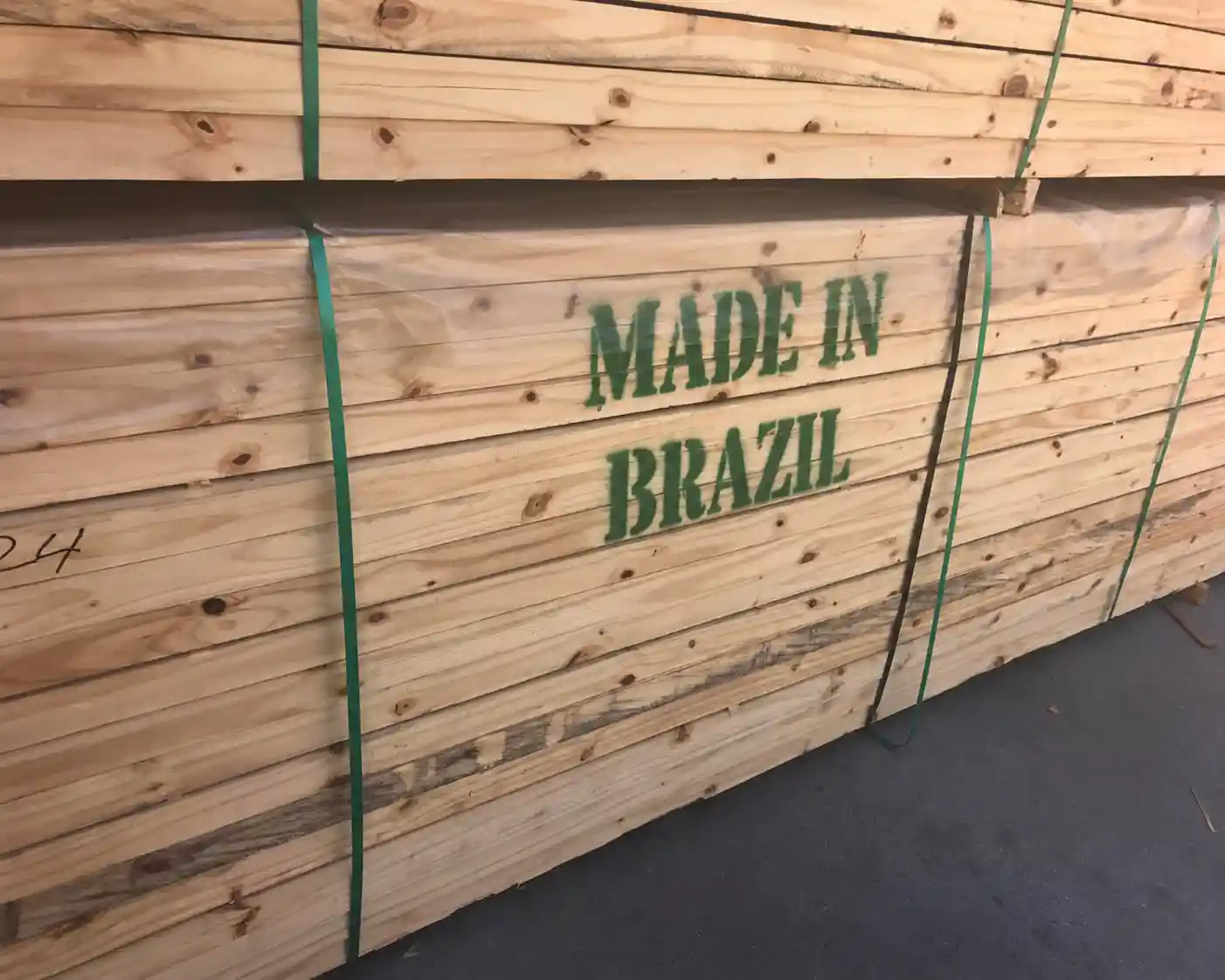
Paraná combines plantation scale, pinus processing, plywood exports and direct port access. The current commercial question is no longer only how much wood the state can produce, but how processors diversify export exposure, raise plant efficiency and move further into higher-value products.
The supplier case in Paraná is not based on a simple “wood market is growing” argument.
Paraná already has scale. APRE Florestas reports roughly 1.17 million hectares of planted forests and more than half of Brazil’s pinus wood production. ABIMCI reports that Paraná accounted for 67% of Brazil’s pinus plywood export volume in 2025.
The pressure is now on the industrial layer: export concentration has become more visible, forest-product exports from Paraná fell in 2025, and processors face a more complicated trade environment. That creates a stronger strategic case for market diversification, higher productivity and more value-added processing.
For technology suppliers, the relevant opportunity therefore sits around the plant and processing chain — automation, material handling, industrial maintenance, quality control, digital integration and higher-value wood processing — rather than around plantation expansion alone.
Why Paraná matters to Brazil’s wood industry
Paraná is not a marginal forestry state. It is one of the operating cores of Brazil’s planted-forest and solid-wood economy.
APRE Florestas reported in July 2026 that Paraná has about 1.17 million hectares of planted forests. Pinus accounts for 710,836.77 hectares, and the state produces more than 50% of Brazil’s pinus wood.
The processing base is equally important. ABIMCI’s 2026 sector study reports that Brazil produced 3.5 million cubic metres of pinus plywood in 2024 and exported 2.3 million cubic metres in 2025. Paraná accounted for 67% of that export volume, with Santa Catarina accounting for the remaining 33%.
Structural reading: Paraná combines the resource base, processing capacity and export logistics needed for a full wood-industry cluster. That makes plant productivity and downstream processing commercially more important than plantation area alone.
The first rebalancing axis: export concentration
The clearest pressure point is market concentration. APRE Florestas reports that Paraná exported US$2.3 billion of forest products in 2025, around 9% less than the US$2.5 billion recorded in 2024.
The decline was particularly sharp in segments with heavy U.S. exposure. According to APRE, mouldings sent 98% of their exports to the U.S. market and fell 61% in export value in 2025. Wooden doors sent 95% to the United States and fell 55%. Pinus plywood exports fell 13%.
The broader Brazilian planted-tree industry remained under pressure in 2026. Ibá reported US$7.5 billion in sector exports during the first half of 2026, down 5.9% year on year, citing a more protectionist and disrupted global trade environment.
Paraná’s issue is not a lack of forestry scale. It is how an export-oriented processing base adapts when customer concentration and trade policy become less predictable.
Tariffs must be read product by product
The tariff story requires precision. It is not accurate to apply one blanket U.S. tariff rate to “Brazilian wood”.
Under the U.S. Section 232 wood-products measure, certain softwood timber and lumber face a 10% tariff, while specified upholstered wooden products, kitchen cabinets and vanities face 25%. Proclamation 11000, signed on December 31, 2025 and published in the Federal Register on January 9, 2026, delayed the planned increases on the latter categories until January 1, 2027.
Plywood deserves a specific distinction. The Section 232 wood-products action does not cover plywood classified under HTS heading 4412; the measure targets specified softwood timber and lumber plus selected upholstered wooden products, kitchen cabinets and vanities. That exclusion from Section 232 does not mean Brazilian plywood is automatically tariff-free: separate trade measures, including the 2026 Brazil Section 301 action, still require a check at the exact HTS subheading level. Separately, the U.S. Trade Representative imposed a 25% Section 301 tariff on certain Brazilian goods in July 2026. APRE Florestas said after the announcement that the association was still reviewing the annexes to determine precisely which wood products were covered or excluded.
Evidence boundary: no single tariff rate describes Paraná’s wood exports
Section 232, Section 301 and product-specific exceptions can overlap differently by HTS classification. For Paraná, the distinction is material because plywood under HTS heading 4412 sits outside the Section 232 wood-products tariff scope, while other U.S. measures may still apply. A commercial assessment therefore needs the exact product code, destination and effective tariff treatment.
This is also why a general market article should not turn an industry-level tariff headline into a company-level landed-cost assumption.
The second rebalancing axis: more value inside the plant
Export diversification is one response. Higher-value industrial processing is another.
Paraná already contains an example of how the value chain can move beyond conventional lumber and plywood. In Almirante Tamandaré, in the Curitiba metropolitan region, Urbem operates an engineered-wood plant producing mass-timber products such as CLT and glulam.
The Government of Paraná reported in June 2025 that the plant represented approximately R$220 million in investment, employed 150 people and had installed capacity of 60,000 cubic metres of pinus structures per year.
Urbem’s own factory material shows what “higher value” means operationally: pressure treatment, visual and mechanical grading using scanners, in-house testing, controlled lamella production and industrial fabrication of structural products.
| Processing layer | What changes | Supplier relevance |
|---|---|---|
| Primary processing | Logs become standardized lumber and plywood inputs. | Sawing, handling, drying, maintenance, controls and throughput. |
| Quality control | Wood is graded, tested and classified for more demanding uses. | Scanning, measurement, testing, process data and traceability systems. |
| Engineered wood | Lamellae become structural CLT and glulam components. | Precision processing, treatment, adhesives, pressing, CNC and factory integration. |
| Industrial integration | Plants optimize yield, downtime, labour and production flow. | Automation, robotics, predictive maintenance and material handling. |
Important distinction: one engineered-wood plant does not prove that the whole Paraná industry is shifting to mass timber. Urbem is evidence that a higher-value processing route exists locally and requires a different technology stack from commodity lumber production.
Where the supplier opportunity actually sits
The strongest supplier case is therefore not “sell equipment to a growing forestry market.” It is more specific: identify which processors are investing in productivity, product quality or downstream processing, then determine who controls the technical specification and purchasing route.
Automation and process integration
Controls, sensors, line integration, robotics and production software become relevant where processors need higher throughput, lower waste or more consistent output.
Material handling
Conveying, sorting and internal logistics matter across sawmills, panel production and integrated processing lines.
Maintenance and uptime
Power transmission, bearings, reducers, lubrication and predictive maintenance address operating efficiency rather than production capacity alone.
Scanning, grading and testing
Higher-value applications increase the importance of dimensional control, mechanical classification and consistent product quality.
Engineered wood systems
CLT, glulam and other advanced products require more controlled processing and tighter integration between engineering and production.
Local service and technical support
For imported machinery, commissioning, spare parts, maintenance capability and response time can matter as much as the equipment itself.
These categories describe structural areas of supplier relevance. They do not establish that a specific Paraná mill currently has an open RFQ or approved investment budget.
Why European suppliers are structurally relevant
The supply side is important because Europe remains unusually strong in woodworking machinery.
VDMA reports that EU-27 manufacturers accounted for 59.0% of global trade in woodworking machinery in 2024, including intra-EU trade. That does not mean European suppliers automatically win in Brazil, but it establishes that the technology categories relevant to Paraná are a real European industrial strength.
Italy illustrates the same point. Acimall reports 2025 Italian woodworking and furniture technology production of €2.398 billion, with exports of €1.582 billion. Exports fell 6.6% from 2024, which also means suppliers themselves are looking for competitive markets rather than operating from a position of effortless demand.
European capability is real. Market access is still local.
A strong export position in woodworking machinery is not the same as a route into a Paraná plant. Suppliers still need to identify the processor, investment trigger, technical gatekeeper, service model, distributor or direct-sales structure, and the point at which specifications become purchasing decisions.
Lignum Latin America makes the technology layer visible this week
The timing of this market question is useful. Lignum Latin America takes place from 15 to 17 September 2026 in Pinhais, in the Curitiba metropolitan region.
The organizer expects more than 160 exhibitors and more than 12,000 qualified visitors. The event is connected to the wider Semana Internacional da Madeira and covers the forestry, industrial processing, biomass and timber-construction chain.
The exhibitor material is revealing because it shows which technology classes are being positioned to the industry. Mendes Máquinas is presenting advanced industrial equipment, automation, material-handling systems and digital production integration. A.T.I. Brasil is showing power transmission, pneumatics, bearings, reducers, lubrication, automation and predictive-maintenance solutions. SVJD Robotics is presenting AI, computer vision and robotics for production decisions.
Lignum also has institutional support from sector organizations in Argentina, Chile, Colombia and Uruguay, reinforcing Curitiba’s role as a regional meeting point rather than only a domestic Brazilian event.
Evidence discipline: an exhibitor list proves supplier positioning, not buyer demand or contract awards. The commercial value is in identifying which technologies suppliers expect the market to discuss, then verifying which Paraná plants have the corresponding investment need.
Paranaguá keeps the export route close to the industrial cluster
Paraná’s supplier case is also supported by logistics. The state’s ports handled a record 1.66 million TEU in 2025.
Portos do Paraná reports that wood was one of the three main containerized export products, totaling 1.6 million tonnes in 2025. The United States was one of the main destinations.
This matters because the cluster is not only near plantations and processing sites. It is connected to a large container-export system. For machinery suppliers, however, port performance solves only one layer: imported equipment still depends on customs, inland transport, installation, commissioning, spare parts and after-sales service.
Marcus A. Volz perspective: the opportunity is created by adjustment, not by forest area
Paraná’s commercial signal is the combination of scale and pressure
Paraná already has the raw material base and an established export-processing industry. That alone does not create a new supplier thesis. The more important signal is that an export-oriented cluster is being forced to review market concentration while processors continue to compete on productivity, quality and downstream value.
This creates two simultaneous adjustment paths. The first is geographic: reduce excessive dependence on a small number of export markets. The second is industrial: improve yield, automation, quality and product sophistication inside the plant.
The second path is where international industrial suppliers become relevant. A European machinery producer does not need the entire Brazilian wood sector to shift into mass timber. It needs a defined group of processors where the economics of throughput, product quality, labour, maintenance or value-added processing justify investment.
The real research question therefore begins below the sector level: which plants are investing, which technical problem is being solved, who specifies the equipment, and whether the commercial route runs through direct sales, a local integrator, a distributor or another supplier already embedded in the mill.
The supplier opportunity is not “Brazilian forestry.” It is the plant-level investment triggered when a mature export cluster has to become more efficient, more flexible or more valuable per cubic metre.
Commercial implications for international suppliers
| Supplier question | What the public evidence supports | What still needs verification |
|---|---|---|
| Is Paraná large enough? | Yes. Plantation, pinus production, plywood exports and port volumes establish industrial scale. | Which sub-segment has the strongest investment cycle now. |
| Is there a productivity case? | Lignum supplier positioning and engineered-wood processing show a broad technology stack around automation, reliability and quality. | Which individual mills have approved projects, budgets or RFQs. |
| Can Europe compete? | EU suppliers hold a 59% share of global woodworking-machinery trade; Italy remains highly export-oriented. | Price positioning, local service, incumbent competitors and channel structure in Paraná. |
| Does export pressure create investment? | Paraná export concentration and 2025 declines create a strategic reason to diversify and improve competitiveness. | Whether a specific processor responds through capex, market diversification, pricing or production cuts. |
Three business questions worth answering next
1. Which Paraná mills are moving from general productivity pressure into an actual 2026–2027 machinery or automation investment?
Public market data identify the cluster. They do not identify the complete capex pipeline, project stage, technical specification or RFQ calendar.
2. Who controls equipment selection: the mill, an engineering partner, a local integrator, the machinery OEM or a distributor?
The buying point can differ by line, retrofit, greenfield project and service requirement. Supplier strategy depends on locating that technical and commercial gatekeeper.
3. Where does an imported technology need local service, spare-parts stock or a Brazilian partner to become commercially credible?
Global technology strength is valuable only when it can be translated into commissioning, uptime and support at plant level.
Where public information stops
Public evidence establishes Paraná’s industrial scale, export exposure, visible processing technologies and supplier categories. It does not establish a complete buyer or procurement map.
The public record does not provide a complete list of mills with approved 2026–2027 capex, equipment replacement cycles, RFQs, approved vendors, line-level technical specifications, incumbent OEM performance, service gaps or current procurement contacts.
It also does not show whether every company affected by export pressure will respond with investment. Some may diversify customers, cut output, change product mix, postpone capex or renegotiate commercial terms.
That boundary matters. The free market insight identifies the structure and the commercial hypothesis. A supplier-specific project would need to verify the target plants, buying points and investment triggers.
Research services for Brazil’s wood-processing market
Econosur can structure deeper research around one defined commercial question in Paraná or the wider Southern Brazil forestry and wood-processing cluster.
Sector & sub-segment screening
Compare sawmilling, plywood, doors, mouldings, panels, engineered wood and adjacent processing through export exposure, plant structure and technology intensity.
Buyer & processor mapping
Identify mills, processors and industrial groups relevant to a defined machine, component, automation or service category.
Supplier & competitor research
Map incumbent OEMs, local integrators, distributors, service providers and competing technologies around a defined technical scope.
Procurement-route analysis
Determine whether specifications and purchasing sit with the mill, engineering, integrator, distributor or another technical intermediary.
Export & tariff exposure
Trace product-level export concentration and test tariff assumptions against HS/HTS classifications and destination markets.
Primary market checks
Where practical, validate investment timing, technical priorities and supplier-access assumptions with companies and sector participants.
- Serviço Florestal Brasileiro / SNIF — foreign-trade statistics based on official MDIC Comex Stat data, updated through 2025.
- MDIC — Comex Stat, Brazil’s official detailed goods-trade database.
- Portos do Paraná — 2025 container and wood-export volumes.
- Government of Paraná — Urbem investment, employment and installed capacity, June 2025.
- U.S. Federal Register — Proclamation 10976, Section 232 timber, lumber and derivative-product tariffs.
- U.S. Federal Register — Proclamation 11000, postponing scheduled furniture/cabinet tariff increases to January 2027.
- RV Industry Association — Section 232 wood-products scope: plywood under HTS heading 4412 is outside the Section 232 tariff list.
- USTR — final Section 301 action on certain Brazilian goods, 15 July 2026.
- APRE Florestas — Paraná planted-forest and pinus base, 8 July 2026.
- APRE Florestas — Paraná 2025 forest-product exports and U.S.-exposed product segments, 9 April 2026.
- APRE Florestas — July 2026 caution on product-level tariff coverage.
- ABIMCI — 2026 sector study: pinus plywood production, exports and Paraná share.
- Ibá — first-half 2026 planted-tree industry exports and global trade pressure.
- Urbem — factory processes, pressure treatment, scanning, grading and testing.
- VDMA — EU-27 share of global woodworking-machinery trade in 2024.
- Acimall — final 2025 Italian woodworking-technology production and export data.
- Lignum Latin America — 15–17 September 2026, Pinhais; expected visitor and exhibitor numbers.
- Lignum Latin America — institutional support from Argentina, Chile, Colombia and Uruguay.
- Lignum Latin America — Mendes Máquinas: industrial equipment, automation, handling and digital integration.
- Lignum Latin America — A.T.I. Brasil: automation, transmission, lubrication and predictive maintenance.
- Lignum Latin America — SVJD Robotics: AI, computer vision and robotics for wood-processing production.
- Evidence note: supplier participation at Lignum is treated as evidence of supplier positioning and technology visibility, not as evidence of a purchase order, installed base or confirmed buyer demand.
- Econosur analysis: the two-axis “rebalancing” framework — geographic diversification plus industrial productivity/value addition — is an analytical interpretation of the cited evidence, not a claim made by any individual source.
- Econosur analysis prepared 14 September 2026.
Frequently asked questions about Brazil’s wood industry in Paraná
Why is Paraná important to Brazil’s wood industry?
APRE Florestas reports about 1.17 million hectares of planted forests in Paraná, including more than 710,000 hectares of pinus, with the state producing more than half of Brazil’s pinus wood. ABIMCI reports that Paraná accounted for 67% of Brazil’s pinus plywood export volume in 2025.
Where is the supplier opportunity in Paraná’s wood industry?
The strongest structural opportunity sits around processing efficiency, automation, material handling, maintenance, quality control, digital production systems and higher-value wood processing. Public evidence does not establish one open procurement pipeline, so buyer- and RFQ-level opportunity requires separate verification.
Are U.S. tariffs the same for all Brazilian wood products?
No. U.S. measures are product-specific and can overlap. Section 232 covers certain softwood timber and lumber and selected furniture and cabinet products, while the July 2026 Section 301 action applies to certain Brazilian goods. Companies need product- and HTS-level checks rather than one blanket tariff assumption.
What does Lignum Latin America show about the market?
The September 2026 event in Pinhais brings together the wood-processing chain and showcases technologies including industrial automation, handling, maintenance, digital systems and robotics. The event is a market signal about supplier positioning, not proof of specific purchase orders.
Need to identify the actual buyers behind Paraná’s wood-processing investment?
Econosur can map processors, suppliers, technical gatekeepers, competitors, procurement routes and investment signals around one defined machinery, automation or industrial-service category in Brazil.
Explore custom market analysis