
Paraguay’s Southwest Export Corridor: From Rural Road to Trade Route
Paraguay has secured the legal and financial framework for a JICA-backed road corridor between Yabebyry and Pilar. Its commercial value will depend on the next layer: whether reliable road access converts southern agricultural freight into sustained cargo flows through Pilar and the Paraguay–Paraná Hidrovía.
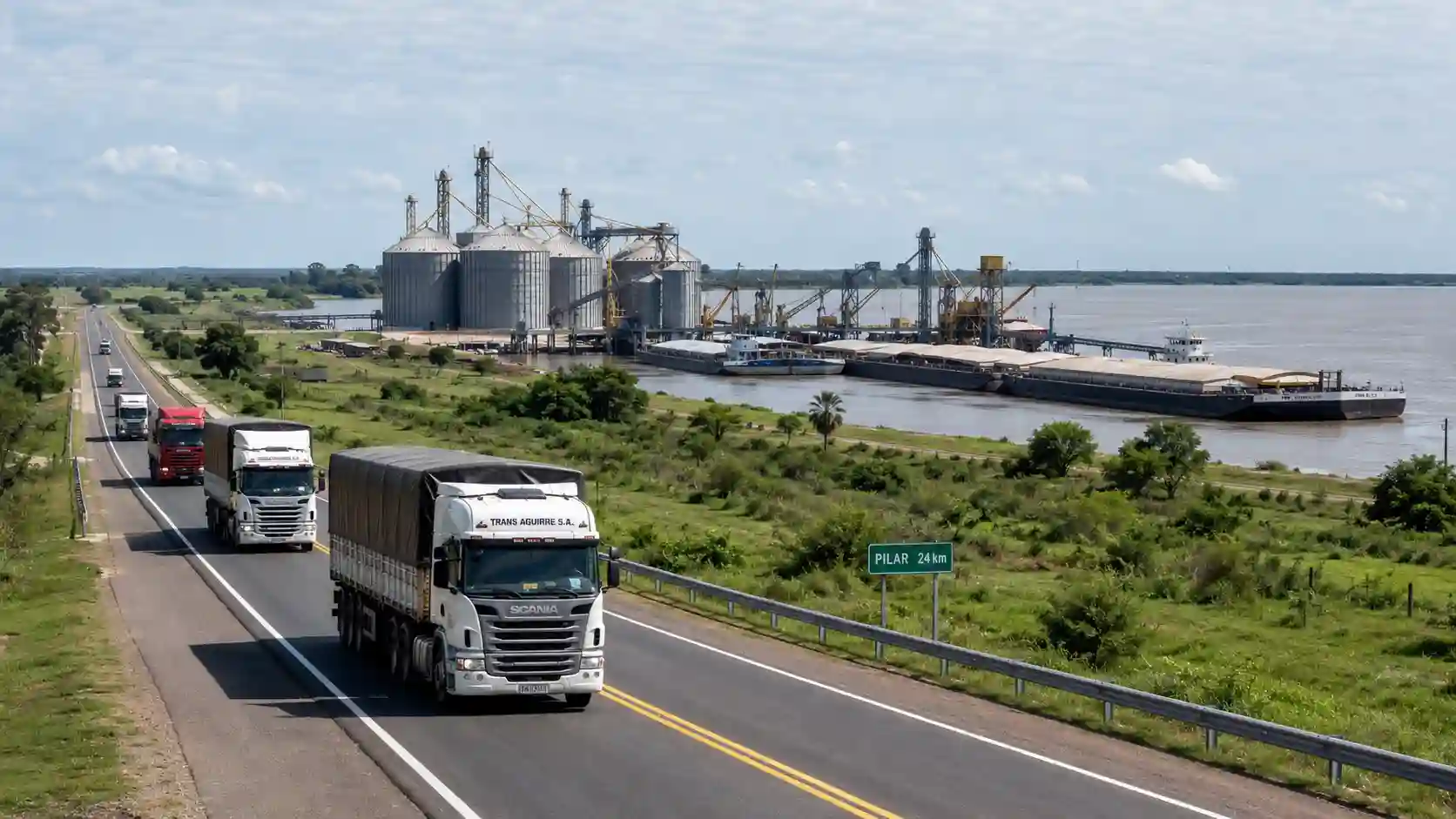
Quick answer: Paraguay’s Southwest Corridor has moved from project concept to a financed and legally approved infrastructure programme. The contractual JICA ceiling is JPY 36.38 billion and Law 7713 was promulgated on August 21, 2026. The implementation timetable contains an important official discrepancy: JICA lists March 2027 for the tender announcement of the first international construction packages, while MOPC’s August 2026 updates describe March 2027 as the start of the design stage and place construction after design and administrative steps. The road can strengthen Pilar as a southern logistics node, but the economic result still depends on freight generation, terminal use, river conditions and connections beyond the road itself.
Econosur research framework
Does the Yabebyry–Pilar investment create a commercially meaningful export corridor for southern Paraguay?
The financing, road scope and procurement schedule are documented; Pilar already operates as an import-export river terminal; rice provides a measurable freight base.
Public sources do not yet establish post-project freight volumes, final construction awards or a complete end-to-end international logistics chain.
The opportunity sits across road construction, bridges, drainage, traffic control, weighing, port interfaces, logistics services and later freight-system development.
August 2026 changed the project’s status
The most important development is legal rather than physical. JICA and Paraguay signed the loan agreement on December 12, 2025. The agreement sets a maximum loan amount of JPY 36.38 billion, a 25-year repayment period with seven years of grace, and a general untied procurement condition. JICA identifies the Ministry of Public Works and Communications, MOPC, as the executing agency.
Paraguay’s Congress completed the domestic approval process in August 2026. President Santiago Peña promulgated Law 7713 on August 21, approving the JICA loan agreement. That closes the main legislative financing step and moves the programme toward detailed design and procurement.
The yen amount is the cleanest financial reference. Paraguayan reporting has attached different US-dollar equivalents to the same JPY 36.38 billion ceiling. This analysis therefore uses the contractual yen amount rather than treating one converted dollar figure as fixed project value.
JICA and Paraguay sign the ODA loan agreement for the southwest integration and socioeconomic-development corridor.
Congress approves the financing and Law 7713 is promulgated on August 21.
Two official schedules currently point to the same month for different milestones: JICA lists the tender announcement of initial construction Packages 1, 2 and 3, while MOPC says the design stage is expected to begin in March 2027 and construction will follow after design and administrative steps.
JICA lists March 2031 as the planned project-completion point upon commencement of facility operation.
The financed scope is a transport system, not a single stretch of asphalt
MOPC describes around 154 kilometres of road works and 25.37 kilometres of urban crossings between the Yabebyry and Pilar corridor area. The intervention covers departmental roads, part of PY20 and the access to Cerrito. It also includes drainage, bypasses, road-safety works and four new bridges, including an approximately 400-metre structure over the Yabebyry River.
The November 2025 MOPC project description adds a useful operational layer. The programme includes 249 new drainage or road structures, reconstruction of 171 existing structures, a toll point, a fixed axle-load scale and bays for mobile weighing equipment. JICA’s own loan description includes mainline roads, access roads, bridges, small bridges, toll infrastructure and axle-load measurement stations.
Those details matter commercially. The project is designed around all-weather freight movement and road durability. Heavy-vehicle control, drainage and bridge capacity are part of the export-corridor logic, not decorative additions to a rural connectivity programme.
Financing, Procurement and Existing Roads
JICA’s published timetable lists March 2027 for initial international construction-package tender announcements and March 2031 for planned completion. These are planned milestones. MOPC’s August account describes different design-stage timing; neither document establishes that the main corridor is already under construction.
September reporting on maintenance complaints near Yabebyry concerns an existing local road. It does not establish an award or construction start for the JICA-backed programme. National rice-export figures provide freight context, not guaranteed future cargo through Pilar.
Rice gives the corridor a measurable freight base
JICA’s preparatory study gives rice a central role in the economic case. Its transport model evaluates how improved access changes the port choice for rice produced in the wider southern region. For 2020, the study attributed about 88,100 tonnes of rice exports to Pilar, corresponding to 23.5% of the modeled port distribution.
JICA then modeled two 2050 scenarios. Without the corridor, Pilar’s share falls to 21.7%. With the corridor, its modeled share rises to 25.3%. The absolute forecast depends on long-term production assumptions and should not be read as a guaranteed cargo outcome. The useful finding is the route-choice mechanism: lower inland transport friction can redirect part of a growing agricultural flow toward Pilar.
Current national trade data show why freight economics still matter. Banco Central del Paraguay reported 484,700 tonnes of parboiled-rice exports in January–May 2026, 12.7% above the same period of 2025. Export value fell 20.4% to US$137.7 million. Physical volume and export value are therefore moving in different directions. In a lower-price environment, inland transport cost, loading efficiency and route reliability become more important to producer and trader margins.
The corridor’s strongest economic case is freight conversion. Southern production already exists. The road investment changes the cost and reliability of reaching a river-export node. Whether that creates sustained additional cargo at Pilar will be an observable commercial result after the infrastructure enters operation.
Pilar is the infrastructure node that gives the road an export function
Pilar already has an institutional river-port function. The Administración Nacional de Navegación y Puertos lists the Pilar terminal at kilometre 1,330 of the Paraguay–Paraná Hidrovía and classifies its operations as import and export. ANNP describes the location as strategic for products from southern Paraguay.
The terminal also has physical assets relevant to a road-to-river logistics chain: a 9,000-square-metre truck parking area, a 6,000-square-metre container yard, cargo warehouses and container-handling equipment. ANNP lists 10-foot river access throughout the year. That is an operator statement and should be read as such. Recent operating conditions show why the qualification matters: during the severe Paraguay River low-water episode reported in October 2025, levels were exceptionally low at Pilar and other stations, and usable draft in some sectors fell to around nine feet, forcing barge-load reductions. Pilar is an existing logistics asset, but its effective capacity remains exposed to river conditions.
The port itself is receiving investment. In June 2026 ANNP reported ongoing renovation works at the terminal, including improvements intended to accommodate institutions involved in border controls. The same month, the new Japanese-donated DRM-5 dredger arrived at Pilar before entering the national navigation system. The vessel has a reported dredging capacity of around 1,500 cubic metres per hour.
This places the road project inside a broader logistics system. Econosur’s analysis of the Paraguay river economy and the Hidrovía explains the downstream layer: ports, barges, dredging, water levels and navigation conditions determine how inland production reaches Atlantic-facing routes.
A road corridor and a trade corridor have different evidence thresholds
The project can be assessed in three stages. The first is road infrastructure: financing, design, construction packages, bridges and all-weather access. Those elements are increasingly documented.
The second is the export corridor: agricultural freight must use the improved route, Pilar must handle additional cargo efficiently, and river transport must offer a competitive continuation of the journey. JICA’s model indicates this mechanism, while actual post-project cargo will provide the operational test.
The third stage is a wider international trade corridor. MOPC has linked the project to eastern Paraguay and to Brazil through the Puente de la Integración and PY07. That creates a possible network architecture. Commercial end-to-end performance will still depend on road continuity, border procedures, freight demand and route economics across the wider system.
River access remains the second half of the corridor
Pilar solves only the inland-road part of the export chain if the river leg works. JICA’s preparatory study explicitly examined river levels and port selection. It found that Pilar can play a complementary role when navigation becomes more difficult farther upstream. ANNP’s ongoing dredging programme provides current evidence that navigability is treated as strategic infrastructure by Paraguay itself.
This is the same execution logic visible across the wider South American logistics and waterways market. Production, road access, terminals, river depth, dredging and downstream connections form one commercial chain. A failure at one layer can absorb part of the benefit created at another.
The Southwest Corridor is a separate architecture from the Capricorn corridor
Paraguayan officials sometimes use bioceanic language when describing the southwest route because it can connect into wider Brazilian and Argentine networks. For market analysis, the architectures should remain separate.
The Inter-American Development Bank defines the Corredor Bioceánico de Capricornio as an Atlantic–Pacific road system running from Brazil through western Paraguay, northern Argentina and northern Chile. In Paraguay, its core geography is the Chaco, including the Carmelo Peralta–Porto Murtinho and Pozo Hondo–Misión La Paz connections.
The Southwest Corridor is centered on Misiones, Ñeembucú, Yabebyry and Pilar. Its strongest immediate logistics logic is southern production plus access to the Hidrovía. Econosur’s Bioceanic Bridge and corridor-readiness analysis covers the separate Capricorn route and the gap between physical infrastructure and mature end-to-end freight operations.
Pilar is also becoming a road node inside a wider Ñeembucú build-out
The Yabebyry–Pilar project is arriving while other southern road works are moving into execution. MOPC is paving the PY04 corridor from Pilar through Humaitá toward Paso de Patria. The two projects have separate contracts, financing structures and procurement routes, so contractor participation on PY04 does not imply any award on the JICA-backed Southwest Corridor.
The geographical effect is still relevant. Pilar gains connections north and east through the Southwest Corridor while the PY04 programme improves the road system to the south. The port, the road network and the Hidrovía can therefore reinforce each other as separate infrastructure assets.
This pattern also links to Paraguay’s wider industrial geography. The Paraguay industrial expansion model depends heavily on the relationship between production locations, external markets and physical logistics rather than on domestic demand alone.
Commercial implications: the first buying points are infrastructure packages
JICA lists the procurement condition as general untied and its December 2025 implementation schedule places the tender announcement for initial international construction Packages 1, 2 and 3 in March 2027. MOPC’s August 2026 updates, however, describe March 2027 as the beginning of the design stage and say construction will start after design and the corresponding administrative steps. The public record therefore identifies March 2027 as a key implementation and procurement marker, while the exact sequencing still requires reconciliation between the two official schedules.
The visible technical demand includes roadworks, bridges, drainage, pavement systems, traffic-safety infrastructure, toll equipment, axle-load measurement, supervision and environmental or social consulting. JICA also states that Japanese technologies may be applicable in subbase improvement, road markings and reinforcement materials for concrete pavement at the toll station.
The exact package structure, bidder qualification requirements, contractor shortlists, approved vendors and later supplier routes are not yet fully visible in public sources. Those questions become commercially relevant as detailed design and bid preparation convert the broad project scope into executable tender packages.
The commercial preparation window opens before physical construction. Firms supplying bridge systems, road materials, drainage, weighing equipment, traffic technology or engineering services need the package architecture and qualification route before awards are made. JICA’s March 2027 tender marker is commercially relevant, while MOPC’s design-stage timetable means suppliers should treat the date as planned rather than as a confirmed construction start.
Three business questions that require deeper research
1. How will JICA and MOPC divide the first construction packages?
JICA identifies Packages 1, 2 and 3 for planned international competitive bidding. MOPC simultaneously places the design stage in March 2027. The commercially decisive layer is therefore the reconciled tender sequence, detailed scope, qualification criteria and entity responsible for each procurement interface.
2. How much agricultural freight can realistically shift toward Pilar?
JICA provides a modeled route-choice effect. A commercial freight study would need current production geography, truck economics, competing ports, storage, river freight rates and seasonal navigation conditions to estimate realistic post-project cargo.
3. Which downstream constraint will set the corridor’s effective capacity?
The answer may sit outside the road itself: Pilar terminal throughput, truck handling, river draft, barge availability, downstream dredging or cross-border continuity can become the binding constraint once road access improves.
Research boundary
Evidence reviewed October 16, 2026: the JICA loan agreement, contractual JPY 36.38 billion ceiling, Law 7713 promulgation, MOPC project scope, JICA’s planned procurement schedule and Pilar’s current ANNP port function. JICA and MOPC currently describe the March 2027 sequencing differently; that discrepancy remains visible rather than being resolved by inference.
Strongly indicated: the road can increase Pilar’s relative attractiveness for agricultural freight and strengthen its role as a southern logistics node.
Unresolved: final construction awards, actual package buyers below the MOPC/JICA level, post-project cargo volumes, terminal-capacity utilization and the performance of any wider international route that uses the corridor.
Marcus A. Volz’s Perspective
The corridor’s economic value depends on converting road access into reliable freight movement. Financing and road design establish the framework; actual cargo, terminal performance and navigation conditions determine whether Pilar becomes a stronger export node.
Marcus A. Volz · Market Analyst & Founder of Econosur
Research Services for Paraguay Logistics and Infrastructure
Marcus A. Volz can investigate a defined company, market, buyer, supplier or project question through source analysis, targeted interviews and verification.
Reconcile official schedules, package scope, qualification and project-specific award status.
Identify engineering, construction, equipment and material purchasing routes.
Test cargo generation, competing ports, trucking cost and realistic use of Pilar.
Assess navigation, dredging, terminal constraints and institutional or industry evidence.
See Custom Market Analysis South America or discuss a research question.
Published information establishes the documented context. It does not by itself establish current buying needs, confidential contracts, complete qualification requirements, supplier positions or commercial accessibility. Announcements, approvals, financing, awards, construction and operations remain separate milestones. Direct research is scoped around a specific question and the evidence available.
Sources and Evidence
Source review: October 16, 2026. Figures retain their reporting periods, definitions and geographical scope. Decisions, company statements, forecasts and operating results are identified separately.
- JICA — ODA loan agreement, project components, financing terms and procurement schedule
- JICA — Preparatory Survey for the Southwest Export Corridor, including rice, port-choice and Pilar logistics analysis
- MOPC — Project scope, drainage, bridges, weighing infrastructure and wider corridor positioning
- MOPC — August 12, 2026 financing approval and current road scope
- MOPC — August 18, 2026 congressional approval and March 2027 design timetable
- ANNP — Pilar Port: location, import-export function, truck yard, container yard and terminal equipment
- ANNP — 2026 renovation works at the Pilar terminal
- ANNP — Arrival of DRM-5 Paraguay dredger at Pilar, June 2026
- Banco Central del Paraguay — May 2026 foreign-trade report and parboiled-rice export data
- Inter-American Development Bank — Corredor Bioceánico de Capricornio geography and integration framework
- MOPC — Current PY04 works between Pilar, Humaitá and Paso de Patria
Independent reporting and Econosur’s analytical pages provide attributed context. Formal milestones are established through the corresponding institutional or company documents.
FAQ
What is Paraguay’s Southwest Export Corridor?
It is a JICA-backed road programme linking Yabebyry in Misiones with Pilar in Ñeembucú. The scope includes road improvements, urban crossings, access roads, drainage, bridges and freight-control infrastructure.
How much financing has been approved?
The contractual JICA loan ceiling is JPY 36.38 billion. Law 7713, promulgated on August 21, 2026, approves the loan agreement in Paraguay.
Why does Pilar matter?
Pilar already operates as an ANNP import-export terminal on the Paraguay–Paraná Hidrovía. It gives the road corridor a direct connection to river logistics and downstream export routes.
Is construction already under way?
No. The financing and legal framework are approved, but physical construction is not yet confirmed. JICA’s December 2025 schedule lists the tender announcement of initial construction Packages 1, 2 and 3 for March 2027, while MOPC’s August 2026 updates say the design stage will begin in March 2027 and construction will follow after design and administrative steps. The official sequencing is therefore not yet fully aligned.
Is this the same corridor as the Bioceanic Corridor of Capricorn?
No. The Southwest Corridor is centered on southern Paraguay and Pilar. The Capricorn corridor crosses western Paraguay through Carmelo Peralta and the Chaco toward northern Argentina and Chile.
What would make the road a functioning export corridor?
Reliable freight generation, competitive trucking, efficient terminal handling at Pilar, river navigability and dependable downstream or cross-border connections must work together.

Market analyst and founder of Econosur. Research focus: South American companies, projects, infrastructure, procurement structures, suppliers and cross-border commercial systems.