
Buquebus’ Electric Ferry:
How Uruguay Built the Infrastructure for the World’s Largest Battery-Powered Ship
The China Zorrilla is the visible part of the project. Its commercial operation depends on something less visible: high-voltage grid reinforcement, underground cable, substations, ultra-fast shore charging, port works and an electricity system in which renewables supplied 98% of generation in 2025. Uruguay’s experience shows that maritime electrification is an infrastructure project before it becomes a transport service.
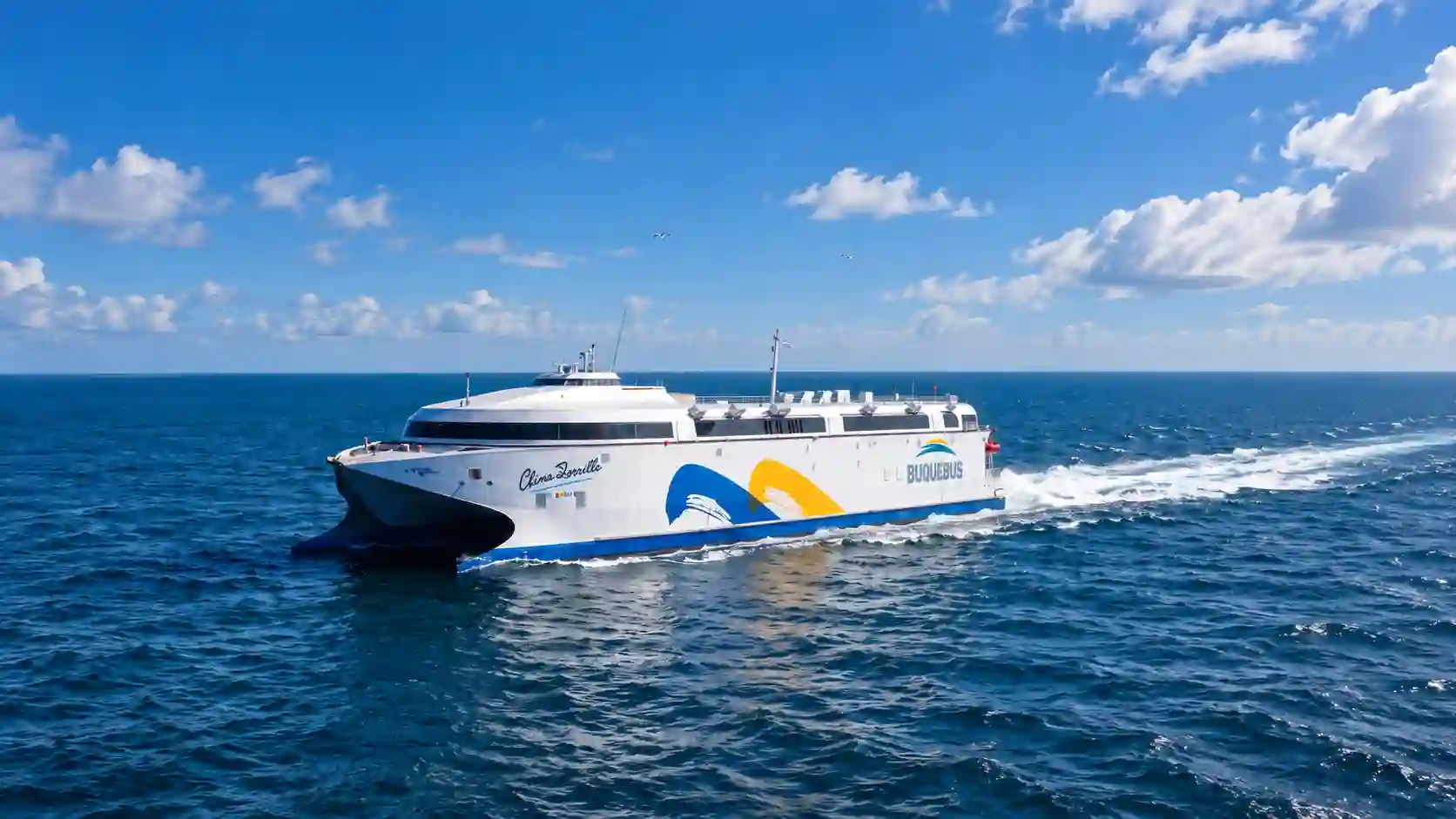
The China Zorrilla is not only a shipbuilding story. It is a grid-and-port infrastructure project.
The 130-metre Buquebus ferry carries an energy-storage system of more than 40 MWh. Recharging a battery system of that scale on a commercial passenger schedule required Uruguay to reinforce the Colonia transmission station, extend roughly nine kilometres of underground electricity network to the port, build new connection and measurement infrastructure, add transformers and substations, and install high-power shore charging.
UTE and ANP describe 15 MW of dedicated or available power at the Port of Colonia. ANP separately describes two charger units rated at 16 MW each. Those figures measure different parts of the system and should not be added together as 32 MW of simultaneous grid supply.
Uruguay also enters the project with an unusually low-carbon power system. The government reported that 98% of electricity generation in 2025 came from renewable sources. That makes the environmental case stronger, but it does not remove the need for site-specific grid investment. The decisive step was converting national electricity resources into a connection capable of serving one very large mobile load at the required location and turnaround time.
The project also fits a broader pattern in Uruguay. The country has repeatedly used relatively small domestic scale to build highly specific infrastructure propositions around logistics, energy and services. Econosur’s analysis of Uruguay’s small-market model describes why the relevant question is often not market size alone, but whether institutions and infrastructure can make a specialized project executable.
Current status, September 11, 2026: China Zorrilla has reached Uruguayan waters aboard the heavy-lift vessel Black Marlin. ANP scheduled the float-off operation at Nueva Palmira for September 12, subject to weather. After unloading, the ferry is to be transferred toward Colonia, commissioned and prepared for Buquebus service.
Commercial operation has not started yet. Secondary reporting currently points to early January 2027 for regular service, but that should be treated as an expected timetable rather than an already completed operating milestone.
The vessel is large enough to change the infrastructure equation
Incat Tasmania built Hull 096, now named China Zorrilla, for Buquebus. Incat describes it as the largest battery-electric ship yet constructed. The vessel is about 130 metres long and is designed to carry up to 2,100 passengers and 225 vehicles between Buenos Aires and Colonia.
The energy system explains why the port side became so important. Incat says the vessel contains 5,016 battery units weighing roughly 250 tonnes and providing more than 40 MWh of installed storage. The battery system feeds eight electric-driven waterjets. Wärtsilä’s integrated scope includes the energy-management system, power-conversion system, DC shore-charging system, battery modules, DC hub, eight electric motors and eight WXJ1100 waterjets. Corvus Energy supplies the Dolphin NextGen battery technology.
A conventional ferry can bunker fuel and carry it on board. A battery-electric ferry instead moves part of the energy system onto land. The commercial schedule therefore depends on charging power, grid availability and port turnaround. The ship and the shore installation become one operating system.
The larger the battery-electric vessel, the less useful it is to analyse the ship without analysing the grid connection behind it.
What Uruguay had to build at the Port of Colonia
The infrastructure work began well before the vessel reached South America. In November 2024, UTE and the Administración Nacional de Puertos signed an agreement covering construction, operation and maintenance of the measurement point and underground cable required to supply electric vessels at the Port of Colonia.
UTE described the engineering in unusually concrete terms. The utility planned 15 MW of dedicated power, expansion of the Colonia transmission station and an extension of roughly nine kilometres of underground network to a new connection point inside the port. This is the physical step that turns Uruguay’s national generation mix into usable charging capacity at the berth.
ANP’s later project updates add the terminal-side detail. By October 2025 the port authority reported two high-power chargers, a special electrical supply from Piedra de los Indios, an existing UTE station and a second transformation substation being built specifically for the vessel. In August 2026, ANP said the Colonia adaptation had required close to US$20 million in ultra-fast land-based charging infrastructure, including new transformers and substations connected to the high-voltage network.
ANP says the system is designed to recharge the ferry in approximately 40 minutes, using the passenger and vehicle turnaround window. That statement should not be read as a documented zero-to-100% recharge of the vessel’s more-than-40-MWh battery: the primary sources reviewed do not publish a complete operational state-of-charge cycle for the 40-minute turnaround. It also states that the grid connection was designed so the high-power charging requirement would not compromise electricity supply to the city of Colonia del Sacramento.
The last distinction matters. ANP reports around US$55 million invested in broader Port of Colonia expansion since 2017 and another roughly US$10 million in more recent terminal works. Those amounts should not be presented as the cost of the electric-ferry charging system. They are part of the wider modernization of a passenger port that ANP expects to handle substantially more traffic over time.
Why 15 MW and two 16 MW chargers are not contradictory
The public project record contains numbers that can look inconsistent if they are treated as identical measures. UTE’s 2024 agreement says 15 MW of power would be installed for the project. ANP’s September 2026 arrival notice says the port had been repowered and now has 15 MW available. Yet ANP’s October 2025 infrastructure update says each of the two installed chargers has a rating of 16 MW.
These figures should not be converted into a claim that the ferry receives 32 MW from the grid. Charger nameplate capability is not the same as the power that the local grid connection is contracted or configured to deliver simultaneously. The available evidence supports a 15 MW port/grid figure and charger equipment with higher individual ratings. It also does not establish that the approximately 40-minute turnaround represents a full battery cycle. Econosur therefore treats the charging-time figure as an operational design statement rather than as a complete energy-balance specification.
Evidence rule. Econosur treats 15 MW as the documented Colonia power-availability figure. The two 16 MW values describe charger equipment. Until a primary technical document specifies simultaneous operating configuration, they should not be added together.
This distinction is commercially relevant. Equipment sizing, grid capacity, duty cycle and charging strategy are separate design variables. A shore-charging system can contain components rated above the actual instantaneous grid draw in order to provide operational redundancy, modularity or different charging configurations.
Why Uruguay’s electricity system makes the project credible
Infrastructure at Colonia solves the local connection problem. Uruguay’s wider electricity system solves another part of the equation: the carbon intensity of the electricity entering that connection.
The Ministry of Industry, Energy and Mining reported that 98% of Uruguay’s electricity generation in 2025 came from renewable sources. Hydropower accounted for 46%, wind 34%, biomass 14% and solar 4%; fossil generation accounted for 2%. The government also reported that around 8% of electricity generated during the year was exported.
That profile is important because electrifying transport only shifts emissions out of the vehicle or vessel if the electricity system itself is sufficiently low-carbon. In Uruguay, maritime electrification builds on an electricity transition that has already taken place.
There is also a broader demand trend. Uruguay’s 2025 energy balance shows that electricity consumption in transport has moved beyond an experimental niche. MIEM reported in July 2026 that transport electricity use exceeded the combined electricity consumption of the leather and textile industries and reached roughly 70% of the electricity used by the cement sector.
The ferry is much larger than ordinary vehicle charging, but the policy direction is consistent: electricity is taking a growing role in transport demand. For Uruguay’s energy infrastructure, the next challenge is therefore not simply renewable generation. It is matching new high-power loads with transmission, distribution and connection investment at the correct locations.
Uruguay’s renewable generation makes the ferry low-carbon. The grid works in Colonia make it operable.
The ferry is a two-shore infrastructure system
The title of this analysis focuses on Uruguay because Colonia provides the clearest public record of the infrastructure build. Operationally, however, the ferry cannot be understood as a one-country system. The route links Colonia with Buenos Aires, and charging capability is required on both sides of the Río de la Plata.
Secondary reporting citing Buquebus states that UTE supplies the Colonia side and EDESUR the Buenos Aires side, with 15 MW-class charging infrastructure at both terminals. That Argentine-side configuration is less well documented in the primary public sources reviewed for this article, so Econosur does not treat the details of the Buenos Aires installation as equally verified.
The commercial implication is straightforward: battery-electric short-sea and river transport is a corridor investment. A vessel can only maintain its schedule if both ends of the corridor have compatible electrical, terminal and operational systems. Electrification therefore moves part of fleet investment into ports and utilities.
Financing the vessel was only part of the capital stack
IFC’s project disclosure estimated the overall Buquebus project at approximately US$170 million. Banco Santander Uruguay provided a US$107 million senior loan, while IFC approved a partial credit guarantee covering up to US$67 million. IFC structured the financing as a blue loan and described the project as a potential proof of concept for medium- and large-scale electric ferries in Latin America and the Caribbean.
The financing record also illustrates how project scope changed over time. IFC’s 2024 announcement said Buquebus would invest another US$14 million in two charging stations and transmission infrastructure. ANP’s later 2026 figure puts the Colonia electrical adaptation at close to US$20 million. Those figures should not be added together automatically. They were published at different stages and may cover different geographies, work packages or updated project scope.
IFC estimated that replacing diesel operation on the route could reduce emissions by the equivalent of 37,545 tonnes of CO₂ per year. ANP’s 2026 award submission separately cites an 84% reduction in the total carbon footprint of the trip. Both are project estimates, not post-operation measurements, because the ferry has not yet begun regular commercial service.
Large-scale vessel electrification creates an infrastructure value chain on shore.
The China Zorrilla required coordination between a ferry operator, port authority, electricity utility, shipbuilder, battery supplier, propulsion integrator and financial institutions. Future projects of this scale can therefore create demand well beyond shipyards.
The more useful market question is not how many electric vessels are announced, but which routes have the grid capacity, terminal works, financing and operating timetable required to support them.
Where B2B demand emerges behind an electric ferry
The China Zorrilla provides a concrete map of supplier categories that become relevant when maritime transport moves from liquid fuel to electricity.
This is why the project belongs as much in Econosur’s logistics and waterways analysis and energy-infrastructure analysis as in transport technology. It links a passenger corridor to a new class of electrical load and forces port planning, utility planning and fleet economics into the same investment decision.
- How much firm grid capacity is available at the berth, not only at national level?
- What transmission, substation and cable works are required before chargers can operate?
- How does charging time fit into passenger, vehicle and vessel turnaround?
- Are chargers, grid connection and vessel power electronics designed as one interoperable system?
- Who finances the shore infrastructure and who owns it after commissioning?
- Does the electricity mix support the emissions case for electrification?
- What redundancy exists if one charging endpoint or grid connection is unavailable?
- Which parts of the investment are vessel-specific and which can support future electric ships?
Why this matters beyond one ferry
Short-distance maritime transport is one of the segments where battery-electric propulsion can be technically plausible because routes are fixed, vessel schedules are predictable and charging can be concentrated at known terminals. But that same predictability exposes the infrastructure constraint: the project needs enough electrical power at exactly the ports where the vessel stops.
Uruguay’s example therefore should not be generalized into a claim that any renewable-rich country can copy the project quickly. Colonia required a dedicated utility program, physical grid reinforcement and port adaptation. The national power mix was an advantage, not a substitute for those works.
The project may become a useful reference case for other South American river and short-sea corridors, but replication will depend on route length, vessel energy demand, turnaround time, terminal geometry, grid strength and financing. A technically similar ship placed at a weaker port connection could require a very different capital package.
Conclusion
The world’s largest battery-electric ferry did not arrive in Uruguay as a standalone technology. It arrived at the end of an infrastructure chain that had already been under construction for years.
China Zorrilla brings more than 40 MWh of batteries and a propulsion system designed around high-power charging. Colonia had to answer that requirement with transmission reinforcement, kilometres of underground cable, substations, transformers and shore-charging equipment. Uruguay’s 98% renewable generation gives the system a low-carbon electricity base; UTE and ANP’s local works make that electricity usable by the vessel.
The broader lesson is that maritime electrification moves investment from the engine room into the port and power system. The ship may attract the attention, but the decisive infrastructure is often on land.
The most important feature of the China Zorrilla project is the coordination between vessel, grid and port rather than the battery size alone.
Uruguay already had a highly renewable electricity system. That national advantage did not automatically create a commercially usable 15 MW connection at the ferry terminal. The project still required transmission reinforcement, underground cable, new transformation infrastructure and a charging system designed around a passenger-ferry timetable.
This distinction matters for infrastructure analysis across South America. Resource abundance and site readiness are different things. Hydropower, wind or solar potential only becomes a commercial advantage when the required load can connect at the right place, on the right timetable and with a bankable operating structure.
For international suppliers, the project is therefore a useful indicator of where value is created: in the interfaces between utilities, ports, transport operators, equipment suppliers and finance. Those interfaces are harder to replicate than the headline claim of cheap or renewable electricity.
Current project status: China Zorrilla reached Uruguayan waters on September 10, 2026 aboard Black Marlin. ANP scheduled unloading at Nueva Palmira for September 12, subject to weather. The ferry is not yet treated as commercially operational.
Colonia power: UTE and ANP support a 15 MW dedicated or available port-power figure. ANP separately reports two charger units rated at 16 MW each. The article does not add those charger ratings into a 32 MW grid-capacity claim.
Charging time: ANP’s August 2026 statement cites approximately 40 minutes. The primary sources reviewed do not state that this is a zero-to-100% recharge of the vessel’s more-than-40-MWh battery, nor do they publish a complete state-of-charge profile for each turnaround. Until operating data are available, the 40-minute figure is treated as an operational design statement rather than measured commercial performance.
Infrastructure cost: IFC cited US$14 million for two charging stations and transmission infrastructure in 2024. ANP later cited close to US$20 million for the Colonia electrical adaptation. They are not assumed to be additive.
Buenos Aires charging: secondary reporting citing Buquebus describes EDESUR-backed charging at the Argentine terminal. The Uruguay side has a stronger primary-source record, so Argentine infrastructure details are not presented with the same evidentiary weight.
Environmental impact: CO₂ reductions and the 84% carbon-footprint figure are forward-looking project estimates from IFC and ANP, not measured results from regular operation.
Buffer batteries: some secondary articles describe shore-side buffer batteries for peak-load management, but the primary UTE, ANP, Wärtsilä and Buquebus material reviewed for this analysis does not clearly document that configuration. Econosur therefore does not use buffer batteries to reconcile the 15 MW and 40-minute figures.
This analysis prioritises port, utility, government, manufacturer and financing sources, followed by specialist and independent reporting. Design claims, equipment ratings, completed infrastructure and commercial-operation status are kept separate. Information available by September 11, 2026.
Primary & official sources
- Administración Nacional de Puertos — China Zorrilla and electrification of the Port of Colonia, 4 August 2026 — approximately US$20 million electrical-infrastructure investment, approximately 40-minute turnaround charging, transformers, substations, high-voltage connection and the ANP project estimate of an 84% reduction in the trip’s total carbon footprint.
- Administración Nacional de Puertos — Port of Colonia infrastructure update, 31 October 2025 — two charger units, special electrical supply, transformation infrastructure and wider terminal works.
- Administración Nacional de Puertos — arrival and unloading plan, published 8 September 2026 — vessel arrival scheduled for 10 September, Nueva Palmira float-off plan, transfer toward Colonia and 15 MW available port power.
- UTE — agreement with ANP for works at the Port of Colonia, 22 November 2024 — 15 MW dedicated capacity, transmission-station expansion, roughly nine kilometres of underground network, new port connection infrastructure and an estimated 84% reduction in emissions associated with passenger maritime transport on the route.
- Uruguay Ministry of Industry, Energy and Mining — 2025 electricity generation, 2 January 2026 — 98% renewable generation and source breakdown.
- Uruguay Ministry of Industry, Energy and Mining — electricity use in transport, 31 July 2026 — growth of electricity as a transport energy source.
- Incat Tasmania — Hull 096 begins journey to South America, 2026 — vessel dimensions, route, passenger and vehicle capacity and delivery status.
- Incat Tasmania — Inside one of the world’s largest battery rooms, 27 October 2025 — 5,016 battery units, approximately 250 tonnes, more than 40 MWh and eight electric-driven waterjets.
- Wärtsilä — integrated propulsion and shore-charging system, 24 August 2023 — power conversion, DC shore charging, battery modules, motors and waterjets.
- Corvus Energy — Buquebus battery-electric ship — more than 40 MWh and Dolphin NextGen battery technology.
- International Finance Corporation — Buquebus project disclosure — estimated US$170 million project cost, US$107 million covered loan and up to US$67 million IFC guarantee.
- International Finance Corporation — financing announcement, 26 July 2024 — blue-finance structure, charging-infrastructure estimate and projected emissions reduction.
Secondary and specialist sources
- ABC News — Black Marlin heavy-lift delivery, 28 July 2026 — independent reporting on the delayed transport operation, heavy-lift logistics and shore-connection dependency.
- Shippax — Hull 096 delivery and technical data, 1 June 2026 — specialist maritime reporting on vessel configuration and service speed.
- Baird Maritime — Vessel Review: China Zorrilla — specialist industry context for large battery-electric ferry operation.
- Latam Mobility — China Zorrilla nears South America, 10 September 2026 — commissioning context and reported expectation of regular service in early January 2027.
- Montevideo Portal — arrival in Uruguayan waters, 10 September 2026 — current arrival reporting.
- Econosur analysis of the relationship between vessel electrification, grid connection, port investment, renewable electricity and commercial transport operations.
From the vessel headline to the infrastructure behind it
Large transport projects are rarely explained by a single technology. Grid capacity, port works, suppliers, financing, operating schedules and institutional coordination determine whether equipment can move from announcement to commercial use.
Econosur prepares company, project, sector and infrastructure analysis for international firms evaluating South American markets. Research can focus on port systems, electricity infrastructure, logistics corridors, suppliers, project maturity, competitive structures or specific commercial questions.
Explore custom market analysisFrequently asked questions
What is the China Zorrilla?
China Zorrilla is a 130-metre battery-electric ferry built by Incat Tasmania for Buquebus. Incat describes it as the world’s largest battery-electric ship. It is intended for the Buenos Aires–Colonia route and can carry up to 2,100 passengers and 225 vehicles.
How large is the ferry’s battery system?
Incat states that the installed energy-storage capacity exceeds 40 MWh. The vessel contains 5,016 battery units weighing about 250 tonnes and powers eight electric-driven waterjets.
What infrastructure did Uruguay build in Colonia?
UTE and ANP developed dedicated high-power electrical infrastructure including transmission-station reinforcement, roughly nine kilometres of underground network, new connection and measurement infrastructure, transformers, substations and shore-charging equipment.
Is the Port of Colonia supplied with 15 MW or 32 MW?
UTE and ANP describe 15 MW of dedicated or available port power, while ANP has described two charger units rated at 16 MW each. Charger nameplate ratings and simultaneous grid-delivery capacity are different measures and should not be added together.
How renewable is Uruguay’s electricity?
Uruguay’s government reported that 98% of electricity generation in 2025 came from renewable sources: 46% hydropower, 34% wind, 14% biomass and 4% solar, with fossil generation at 2%.
Is China Zorrilla already in commercial service?
No. It reached Uruguayan waters on September 10, 2026 aboard the heavy-lift vessel Black Marlin. ANP scheduled the float-off operation at Nueva Palmira for September 12, subject to weather, followed by transfer to Colonia, commissioning and preparation for service.
How was the project financed?
IFC disclosed an estimated total project cost of about US$170 million, including a US$107 million loan from Banco Santander Uruguay and an IFC partial credit guarantee covering up to US$67 million.