
European Suppliers in Vaca Muerta.
How industrial suppliers reach procurement and specification decisions in Argentina’s unconventional energy market.
Vaca Muerta is not one procurement market. European suppliers reach demand through specific operators, EPC contractors, integrators, distributors, local service structures and project packages.
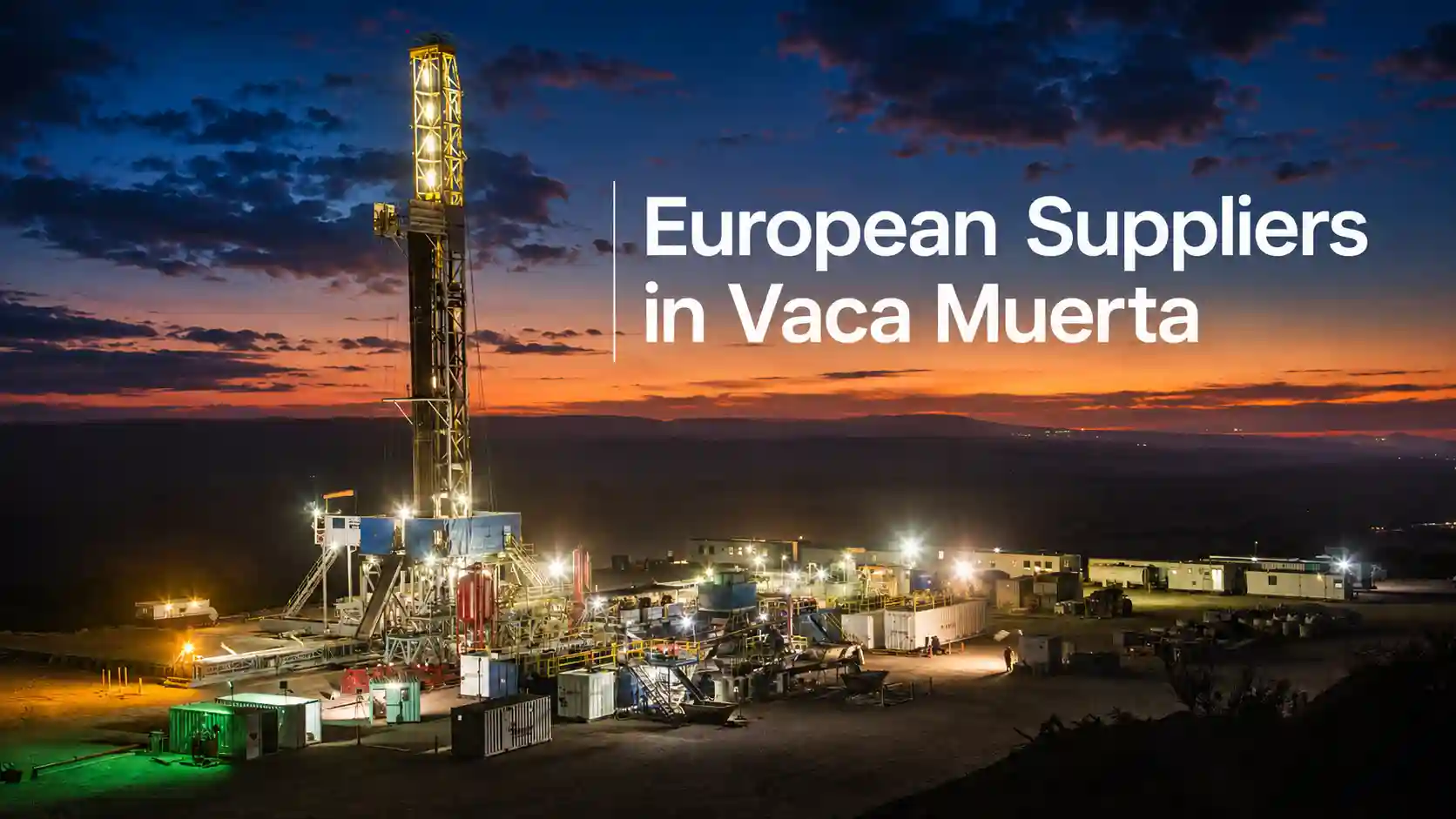
Technical demand does not automatically create market access
Vaca Muerta is usually described through production growth, investment and export potential. For industrial suppliers, however, the commercially decisive question comes one level lower: how is demand actually specified, purchased, installed and supported?
The report examines 24 European supplier cases and finds that market access depends on the operational logic of the product, the project stage and the contracting structure. The visible operator is often not the decisive gatekeeper. Engineering firms, EPC contractors, integrators, distributors, project companies and local service partners can control specification, qualification or procurement.
European suppliers do not enter Vaca Muerta through one market. They enter through specific procurement chains.
The report’s procurement thesis is becoming more important as capital moves into execution
Vaca Muerta reached 643,100 barrels of oil per day in July 2026, while several large projects have moved beyond announcement into approval, financing, construction or operating service capacity. For suppliers, that matters because the number of technical interfaces is expanding at the same time that project stages are becoming more differentiated.
VMOS is in construction and has secured project financing of up to US$2 billion. VMOS’ current website still presents a staged 190,000-barrel-per-day early phase and 390,000 barrels per day from mid-2027, while its financing announcement describes an initial operating capacity of about 180,000 barrels per day toward the end of 2026 and a ramp toward 550,000 barrels per day during 2027. The practical supplier implication is to follow construction and commissioning milestones rather than treat one schedule figure as settled.
Argentina LNG submitted a US$51 billion RIGI application in August 2026. Eni describes the first integrated development as two FLNG units with combined capacity of 12 MTPA and continues to target final investment decision by the end of 2026. The project is therefore large but still pre-FID.
TGS approved final investment decision for a US$3 billion NGL-processing project in June 2026, with agreements covering more than 80% of capacity with YPF, Pluspetrol and Chevron. The project adds processing, pipelines, fractionation, storage and export-terminal works to the supplier landscape.
Los Toldos II Este received RIGI approval for a US$6.4 billion investment program in August. Tecpetrol says more than US$2 billion is to be deployed through the end of 2027 and that around 800 Argentine companies are already participating in construction activities.
A supplier-side example reinforces the report’s central thesis. Tenaris put its third hydraulic-fracturing set into operation at Los Toldos II Este in August after a US$110 million investment. The company says it has invested more than US$240 million in oilfield-services capacity in Argentina since 2020 and operates a 25-hectare service center in Vista Alegre.
Current project context: Vaca Muerta Investment Map · RIGI Energy Execution · Oil & Gas in South America.
The strongest supplier signal is not the headline capex. It is the point where capital becomes an operating requirement.
The developments since publication strengthen the report’s original conclusion. Vaca Muerta is attracting more capital, but that does not simplify supplier access. It makes project-stage discipline more important.
VMOS, Los Toldos II Este, the TGS NGL project and Argentina LNG sit at different points between construction, approved investment, FID and pre-FID development. A supplier approaching all four with the same sales logic would be ignoring the structure that actually determines demand.
The Tenaris example is particularly instructive. Its position is built around equipment, field operations, service capacity and a permanent local base. That does not mean every European supplier needs to reproduce that model. It shows that local presence should follow the operational logic of the product. For some categories, local stock or service may be essential; for others, an EPC relationship, distributor or project-specific technical partner may be enough.
This is also why the new Vaca Muerta Investment Map complements this report. The investment map identifies where capital is going and what stage it has reached. This report addresses the next question: through which commercial and procurement route can a supplier reach that demand?
What the 24 cases show
The cases differ by technology and evidence strength, but six recurring conclusions emerge across the supplier fields.
Local execution matters when the product demands it
Commissioning, maintenance, calibration, testing, chemical handling and rapid replacement make local service capacity commercially important.
Market access often starts before the first public contract
Local subsidiaries, technical market development, trade fairs, recruitment and partner relationships can precede a named Vaca Muerta reference.
The operator is not always the buyer
EPC contractors, engineering firms, integrators, distributors and project companies can control qualification, specification and package procurement.
European technology is strongest when paired with execution
The more service-intensive or operationally critical the product, the less defensible a pure export model becomes.
Public visibility is uneven
A lack of public project detail is an evidence gap, not proof that a supplier has no activity in the market.
Commercial structure can accelerate access
Financing, rental and pay-per-use can lower adoption barriers when capital is constrained, but they do not replace specification, qualification or customer access.
Six recurring routes into Vaca Muerta
The models are not mutually exclusive. A supplier may combine several routes, while a large project contract can also create a strong position through direct access alone.
Direct project access
A supplier enters through a named operator, infrastructure project, EPC package or specialist project contract.
Local subsidiary and service platform
The company maintains Argentine engineering, service, logistics, laboratory, production or repair capacity.
Distributor or specialist partner
A local commercial and technical partner provides customer access, stock, field support or after-sales continuity.
Specification and contractor access
The relevant decision point sits inside an engineering firm, integrator, EPC contractor or procurement package.
Cluster and event-based market development
Neuquén-based industry events, missions and market development build relationships before a public project reference appears.
Local production or value creation
Manufacturing, assembly, coating, repair, testing or other local value creation strengthens the execution model inside Argentina.
What European suppliers need to know before approaching Vaca Muerta procurement
The 24 cases map publicly visible market-access structures. For a specific supplier, the commercial decision starts where the public record becomes incomplete: which procurement route applies, how much local execution is required and when qualification must begin.
Which procurement routes give European industrial suppliers access to Vaca Muerta?
Vaca Muerta is not a single procurement market. Access can run through operators, EPC contractors, engineering firms, integrators, distributors, project companies or local service platforms. The most realistic route depends on the product, the project stage and who controls specification, qualification and purchasing.
Research gap: public sources can identify companies and projects, but they do not necessarily show the live buying route for a specific product category or which decision-maker currently controls access.
How much local presence do European suppliers need to compete in Argentina’s Vaca Muerta market?
The report shows that local execution becomes more important when products require commissioning, calibration, maintenance, rapid replacement, field support or other operational continuity. A wholly owned Argentine subsidiary is not always necessary; distributors, specialist partners and project-specific service structures can also provide market access.
Research gap: public evidence rarely establishes the service levels, response times, local stock requirements or qualification conditions that buyers expect from a particular supplier category.
When should European suppliers enter Vaca Muerta specification, qualification and procurement processes?
Market access can begin before a public contract appears. For products influenced by engineering specifications, approved-vendor lists or EPC package design, a supplier may need to become visible during engineering and qualification rather than waiting for the final tender.
Research gap: project announcements and supplier references do not normally reveal active qualification windows, incumbent positions or the point at which a new supplier still has a realistic chance to enter the process.
Where public evidence is strongest — and where it remains thinner
Each supplier field contains six cases. The figures below show public evidence strength only. They do not measure market size, attractiveness or commercial success.
Field 1 — Pumps, valves and mechanical flow control
Local service, stock and partner structures matter strongly, but public project evidence is uneven.
Field 2 — Automation, measurement and safety instrumentation
The most consistently supported field overall: all six selected cases are graded High or Medium.
Field 3 — Export infrastructure and offshore logistics
VMOS creates visible project packages and contractor interfaces, producing the largest number of High-evidence cases.
Field 4 — Water treatment and process support systems
Structural demand is rising, while public supplier transparency remains comparatively limited.
Compare access problems, not companies
The 24 cases are evidence, not an end in themselves. The useful question is not “Which supplier looks like us?” but “Which access problem looks like ours?”
- 01 Identify the operational logic. Does the product require local commissioning, maintenance, calibration, stock or field support?
- 02 Map the decision point. Determine who controls specification, qualification and procurement.
- 03 Define local execution. Separate genuinely necessary local capability from symbolic market presence.
- 04 Identify the project stage. Establish when the supplier must become visible, specified or qualified.
- 05 Test commercial execution. Determine whether payment terms, rental, financing or another structure lowers the buyer’s implementation barrier.
A public-evidence map, not a catalogue of suppliers
The report distinguishes technical suitability, market-access capacity and documented project participation instead of treating them as the same thing.
Evidence grading
High, Medium, Low–Medium and Low grades reflect how specifically the public record supports a project, activity, product, location, customer or access route.
Claims remain attributed
Supplier-originated performance figures and management statements are retained as company claims unless independently confirmed.
Absence is not inferred
No identified public project does not mean that no commercial activity exists. It is recorded as an evidence gap.
PDF edition
The complete report contains the 24 supplier cases, evidence grades, market-access framework, cross-case findings, strategic implications, source record and company reference table.
Included in the full report
- 24 European supplier cases
- Four industrial supplier fields
- Six recurring market-access models
- Evidence grading and explicit evidence limits
- VMOS procurement and project-chain analysis
- Gatekeepers and decision points
- Implications for European industrial suppliers
- Public-source record and company reference table
Vaca Muerta market research services for international suppliers
The public record can identify Vaca Muerta projects, operators, contractors, announced investment, local offices and documented supplier relationships. It rarely shows the commercial layer that determines whether a supplier can actually win business: current procurement status, buyer requirements, incumbent positions, qualification windows and practical procurement access.
Econosur conducts custom and primary market research for international companies evaluating Argentina, Mercosur and the Southern Cone. The work is designed to close the gap between what project filings and company announcements show publicly and what suppliers need to know before committing time, travel or commercial-development resources.
Primary interviews
Structured interviews with relevant market participants and industry contacts to test buyer requirements, procurement practice and commercial assumptions that are not visible in public documentation.
Company and competitor research
Research on suppliers, competitors, local subsidiaries, service structures and documented market positions to establish who is already active and how companies are positioned.
Supplier and distributor checks
Assessment of potential distributors, specialist partners and local service providers, including their market relevance, technical role and fit for a defined product category.
Procurement and qualification research
Identification of operators, EPC contractors, engineering firms, integrators and other gatekeepers that influence specification, approved-vendor access, qualification and purchasing.
Project verification
Verification of project stage, procurement signals and commercial relevance to distinguish announced investment from opportunities that are actually approaching specification, tender or execution.
Trade-fair and industry-event research
Targeted research around relevant industry events to identify active companies, competitors, partners, buyer signals and market-development activity beyond formal project announcements.
Field research in Argentina and the Southern Cone
Project-specific on-the-ground verification when physical presence adds value, including local market observation, company or partner checks and validation of operating conditions.
Market-access synthesis
Integration of desk research and primary findings into a practical market-access view: who controls demand, when to enter the process, what local execution is required and which uncertainties remain.
Investment & project-stage tracking
Separate announced capital, RIGI applications, approvals, FID, financing, construction and operating assets to identify when a project becomes commercially relevant for a supplier category.
B2B connections
Where research identifies a concrete commercial fit, Econosur can screen relevant operators, buyers, suppliers, contractors, distributors or business partners and facilitate an introduction. See B2B Connections in South America.
Questions Econosur can investigate for a defined supplier or product category
The purpose is not to produce another generic Vaca Muerta market overview. A custom assignment starts with a concrete commercial uncertainty and investigates the buyer, competitor, qualification or execution conditions behind it.
Examples of questions to verify
- Who actually controls procurement for this product category in Vaca Muerta?
- Which suppliers are already positioned with the relevant operators, EPCs or integrators?
- Is supplier qualification still open, and at which stage does it occur?
- Does the buyer require local stock, commissioning, maintenance or field service?
- Which distributor, specialist partner or contractor provides the most realistic route to market?
- Which announced projects are translating into real procurement activity?
- What buyer requirements or commercial barriers are missing from public project documentation?
Primary and secondary sources used for the September 2026 update
Primary sources
- 01Argentina Secretariat of Energy — July 2026 production: 916.2k b/d nationally and 643.1k b/d from Vaca Muerta.
- 02VMOS — project phases, pipeline capacity and expansion design.
- 03VMOS financing announcement — financing of up to US$2bn, construction status and initial 180k b/d operating reference.
- 04Eni — Argentina LNG RIGI application, 12 MTPA initial development and end-2026 FID target.
- 05TGS — US$3bn NGL project FID and capacity agreements covering more than 80%.
- 06Tecpetrol — US$6.4bn RIGI approval for Los Toldos II Este and supplier participation.
- 07Tenaris — third frac set operating at Los Toldos II Este after US$110m investment.
Secondary & analytical sources
- 01Reuters — independent reporting on the US$51bn Argentina LNG RIGI application.
- 02Wood Mackenzie — estimate of roughly US$22bn additional upstream capex and about 1,000 wells required by 2032 for planned export growth.
- 03Evidence boundary: these sources update the market context around the August report. They do not change the report’s original 24-case evidence grades unless the underlying supplier case itself is re-researched and the report edition is formally revised.
Related research and market analysis
The Vaca Muerta report sits within Econosur’s wider South America market-analysis and industrial research coverage.
-
01
Vaca Muerta Investment Map — where capital is going across upstream, infrastructure, project finance and supplier capacity.
-
02
RIGI Energy Execution — where approved investment is moving into drilling, EPC, processing and infrastructure execution.
-
03
Vaca Muerta Pacific Route — how crude export infrastructure changes the commercial geography of the basin.
-
04
Vaca Muerta–Brazil Gas Corridors — regional gas transport, buyer and infrastructure constraints.
-
05
Reports & Briefs — structured Econosur market reports, briefs and custom analysis.
-
10
Custom Market Analysis — tailored research for defined supplier, procurement, competitor and commercial questions.
-
07
Industry Research — sector context across South American industrial markets.
-
08
Research Cases — examples of how Econosur connects business questions, evidence, findings and commercial implications.
-
09
Econosur Insights — public analysis of companies, projects, markets and regional developments.
-
06
Contact Econosur — discuss a defined supplier, procurement or commercial research question.

Marcus A. Volz is a market analyst based in Argentina since 2006 and founder of Econosur. His research focuses on industrial markets, procurement structures and competitive positioning in Argentina, Mercosur and the Southern Cone, with particular emphasis on energy, mining, manufacturing and infrastructure.
Public filings can establish projects, permits, announced capacity and documented supplier relationships. His custom research addresses the commercial layer those sources often leave unresolved: procurement status, buyer requirements, supplier positioning and practical procurement access.
Assignments can combine primary interviews and company or competitor research with project verification and supplier or distributor checks. Where relevant, field research in Argentina and the Southern Cone is used to test whether the commercial reality matches the public record.
Questions about the Vaca Muerta supplier report
What does the European Suppliers in Vaca Muerta report examine?
The report examines how European industrial suppliers gain access to Vaca Muerta through procurement chains, local subsidiaries, service platforms, distributors, specialist partners, integrators, EPC contractors and project-specific contracts.
How many companies are included?
The study examines 24 European supplier cases across four supplier fields: pumps and valves, automation and measurement, pipeline and export infrastructure, and water and process technology.
Which market-access models does the study identify?
Six recurring models are used: direct project access, local subsidiary and service platform, distributor or specialist partner, specification and contractor access, cluster and event-based market development, and local production or value creation.
Does a supplier need its own Argentine subsidiary?
Not necessarily. The report shows several viable structures. The appropriate model depends on the product’s operational logic. Some products require local field service, while others can be supported through a specialist distributor, integrator, EPC contractor or project-specific route.
Does a lack of public project evidence mean that a company is not active?
No. The report treats the absence of public evidence as an evidence gap rather than proof of inactivity. Local offices, distributor relationships, recruitment, events and technical market development can establish market-access capacity without proving a completed Vaca Muerta project.
Which procurement routes give European industrial suppliers access to Vaca Muerta?
Access can run through operators, EPC contractors, engineering firms, integrators, distributors, project companies and local service platforms. The relevant route depends on the product, project stage and who controls specification, qualification and purchasing.
How much local presence do European suppliers need to compete in Argentina’s Vaca Muerta market?
The required local presence depends on the product’s operating logic. Service-intensive or operationally critical products may require local commissioning, maintenance, stock or field support, while other suppliers can work through distributors, specialist partners or project-specific service structures.
When should European suppliers enter Vaca Muerta specification, qualification and procurement processes?
Suppliers may need to become visible before the final tender, particularly where engineering firms, EPC contractors, approved-vendor lists or technical specifications shape procurement. The relevant entry point depends on the package and project stage.
Can Econosur analyse the route for a specific product category?
Yes. Custom research can focus on the operators, EPC contractors, engineering firms, integrators, distributors, qualification processes and local execution structures relevant to a defined product or supplier category.
Start with the Vaca Muerta procurement route, not the headline market size
For European industrial suppliers, the practical question is not simply whether Vaca Muerta needs the technology. It is who controls specification and procurement, when supplier qualification occurs, which competitors are already positioned and what local execution model makes the offer commercially usable.