
Argentina · Agriculture · Export logistics
How Argentina Exports Wheat
How Argentina’s grain traders, ports and overseas buyers shape the wheat trade, from the Paraná export corridor to Brazilian flour mills.
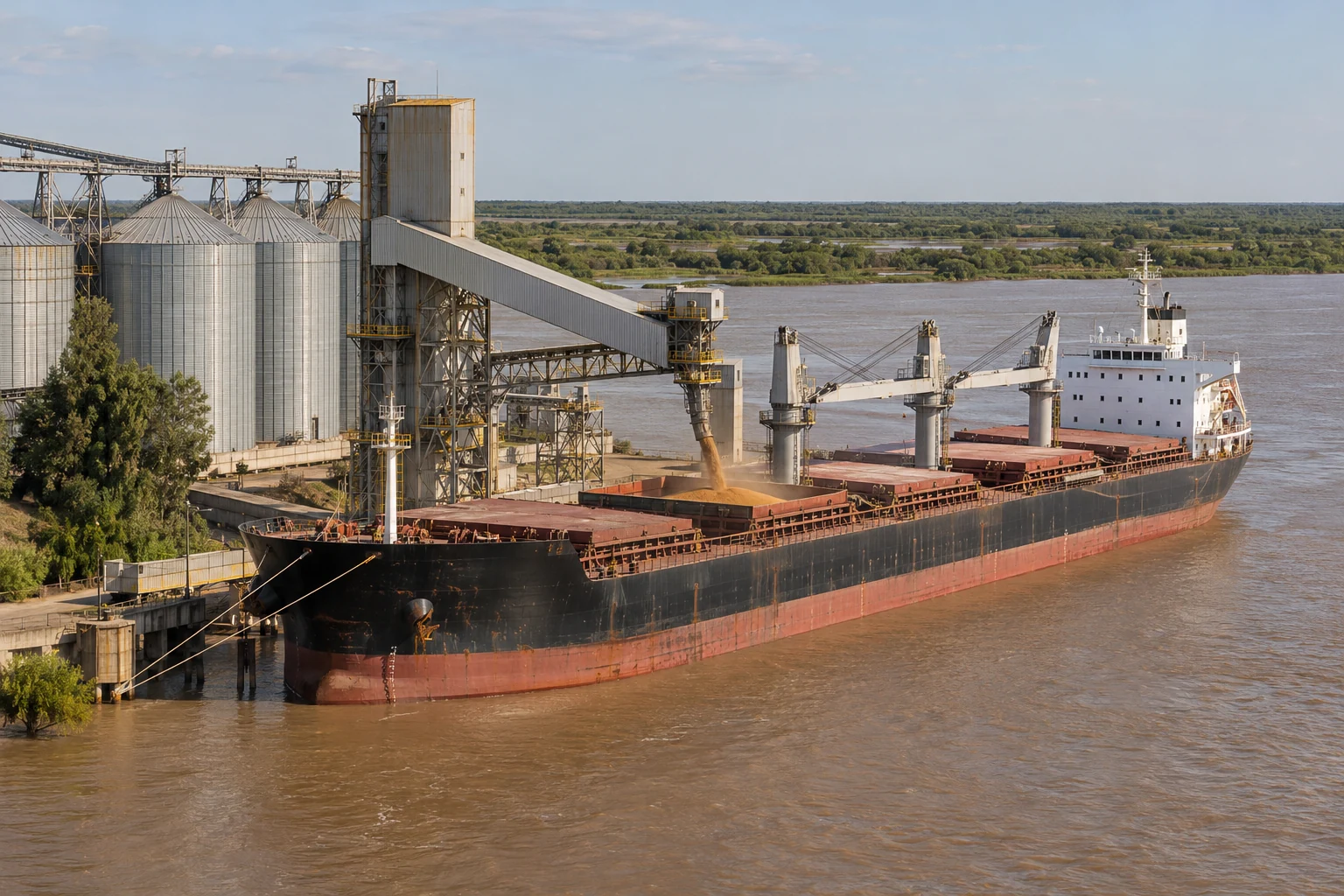
Quick answer
Rosario and San Lorenzo account for roughly 90% of the wheat scheduled to load in the 18 November–15 December port programme. Bunge, Cargill and Louis Dreyfus Company (LDC) led wheat-complex export registrations in the first half of 2026. Those names are a starting point for following the new campaign, which begins in December. The port totals identify planned volumes by location, and the first-half rankings identify the companies behind earlier sales declarations. [3] [4] [2]
The harvest was already reaching ports before the new campaign
In the third week of November, Argentine terminals received almost 597,000 tonnes of wheat. That took receipts for 1–19 November to 1.45 million tonnes, the highest volume for that window in at least five years, according to STOP logistics figures reported by BCR. The same report put the national harvest at 23% complete. The port data record incoming wheat without identifying the crop year of each delivery. [2]
BCR’s November estimate of 24.3 million tonnes is 4.2 million below its own estimate for the previous harvest, which was exceptional. The Buenos Aires Grain Exchange maintained its separate forecast of 23.4 million tonnes on 19 November, with 16.7% of the harvestable area cut in its survey as of 18 November. The two exchanges publish separate estimates. Buenos Aires Grain Exchange crop report, 19 November. The immediate price pressure is visible in Rosario. BCR reported a weekly average reference price of US$185 per tonne through 19 November and a low of US$220 per tonne for its November FOB indication. Those prices describe different points in the supply chain. The first is a local market reference and the second is an export price at the loading port. [1] [2] [11]
Early loading schedules are concentrated on the Paraná
Rosario and San Lorenzo are grouped in the shipping schedule. Their terminals line the Paraná in Santa Fe province, on the Paraná–Paraguay waterway. Bahía Blanca is an Atlantic outlet in southern Buenos Aires province. Econosur’s analysis of Argentina’s export ports covers the infrastructure and investment behind both routes. The river corridor leads across this four-week snapshot, which spans the end of one marketing year and the start of the next. Another NABSA snapshot, reported by fyo on 17 November, explicitly linked strong late-season bookings to the large 2025/26 harvest. [2] [3] [9]
| Port group | Scheduled tonnes | Share of snapshot |
|---|---|---|
| Rosario / San Lorenzo | 1,010,850 | 90.2% |
| Bahía Blanca | 109,500 | 9.8% |
| Necochea and other ports | 0 listed | 0% |
| Total | 1,120,350 | 100% |
The schedule can change as vessels move and cargoes are rescheduled. Its zero for Necochea describes that publication window. December’s completed loadings will give a clearer reading of how the Paraná and Atlantic terminals divide the first month of the campaign. [3]
Bunge, Cargill and LDC set the commercial benchmark
BCR compiled the January–June 2026 ranking from official Declaraciones Juradas de Ventas al Exterior (DJVE), Argentina’s export-sale declarations. Wheat-complex registrations totalled 9.4 million tonnes, of which 96% was bread wheat. The three leaders together accounted for roughly 55% of the declared tonnage, using the rounded figures below. [4] [5]
| Exporter | Declared volume |
|---|---|
| Bunge | 2.3 Mt |
| Cargill | 1.6 Mt |
| Louis Dreyfus Company | 1.3 Mt |
Forward sales were already visible in October. On 17 October, La Nación reported 940,000 tonnes registered for the new crop, with 640,000 tonnes assigned to December shipment and 300,000 to January. That October tally provides a benchmark for the pace of early sales. For comparison, Rosario’s exchange recorded 14.5 million tonnes of actual wheat shipments in January–October 2026, up 45% year on year. That calendar-year total is a measure of shipments already made. BCR shipment report, 13 November. The November sources reviewed here establish a port-level schedule and an earlier company ranking. A ranking of companies for 2026/27 still requires current filings attributed to each exporter. [3] [4] [5] [10]
Brazil has more wheat to buy
Brazil’s national crop agency Conab cut its 2026 wheat production estimate from 5.73 million tonnes in October to 5.26 million in November, compared with 7.87 million in 2025. It raised its import forecast for the 2026 balance from 7.06 million to 8.94 million tonnes. Conab also reported quality problems in the domestic crop, a relevant issue for mills buying bread wheat. [7]
The commercial question is how much of that demand Argentina captures. Argentina’s INDEC records exports by destination, and Brazil’s Comex Stat records imports by origin. A monthly comparison for wheat grain, using the relevant lines under HS heading 1001 and measuring net weight, can show whether Brazilian imports of Argentine wheat pick up once December cargoes reach the market. [6] [8]
Marcus A. Volz perspective
The most revealing comparison in December will be between who books the wheat and where it loads. The sales data show which trading houses can assemble grain at scale. The port programme shows where that grain can get aboard a ship. Those are different advantages. An exporter can arrange loading at a terminal run by another company, and a busy terminal can handle cargoes sold by several traders. This distinction also matters in Argentina’s soy export industry, where company rankings and control of physical assets tell different parts of the story.
For a Brazilian mill, the offer depends on whether a trader can deliver grain that meets its specifications, on a workable sailing date and at a competitive landed price. Rosario’s early concentration gives it the strongest starting position in the schedule. The first Brazilian import data will help tell whether that concentration carries through to trade with Brazil or mainly reflects other destinations and the carry-over from the previous Argentine crop.
Sources and methodology
The analysis uses information available through 22 November 2026. Figures are in metric tonnes. Port shares use the scheduled tonnage in the cited snapshot. For that snapshot, see the downloadable NABSA file and its BCR summary table.
Primary data and original market research
- Original crop forecast. Compares 24.3 million tonnes for 2026/27 with 28.5 million tonnes for 2025/26 on the same BCR series. Bolsa de Comercio de Rosario / GEA — Argentine wheat production estimate, 12 November
- BCR market report drawing on STOP port receipts and Argentine agriculture ministry harvest data. Also provides Rosario prices and the November FOB indication. Bolsa de Comercio de Rosario — 2026/27 harvest pressure, 20 November
- Dated spreadsheet linked from the BCR summary table. The figures in this article come from the published port totals. NABSA / BCR — port loading programme, 18 November–15 December
- Original compilation from official DJVE records, including the wheat complex, product mix and exporter rankings. Bolsa de Comercio de Rosario — agro-exporter ranking for January–June 2026
- Official source for export-sale declarations and statistics by product, campaign and intended shipment period. Argentina’s Secretariat of Agriculture — DJVE registry
- Argentine customs-based trade statistics. Search by product code and destination, subject to statistical confidentiality. INDEC — foreign trade database
- Brazil’s November production and import forecasts, including the previous October estimates. Conab — November grain survey, wheat chapter and balance sheet
- Brazilian import-side check for monthly wheat volumes of Argentine origin. Brazil’s Ministry of Development, Industry, Trade and Services — Comex Stat
Secondary and trade reporting
- Trade commentary on the 16 November NABSA snapshot and the contribution of the previous crop to the late-season programme. fyo — wheat vessel line-up, 17 November
- Dated reporting on early 2026/27 wheat sales and their intended delivery months. La Nación — registered grain export sales, 17 October
- Regional coverage of the 20 November BCR release, which it uses for the harvest and price figures. El Litoral — harvest pressure and Argentine wheat pricing, 22 November
Frequently asked questions
How large is Argentina’s 2026/27 wheat crop?
The Bolsa de Comercio de Rosario estimated 24.3 million tonnes on 12 November 2026. Its estimate for the preceding campaign was 28.5 million tonnes.
Which ports are scheduled to load the most wheat?
NABSA’s 18 November–15 December programme listed 1,010,850 tonnes at Rosario and San Lorenzo and 109,500 tonnes at Bahía Blanca, out of a national total of 1,120,350 tonnes in that snapshot.
Who led Argentine wheat export registrations in early 2026?
For the wheat complex, BCR ranked Bunge first with 2.3 million tonnes, Cargill second with 1.6 million and Louis Dreyfus Company third with 1.3 million in January–June. The ranking covers registered sales during that period.
How much wheat could Brazil import?
Conab’s November balance projected Brazilian wheat imports of 8.94 million tonnes from all suppliers. An Argentine share can be measured from subsequent destination or import-origin data.
Map a grain export market or trade corridor
Econosur researches exporters, terminal operators, trade flows and buyer markets in South America for companies evaluating sourcing, logistics or market entry.
Discuss your research question