
Chile · Copper Mining · Investment Economics · October 2026
Sierra Gorda's $725 Million Expansion: The Economics Behind Chile's Copper Growth
KGHM and South32 are expanding a profitable copper mine while Chile faces a difficult production outlook. The economic case is built on higher ore throughput, existing infrastructure, low-grade processing and projected cost efficiencies.
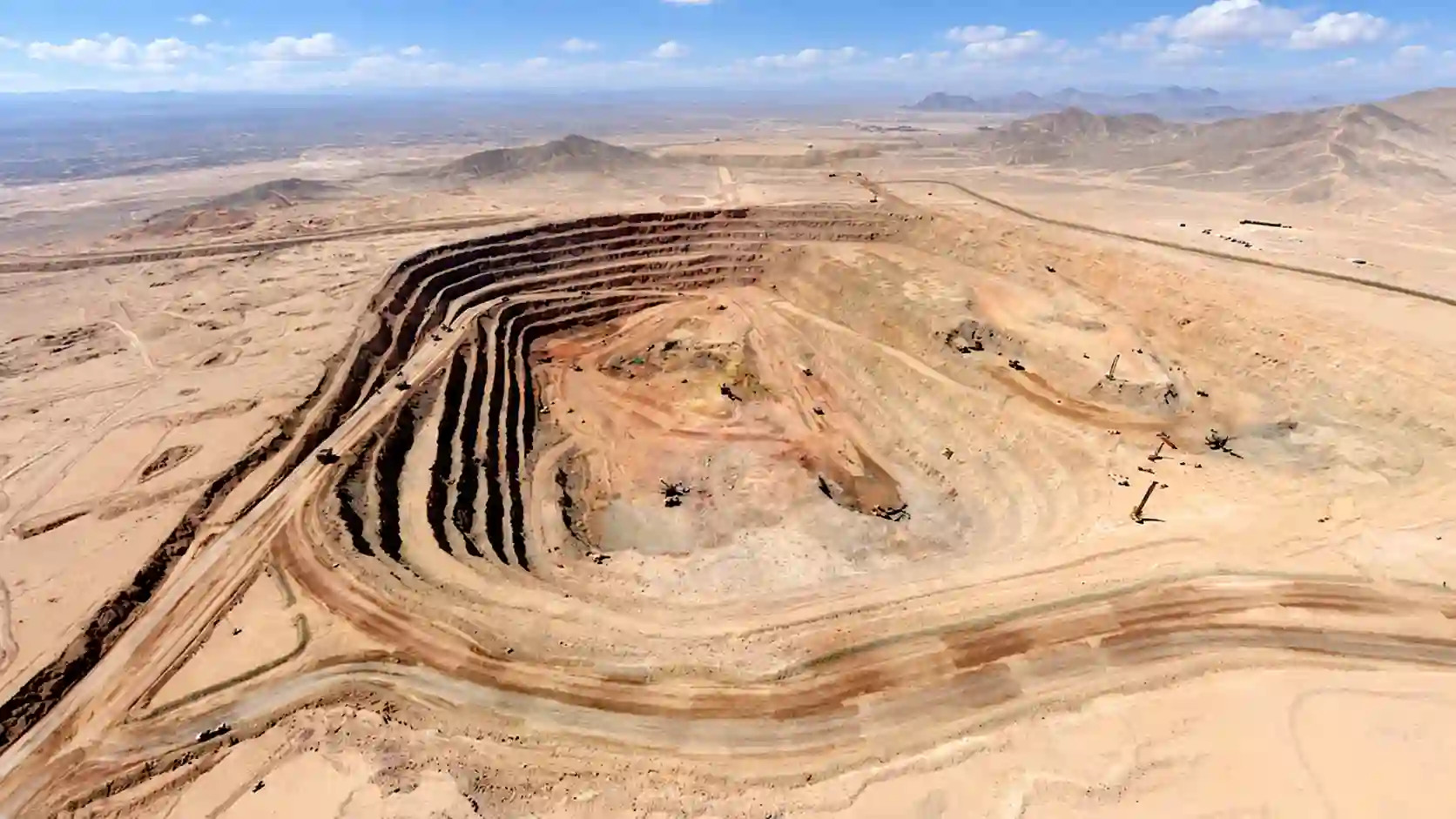
Sierra Gorda's US$725 million fourth grinding line is a bet on processing more ore efficiently at an existing mine. The joint venture between Poland's KGHM (55%) and Australia's South32 (45%) expects annual processing capacity to rise from around 48 million to 60 million tonnes and copper-equivalent production to increase by roughly 30% after the project reaches full operation.
South32's feasibility study estimates a nominal post-tax internal rate of return of about 20% at US$5/lb copper and 23% at US$6/lb. Those are company forecasts, not earned returns. The economic logic rests on reusing expensive water, power and transport infrastructure while increasing throughput and spreading operating costs across more production. [1] [2]
The investment arrives as Chile struggles to maintain copper output from mature deposits. The central question is not merely how much Sierra Gorda will produce, but whether productivity-led expansions can offset the structural pressures affecting the country's wider mining industry.
Chile's Copper Problem Is About More Than Demand
Chile remains the world's leading copper-producing country, yet its production trajectory has become harder to expand. Ageing mines, changing ore characteristics, maintenance cycles, water constraints and the time needed to deliver new projects place pressure on supply. Strong copper prices can improve mining revenue, but they do not by themselves create additional saleable metal.
In August 2026, the Chilean Copper Commission (Cochilco) reduced its estimate of national output to 5.27 million tonnes in 2026, a 2.6% decline from 2025. It expected a recovery to around 5.55 million tonnes in 2027, partly reflecting normalisation after a weak first half at major operations including Codelco, Escondida and Spence. [3]
The longer-term issue is more structural. Cochilco's 2025–2034 production model shows an expected dip from 5.97 million tonnes in 2027 to 5.43 million tonnes in 2030, followed by a project-dependent recovery to approximately 6.06 million tonnes in 2033. The 2027 figure in this earlier study is not the same as Cochilco's revised August 2026 near-term forecast, and they should not be combined into a single updated series. [4]
The problem for Chile is not a lack of potential copper demand. It is the challenge of sustaining physical output while existing ore bodies become more demanding to mine and process. Sierra Gorda illustrates one response: extract more economic value from a developed operating system before relying on a completely new mine.
The Brownfield Advantage: More Capacity, Existing Infrastructure
The fourth line adds a new crusher, a high-pressure grinding roll (HPGR), a ball mill, flotation capacity and associated infrastructure. The plan is to process roughly a quarter more ore each year, raising nameplate capacity from about 48 to 60 million tonnes. KGHM expects roughly 20% higher output of copper and associated metals, while South32 forecasts an approximately 30% increase in copper-equivalent production. The percentages differ because they measure different things. [2] [1]
As a brownfield expansion, the project builds on an operating mine that already has a seawater pipeline, electrical supply and export connections via road and rail to Antofagasta and Angamos. According to KGHM, the operation uses seawater from the Mejillones area and electricity supplied from renewable sources. Infrastructure that would be expensive and time-consuming to establish for a new mine is already in place. [2] [5]
That does not eliminate construction or operating risk. It changes where the investment is concentrated: upgrading the processing bottleneck rather than recreating the entire industrial system.
More ore passes through an established operation, creating the potential for higher recovered-metal volumes.
Existing water, power, roads and rail can support expansion without equivalent new greenfield investment.
Successful ramp-up can distribute fixed operating costs over higher output, subject to recovery and input costs.
A Profitable Mine Is Funding Its Next Phase
Sierra Gorda's recent earnings provide an important part of the investment story. South32 reports that its 45% economic share generated US$758 million of underlying EBITDA in FY2026, up from US$482 million the year before. The underlying operating EBITDA margin rose to 66%. South32 attributes much of the earnings increase to higher realised metal prices, not higher output: its payable copper-equivalent production declined by around 3% to 87,100 tonnes on the company's attributable basis. [6]
This distinction matters. Higher earnings in a strong commodity-price environment show the asset's current cash-generating capacity; they do not prove that its operating productivity improved by the same percentage. In the same reporting year, operating cost per tonne of ore processed rose from US$16.1 to US$18.9. South32's measures and commodity-price movements have to be read together. [6]
| Indicator | FY2025 | FY2026 | Interpretation |
|---|---|---|---|
| Underlying EBITDA South32's 45% share |
US$482m | US$758m | Strong price-led profitability despite slightly lower production. |
| Underlying EBITDA margin | 58% | 66% | Higher margin partly reflects realised metal prices. |
| Operating cost per tonne of ore processed | US$16.1 | US$18.9 | Costs rose in FY2026; the future 10% reduction uses a different long-term basis. |
| Payable copper-equivalent production South32 share |
Approx. 89.7kt | 87.1kt | Not directly comparable with the full joint venture's total copper production. |
FY2025 copper-equivalent output is approximated from South32's stated FY2026 decline of 2.6kt. Financial and operating figures are drawn from South32's FY2026 results, using its reporting definitions. Source [6].
From KGHM's perspective, Sierra Gorda is also a proven cash contributor. In its discussion of 2025 results, KGHM said international assets contributed 48% of the group's adjusted EBITDA, while Sierra Gorda had repaid more than US$1 billion to KGHM since 2021. The owners expect the expansion to be financed through mine-level operating cash flow and available joint-venture debt facilities. [7] [1]
The Low-Grade Ore Equation: Volume Is Central
Sierra Gorda's ore characteristics explain why processing scale is so important. Reporting from Chile's 2026 mining summit cites a grade of approximately 0.389% copper at Sierra Gorda, against a cited comparison figure of 0.8% for Chilean mining. The comparison originates in a conference report rather than a harmonised, independently reproduced national grade series, and should therefore be interpreted as an indication of the mine's low-grade profile rather than an exact nationwide benchmark. [8]
At a lower grade, more tonnes of rock must normally be mined, moved and treated to obtain a tonne of contained copper, before accounting for metallurgical recovery, by-products and dilution. A higher-throughput plant can therefore play a critical role in the economics of a low-grade deposit. The relevant variables are not just nominal processing capacity, but how many recoverable and payable metal units each tonne generates at what total cost.
Sierra Gorda also produces molybdenum, gold and silver. Their revenue contribution matters: they affect the operation's effective cost position and help explain why South32 reports copper-equivalent output alongside actual copper volumes. Treating the mine as a copper-only operation would miss part of its commercial model. [1] [9]
At Sierra Gorda, growth is not primarily a question of finding more ore to mine tomorrow. It is a question of converting an existing mineral and infrastructure base into more payable metal at a competitive long-term cost.
What the US$725 Million Investment Must Deliver
South32's published investment case puts the project at approximately US$725 million on a 100% joint-venture basis, with spending planned across its financial years FY2027–FY2030. The company's modelling estimates 20% nominal post-tax IRR with long-term copper at US$5/lb and 23% with copper at US$6/lb. The underlying forecasts include assumptions for molybdenum, gold and silver; the document does not present these returns as guaranteed outcomes. [1]
The feasibility study also expects around a 10% reduction in average operating unit costs after expansion. This estimate is measured over the calendar-year 2031–2041 period, not against the FY2026 cost per tonne of ore mentioned above. Comparing the two as though they were identical cost series would be misleading. [1]
| Project variable | Operator's expectation | Economic significance |
|---|---|---|
| Capital spending | ~US$725m during South32 FY2027–FY2030 | Concentrated investment in a processing expansion rather than a new standalone mine. |
| Annual ore capacity | ~48 Mt → ~60 Mt | 25% more design throughput, conditional on successful completion and ramp-up. |
| Average payable metals, post-project | ~195kt copper; ~6kt molybdenum; ~58koz gold; ~1.7Moz silver annually | Revenue depends on several metals and their realised prices. |
| Projected average unit costs | ~10% lower over 2031–2041 | Improvement comes from cost leverage and operating assumptions. |
| Nominal post-tax IRR | ~20% at US$5/lb copper; ~23% at US$6/lb | Sensitivity to copper prices; other model assumptions also matter. |
| Full run rate | Second half of 2030 / South32 FY2031 | Benefits arrive after a multi-year investment period. |
Cochilco's August 2026 copper-price projection was US$5.95/lb for 2026 and US$5.10/lb for 2027. This helps frame prevailing market conditions, but cannot substitute for the long-run price assumptions used in a multi-decade investment model. [3]
The project has to justify a large upfront outlay with a durable increase in recoverable metals and lower average costs over many years. A strong copper market may improve near-term economics, but execution delays, higher power or labour costs, lower recoveries and metal-price changes could alter realised returns.
Why Sierra Gorda Matters to KGHM and South32
For KGHM, Sierra Gorda is a major international operating asset and part of its effort to diversify earnings geographically. The company's October project announcement explicitly links the fourth grinding line to the KGHM 2055+ strategy and its long-term copper position. The Polish group owns 55% of Sierra Gorda and has already received substantial cash repayments from the operation. [2] [7]
For South32, which holds the remaining 45%, the project offers additional exposure to copper without starting an entirely new operation. The expansion is attached to a mature, profitable asset with a track record of cash generation. South32's financial disclosures emphasise higher-margin copper growth and the use of established infrastructure rather than simply presenting a production target. [1] [6]
Both ownership perspectives support the same commercial decision: reinvest in an asset that has already demonstrated operating and financial resilience, while testing whether geological potential can support an even longer production life.
What Could Limit the Economic Gains?
The brownfield advantage is substantial, but Sierra Gorda remains an industrial operation in the Atacama Desert with demanding geology and resource requirements. Project execution and process performance determine whether rated capacity translates into payable metal.
Higher ore throughput is most valuable when grade, recovery and metal mix support sufficient saleable output.
Capital overruns, delayed commissioning or slower-than-planned ramp-up would postpone financial benefits.
Existing supply systems lower entry costs but do not eliminate exposure to energy use, pumping, labour and maintenance costs.
Copper, molybdenum, gold and silver prices all influence revenues and the reported copper-equivalent economics.
The mine's water supply and renewable electricity arrangements are important infrastructure assets. Their existence should not be interpreted as evidence that future energy or water costs are immaterial. The investment case depends on cost discipline as well as throughput.
A Bigger Processing Plant Needs a Long-Term Resource Base
South32 announced a 61% increase in Sierra Gorda's ore reserve estimate to approximately 1.1 billion tonnes in FY2026, extending the stated reserve life by about five years to 2045. That improves the economic context for the additional processing capacity: a plant has greater value when supported by a sufficiently long sequence of mineable ore. [6]
There may be further potential beyond the existing reserve model. South32 has published a conceptual exploration target for Catabela Northeast of 1.1–2.9 billion tonnes at indicated target grades of approximately 0.45–0.48% total copper. This is expressly an exploration target, not an ore reserve or an economically proven mine-life extension. Further drilling and technical work are necessary before any such potential can be included in a future mine plan. [6] [2]
At a Chilean mining summit, Sierra Gorda also outlined separate possible future spending on tailings facilities, thickeners and mine-life extension. Such plans are relevant to the longer industrial system, but are not automatically part of the approved US$725 million grinding-line budget. [8]
What the Expansion Reveals About Chile's Copper Model
Cochilco's 2025–2034 investment portfolio amounts to approximately US$104.55 billion of planned mining projects. It includes developments at different stages of permitting and financing; the figure must not be read as fully committed spending. Several of the portfolio's largest proposed projects expand ore-processing capacity at existing large mines, which places Sierra Gorda within a wider investment pattern. [10]
The International Energy Agency's 2026 minerals outlook reports an increase in investment by copper-focused companies, despite weaker spending across several other critical-mineral segments. This supports the broader argument that investors see a significant long-term copper opportunity. It does not guarantee the profitability of any specific Chilean project. [11]
For Chile, the key economic challenge is to turn project pipelines into reliable incremental production. A large investment announcement and a strong metal price do not immediately change national output. Actual capacity, ore recovery, construction schedules, permitting and mine lives determine the country's longer-term position.
- Existing mines are an important source of growth. Upgrades can extract additional value from infrastructure that has already been built.
- Capacity and output are different measures. More grinding capacity does not mechanically produce the same percentage increase in copper.
- Metals mix matters. By-product production and prices contribute materially to profitability at polymetallic copper operations.
- Project timing matters for national supply. Sierra Gorda's full contribution is expected around 2030, not during the current production downturn.
- Competition is international. Chile's future share of the copper market depends on successful investment execution while producers elsewhere also expand.
Sierra Gorda illustrates a central feature of the next phase of Chilean copper mining: economic growth increasingly depends on upgrading existing productive assets.
The fourth grinding line is not merely a larger mill. It is an investment in the ratio between existing capital, ore processed and metal recovered. For a low-grade operation, throughput and cost control can be as strategically important as new mineral discoveries. A pipeline, power system and export connection already in place make this approach commercially distinct from building a new mine.
The investment also highlights the difference between a strong commodity market and a strong production outlook. Chile can benefit from higher copper prices while its mines still struggle to increase physical output. Profitability and production growth are related, but they are not interchangeable.
The important test will come after construction: whether the new capacity delivers the recoverable-metal volumes, average costs and long-term returns anticipated by the joint-venture partners. Sierra Gorda is therefore a useful case for understanding how Chile seeks to defend its copper position through operational investment rather than relying only on the next generation of new mines.
Chile Mining, Company & Investment Research
Econosur researches defined economic questions about mining companies, investment projects and industrial development in Chile and South America. Work is based on public documents, company disclosures, market and sector data, and targeted source verification where required.
Assess ownership, performance, capital allocation, profitability, business models and operational positioning.
Evaluate copper production, market structure, competitiveness, price exposure and long-term sector trends.
Examine the economics, status, financing, constraints and strategic role of specific industrial projects.
Connect Latin American and international filings, operating data and regulatory evidence to answer defined business questions.
Explore custom market analysis, company reports and South America market briefs.
Forecast vs. realised performance: US$725 million, +30% copper equivalent, –10% average unit costs and 20–23% IRR describe the operator's approved investment case and projections; they are not realised results.
Different measurement bases: ore throughput (+25%), copper and associated-metal output (approximately +20% in KGHM's communication), and copper-equivalent output (approximately +30% in South32's model) are not interchangeable.
Reporting basis: South32's FY2026 EBITDA and attributable production are shown on its 45% share, whereas the expansion budget and plant capacity refer to the whole joint venture. C1 cost per pound and cost per tonne processed are different metrics.
Time horizon: South32's FY2027–FY2030 spending estimates are for its financial years. Cochilco's older long-term production series and August 2026 revisions represent different forecast vintages.
Geology: ore reserves are not identical to exploration targets. Possible Catabela Northeast mineralisation cannot be treated as commercially proved production.
Industry interpretation: Sierra Gorda is one case within Chilean copper mining. Its grade, processing conditions and returns should not be assumed to represent all mines in the country.
Primary, Institutional and Secondary Sources
- [1] South32 — Final investment approval of Sierra Gorda's fourth grinding line (1 July 2026) . Primary stock-market disclosure: investment budget, forecast capacity, payable-metal output, cost assumptions, nominal post-tax IRR and financial-model footnotes.
- [2] KGHM — Sierra Gorda expansion project launch (2 October 2026) . Official owner announcement covering project scope, processing equipment, ownership, strategy, infrastructure, schedule and production assumptions.
- [3] Cochilco — Copper-market outlook for 2026–2027 (11 August 2026) . Updated official copper-price estimates and Chilean production forecasts for 2026 and 2027.
- [4] Cochilco — Proyección de la producción de cobre en Chile, 2025–2034 (PDF) . Official long-term production scenarios and the projected contribution of future mining developments.
- [5] Sierra Gorda SCM — Production process . Operator information on the mine's concentration process and established industrial infrastructure.
- [6] South32 — FY2026 financial results and outlook (27 August 2026) . Primary financial disclosure covering Sierra Gorda EBITDA, attributable production, operating costs, capital programme, ore reserves and the Catabela Northeast exploration target.
- [7] KGHM — FY2025 results conference transcript (PDF) . Corporate reporting on the contribution of international assets to adjusted EBITDA and historical cash repayment from Sierra Gorda.
- [10] Cochilco — Mining investment project portfolio 2025–2034 . Official project pipeline, investment totals and major mining development categories.
- [11] International Energy Agency — Global Critical Minerals Outlook 2026 . International demand, supply and investment trends relevant to the longer-term copper market.
- [8] Minería Chilena — Mining summit investment presentations (28 August 2026) . Conference reporting on Sierra Gorda's ore-grade comparison and longer-term investment possibilities. Reported numbers are attributed to company presentations.
- [9] SONAMI Boletín Minero — Interview with Sierra Gorda CEO Marcelo Bustos (28 September 2026) . Management perspective on low-grade mining, financial performance, operational conditions and the company's investment plans.
- FactSet — Metals & Mining: Copper Capex Watch (July 2026) . Research into international copper-project capital intensity. Its copper-capacity figures are not directly equivalent to South32's copper-equivalent capacity measure, so no direct numerical cost ranking is made.
- Evidence note: Econosur gives priority to original company filings, official financial reporting and Cochilco data for quantitative claims. Industry interviews provide operational context. Figures based on different reporting periods, ownership shares and definitions are kept separate.
- Econosur analysis prepared 8 October 2026.
Chile Copper Mining & Investment Analysis
Econosur prepares company, investment and industry research for businesses assessing Chile and South American markets. Reports connect ownership, economics, operational realities, public filings and sector data.
Research can address a specific mine, corporate strategy, industrial project, competitive structure or international market question.
Explore custom market analysisFrequently Asked Questions
What is Sierra Gorda's fourth grinding line?
It is a US$725 million brownfield expansion of the existing copper and molybdenum processing operation in Chile's Antofagasta region, designed to raise ore throughput from around 48 million to 60 million tonnes per year.
Why are KGHM and South32 investing US$725 million?
The joint-venture owners expect higher metal output and lower average operating unit costs from more processing capacity using existing water, power and transport infrastructure. South32's feasibility study estimates a nominal post-tax internal rate of return of approximately 20% at US$5/lb copper and 23% at US$6/lb.
Does Sierra Gorda's expansion increase copper production by 20% or 30%?
KGHM describes an increase of around 20% in copper and associated-metal output. South32 forecasts approximately 30% growth in copper-equivalent production, a measure that includes the economic contribution of molybdenum, gold and silver. Ore throughput rises by approximately 25%; these are different metrics.
When will the Sierra Gorda expansion produce at full capacity?
KGHM schedules construction completion for the end of 2029 and expects full capacity during the second half of 2030. South32 anticipates first production around the middle of its financial year 2030 and full rates in FY31.
What is Chile's copper production outlook for 2026 and 2027?
In August 2026 Cochilco forecast Chilean copper output of 5.27 million tonnes in 2026, a 2.6% annual decline, and 5.55 million tonnes in 2027. These short-term estimates supersede the same years in Cochilco's older 2025–2034 projection.
Does the project guarantee higher profitability?
No. The projected returns, output and cost savings depend on project execution, metallurgical recovery, ore characteristics, input costs, commodity prices and other variables. South32's estimates are forward-looking and should not be treated as actual outcomes.