
Market Insight · Uruguay · Dairy · Agribusiness · Trade · Market Access
Uruguay’s Dairy Export System: Production, Processors and Markets
Uruguay reached record milk deliveries and USD 965 million in dairy exports in 2025. The same system is concentrated at every critical point: fewer and more productive farms, four dominant processors, a heavy dependence on whole milk powder and two markets that absorb most export revenue.
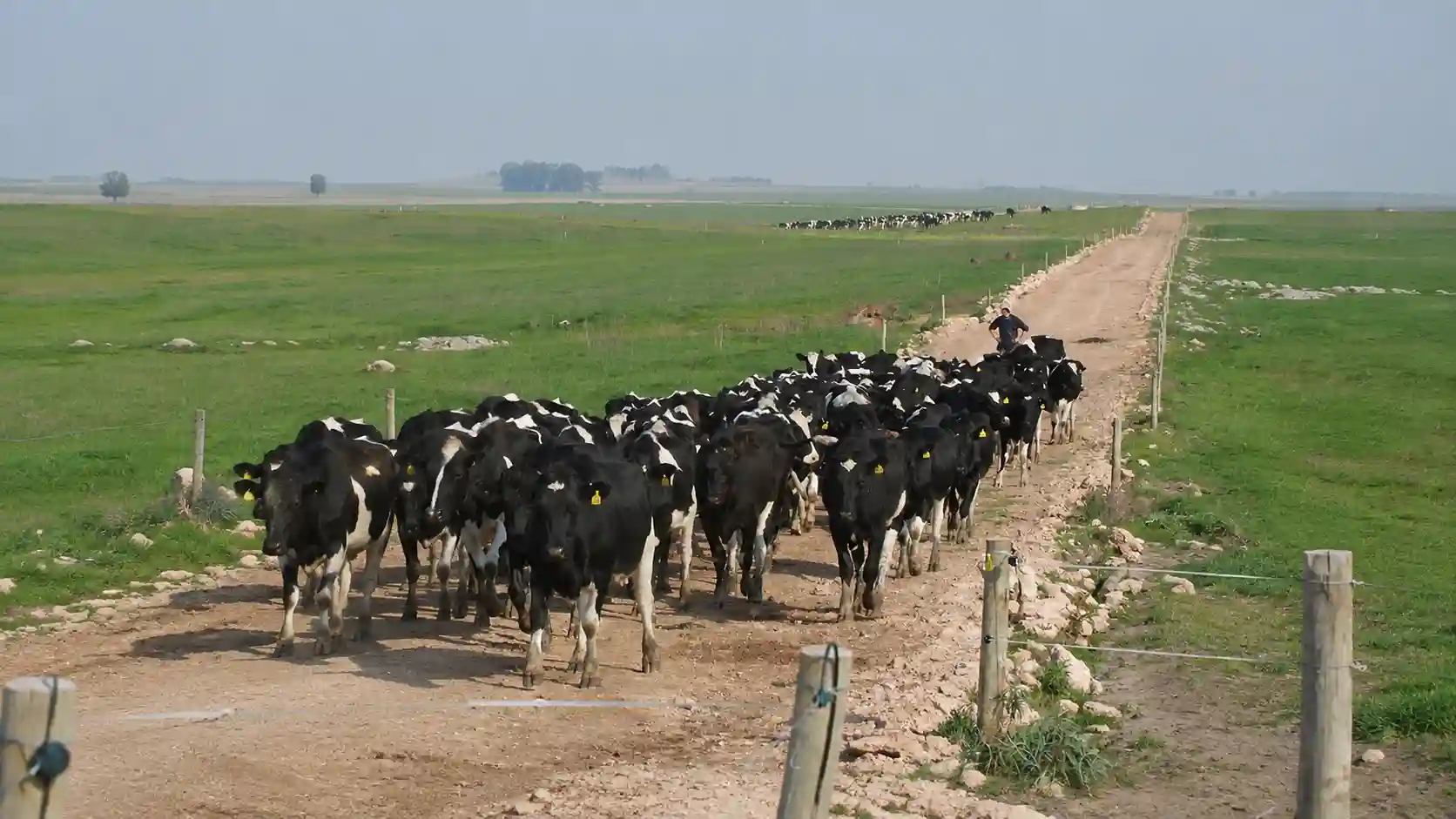
Uruguay’s dairy sector is highly productive, strongly export-oriented and concentrated at every decisive point in the chain.
Milk deliveries to processors reached a record 2.212 billion litres in 2025, up 8.4 percent from the previous year. Dairy exports generated USD 965 million, while 74 percent of processed milk, measured in milk equivalent, was directed abroad.
Four processors — Conaprole, Estancias del Lago, Lactalis and Alimentos Fray Bentos — received 91 percent of industrial milk. Whole milk powder generated 69 percent of dairy export revenue. Algeria and Brazil accounted for 36 percent and 26 percent of destination value respectively.
That concentration creates efficiency and scale, but it also creates exposure. Brazil’s June 2026 antidumping decision established company-specific duties on Uruguayan milk powder, including USD 613.32 per tonne for Conaprole. Collection was suspended at the same time on public-interest grounds, but the decision showed how quickly market access can become conditional.
For wider context, see Econosur’s Uruguay Export Map, Logic of the Small Market and Agriculture and Food Systems.
Core market reading:
Uruguay does not have a milk-volume problem. It has a concentration problem that is also a source of competitiveness. Scale allows a small country to export most of its processed milk, but the system depends heavily on a few farms, processors, products, certifications and external buyers.
Data update · October 4, 2026
INALE’s August 2026 dairy-export report records USD 606 million in cumulative January–August export invoicing, 1% above the corresponding 2025 period. Algeria, Brazil and Mexico were the leading year-to-date destinations.
The newer Uruguay XXI September 2026 report places dairy at USD 654 million for January–September, down 1% year on year and fourth among goods-export categories. September alone contributed USD 80 million, down 13%; Brazil took 38% of the month’s dairy export value.
The two cumulative figures use different cut-off months and reporting systems and should not be spliced into a single series. INALE also distinguishes invoiced exports from the month in which payment is received. Record 2025 milk deliveries are a production baseline, not proof of sustained 2026 export-value growth.
Why the dairy export system matters now
The 2025 production record and the 2026 trade data place dairy among Uruguay’s most important export systems. The sector is smaller in value than beef or pulp, but it is unusually dependent on external markets relative to the size of domestic demand.
INALE reported that milk deliveries increased by 8.4 percent in 2025 and milk solids by 9.7 percent. Export revenue rose 13 percent to USD 965 million. The increase in export value was driven more by improved realization than by a comparable rise in physical volume.
The first half of 2026 confirmed the sector’s national relevance. Uruguay XXI reported USD 416 million in dairy export applications between January and June, making dairy products the country’s third-largest goods export category after beef and pulp. June alone generated USD 72 million, 8 percent more than a year earlier.
The current issue is therefore not whether Uruguay can produce and export dairy products. The central question is how resilient the system remains when processing, products and buyers are concentrated and when a major neighboring market can introduce trade-remedy measures against the flagship product.
Uruguay’s dairy model converts a small home market into export scale.
The same structure that makes the model viable also magnifies external shocks. A price decline in milk powder, a sanitary restriction, a financing problem at one large processor or a market-access decision in Brazil can affect a large share of the national chain.
How Uruguay’s dairy export system works
The system begins with a pastoral production base and ends in destination-specific industrial products. Each layer has its own concentration and market-access requirements.
These layers cannot be evaluated separately. A rise in milk supply creates value only if processors can absorb it, convert it into products that meet buyer specifications, obtain sanitary certificates and sell into markets with viable prices and trade conditions.
Record production with fewer farms
Uruguay’s primary dairy sector delivered a record 2.212 billion litres to processors in 2025. The increase was accompanied by a record 172 million kilograms of milk solids, confirming that the expansion was not only a change in liquid volume.
The long-term production model has changed. A peer-reviewed study of Uruguayan dairy systems describes two decades of intensification and concentration: higher productivity per cow, a broadly stable herd, less land devoted to dairying and fewer farms. A separate 2026 Agrociencia study reports that Uruguay lost almost 800 milk producers between 2010 and 2020 while the sector continued to intensify.
This does not mean that every large or intensive farm is economically stronger. The research identified wide differences in stocking rates, grass use, supplementation, productivity and economic performance. The weakest farm type combined low productivity with negative economic indicators, while the strongest systems achieved better results through higher forage use, stocking rates and management.
The national result is therefore a structural concentration process rather than a simple production boom. More milk is being produced and delivered through a smaller number of production units, increasing average scale while raising questions about succession, family-farm continuity and regional resilience.
Uruguay’s production record is the result of a more concentrated and more productive farm system, not a broad expansion in the number of dairy producers.
Four processors receive 91 percent of industrial milk
Concentration increases sharply at the industrial stage. INALE reported that Conaprole, Estancias del Lago, Lactalis and Alimentos Fray Bentos received 91 percent of milk delivered to processors in 2025. Cooperatives retained a 75 percent share of total industrial intake.
This structure creates operational scale. Large plants can run drying towers, cheese lines, butter production, laboratories, cold storage, export documentation and destination-specific quality systems more efficiently than a fragmented processing base.
It also creates systemic exposure. A closure, acquisition, maintenance interruption or financing problem at one large processor can affect a significant number of farms and a meaningful share of national milk intake. INALE’s 2025 industrial review explicitly described a year marked by acquisitions and closures.
The balance between cooperative and investor-owned processing is another defining feature. Conaprole’s cooperative structure links producer ownership to industrial and export decisions. Estancias del Lago represents a large integrated model. Lactalis brings multinational ownership and commercial networks. Alimentos Fray Bentos adds another private processing platform.
| Processor | Structural role | Market relevance |
|---|---|---|
| Conaprole | National producer cooperative with seven industrial plants and a broad domestic and export portfolio. | Central platform connecting farms, industrial capacity, certifications, finance and international customers. |
| Estancias del Lago | Large integrated dairy production and processing operation. | Adds industrial-scale milk powder capacity outside the traditional cooperative model. |
| Lactalis | Uruguayan operations within a global dairy group. | Connects local milk processing with multinational product and market networks. |
| Alimentos Fray Bentos | Private processor included among the four largest recipients of industrial milk. | Relevant to milk intake and directly exposed to Brazil’s company-specific trade measure. |
Whole milk powder dominates the export portfolio
Uruguay’s dairy exports are not evenly distributed across products. Whole milk powder generated 69 percent of dairy export revenue in 2025. Cheese represented 9 percent, butter 8 percent and skim milk powder 6 percent.
This mix reflects the economics of a small producing country with a limited domestic market. Powder converts perishable raw milk into a storable, standardized and internationally traded commodity. It allows processors to absorb large seasonal volumes and serve distant buyers.
The advantage comes with commodity exposure. Milk powder prices are influenced by global production, tenders, inventories, Chinese demand, New Zealand supply, feed costs and currency movements. Product concentration therefore transfers a large part of Uruguay’s dairy income into an international price cycle.
Cheese, butter, whey products and specialized ingredients offer diversification, but they require different plants, customers, certifications and commercial capabilities. Moving toward higher-value products is not simply a marketing decision. It requires industrial investment and reliable access to buyers willing to pay for more differentiated specifications.
Algeria and Brazil shape the export model
Destination concentration is as important as product concentration. Algeria accounted for 36 percent of dairy export revenue in 2025 and Brazil for 26 percent. Mauritania and Chile each represented 3 percent, while Russia accounted for 2 percent.
Algeria is especially important for whole milk powder. Its large public and commercial purchasing requirements provide scale, but tender-driven demand can be irregular and highly price-sensitive. A change in procurement, financing or supplier competition can affect Uruguayan export realization.
Brazil provides geographic proximity, established trade channels and a large consumer market. It is also a producer with powerful agricultural interests and a history of trade-remedy action in dairy. Regional integration does not eliminate defensive trade policy when domestic producers argue that imports are causing injury.
The concentration is not only geographic. Different products depend on different markets. Whole milk powder is strongly tied to Algeria, while Brazil is particularly important for cheese and regional dairy trade. Commercial diversification therefore requires product-specific market development rather than simply adding country names to an exporter list.
| Destination | Share of dairy export revenue, 2025 | Strategic meaning |
|---|---|---|
| Algeria | 36% | Largest destination and a core market for whole milk powder; high-value concentration in a distant, tender-sensitive buyer. |
| Brazil | 26% | Large nearby market with strong regional integration, but also domestic producer pressure and trade-remedy risk. |
| Mauritania | 3% | Secondary powder market that contributes to geographic diversification. |
| Chile | 3% | Regional market with established logistics and product-specific demand. |
| Russia | 2% | Historically relevant but exposed to geopolitical, payment and market-access uncertainty. |
This structure fits the broader national pattern described in Econosur’s Uruguay Export Map: a small economy achieves scale through specialization, but external demand and buyer concentration remain central determinants of domestic performance.
Dairy was a top-three export category in the first half of 2026
Uruguay XXI reported USD 416 million in dairy export applications in the first half of 2026. Dairy products ranked third after beef and pulp, ahead of beverage concentrates and soybeans.
The monthly path was uneven but positive in several periods. May dairy exports reached USD 85 million, 29 percent above May 2025. June generated USD 72 million, an increase of 8 percent year on year.
These figures are export applications reported by Uruguay XXI, including the agency’s established national trade methodology. They should not be described as audited revenue received by individual processors. They establish the first-half baseline; the September update above shows dairy ranked fourth in the January–September cumulative total.
Dairy generated USD 416 million in export applications in the first half of 2026, confirming its position behind beef and pulp.
Export momentum still depends heavily on whole milk powder, Algeria and Brazil rather than a broadly diversified product-market portfolio.
The antidumping decision showed that favorable regional access can be challenged even when duty collection is suspended.
Brazil’s antidumping decision exposed the market risk
Brazil opened an antidumping investigation into non-retail whole and skim milk powder from Argentina and Uruguay on December 11, 2024. On June 3, 2026, the Brazilian Gecex adopted Resolution 907, which established definitive duties for up to five years. The resolution was published on June 8.
The same resolution suspended application of the duties on public-interest grounds. This distinction is essential. Brazil created definitive company-specific rates, but the additional charges were not being collected as of the publication of this analysis.
For Uruguay, the measure assigned rates of USD 378.27 per tonne to Alimentos Fray Bentos, USD 850.07 per tonne to Claldy (Compañía Láctea Agropecuaria Lecheros de Young S.A.) and USD 613.32 per tonne to Conaprole. Other Uruguayan producers or exporters were assigned USD 4,196.72 per tonne.
| Uruguayan producer or exporter | Definitive antidumping rate | Status as of August 1, 2026 |
|---|---|---|
| Alimentos Fray Bentos | USD 378.27 per tonne | Rate established; application suspended on public-interest grounds. |
| Claldy Compañía Láctea Agropecuaria Lecheros de Young S.A. |
USD 850.07 per tonne | Rate established; application suspended on public-interest grounds. |
| Conaprole | USD 613.32 per tonne | Rate established; application suspended on public-interest grounds. |
| Other companies | USD 4,196.72 per tonne | Residual rate established; application suspended on public-interest grounds. |
The commercial significance goes beyond the immediate suspension. A definitive rate creates a legal and policy structure that can affect negotiations, risk assessment and future access. The official measure runs to June 8, 2031, subject to the rules governing the suspension and any later reapplication or expiry.
The case also demonstrates a limit of Mercosur integration. Uruguay and Brazil share a customs and regional trade framework, but domestic injury claims and trade-defense instruments can still reshape access for a core agricultural product.
Trade-policy distinction:
Brazil established definitive antidumping duties and suspended their application in the same decision. The correct description is a legally adopted but currently suspended trade barrier, not an active surcharge on every shipment.
Sanitary approval is part of the export infrastructure
Market access for dairy products is operational rather than abstract. Uruguay’s MGAP maintains a current list of markets classified as open, restricted or closed, including the products authorized, sanitary requirements and export history.
A plant seeking export authorization must first hold valid domestic approval. It then requires an approved and verified HACCP plan for the product line and must request access for the specific destination and product. Authorities can impose additional destination-specific conditions.
Individual shipments require sanitary certification covering animal health, raw-material collection, industrial processing, storage and loading. The procedure can also require analytical certification from LATU and the current international certificate model accepted by the destination.
This means that an exporter cannot freely redirect product from one market to another after a commercial shock. A new customer may require plant approval, product registration, updated certificates, audits, labels, religious certification or a negotiated veterinary protocol.
| Access layer | Requirement | Commercial implication |
|---|---|---|
| Plant authorization | Current hygienic and sanitary approval for domestic operation. | The processor must maintain compliant facilities and approved production lines. |
| Export authorization | Approved HACCP plan and authorization for the intended product and destination. | Access is plant-, product- and country-specific rather than automatic. |
| Shipment certification | International sanitary certificate and supporting analytical documentation. | Each shipment depends on valid documentation and destination requirements. |
| Buyer standards | Quality, food-safety, Halal, Kosher or other commercial certification where required. | Official access does not guarantee acceptance by a specific customer. |
Market diversification therefore requires regulatory preparation alongside commercial sales. Uruguay’s competitiveness depends on maintaining a portfolio of approved plants, products and destination protocols before a shock occurs.
Conaprole is the central industrial platform
Conaprole was created in 1936 as the national cooperative structure for receiving, processing and commercializing milk. Its current role extends across farm relationships, industrial processing, domestic distribution, export products, certification and financing.
The company reports seven industrial plants and more than 350 product presentations across milk, yoghurt, butter, dulce de leche, cheese, frozen products and powdered dairy ingredients. Its export platform includes milk powders, butter and whey-based ingredients.
Conaprole’s certifications include ISO systems, FSSC 22000, HACCP, Halal and Kosher standards across different plants and product lines. These company-reported systems show why market access is built into the industrial model rather than added after production.
The cooperative is also visible in Uruguay’s capital market. The Bolsa de Valores de Montevideo publishes Conaprole financial statements, risk ratings and Conahorro issuance documents. This creates a level of financial documentation that can support a separate company-level analysis.
Conaprole’s central position does not mean that every national dairy result can be attributed to the cooperative. The 91 percent concentration figure covers four processors, and INALE’s national export data include multiple companies. Conaprole should be read as the system’s leading platform, not as the entire sector.
Risk map: concentration creates efficiency and exposure
The first risk is farm-base concentration. Higher productivity supports competitiveness, but the continuing loss of establishments can weaken rural communities, producer succession and the diversity of supply relationships.
The second risk is processor concentration. Four companies control most milk intake. This gives the system industrial scale but magnifies company-specific disruptions.
The third risk is product concentration. Whole milk powder absorbs a large share of export milk and revenue, tying national performance to a global commodity cycle.
The fourth risk is destination concentration. Algeria and Brazil account for nearly two-thirds of export revenue. Each market carries different policy, payment, tender and competitive risks.
The fifth risk is access concentration. The ability to redirect exports depends on approved plants, sanitary protocols, certifications and buyer acceptance. A market may be commercially attractive but operationally unavailable.
| Risk layer | Current concentration | What to monitor |
|---|---|---|
| Farm base | Long-term decline in the number of dairy establishments. | Producer exits, productivity, debt, milk price, succession and regional supply. |
| Processing | Four processors receive 91% of industrial milk. | Plant utilization, acquisitions, closures, financial condition and supplier contracts. |
| Products | Whole milk powder generates 69% of export revenue. | Global powder prices, tenders, inventory, plant mix and higher-value product investment. |
| Destinations | Algeria and Brazil represent 62% of dairy export revenue. | Import policy, tenders, payment conditions, domestic producer pressure and buyer diversification. |
| Market access | Product and plant approvals differ by destination. | Sanitary protocols, audits, certification renewals and new-market authorization. |
What could change the model
The most direct path is product diversification. More cheese, butter, whey ingredients and specialized powders could reduce dependence on whole milk powder, but the change requires capital, customer development and product-specific market approvals.
The second path is destination diversification. Uruguay already exports to a broad set of markets, yet revenue remains concentrated. New destinations matter only when they absorb meaningful, repeated volumes at viable prices.
The third path is deeper value-chain integration. Traceability, analytical systems, food-safety certification and specialized ingredients can support more demanding buyers. These capabilities can protect margins but also raise fixed costs and technical requirements.
The fourth path is a more resilient farm base. Productivity growth remains essential, but the sector’s long-term stability also depends on financing, management succession, technical support and viable returns for producers outside the largest farm categories.
Uruguay’s dairy system will remain export-oriented because the domestic market is too small to absorb national output. The strategic objective is therefore not self-sufficiency. It is a broader and more resilient combination of processors, products, approved markets and buyers.
Uruguay’s dairy challenge is not to export more of the same product to the same buyers. It is to preserve scale while reducing the number of points at which one external shock can affect the entire system.
Why this market case matters for Uruguay
Dairy captures the economic logic of Uruguay unusually well. A small domestic market supports a production system much larger than local consumption because the country specializes, industrializes and exports.
The model depends on institutions that are easy to overlook: farm data, plant authorization, veterinary protocols, quality laboratories, certifications, trade finance, cooperative governance and market intelligence. The export product is the visible end of a much larger institutional system.
It also demonstrates the limits of scale in a small economy. Uruguay can be highly competitive without being diversified. Concentration provides efficiency, but the cost appears when one processor, one product or one destination changes its conditions.
This is the same broader structure examined in Econosur’s Logic of the Small Market and Uruguay Export Map: openness is not a secondary feature of the economy. It is the operating condition that allows specialized sectors to exist at their current scale.
Marcus A. Volz perspective
The newer data show why production scale and commercial resilience need separate analysis. A concentrated processor system can deliver milk efficiently while export revenue becomes more exposed to product prices, destination demand and trade measures. A strong production year does not resolve those downstream risks.
For a supplier or market entrant, the actionable unit is the processor, plant and product line. Packaging, refrigeration, ingredients and industrial equipment face different buyers and different investment needs. Destination approval must also be checked for the specific product and establishment; broad statements that a country is “open” do not establish a ready route to market.
Research services for Uruguay’s dairy export and processing system
Econosur can turn a defined business question into a sourced brief or a scoped research assignment.
- Sector briefs: Connect milk supply, processor concentration, product mix and destination exposure for a defined dairy-market question.
- Company reports: Review a processor’s plant network, product portfolio and publicly documented commercial and certification context.
- Custom analysis: Assess equipment, packaging or ingredient demand and the evidence needed to validate a specific market-access route.
Public research is the starting point. Direct verification, interviews or additional datasets can be scoped where they are necessary and feasible; they are not implied by this article. The proposal defines deliverables, timing and evidence limits.
This analysis prioritizes INALE production, industry and trade data; Uruguay XXI export reporting; MGAP sanitary-market documentation; official Brazilian trade-remedy records; peer-reviewed research on dairy-farm structure; and company information for Conaprole’s industrial and certification platform.
Primary, institutional and company sources
- INALE — 2025 record milk deliveries, four-processor concentration, export orientation, export value, product mix and destination shares.
- INALE — Primary production, milk solids and the 2025 farm-level context.
- INALE — Industrial concentration, cooperative share, acquisitions and closures.
- INALE — Detailed dairy-trade structure and export-product analysis.
- Uruguay XXI — First-half 2026 goods exports and USD 416 million in dairy export applications.
- MGAP — Open, restricted and closed dairy markets, approved products and destination requirements, April 2026.
- MGAP — Sanitary certification requirements for dairy exports.
- Brazil MDIC — Resolution GECEX No. 907 of June 3, 2026, company-specific milk-powder antidumping rates and suspension of application.
- Brazil MDIC — Current public-interest suspensions, including milk powder from Argentina and Uruguay.
- Agrociencia Uruguay — Peer-reviewed analysis of intensification, concentration and economic performance in Uruguayan dairy farming.
- Agrociencia Uruguay — Peer-reviewed study reporting a reduction of almost 800 milk producers in Uruguay between 2010 and 2020.
- Conaprole — Seven industrial plants, product portfolio, laboratories and traceability systems.
- Conaprole Forexport — ISO, FSSC, Halal and Kosher certifications by plant and product.
- Bolsa de Valores de Montevideo — Conaprole financial statements, risk ratings and issuance documents.
- INALE — August 2026 exports; invoicing, product mix and cumulative destinations.
- Uruguay XXI — September 2026 and January–September export applications; categories and destinations.
Industry and secondary sources
The next phase of Uruguay’s dairy model will depend on commercial diversification, processor stability, farm economics and the status of Brazil’s suspended trade measure.
- Will Brazil maintain, remove or reactivate the suspended antidumping duties?
- Can Uruguay reduce the 69 percent export-revenue dependence on whole milk powder?
- Which new markets can absorb repeated commercial volumes rather than occasional shipments?
- Will processor concentration increase through further acquisitions or closures?
- Can smaller and medium-sized farms remain viable as the sector becomes more intensive?
- Which plants and product lines are approved for the most promising new destination markets?
- How much investment will move toward cheese, whey ingredients and specialized nutrition products?
- Can Conaprole and other processors preserve scale while reducing destination risk?
From milk production to export-market exposure
Uruguay’s dairy economy is a complete market system: farms, processors, industrial plants, certifications, products, trade rules and buyers. Evaluating only milk volume or export revenue misses the concentration that determines commercial risk.
Econosur prepares custom market analysis for companies, analysts and institutions evaluating Uruguay, agribusiness, food processing, dairy exports, market access and South American trade structures.
Explore custom market analysisFAQ
How much milk did Uruguay deliver to processors in 2025?
Uruguay delivered a record 2.212 billion litres of milk to dairy processors in 2025. INALE reported an increase of 8.4 percent from 2024.
How export-oriented is Uruguay’s dairy industry?
INALE reported that 74 percent of the milk used in processed dairy products, measured in milk equivalent, was directed to exports in 2025. Export revenue reached USD 965 million.
Which companies dominate dairy processing in Uruguay?
Conaprole, Estancias del Lago, Lactalis and Alimentos Fray Bentos together received 91 percent of industrial milk intake in 2025.
What is Uruguay’s main dairy export product?
Whole milk powder is the dominant product. It generated 69 percent of Uruguay’s dairy export revenue in 2025.
Which markets are most important for Uruguay’s dairy exports?
Algeria represented 36 percent and Brazil 26 percent of dairy export revenue in 2025. Together they accounted for 62 percent.
Did Brazil impose antidumping duties on Uruguayan milk powder?
Brazil established definitive company-specific duties in June 2026, including USD 613.32 per tonne for Conaprole. The same resolution suspended their application on public-interest grounds, so the additional duties were not being collected as of August 1, 2026.
Why can Uruguay not immediately redirect all dairy exports?
Plants and products require destination-specific sanitary authorization, HACCP controls, international certificates, analytical documentation and sometimes buyer-specific certifications. Commercial demand alone does not create operational market access.
Why is Conaprole central to the system?
Conaprole connects producer ownership, seven industrial plants, a broad product portfolio, export certifications, laboratories and international sales. It is the leading platform in the sector, although national dairy data include several other processors.