
South America Car Market:
China, Europe
and US Competition
South America’s car market is becoming a regional industrial contest. Chinese brands, European incumbents, US automakers, Brazilian production scale and supplier corridors are reshaping how vehicles are produced, imported, financed and localized.
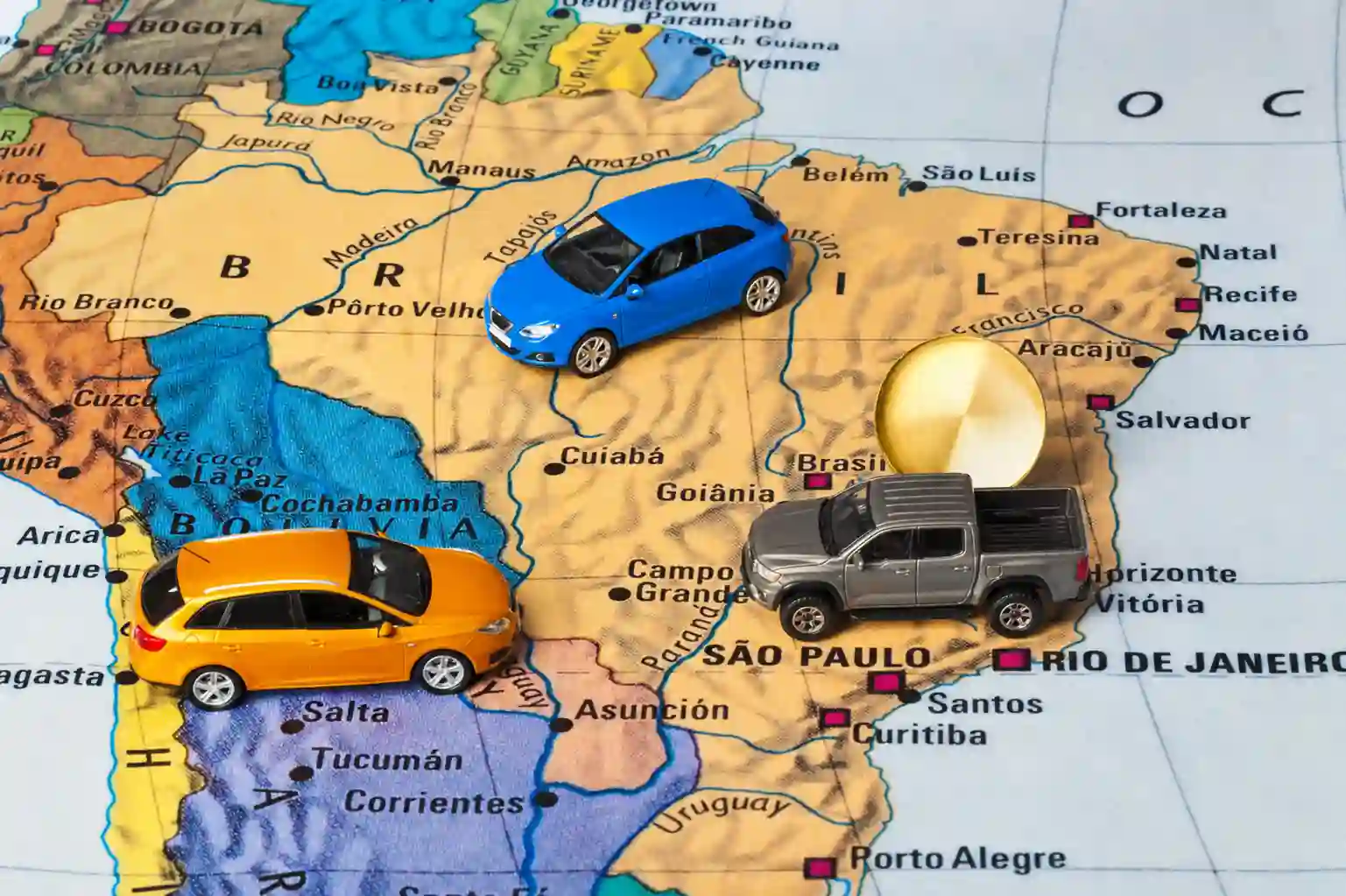
South America’s car market is being reshaped by localization, not only by sales.
Chinese automakers are entering through price, electric and hybrid models, logistics and new factory strategies. European and US manufacturers still control deep industrial history, dealer networks, production routines and brand trust.
The regional structure is uneven: Brazil is the production battlefield, Chile is the import and brand laboratory, Argentina is the supplier stress test, while Paraguay and Uruguay reveal smaller but strategically relevant supplier, logistics and adoption layers.
The South America car market is no longer only a sales question. It is a regional industrial question involving production scale, supplier depth, import channels, local sourcing, financing, software, batteries and logistics.
This is why the topic belongs in the wider Cono Sur market system. Brazil, Argentina, Chile, Paraguay and Uruguay do not play the same role, but together they show how automotive power in South America is becoming regional even when the data still appear national.
The industrial layer connects directly to Brazil as the production core, Argentina as an export-specialized manufacturing base and the broader Econosur section on Manufacturing & Industrial Cases.
Market reading: South America’s car market is being reshaped by competition between Chinese localization, European industrial incumbency, US brand legacy and regional production systems. The decisive question is who controls the value chain behind the vehicle: factories, suppliers, tariffs, logistics, financing, software and after-sales networks.
June 2026 update: localization becomes the central issue
The latest market signal is not only sales growth. It is the shift from import competition to production and sourcing strategy. Brazil’s EV tariff path, Chinese factory investment, Argentina’s supplier pressure and Chile’s open import market all point in the same direction: South America’s car market is becoming a regional industrial system again, but under a different competitive order.
BYD’s Brazil strategy is the clearest example. The company is using the former Ford site in Camaçari, Bahia, plans to scale production capacity to 300,000 vehicles annually by the end of 2026 and aims to source or produce 50% of components locally by January 2027. That turns Brazil from an import destination into a localization platform.
South America’s automotive market is defined by who controls the production system behind the car.
What is the market signal?
The market signal is that South America is moving from a legacy automotive geography into a contested automotive system. Europe and the United States still carry decades of industrial presence, dealer networks and brand trust. China is adding a different layer: aggressive pricing, electric and hybrid models, new logistics routes and a willingness to localize production when tariffs make exports less attractive.
Brazil is the production battlefield. Chile is the brand laboratory. Argentina shows the pressure on the old supplier model. Paraguay and Uruguay show how smaller markets can matter as supplier, assembly, logistics or adoption corridors rather than as large manufacturing bases.
This is also why automotive competition should be connected to regional infrastructure. The same market logic appears in logistics corridors such as the Paraná-Paraguay Waterway, where production, suppliers and trade access are shaped by routes rather than country labels alone.
The old order: Europe and the US built the industrial base
South America’s automotive base was not built by Chinese brands. It was built over decades by European, US, Japanese and Korean manufacturers operating through factories, dealers, suppliers and fleet relationships.
Brazil is the clearest example. Anfavea describes Brazil’s automotive industry as a system with more than 60 factories, more than 80 million vehicles produced historically, 17 million exported and around 1.3 million jobs linked to the sector. The association also presents Brazil as the ninth-largest producer and seventh-largest domestic market in the world.
This industrial depth matters. It means that established players such as Stellantis, Volkswagen, Renault, Toyota, General Motors, Mercedes-Benz and others do not only compete as brands. They are embedded in factories, parts suppliers, engineering routines, financing structures and government policy.
Argentina belongs to the same legacy system, but with a more specialized and fragile position. Its automotive economy depends heavily on Brazil, light commercial vehicle exports and the ability of local suppliers to survive macroeconomic volatility. The country can be an export platform, but it is also exposed when trade liberalization and currency conditions make imported components more competitive.
The old order remains the industrial backbone of the region. It is no longer the only logic shaping the market.
The new order: China enters through price, EVs and logistics
China’s automotive expansion in South America is not just a story about cheaper cars. It is a strategy that combines price, electrification, logistics and gradual localization.
Chinese EV and hybrid models are gaining legitimacy across South America in markets where Tesla has little or no formal presence. Affordable pricing, dealer expansion and financing partnerships make Chinese brands more visible to buyers who previously associated electric mobility with premium imports.
That logistics angle matters. If Chinese manufacturers can use Pacific routes for import markets and Brazil for production, they are no longer simply sending cars into South America. They are learning how to use South America as an automotive system.
Chinese automakers are also designing vehicles specifically for overseas buyers. BYD, Chery, Changan, SAIC’s MG and FAW’s Hongqi have been developing export-oriented models, from small hatchbacks to pickups. The implication for South America is direct: Chinese brands are moving beyond one-size-fits-all export models and toward regional adaptation.
Non-commodity signal: Chinese automotive expansion in South America is not driven only by resource access or cheap imports. It is becoming a market-design strategy: ports, dealerships, financing, EV infrastructure, model adaptation and local production all move together.
Brazil: the production battlefield
Brazil is the place where the old and new automotive orders meet most directly.
Anfavea reported that Brazilian vehicle production reached 264,100 units in March 2026, up 35.6% from March 2025 and the strongest monthly result since October 2019. Q1 production reached 634,700 units, 6.0% above the first quarter of the previous year. This is not only a recovery statistic. It confirms that Brazil still has the scale to absorb new platform strategies.
That scale is precisely why Chinese automakers are not treating Brazil as just another import market. BYD is using the former Ford site in Camaçari, Bahia, and plans to source or produce 50% of vehicle components locally by January 1, 2027. The company also plans to expand annual production capacity to 300,000 cars by the end of 2026 and begin exporting from Brazil to Mercosur markets.
GWM has also turned Brazil into a regional production bet. The company launched partial production at a repurposed Mercedes-Benz facility and expects to begin exporting vehicles from Brazil to the region by 2027, possibly earlier.
This is why Brazil should not be read simply as “the largest market.” It is the country where tariff policy, local-content rules, supplier development, Chinese localization and legacy industrial capacity collide.
Brazil is also where China’s import strategy faces the strongest institutional resistance. Import tariffs on fully assembled EVs are scheduled to reach 35% by July 2026. That does not block Chinese brands; it pushes them toward local assembly, local sourcing and Brazilian production as a regional platform.
Chile: the brand laboratory
Chile plays a different role. It is not the region’s production center. It is one of the clearest laboratories for brand origin, import competition and buyer acceptance.
ANAC reported that Chile registered 22,318 light and medium vehicle sales in February 2026, up 6.1% year-on-year. SUVs concentrated 11,948 units in February and explained 53.8% of registrations. That alone says something about demand: the Chilean buyer is not only looking for low-cost mobility, but for a vehicle type that combines status, utility and perceived safety.
The more important signal is brand origin. ANAC’s February report shows Chinese brands reaching 40.4% by brand origin in the January 2026 accumulated data, ahead of Japan, Korea, the United States, Germany and France. By manufacturing origin, China reached 51.6%.
Chile therefore shows how fast brand perception can change when the market is open, import-driven and less protected by a large local manufacturing base. Chinese brands do not need to own factories in Chile to reshape the Chilean market. They need distribution, pricing, financing, model availability and service credibility.
For Europe and the United States, Chile is a warning signal. Legacy brand trust still exists, but it no longer automatically blocks Chinese adoption when the price-performance gap becomes visible.
Argentina: export specialization under supplier pressure
Argentina is not the main battlefield of this article, but it is an important stress test for the old supplier model.
ADEFA reported that Argentine terminals produced 41,716 vehicles in March 2026, up 40.8% from February and 0.4% from March 2025. March exports reached 26,646 units, 9.7% above March 2025. But the first quarter remained weaker: terminal production reached 92,346 units, 19.0% below Q1 2025, and exports reached 52,396 units, down 9.5% year-on-year.
The supply chain picture is even more sensitive. Reuters reported that Argentina’s auto-parts output fell 22.5% in the first two months of 2026, while imports of auto parts rose 11.6% in 2025 to about USD 10.32 billion. Imports from China jumped 80.9% year-on-year to USD 1.46 billion, although Brazil remained the top supplier.
That makes Argentina a useful contrast. It can still produce and export vehicles, especially light commercial models. But the domestic supplier layer is exposed when import competition, weak internal demand and exchange-rate dynamics move against local manufacturers.
Argentina’s automotive role may therefore become more specialized: fewer broad industrial protections, more export logic, more dependence on Brazil, and stronger pressure to decide which components and vehicle categories deserve local depth.
Paraguay and Uruguay: small markets, hidden automotive layers
Paraguay and Uruguay do not look like central automotive markets if the only measure is vehicle production. But smaller markets often reveal the second layer of a regional automotive system.
Paraguay is relevant as a supplier and maquila platform. Banco Central del Paraguay data for Q1 2026 show that registered exports included USD 106.3 million in hilos, cables and electrical conductors. Econosur’s master intelligence table also flags cables/autoparts as a growing industrial signal: manufactured-origin industrial exports rose 33.4%, cable/autoparts grew 22%, and maquila exports reached USD 368.5 million, up 36.1%. Brazil absorbed 64% of Paraguay’s maquila exports, while Argentina took 13.9%.
That does not make Paraguay a carmaker. It makes Paraguay part of the supplier geography around the region’s automotive core. If Brazil becomes the production battlefield, smaller countries that provide cables, components, assembly capacity or cost-efficient industrial regimes become strategically more visible.
Uruguay shows the adoption side. Chinese brands have gained traction quickly in smaller open markets where price, financing and availability can shift brand acceptance faster than in protected industrial markets.
In other words, small markets are not irrelevant. Paraguay shows how automotive inputs can enter the regional value chain. Uruguay shows how quickly buyer acceptance can change when Chinese brands combine price, financing and credibility.
EU-Mercosur changes the tariff layer, not the whole game
The EU-Mercosur agreement adds a new strategic layer, especially for European automakers and suppliers. The agreement can improve the economics of European vehicle and component exports and make the region more attractive for machinery, parts, battery-related technology and supplier networks.
For a wider infrastructure and market-access view, the automotive discussion also connects with the Econosur analysis on Bolivia’s Bioceanic Corridor and Central Capricorn route. Industrial competition depends not only on tariffs, but also on where goods move, where suppliers can connect and where regional corridors reduce friction.
Tariff cuts do not automatically rebuild market power. China is not only competing on import duties. It is competing through price, financing, logistics, EV availability, hybrid positioning, software, battery supply chains and local production. The United States still has deep brand presence through GM/Chevrolet and Ford’s legacy, but US automotive influence in South America is not the same as US market dominance.
The EU-Mercosur agreement can therefore improve Europe’s position. It does not decide the future of the car market by itself.
The same region, five different automotive roles
The regional structure becomes clearer when the countries are not compared as “large” or “small” markets, but as different roles inside one automotive system.
| Market | Automotive role | Main signal | Strategic question |
|---|---|---|---|
| Brazil | Production battlefield | Legacy scale, Chinese localization, tariff pressure and supplier development collide. | Who controls local production and regional export capacity? |
| Chile | Brand laboratory | Open import market reveals fast changes in brand origin and buyer acceptance. | Which brands gain trust when buyers compare price, technology and service directly? |
| Argentina | Export-specialized producer under pressure | Terminal production can recover monthly, but supplier output and local parts face import pressure. | Can Argentina specialize enough to stay relevant in vehicle exports while protecting critical supplier depth? |
| Paraguay | Supplier and maquila layer | Cables, autoparts and maquila exports link Paraguay to Brazil and Argentina. | Can Paraguay become a cost-efficient supplier platform around the Mercosur automotive core? |
| Uruguay | Adoption and distribution signal | Chinese brands gain traction quickly in a smaller but open market. | Does rapid brand acceptance in smaller markets foreshadow broader regional adoption? |
Why this matters for suppliers
For suppliers, the South American automotive market should not be approached as one generic “Latin America” opportunity. It is a layered system.
For international automotive suppliers: South America’s automotive market is not one generic regional opportunity. VolzMarketing provides related automotive supplier market entry analysis in Mercosur for companies evaluating local production, supplier corridors, sourcing risks or regional positioning.
A European component supplier faces one kind of opportunity in Brazil, where local production and supplier localization matter. The same supplier faces a different opportunity in Chile, where distribution, import pricing and service networks matter more than factory integration. In Argentina, the central question may be whether the supplier can support export-specialized platforms or help local firms improve productivity under import pressure. In Paraguay, the question may be whether maquila and cable production can connect to larger regional value chains.
This also matters for battery, software, charging, logistics and industrial-service providers. Electric and hybrid vehicles do not only create demand for cars. They create demand for charging systems, power electronics, diagnostics, fleet management, battery handling, repair networks, safety standards and specialized training.
The opportunity is more precise than vehicle demand alone: South America is reorganizing how cars are sourced, produced, financed, distributed, repaired and interpreted by buyers.
Who owns the future?
No single bloc owns the future of South America’s car market.
Europe owns deep industrial history, engineering trust and a renewed tariff opportunity through EU-Mercosur. The United States owns important brand legacy, especially through GM/Chevrolet and Ford’s historical role. China owns speed, pricing pressure, EV momentum, logistics ambition and an increasingly serious local-production strategy.
The future will be decided where these advantages meet: in Brazilian factories, Chilean showrooms, Argentine supplier plants, Paraguayan maquila corridors, Uruguayan adoption patterns and the ports that connect the region to the Pacific and Atlantic.
That is why South America’s car market should be read as a regional industrial system, not as a set of isolated national sales charts.
Market Reality: South America’s automotive market is being reorganized around production, sourcing, logistics and localization. Brazil remains the industrial core, but Chile, Argentina, Paraguay and Uruguay reveal different layers of the same regional system.
Visibility: Public debate often focuses on sales, EV adoption or Chinese brands. The stronger market signal is the structure behind the vehicle: factories, parts, tariffs, dealer networks, logistics, financing and after-sales capability.
Human Interpretation: For suppliers, automakers and industrial-service providers, the opportunity is not “South America” as one market. The practical question is which role each country plays in the automotive chain and where a company can enter that chain without misreading local conditions.
This analysis uses automotive production, trade, supplier and market data available by June 2026, combined with Econosur interpretation of regional market structure.
- Anfavea: Brazil automotive production, industry scale and March/Q1 2026 production data used in this analysis.
- ANAC Chile: February 2026 light and medium vehicle sales and January 2026 brand-origin data used in this analysis.
- ADEFA: Argentina terminal production and export data for March and Q1 2026 used in this analysis.
- Reuters: reporting on Argentina auto-parts output decline, import pressure and China-origin auto-parts growth used in this analysis.
- Banco Central del Paraguay: Q1 2026 export and maquila data, including cables and electrical conductors, used in this analysis.
- Econosur analysis: country-role interpretation, supplier-layer reading, EU-Mercosur automotive implications and regional corridor logic.
- Visible status of this article: updated June 2026.
From automotive data to sector interpretation
South America’s automotive market cannot be read through sales numbers alone. Production, tariffs, local sourcing, supplier stress, logistics corridors, brand acceptance and EV infrastructure determine where the market is moving.
Econosur prepares short sector briefs and custom analysis for companies, analysts and institutions evaluating automotive, EV, supplier, logistics or market-entry questions in South America. Possible scopes include Brazil production strategy, Chile import competition, Argentina supplier pressure, Paraguay maquila potential, Chinese EV localization, EU-Mercosur tariff impact or regional supplier corridors.
Explore sector briefsFrequently asked questions
Who is reshaping South America’s car market?
South America’s car market is being reshaped by European and US legacy manufacturers, Chinese automakers entering through price and electrification, and regional production systems centered on Brazil, Argentina and supplier corridors such as Paraguay.
Why is Brazil the central automotive market in South America?
Brazil combines the region’s largest production base, a large domestic market, tariff-driven incentives for local production and new factory strategies by Chinese and legacy manufacturers.
Why does Chile matter if it is not a production hub?
Chile works as a brand and import laboratory. Its open market reveals how quickly Chinese, Japanese, Korean, US and European brands can gain or lose buyer attention without the protection of a large local manufacturing base.
What does China add to the South American automotive market?
Chinese automakers add price pressure, electric and hybrid models, logistics routes through Pacific and Atlantic ports and an increasing willingness to localize production in Brazil rather than only export finished cars.
Why do Paraguay and Uruguay matter in South America’s automotive market?
Paraguay and Uruguay are not major vehicle-production markets, but they reveal supplier, assembly, logistics and adoption layers. Paraguay matters through maquila, cables and component exports, while Uruguay shows how quickly smaller open markets can adopt Chinese brands.
Does EU-Mercosur change the automotive balance?
The EU-Mercosur agreement changes the tariff environment for European automakers and suppliers, but tariff cuts alone do not determine market power. The decisive question is who controls production, sourcing, logistics, local financing, brand trust and supplier networks.