
Argentina · PIAP · Heavy Water · CNEA · Neuquén · Updated August 2026
PIAP Reactivation: Argentina’s Heavy-Water Infrastructure Test
PIAP is not yet a reactivation project under execution. It is a preserved public asset with an official tender process in preparation, a private USD 120 million proposal under review and credible but still non-binding domestic and international demand signals.
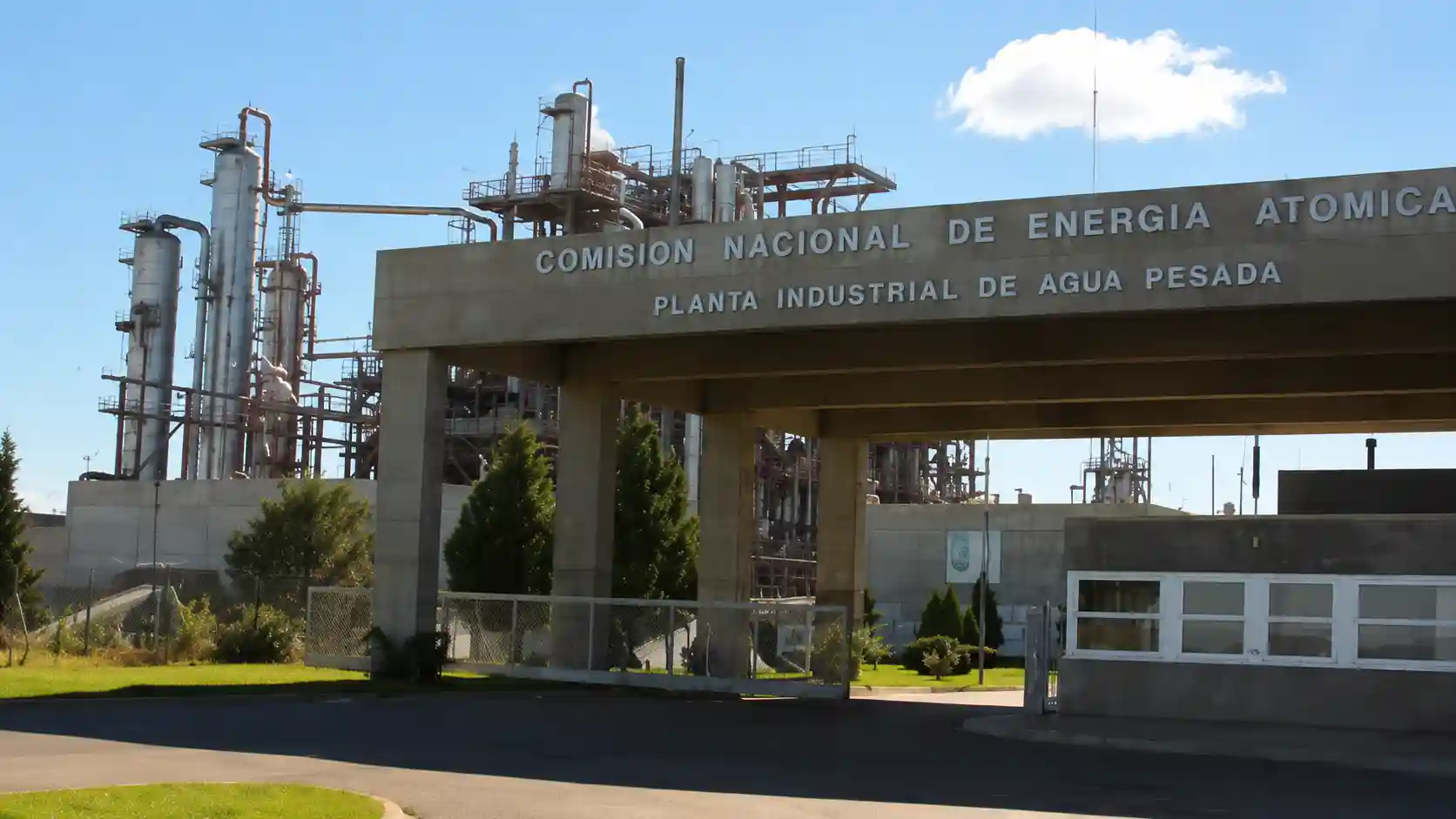
PIAP is a strategic public asset, but no operating restart or private concession has been confirmed.
CNEA is preserving the plant with its own personnel and preparing an open tender for the revamping required to restart production.
SAESA and SPARK submitted a separate private initiative on May 19, 2026. The sponsors propose more than USD 120 million of investment, a 36-month execution period and private operation under a concession while PIAP remains publicly owned.
The commercial case has credible signals, including a CNEA-Candu-CONUAR memorandum and current domestic heavy-water use. These signals are not the same as binding purchase contracts or an awarded operating model.
Core market reading:
PIAP has an owner, an industrial function and potential buyers. What it does not yet have is a completed tender, an awarded operating model, a validated revamping budget, binding offtake and a confirmed restart date.
Current status: six different milestones
The PIAP debate becomes confusing when preservation, tender preparation, private proposals, demand memoranda, concessions and production are treated as one event.
CNEA maintenance
CNEA decided in January 2026 to preserve critical assets and perform maintenance with its own personnel.
Open revamping tender
CNEA is preparing an open and transparent process for modernization and reactivation.
SAESA-SPARK initiative
A private initiative was formally submitted on May 19, 2026. Submission is not selection or award.
Operating concession
The sponsor proposal envisages a concession model, but no concession award has been published.
Candu and CONUAR cooperation
The 2025 memorandum creates a legal framework for supply and engineering negotiations, not a confirmed final purchase contract.
Production restart
PIAP has remained out of operation since 2017. No current operating restart date is confirmed.
What PIAP is
The Planta Industrial de Agua Pesada is located in Arroyito, Neuquén and belongs to the Comisión Nacional de Energía Atómica.
Inaugurated in 1993, it was designed for annual production of approximately 200 tonnes of heavy water. The product is used as moderator and coolant in nuclear reactors based on natural-uranium technology.
PIAP has been inactive since 2017. CNEA now treats asset preservation as urgent because further mechanical degradation could make future reactivation significantly more difficult.
The official CNEA reactivation path
The most authoritative current status comes from CNEA’s January 23, 2026 announcement.
CNEA said it would assume maintenance with its own personnel while preparing an open and transparent tender for the revamping required to restart production.
This official path has two immediate objectives:
- preserve the plant’s critical mechanical and industrial assets;
- create a commercially viable operating model that can generate income for CNEA.
The tender documents, commercial structure, technical audit, final investment requirement and operating award were not yet publicly confirmed in the sources reviewed for this update.
The SAESA-SPARK private initiative
SAESA and engineering company SPARK submitted a private initiative to the national government on May 19, 2026.
According to SAESA, the proposal includes:
- more than USD 120 million of investment;
- modernization and reactivation of the industrial complex;
- a 36-month horizon to reach full operability;
- the possibility of restarting the first production line earlier;
- approximately 200 direct jobs;
- private operation and commercialization through a concession while PIAP remains CNEA property.
These are sponsor claims and proposed terms. They are not evidence that the state has selected SAESA and SPARK, accepted the investment amount, approved the schedule or awarded the concession.
Status discipline:
The SAESA-SPARK proposal is relevant because it introduces capital, gas-supply capability, engineering and claimed buyer interest. It must still pass through the official competitive process and technical validation.
Demand signals: domestic reactors, RA-10 and Candu cooperation
Domestic power-reactor requirements
Atucha I, Atucha II and Embalse use heavy water. Argentine authorities stated in 2022–2023 that approximately 485 tonnes would be required through the operating lives of the three plants.
That figure should be treated as an earlier official planning estimate rather than a newly calculated July 2026 requirement. Atucha II’s operating licence was renewed in May 2026 through May 26, 2036, illustrating why the requirement should be updated as reactor timelines change.
RA-10: a current domestic use case
In June 2026, Argentina’s new RA-10 multipurpose research reactor received six tonnes of reactor-grade heavy water for its neutron-reflector tank.
RA-10 confirms active domestic technical use beyond the three power reactors. It does not by itself establish future demand for newly produced PIAP output.
Candu Energy and CONUAR
In May 2025, CNEA, Candu Energy and CONUAR signed a memorandum covering possible heavy-water supply from Argentina to Canada, engineering services, Argentine supply-chain cooperation and technical knowledge exchange.
The memorandum is a credible international demand signal and a framework for negotiating contracts. It is not a publicly confirmed final purchase agreement with fixed volumes, prices and delivery dates.
| Demand signal | Confirmed status | What remains open |
|---|---|---|
| Argentine power reactors | Heavy-water users with an older 485-tonne official planning estimate. | Updated consolidated requirement and procurement schedule. |
| RA-10 | Six tonnes received in June 2026. | Future replacement and operating demand. |
| Candu / CONUAR MOU | Legal and technical cooperation framework signed. | Binding purchase contracts, volumes, prices and delivery dates. |
| SAESA off-taker claims | Sponsor states that memoranda have been signed. | Counterparties, binding status and commercial terms. |
Vaca Muerta gas is an energy and process input
The PIAP case is often summarized as turning Vaca Muerta gas into heavy water. That is useful as an industrial-value metaphor but technically incomplete.
Natural gas and electricity provide energy and process inputs for the separation, enrichment and upgrading required to produce high-purity heavy water. The deuterium content is not simply manufactured from the natural-gas molecule.
No final gas-supply contract, approved daily consumption level or electricity arrangement has been published for the current reactivation process.
The operating economics will therefore depend on:
- gas and electricity availability;
- long-term input pricing;
- plant efficiency after revamping;
- quality-control requirements;
- utilization rate and buyer contracts.
Ownership, ENSI and concession governance
PIAP remains property of CNEA.
ENSI is the operating company associated with the plant. It is owned 51 percent by the Province of Neuquén and 49 percent by CNEA.
A 2025 agreement between CNEA, Neuquén Province and ENSI addressed ENSI’s corporate adaptation and the search for potential heavy-water buyers.
The SAESA-SPARK proposal would preserve public ownership while transferring operation and commercialization through a concession. Whether the final tender adopts that exact structure remains to be seen.
CNEA
Owns PIAP, leads current preservation work and is preparing the official revamping process.
ENSI
Neuquén-CNEA company historically responsible for operating the industrial plant.
SAESA and SPARK
Propose capital, engineering, gas supply and commercial operation under a concession model.
Candu Energy and CONUAR
Participate in the supply and technology-cooperation memorandum with CNEA.
Execution and procurement: potential, not open tenders
A PIAP revamping could require engineering, mechanical rehabilitation, process control, instrumentation, industrial safety, power systems, gas systems, maintenance, laboratories, certification and nuclear-quality assurance.
These are plausible future demand categories. They should not be described as open procurement packages until official tender documents define scope, qualification requirements, contracting structure and timelines.
The central B2B question is therefore not which supplier can sell immediately. It is which companies can meet the technical, nuclear, local-presence and contracting requirements once the formal process opens.
Reactivation risk matrix
| Risk layer | Current position | Required next milestone |
|---|---|---|
| Asset preservation | CNEA maintenance announced. | Verified condition assessment and preservation progress. |
| Tender and governance | Open process in preparation. | Published tender, transparent selection and enforceable contract. |
| Revamping scope | Sponsor proposal and general official objective. | Independent technical audit, detailed engineering and validated budget. |
| Financing | Private proposal claims committed investment. | Bankable financing after tender and contractual award. |
| Input supply | Vaca Muerta and grid context. | Firm gas and electricity contracts at viable prices. |
| Offtake | MOU and sponsor claims. | Binding contracts with volume, quality, price and delivery terms. |
| Operating reliability | Plant inactive since 2017. | Commissioning, nuclear quality assurance and stable production. |
Reactivation, Procurement & Market Questions
What must happen before PIAP can restart commercial heavy-water production?
PIAP still has to move from preservation and tender preparation into an awarded and executable operating model. That means a defined revamping scope, technical validation, financing, firm gas and electricity arrangements, buyer contracts, commissioning, nuclear-quality assurance and stable production. The current public record confirms preservation work and preparation of an open revamping process, but it does not yet confirm the full chain required for commercial operation.
Which procurement opportunities could PIAP reactivation create for industrial and nuclear suppliers?
A revamping could create demand for engineering, mechanical rehabilitation, process control, instrumentation, industrial safety, power and gas systems, maintenance, laboratories, certification and nuclear-quality assurance. These are potential demand categories rather than confirmed tenders. Commercial access will depend on the official scope, qualification rules, contracting structure, package timing and the role assigned to the eventual operator or concessionaire.
Is there enough domestic and international demand to support a commercial restart of PIAP?
Argentina has active heavy-water users, RA-10 provides a recent domestic use case, and the CNEA-Candu-CONUAR memorandum creates a framework for possible international supply and engineering cooperation. Those signals improve the commercial case, but they do not yet establish a complete bankable offtake base. Updated volumes, binding purchase commitments, prices, delivery schedules and long-term utilization still matter for a sustainable restart.
Public sources can show ownership, preservation work, sponsor proposals, cooperation memoranda and broad revamping needs. They do not reliably show which procurement packages will actually open, who will control each purchasing decision, which suppliers are already positioned, what nuclear-quality and local-service requirements will apply, or whether buyer interest has become binding commercial demand.
PIAP and Argentina Industrial Market Research Services
Marcus A. Volz conducts custom and primary market research for international companies evaluating Argentina's industrial infrastructure and specialized supply chains. For a project such as PIAP, the objective is to move from public project information to a verified view of commercial access, procurement status and market demand.
Interviews and market checks
Targeted interviews and direct checks with relevant market participants where public information is incomplete.
Company and supplier research
Research on project actors, incumbent suppliers, competitors, engineering partners and potential local routes to market.
Tender and qualification research
Verification of procurement structures, package timing, vendor requirements, qualification criteria and decision points.
Project and demand verification
Checks on project status, buyer demand, offtake signals, operating assumptions and whether a commercial opportunity is accessible now.
Who will control procurement once the PIAP tender structure is defined? Which revamping packages are likely to be accessible to international suppliers? Which nuclear-quality, local-service or partner requirements matter? Which suppliers are already positioned? And does current heavy-water demand support the production and utilization assumptions behind a restart?
Strategic conclusion
PIAP is a strong critical-infrastructure case precisely because it is not yet resolved.
Argentina possesses the plant, technical knowledge, nuclear users and potential international counterparties. The 2026 process also has a concrete private proposal.
What separates those assets from market value is still execution: preservation, tendering, governance, financing, revamping, energy supply, buyer contracts and reliable operation.
PIAP becomes a strategic export platform only when a preserved public asset turns into an awarded, financed, modernized and reliably operating plant.
- CNEA — January 2026 maintenance decision and preparation of an open revamping tender.
- CNEA — PIAP ownership, ENSI structure and search for potential heavy-water buyers.
- SAESA — sponsor description of the USD 120m-plus proposal, 36-month timeline, jobs and concession model.
- CNEA — Candu Energy and CONUAR memorandum on supply and technological cooperation.
- CNEA — six tonnes of heavy water delivered to RA-10 in June 2026.
- ARN — Atucha II operating licence renewed through May 26, 2036.
- Argentina.gob.ar — historical 485-tonne planning estimate and 200-tonne annual capacity.
From public reactivation plans to commercial verification
Public documents can establish PIAP's ownership, preservation path, sponsor proposals and broad demand signals. They do not establish the live procurement route, supplier positions, qualification windows, buyer commitments or commercial accessibility of a specific opportunity.
Econosur custom research can investigate those gaps for industrial suppliers, technology providers and investors evaluating Argentina's specialized infrastructure markets.
Discuss a research questionFrequently asked questions
What is PIAP?
PIAP is the Planta Industrial de Agua Pesada in Arroyito, Neuquén. It is owned by Argentina's National Atomic Energy Commission and historically operated by ENSI.
Is PIAP currently operating?
No. The plant has been out of operation since 2017. CNEA is carrying out preservation and maintenance work while preparing an open tender for modernization and reactivation.
Has SAESA or SPARK received the PIAP concession?
No concession award has been confirmed. SAESA and SPARK submitted a private initiative on May 19, 2026, but the official CNEA process remains at maintenance and tender-preparation stage.
What does the SAESA-SPARK proposal include?
The sponsors describe an investment of more than 120 million dollars, a 36-month execution period, approximately 200 direct jobs and a concession model under which PIAP would remain publicly owned.
What is the role of ENSI?
ENSI is the operating company associated with PIAP. It is owned 51 percent by the Province of Neuquén and 49 percent by CNEA.
Is there confirmed international demand for PIAP heavy water?
CNEA, Candu Energy and CONUAR signed a memorandum in May 2025 that creates a framework to negotiate supply and engineering contracts. A binding purchase contract has not been publicly confirmed.
How is Vaca Muerta connected to PIAP?
Natural gas and electricity can provide energy and process inputs for heavy-water separation and upgrading. Heavy water is not simply produced from the gas molecule itself.
How much heavy water could PIAP produce?
PIAP's historical nameplate capacity was 200 tonnes per year. A future operating rate would depend on revamping, technical validation and the final production plan.
What current domestic demand signal exists?
Argentina's RA-10 multipurpose reactor received six tonnes of reactor-grade heavy water in June 2026 for its neutron-reflector system.
What is the main risk to reactivation?
The central risk is execution across tender design, technical revamping, financing, gas and electricity supply, governance, buyer contracts, nuclear quality assurance and long-term operating reliability.
What must happen before PIAP can restart commercial heavy-water production?
PIAP must move from preservation and tender preparation through an awarded operating model, technical revamping, financing, firm gas and electricity arrangements, buyer contracts, commissioning, nuclear-quality assurance and stable production. The current public record does not yet confirm all of those steps.
Which procurement opportunities could PIAP reactivation create for industrial and nuclear suppliers?
Potential demand could include engineering, mechanical rehabilitation, process control, instrumentation, industrial safety, power and gas systems, maintenance, laboratories, certification and nuclear-quality assurance. These are potential demand categories, not confirmed open procurement packages, until official tender documents define scope, qualification requirements, contracting structure and timelines.
Is there enough domestic and international demand to support a commercial restart of PIAP?
There are credible demand signals from Argentine heavy-water users, the RA-10 reactor and the CNEA-Candu-CONUAR cooperation framework. However, the public record does not yet establish a complete bankable offtake base with updated volumes, binding contracts, prices and delivery schedules.