
Argentina · Stabilization · Business Demand · Market Entry · Market Signals
Argentina’s Stabilization Gap: Why Macro Repair Still Feels Fragile
Argentina’s 2024–2026 transition is not a simple story of recovery or crisis. It is better understood as a stabilization gap: macroeconomic indicators improved faster than household confidence, purchasing power and social trust.
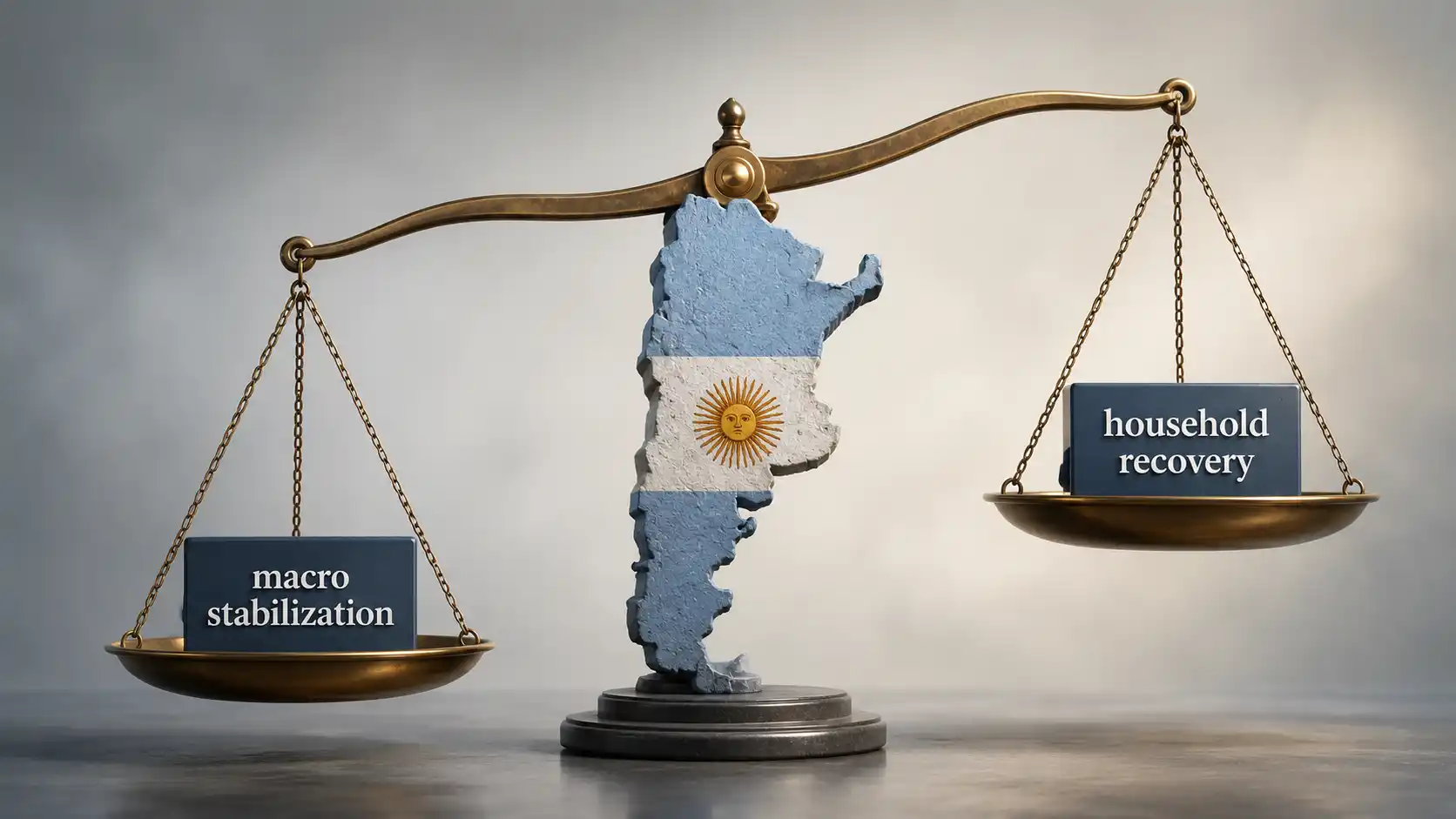
Argentina is stabilizing, but stabilization is not the same as recovery.
Inflation has slowed, country risk has improved and GDP returned to growth in 2025. Yet households still face high price levels, fragile income, weak purchasing power and low trust after years of economic volatility.
The core issue is transmission: whether macro repair can reach wages, consumption, employment quality, credit access and daily household confidence.
Core market reading:
Argentina’s 2024–2026 transition should be read as a transmission problem. Financial indicators can improve before households experience recovery. That gap matters for companies, investors, lenders, exporters and analysts trying to understand real market demand.
The useful question is not recovery or crisis
The external debate around Argentina often looks for a simple verdict: has the adjustment worked, or has it failed?
That framing is too narrow for Argentina. The answer depends on where the economy is observed from: a supermarket, a wage negotiation, a provincial household, a small company, a bond desk, a mining project, an energy pipeline or a capital-market discussion.
Argentina can look more credible to markets before it feels more stable to households. It can show lower inflation and still feel expensive. It can report lower poverty than during the peak of the adjustment shock and still have a fragile social base.
This is the stabilization gap. It is not a contradiction. It is the distance between macro repair and social transmission.
"The central Argentine question in 2026 is not whether stabilization exists. It is whether stabilization is being transmitted into daily life."
The starting point was not a normal economy
Argentina’s 2024–2026 stabilization phase did not begin from a normal macroeconomic baseline.
At the end of 2023, the country was already shaped by years of high inflation, weak currency credibility, subsidy distortions, fiscal imbalance, capital controls, multiple exchange-rate workarounds and a deep loss of confidence in long-term rules.
This matters for the time horizon. Economic direction can change quickly. Inflationary behavior, institutional mistrust and household defensive habits do not disappear in one or two years.
That does not make the social cost irrelevant. It makes the transition more difficult to read. Macro correction and household pressure can occur at the same time.
Inflation is the clearest stabilization signal
The strongest macroeconomic change is inflation. INDEC reported that Argentina’s consumer price index rose 2.6% in April 2026, with accumulated inflation of 12.3% for the first four months of the year and annual inflation of 32.4%.
For a stable economy, annual inflation above 30% would still be a serious problem. For Argentina, after the dynamics of 2023 and early 2024, the slowdown is a material stabilization signal.
This is where the public reading often becomes confused. Lower inflation does not mean lower prices. It means prices are rising more slowly. For households, the accumulated price level remains the daily reality.
Lower inflation is a macro improvement.
It is not automatically a household recovery. A family does not live inside the inflation trend. It lives inside the price level.
The supermarket still tells a harder story
The gap between inflation data and daily experience becomes visible in the basic basket. In April 2026, INDEC estimated that a reference adult in Greater Buenos Aires needed ARS 215,228 to cover basic food needs and ARS 475,653 to cover a broader set of basic living costs.
For a household of four members, INDEC placed the food basket at ARS 665,053 and the total basic basket at ARS 1,469,768. That is the household threshold behind the poverty line in Greater Buenos Aires.
These numbers explain why many Argentines do not experience falling inflation as immediate relief. Food, rent, utilities, transport, medicine, school costs and basic services are not experienced as a chart. They are experienced as a monthly cash-flow problem.
Argentina’s social mood is therefore not irrational. It reflects the distance between statistical stabilization and the accumulated affordability shock that households still need to absorb.
"The supermarket does not measure whether inflation is falling. It measures whether wages can still reach the end of the month."
Poverty improved, but the social base remains fragile
The poverty data is one of the clearest examples of Argentina’s contradictory transition.
According to INDEC, poverty among persons in the 31 urban agglomerates reached 28.2% in the second half of 2025, while indigence stood at 6.3%.
That is a major improvement from the peak of the adjustment shock. But it is not the same as broad middle-class recovery. INDEC still reported that 41.3% of children aged 0 to 14 lived in households below the poverty line in the second half of 2025.
This is why the social reading remains fragile. The official data shows improvement. The household structure still shows vulnerability. Both statements are true.
Growth returned, but recovery is uneven
Argentina returned to growth in 2025. The Argentine Economic Outlook published by the Centre for International Economy reported annual GDP growth of 4.4%, supported by investment, private consumption and exports.
But the composition matters. A rebound after recession is not the same as a stable, inclusive recovery. It can be driven by base effects, export sectors, financial normalization, investment pipelines and specific industries while many households and smaller firms remain under pressure.
The same report showed that early 2026 remained uneven. Agriculture and mining helped explain year-on-year growth in January, while trade and manufacturing showed negative results. Unemployment in the fourth quarter of 2025 reached 7.5% of the economically active population.
For Argentina, the relevant question is transmission: through which sectors, regions and income groups does macro recovery become visible?
Markets reacted faster than households
Financial markets usually react to credibility signals before households feel relief. Argentina is a clear case.
Reuters reported in May 2026 that Argentina’s country risk had tightened to 498 basis points, its lowest level since early February. The improvement followed stronger investor confidence, fiscal discipline and a Fitch upgrade to B- with a stable outlook.
That matters. Lower country risk can improve the discussion around capital-market access, energy projects, mining investment and long-term financing. It changes how investors price Argentina.
But it does not immediately change how a family prices meat, rent or transport. A lower sovereign spread is a leading financial signal. Household recovery is a lagging social signal.
Investor confidence and household confidence are not the same indicator.
Investors read fiscal discipline, country risk, reserves and debt-market access. Households read wages, food prices, rent, utilities and job security.
Beef consumption shows the household side of stabilization
One concrete social signal is beef consumption.
In Argentina, beef is not only a product category. It is part of household culture, weekend life and national identity. When beef consumption falls sharply, it says something about purchasing power that abstract indicators often miss.
Associated Press reported in May 2026 that annual per-capita beef consumption had fallen to 44.5 kilograms as of April 2026, down from 63.4 kilograms in 2006, amid higher prices and weaker household purchasing power.
This is exactly where stabilization feels different from recovery. A macro indicator can improve while families change protein choices, reduce meat purchases or replace beef with cheaper alternatives. In Argentina, beef consumption is not just consumption data. It is a household confidence signal.
The reserve and currency question still matters
Argentina’s economic credibility also depends on reserves and currency expectations.
The Central Bank reported that the only expansionary factor for the monetary base in April 2026 was foreign-currency purchases in the exchange market, which reached USD 2.77 billion. The Argentine Economic Outlook reported BCRA international reserves of USD 42.1 billion as of 31 March 2026.
These figures matter because Argentina’s economic history makes reserves more than a technical variable. They influence exchange-rate credibility, import expectations, debt capacity and the ability to manage future shocks.
Still, reserve accumulation is not household relief. It helps repair the macro framework. It does not immediately make daily life cheaper.
Argentina has a trust lag
Argentina is not only an economy with data series. It is a society with memory.
Many people have lived through repeated stabilization promises, freezes, devaluations, defaults, currency restrictions and sudden changes in rules. This history shapes how improvement is perceived.
When inflation slows, households do not immediately assume that the crisis has ended. They wait. They protect liquidity. They postpone purchases. They mistrust the next change. They calculate in pesos and dollars at the same time.
This is why Argentina’s psychological recovery can be slower than its macro recovery. A spreadsheet can show stabilization before a society believes in it.
"In Argentina, expectations are not rebuilt by one data release. They are rebuilt after repeated proof that the rules will hold."
The real test is transmission
The next phase is the decisive one.
Argentina’s stabilization becomes recovery when lower inflation begins to coincide with real wage recovery, stronger private employment, broader access to credit, more predictable imports, reserve accumulation and investment that moves beyond announcements.
A durable recovery would also require part of the labor market to move from informal survival work toward more formal employment, predictable income and access to credit. That transition is slow because informality is not only a worker-side reality: many employers also use informal labor to reduce costs, avoid obligations and keep maximum flexibility. Even formal employment does not automatically solve the income problem when many workers remain close to a relatively low minimum-wage floor.
This is where different observers will continue to read Argentina differently. Investors will track inflation, reserves, country risk, fiscal discipline, capital-market access, energy pipelines and mining projects. Households will track salaries, supermarket prices, rent, utilities, medicine, job security and whether income reaches the end of the month.
Both readings can be rational because they measure different parts of the same transition. The analytical mistake is to treat one layer as if it cancels the other.
For households, the test is practical: whether salaries buy more, basic costs become manageable and consumption no longer feels like constant triage.
For investors, the test is whether fiscal credibility, reserves and sector investment translate into operating projects without recreating old vulnerabilities.
What the transmission gap means for observers outside Argentina
For observers outside Argentina, the main risk is reading the country through only one layer of evidence.
A financial-market reading may overstate the speed of recovery because country risk, reserves, inflation and fiscal signals can improve before households feel relief. A purely social reading may understate the macroeconomic shift because daily pressure can remain intense even after the stabilization trend has changed.
This is why Argentina’s 2024–2026 transition needs to be read as a transmission problem. The question is not only whether macro indicators improve. The question is how quickly those improvements reach wages, consumption, credit, employment, regional activity and business confidence.
For companies, investors and analysts, the practical conclusion is clear: Argentina is not only a political headline. It is a market where macro repair, household reality, sector geography and long-term trust must be evaluated together.
That wider reading also connects this article to other Econosur Argentina analysis, including Argentina’s critical infrastructure test around PIAP and heavy water, Vaca Muerta, urea and fertilizer security and the broader Argentina market profile.
Market Reality: Argentina’s macro repair is visible in inflation, country risk, reserves and the return of growth. The household economy still moves more slowly because wages, basic costs, employment quality and trust need more time to recover.
Visibility: International coverage often separates financial-market improvement from social stress. A useful Argentina reading needs both layers at the same time: sovereign indicators, sector geography, household affordability and business operating conditions.
Human Interpretation: The relevant question for companies and investors is not whether Argentina is simply back or still broken. The practical question is where stabilization has already changed market conditions and where household pressure still limits demand.
Business Demand, Sector & Market-Entry Questions
Where has Argentina’s stabilization already translated into stronger business demand?
Not across the economy as a whole. The evidence in this analysis points first to investment- and export-facing parts of the economy rather than a broad consumer-demand rebound. GDP returned to growth in 2025, agriculture and mining supported year-on-year growth in early 2026, and lower country risk improved the financing discussion around large energy, mining and infrastructure projects.
Household affordability remains more fragile. For an international supplier or service company, the practical conclusion is that improving macro conditions do not prove broad market demand: demand still has to be tested by sector, region, customer group and purchasing capacity.
Which sectors in Argentina are benefiting first from macroeconomic stabilization?
The article’s strongest early sector signals come from agriculture and mining, which helped explain year-on-year growth in early 2026, while trade and manufacturing showed weaker results. Energy and mining can also benefit from improved sovereign credibility because lower country risk changes the financing environment for large projects.
This should not be read as a complete sector ranking. Argentina’s recovery remains uneven: export-driven, investment-driven and consumer-driven markets can move at different speeds, and conditions can differ materially across provinces and buyer segments.
What should international companies verify before entering the Argentine market during the stabilization phase?
Macro data can show that the direction of the economy is changing, but it cannot establish whether a specific commercial opportunity is attractive. Before entry, companies should verify current demand, buyer structures and budgets, competition, pricing and payment conditions, import predictability, distributor or channel options, regional differences and operating risks.
The key question is therefore not simply whether Argentina is recovering. It is whether the relevant customers, sector and route to market are commercially accessible now.
Official statistics and financial indicators can show inflation, growth, poverty, reserves and sovereign risk. They do not reliably show which individual buyers have budgets, which distributors are effective, how competitors are positioned, what payment terms are accepted, where regional demand is strongest or whether a specific product is being purchased now.
Those gaps require company-level and market-level verification rather than another macroeconomic chart.
Argentina Market Research and Market Verification Services
Marcus A. Volz conducts custom market research for international companies evaluating Argentina. The work connects macroeconomic context with the commercial questions that public statistics cannot answer on their own.
- Primary interviews and market checks — targeted conversations with relevant market participants where public information is insufficient.
- Company and competitor research — market positioning, incumbent suppliers, competitive structure and visible commercial activity.
- Demand and sector validation — testing whether macro improvement is translating into demand for a specific B2B offering.
- Buyer and distributor checks — identifying purchasing structures, channels, potential partners and route-to-market constraints.
- Pricing, import and operating-condition research — verification of practical market conditions relevant to commercial entry.
- Regional market verification in Argentina — comparing conditions across provinces and industrial or commercial clusters when geography changes the opportunity.
- Is demand for this product or service actually strengthening in Argentina?
- Which sectors and customer groups have purchasing capacity now?
- Who are the relevant buyers, competitors, distributors or local partners?
- How do pricing, payment practices and import conditions affect commercial feasibility?
- Which Argentine regions offer the strongest fit for this market?
- Is the opportunity strong enough to justify market entry, local outreach or deeper research?
This article uses official Argentine statistical sources, central-bank information, international financial reporting and current household-consumption reporting available by June 2026.
- INDEC: Índice de precios al consumidor. Abril de 2026.
- INDEC: Incidencia de la pobreza y la indigencia. Segundo semestre de 2025.
- INDEC: Canasta básica alimentaria y canasta básica total. Gran Buenos Aires. Abril de 2026.
- BCRA: Monthly Monetary Report. April 2026.
- Centre for International Economy: Argentine Economic Outlook. April 2026.
- World Bank: Global Economic Prospects, Latin America and the Caribbean. January 2026.
- Reuters: Argentina country risk falls steadily. May 2026.
- Associated Press: Argentina beef consumption falls to lowest level in 20 years. May 2026.
FAQ
What is Argentina’s stabilization gap?
Argentina’s stabilization gap is the distance between improving macroeconomic indicators and the slower recovery of household purchasing power, confidence and social stability. The country can look more credible to markets before it feels more stable to families.
Is Argentina recovering or still in crisis?
Argentina is stabilizing, but stabilization is not the same as full recovery. Inflation has slowed, country risk has improved and GDP returned to growth in 2025, while households still face high prices, fragile income and weak confidence.
Why does Argentina still feel expensive if inflation is falling?
Falling inflation means prices are rising more slowly. It does not mean that prices are low again. Many households still live with the accumulated price level in food, rent, utilities, transport, medicine and basic services.
Did poverty improve in Argentina during 2025?
Yes. INDEC reported that poverty among persons fell to 28.2% in the second half of 2025, while indigence fell to 6.3%. But the social base remains fragile, especially among children and households close to the poverty line.
Why does informal employment matter for Argentina’s recovery?
Informal employment matters because households may earn income without stable contracts, predictable wages or access to credit. A durable recovery requires more formal employment, but that transition takes time and depends on employer behavior, enforcement and wage quality.
Why do investors and households read Argentina differently?
Investors look at inflation, reserves, country risk, fiscal discipline and capital-market prospects. Households look at wages, food prices, rent, utilities, employment quality and whether monthly income reaches the end of the month.
What would turn Argentina’s stabilization into real recovery?
Argentina’s stabilization becomes recovery when lower inflation is matched by real wage recovery, stronger private employment, broader credit access, reserve accumulation, investment beyond announcements and more predictable household consumption.