
Company Insight · Chile · CRAMSA · Aguas Marítimas · Desalination · Mining Water
CRAMSA / Aguas Marítimas: Chile’s Desalination Corridor Test
CRAMSA’s environmentally approved Aguas Marítimas project is a regional water-infrastructure corridor linking Caleta Bolfín, Antofagasta, Sierra Gorda and Calama with copper, lithium, industrial and agricultural water demand.
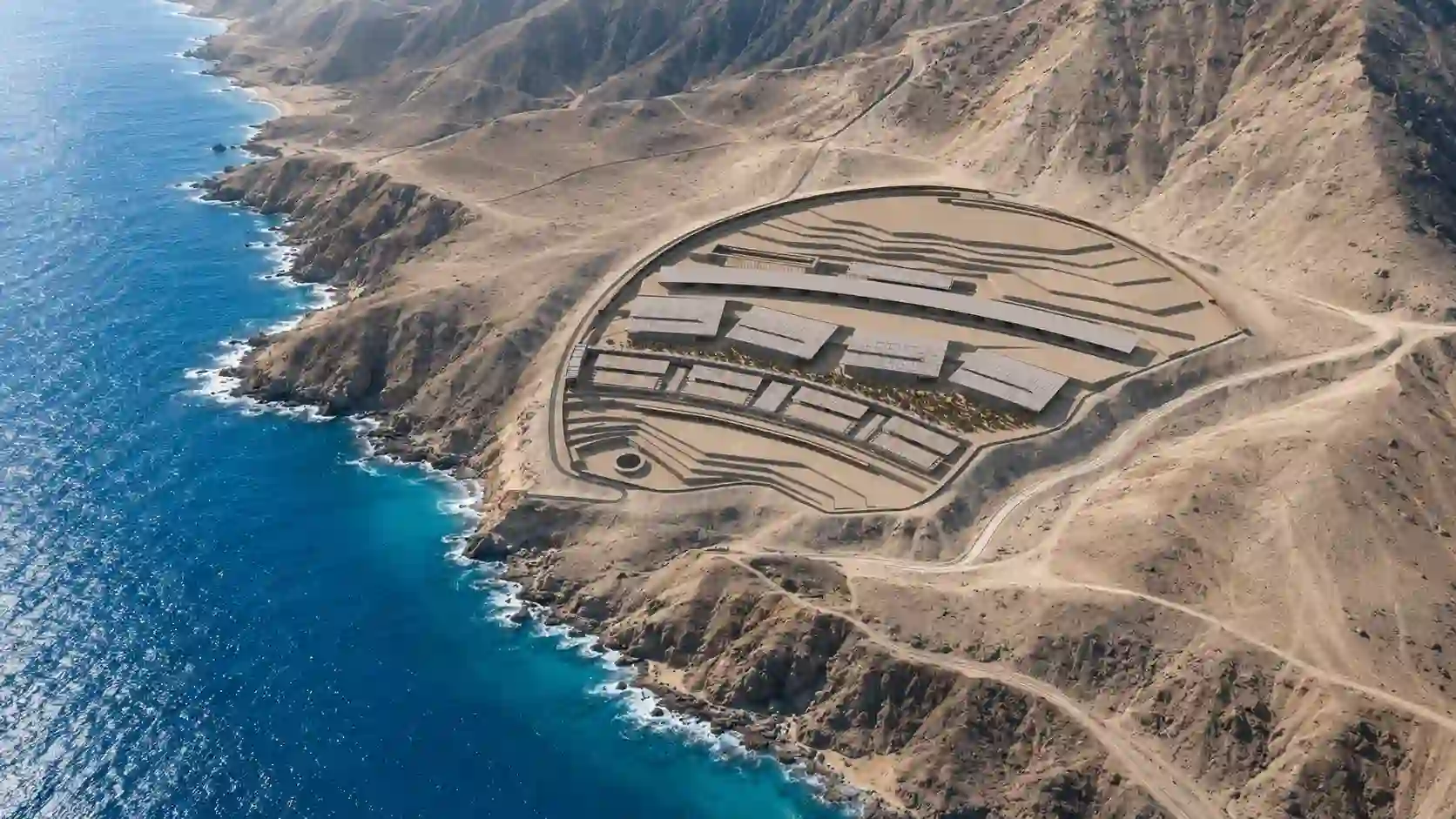
CRAMSA / Aguas Marítimas is a company-level case for Chile’s new mining-water infrastructure.
The project is designed to produce desalinated water at Caleta Bolfín and move it through a regional distribution system toward Antofagasta, Sierra Gorda and Calama. The environmental approval process concluded favorably in May 2026. As of July 23, 2026, the project was not yet financed, under construction or operating.
For Econosur, the strongest reading is simple: Aguas Marítimas shows that Chile’s seawater transition is decided by engineering, but also by institutions.
For broader context, see Econosur’s Seawater Mining Infrastructure analysis as the parent market view, the Chile Power Grid analysis for the electricity-system layer, the Codelco / Aguas Horizonte company insight as a single-district comparison, and the Energy Infrastructure overview for the wider regional context.
Core market reading:
Aguas Marítimas is best read as a corridor project. It converts seawater into a regional industrial input and makes mining-water supply dependent on coastal infrastructure, power systems, pumping stations, environmental permits and social legitimacy.
Why CRAMSA matters now
CRAMSA matters now because Chile’s mining-water transition is moving from concept to infrastructure. Northern Chile’s copper and lithium regions cannot be read only through resource reserves, extraction technology or global demand. They are increasingly shaped by water systems: desalination plants, pipelines, pumping stations, transmission lines, reservoirs, environmental permits and local legitimacy.
Aguas Marítimas is one of the clearest project cases for that shift. It is large enough to affect regional water-infrastructure planning, close enough to mining demand to matter commercially, and institutionally visible enough to show how environmental review and public approval shape Chile’s resource economy.
The project’s environmental approval makes it especially relevant. The Comisión de Evaluación Ambiental de Antofagasta approved Aguas Marítimas unanimously on May 4, 2026, and the environmental approval resolution was published on May 18. The approval closed the environmental-evaluation stage, but it did not establish financing, construction or operation.
CRAMSA is not just a water company profile. It is a test of Chile’s ability to build the infrastructure layer behind copper and lithium growth.
The project links mining demand, coastal infrastructure, power systems, environmental approval and regional legitimacy in one company-level case.
Company profile: CRAMSA as a water-infrastructure vehicle
CRAMSA is the public company and project identity associated with Aguas Marítimas. In Chile’s official environmental record, the project proponent is CRAMSA Infraestructura SpA. Aguas Marítimas is the name of the infrastructure project itself.
CRAMSA presents Aguas Marítimas as a multipurpose desalinated-water supply system for Antofagasta, Sierra Gorda and Calama, using seawater captured at Caleta Bolfín, south of Antofagasta. The current project description states a final capacity of 700,000 cubic meters per day, a first stage of 350,000 cubic meters per day, roughly 480 kilometers of distribution infrastructure, 18 pumping stations, 350 kilometers of transmission lines, 21 substations and estimated annual electricity consumption of 4,600 GWh.
Those numbers matter because they show what “desalination for mining” means in northern Chile. It is not a containerized water plant at the edge of a mine. It is regional infrastructure.
Aguas Marítimas as a corridor project
The most important point is that Aguas Marítimas should not be read as a single plant. It is a corridor project. It starts at the coast and extends inland toward some of the most important industrial and mining demand zones in northern Chile.
The intake point is Caleta Bolfín. The intended supply geography includes Antofagasta, Sierra Gorda and Calama. That geography matters because it connects desalinated seawater to copper mining, lithium mining, agriculture and industrial water demand in one of the driest operating environments in South America.
CRAMSA’s stated first phase of 350,000 cubic meters per day and final capacity of 700,000 cubic meters per day place the project in the same discussion as Chile’s broader move from freshwater dependence toward seawater-based mining infrastructure.
Aguas Marítimas turns seawater into an industrial corridor.
The infrastructure system: coast, pipeline, pumps and power
The project’s infrastructure logic runs from the Pacific coast into Chile’s mining geography. The desalination plant is only one component. The commercial value depends on the full chain: seawater intake, desalination, storage, pumping, pipeline routing, electricity supply, substations, environmental compliance, maintenance and offtake agreements.
This is why Aguas Marítimas is relevant for suppliers and market analysts. A project like this creates demand for marine works, reverse osmosis, pretreatment, pumping systems, high-pressure pipelines, corrosion management, substations, transmission infrastructure, sensors, monitoring and environmental services.
| Infrastructure layer | Project element | Market meaning |
|---|---|---|
| Coastal intake | Caleta Bolfín, south of Antofagasta. | The mining-water system begins at the Pacific, not at the mine. |
| Desalination | 350,000 m³/day first stage; 700,000 m³/day final capacity, according to CRAMSA. | Large-scale conversion of seawater into industrial and mining water supply. |
| Distribution | Approx. 480 km of pipelines and water-distribution infrastructure. | Turns the project into a regional corridor rather than a single-plant asset. |
| Pumping | CRAMSA states 18 pumping stations; La Tercera reports 17. | Shows how elevation and distance shape the cost and complexity of mining-water supply. |
| Power | 350 km of transmission lines, 21 substations and 4,600 GWh annual electricity consumption, according to CRAMSA. | Water infrastructure becomes energy infrastructure at the same time. |
For mining companies and suppliers, this changes the definition of water risk. Water risk is no longer only groundwater availability. It becomes a question of infrastructure execution: whether desalinated seawater can be permitted, powered, transported and contractually integrated into industrial operations.
The project’s stated 350 km of transmission lines, 21 substations and 4,600 GWh of annual electricity consumption make the power layer unusually explicit. Econosur’s Chile Power Grid analysis provides the system-level context for this demand. Kimal–Lo Aguirre is a separate project, but it is useful as a scale comparison for the kind of high-voltage investment now being built across Chile’s northern-to-central electricity geography.
Approval and legitimacy: the institutional test
The official environmental record identifies CRAMSA Infraestructura SpA as the project proponent. The Comisión de Evaluación Ambiental de Antofagasta approved Aguas Marítimas unanimously on May 4, 2026. CRAMSA states that the Resolución de Calificación Ambiental was officially published on May 18, concluding the environmental-evaluation process favorably.
This is the point that makes CRAMSA strategically interesting. The project is not only a technical water-supply story. It is a case of how Chile moves large resource-linked infrastructure through environmental review, public agencies, regional scrutiny and legitimacy constraints.
The RCA confirms environmental approval. It does not confirm project financing, customer commitments, completion of every sector-specific authorization, construction or operation. CRAMSA’s current project page states that construction is expected to begin in 2028.
Aguas Marítimas links desalination to copper, lithium, industry and agriculture through a regional water corridor.
The four-year EIA process shows that environmental review is not a side process. It is part of the project’s market value and risk profile.
After environmental approval, the project still depends on financing, customer commitments, detailed engineering, construction, power supply and long-term environmental compliance.
From freshwater relief to coastal conflict
Large-scale desalination is often presented as a way to reduce pressure on inland freshwater systems. That is true, but incomplete. The academic literature on desalination in Chile’s mining regions warns that desalination can ease some conflicts in highland communities while transferring part of the environmental and social burden to coastal areas.
That is the central legitimacy issue for Aguas Marítimas. A project can reduce pressure on aquifers and inland water claims, while creating new questions around intake systems, brine discharge, marine ecosystems, fishing communities, power use, pipeline corridors and regional distribution.
This does not make desalination irrelevant. It makes it politically and operationally more complex. The more Chile’s mining industry depends on seawater, the more coastal governance becomes part of mining governance.
Infrastructure-model comparison:
Codelco / Aguas Horizonte is a defined mining-district water system built for Codelco’s northern operations. Aguas Marítimas is designed as a larger multi-user corridor serving mining, industrial and potentially agricultural demand across Antofagasta, Sierra Gorda and Calama. The commercial and financing logic is therefore different even though both depend on desalination, pumping and electricity infrastructure.
Project vehicle, status and execution
The company and project names have different functions. CRAMSA is the public identity used in company communication. CRAMSA Infraestructura SpA is the project proponent named in the official environmental process. Aguas Marítimas is the approved infrastructure project.
That distinction improves the status reading. Environmental approval belongs to the project and its official proponent. It does not mean that the complete corridor is financed, contracted or being built.
Status as of July 23, 2026:
Aguas Marítimas was environmentally approved in May 2026. Construction had not started. CRAMSA’s current project page states 2028 as the expected construction start. Financing, customer commitments, detailed contracting and final execution remained open.
| Stage | Status | Econosur reading |
|---|---|---|
| Environmental evaluation | Completed favorably in May 2026. | Officially supported by the SEA process and RCA publication. |
| Engineering and planning | Next development stage identified by CRAMSA. | Project preparation, not physical construction. |
| Construction | Expected by CRAMSA from 2028. | Planned date; no confirmed construction start as of July 23, 2026. |
| Financing and customers | Not established as complete in the reviewed public sources. | Critical execution layer for a project exceeding US$5 billion. |
| Operation | Not operating. | Design capacity must not be presented as delivered water. |
Supplier-market signal
Aguas Marítimas creates a supplier-market signal far beyond desalination membranes. The project implies demand for marine works, intake infrastructure, reverse osmosis, pretreatment, pumping equipment, valves, pipes, reservoirs, corrosion management, power systems, substations, transmission, sensors, monitoring, maintenance, environmental documentation and technical services.
For international suppliers, the case also shows a communication problem. Technology alone is not enough. Suppliers have to explain reliability, operating cost, energy demand, maintenance, environmental performance and compliance in a Chilean permitting and mining-procurement context.
This is where project documentation matters. In Chile, major infrastructure and mining-water projects are not sold through generic product claims. They move through engineering review, environmental files, procurement specifications, public agencies and local stakeholders.
The electrical package creates a parallel supplier layer in transformers, substations, protection, control, high-capacity drives and transmission equipment. The Kimal–Lo Aguirre analysis is useful as a separate procurement benchmark for how specialist high-voltage equipment, international suppliers and logistics enter large Chilean infrastructure projects. It should not be read as part of CRAMSA’s own project scope.
Risk map: the company insight behind the project
CRAMSA’s Aguas Marítimas project sits in a market with strong structural demand. Northern Chile needs water infrastructure for mining, industry and regional development. Copper and lithium demand remain tied to global electrification. The Antofagasta Region has the industrial base and water scarcity that make desalination commercially relevant.
The risks are equally structural. The project requires large capital, long permitting, high energy consumption, multi-year construction, social legitimacy, coastal environmental management, offtake alignment and operating credibility. A project of this size can be technically coherent and still face execution risk.
That is why Aguas Marítimas is a useful company case. It shows the exact layer where Chile’s mining future becomes practical: not in a PowerPoint about copper demand, but in the approval, financing, construction and operation of water corridors.
Aguas Marítimas is where Chile’s mining-water future becomes an institutional infrastructure test.
Commercial questions behind Aguas Marítimas
The public project record establishes the scale of Aguas Marítimas, its environmental approval, planned infrastructure and CRAMSA’s expected 2028 construction start. For companies evaluating the project commercially, the harder questions begin after those public milestones.
Which customer and offtake commitments could make Aguas Marítimas bankable?
Aguas Marítimas is designed as a multi-user corridor rather than a water system for one mine. Its commercial case therefore depends on converting regional demand into long-term, creditworthy water-purchase commitments that can support financing and phased construction. Mining and industrial customers are especially important because their demand can be large, continuous and contractable over long periods.
The reviewed public sources establish the intended demand geography and project scale, but they do not identify a complete set of executed offtake agreements or demonstrate that customer commitments are sufficient to finance the full corridor. That distinction is central for infrastructure investors, equipment suppliers and contractors assessing how close the project is to a bankable construction phase.
Which supplier opportunities are likely to open first as Aguas Marítimas moves toward construction?
The earliest commercial opportunities are most likely to emerge around the transition from planning into detailed engineering, contracting and site execution. The announced project scope points to potential demand in marine intake works, pretreatment and reverse osmosis, pipelines, pumping stations, reservoirs, valves, corrosion management, electrical systems, substations, transmission, monitoring and environmental services.
These are project-scope signals, not confirmed tenders. Actual supplier access will depend on how CRAMSA structures engineering and construction packages, which contractors or project managers control procurement, when qualification begins and whether the corridor advances on the announced timetable.
What should suppliers and infrastructure investors verify before committing resources to Aguas Marítimas?
Before allocating sales, engineering or investment resources, companies need to distinguish project visibility from commercial readiness. The key checks include the status of customer commitments, financing, detailed engineering, procurement packaging, responsible buyers, EPC or EPCM structures, qualification requirements, tender timing, local contractor needs, power-supply arrangements and environmental conditions that may affect package scope or schedule.
For suppliers, this determines whether a visible project represents an immediate procurement opportunity, a qualification opportunity or a longer-term account-development target. For investors, it helps separate an environmentally approved infrastructure concept from a financed and contractually supported construction programme.
Public sources can establish environmental approval, announced capacity, infrastructure scope, project geography, planned investment and CRAMSA’s stated construction timetable. They do not establish a complete picture of current bankable offtake commitments, financing closure, live procurement packages, buyer responsibilities, contractor structures, vendor qualification or current tender timing.
Econosur investigates these questions through targeted primary and commercial research.
CRAMSA customer, supplier and project research
For companies evaluating Aguas Marítimas or the wider northern Chile mining-water market, Econosur can extend the public-source analysis with targeted research on the commercial structure behind the project.
This company insight uses CRAMSA’s current project page for technical specifications and its expected 2028 construction start; CRAMSA’s May 2026 approval notice for the approval and RCA-publication dates; the official SEA and SEIA records for the project proponent and environmental process; and Scott D. Odell’s academic article for the hydrosocial-conflict and coastal-impact framework. Investment figures, design capacities and timelines remain project-stage information until financing, contracting, construction and operation are confirmed.
- CRAMSA: Proyecto Aguas Marítimas — current technical data, phased capacity, network, power demand, investment and expected 2028 construction start.
- CRAMSA: Environmental approval update — unanimous approval on May 4, 2026 and RCA publication on May 18, 2026.
- SEA Chile: Commission agenda identifying Aguas Marítimas and CRAMSA Infraestructura SpA as the project proponent.
- SEIA: Aguas Marítimas environmental file — official permitting and environmental-review record.
- Scott D. Odell: Desalination in Chile’s mining regions — academic framework for desalination, hydrosocial conflict and coastal impact.
Examples of questions that require deeper company, customer, supplier or procurement research beyond the public project record:
- Which mining and industrial customers are in active discussions for long-term water supply?
- Which customer commitments are binding enough to support project financing?
- Which engineering and procurement packages are being defined first?
- Who will control procurement for desalination, pipelines, pumping, substations and transmission packages?
- Which EPC, EPCM, owner’s-engineer or specialist contractors are already involved?
- When will supplier qualification and tender processes begin?
- Which international suppliers already have relevant references or incumbent relationships in northern Chile?
- What local-service, maintenance or contractor requirements could affect foreign suppliers?
- How could power-supply arrangements and grid constraints affect package timing and economics?
- What must occur between environmental approval and a credible 2028 construction start?
Need to verify the commercial reality behind Aguas Marítimas?
Public project information shows the corridor’s scale, environmental approval and planned infrastructure. Commercial decisions require a closer view of customers, offtake commitments, financing, procurement packages, contractors, qualification routes and timing.
Econosur provides targeted company, supplier, customer and procurement research for South American mining and infrastructure markets.
Explore custom market analysisFAQ
What is CRAMSA?
CRAMSA is the public company and project identity associated with Aguas Marítimas. CRAMSA Infraestructura SpA is the official project proponent named in Chile’s environmental process.
What is Aguas Marítimas?
Aguas Marítimas is a large desalination and water-transport project designed to supply Antofagasta, Sierra Gorda and Calama from a seawater intake at Caleta Bolfín. CRAMSA describes a final capacity of 700,000 cubic meters per day and a distribution network of roughly 480 kilometers.
Why is the project important for Chilean mining?
The project is important because Chile’s copper and lithium regions increasingly depend on desalinated seawater, pipelines, pumping stations, power infrastructure and environmental approval. Aguas Marítimas is a concrete example of water becoming mining infrastructure.
Was Aguas Marítimas environmentally approved?
The Comisión de Evaluación Ambiental de Antofagasta approved Aguas Marítimas unanimously on May 4, 2026, and the environmental approval resolution was published on May 18. The project was environmentally approved but was not yet financed, under construction or operating as of July 23, 2026.
How is Aguas Marítimas connected to Chile’s power system?
Desalination and long-distance pumping require continuous electricity. CRAMSA states around 350 km of transmission lines, 21 substations and annual electricity consumption of 4,600 GWh, making grid access and power-system execution part of the project’s water-supply risk. See the Chile Power Grid analysis for the wider system context.
What is the main risk around CRAMSA / Aguas Marítimas?
The main risk is not only engineering. A desalination corridor of this size has to pass environmental review, coastal-impact scrutiny, power-supply planning, financing, offtake alignment, pipeline execution and long-term social legitimacy before it becomes reliable supply.
Which customer and offtake commitments could make Aguas Marítimas bankable?
The commercial case depends on converting regional mining and industrial water demand into long-term, creditworthy purchase commitments that can support financing and phased construction. The reviewed public sources do not establish that a complete bankable set of offtake agreements is already in place.
Which supplier opportunities are likely to open first as Aguas Marítimas moves toward construction?
The announced scope points to potential opportunities in marine intake works, desalination and pretreatment, pipelines, pumping, reservoirs, valves, electrical systems, substations, transmission, monitoring and environmental services. These are project-scope signals rather than confirmed tenders.
What should suppliers and infrastructure investors verify before committing resources to Aguas Marítimas?
Key checks include customer commitments, financing, detailed engineering, procurement packaging, buyer responsibilities, EPC or EPCM structures, qualification requirements, tender timing, local contractor needs, power-supply arrangements and environmental conditions that could affect scope or schedule.