
Can South America Compete for the Next Generation of
AI Data Centers?
The United States, China and Europe still dominate installed data-center capacity. But AI is changing where the next large blocks of compute can be built. Power delivery, grids, low-carbon electricity, fiber, cooling, land, GPU access and permitting are pushing site selection beyond established hubs. This analysis tests whether South America can convert its resource advantages into globally competitive AI infrastructure.
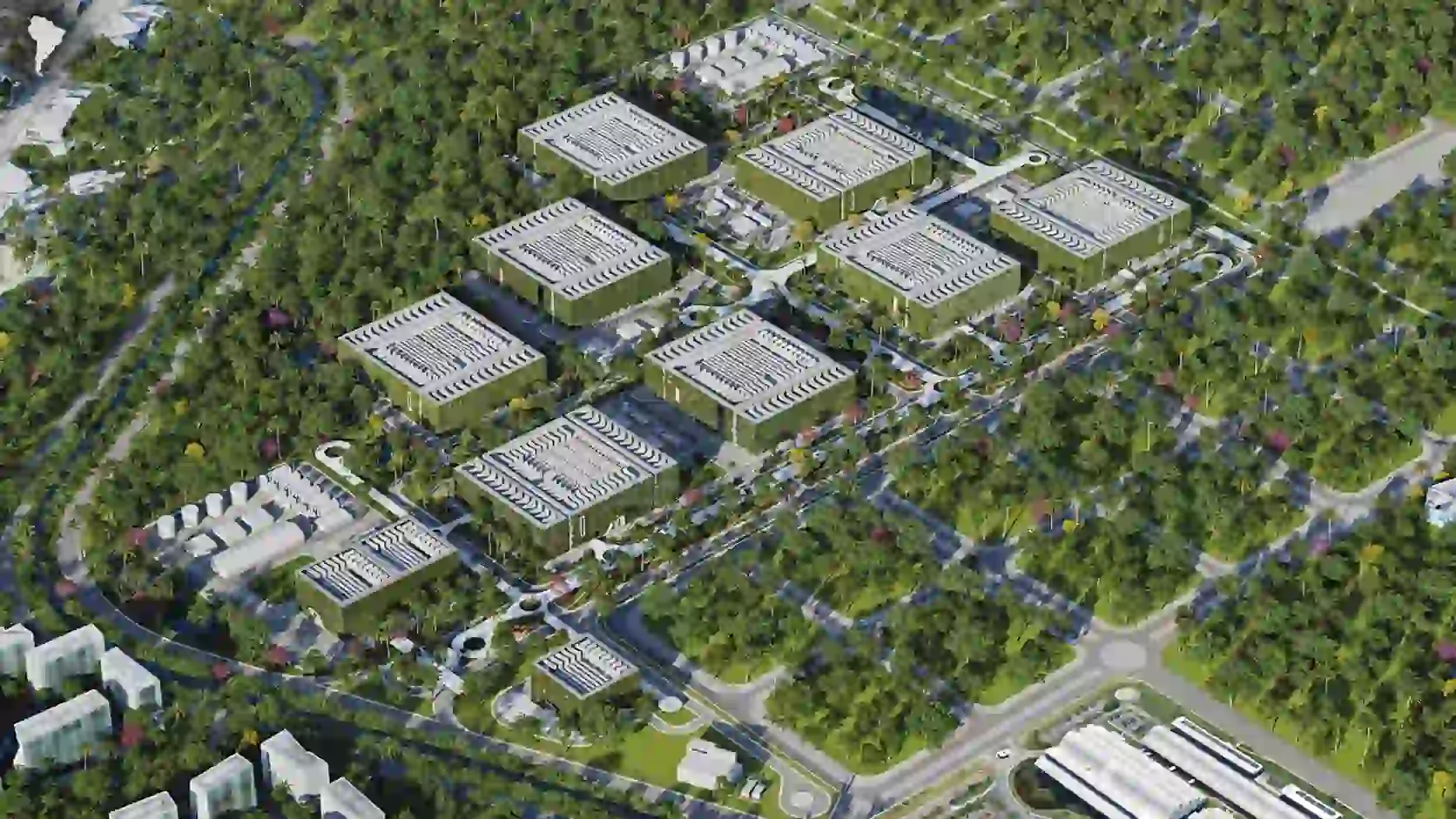
South America is not yet a peer of the United States, China or Europe in installed data-center scale. It can, however, compete for parts of the next AI infrastructure cycle if it converts energy and land advantages into sites that are actually grid-connected, permitted, fiber-redundant, coolable and commercially bankable.
The global market is moving in that direction. The International Energy Agency expects data-center electricity consumption to more than double to around 945 TWh by 2030. PwC models US$31.6 trillion of cumulative data-center capital expenditure through 2050 and identifies power as the most important location constraint, alongside connectivity, trusted hosting, GPU access, policy certainty and community consent.
That does not make geography irrelevant. It changes which geography matters. Latency-sensitive inference, financial systems and consumer services still benefit from proximity to demand. Very large AI training and other power-intensive workloads can be more mobile, allowing developers to consider secondary regions where hundreds of megawatts, land and transmission can be assembled.
South America’s opportunity is therefore not to imitate Northern Virginia or Frankfurt. It is to prove that selected locations can deliver large blocks of compute with a credible combination of power, grid access, connectivity, regulation and execution.
This article is deliberately different from Econosur’s earlier analysis of AI cost and data-center investment. That piece examined the economics of falling AI unit costs and rising aggregate infrastructure demand. The question here is site competitiveness: how South American locations compare with the United States, China and Europe when the next generation of AI capacity is placed.
The comparison starts with a large global scale gap
The United States remains the largest national data-center market. S&P Global reported 62,242 MW of US capacity in March 2026, compared with 34,015 MW in China. China’s own National Development and Reform Commission reported 13.73 million standard racks in operation by the end of 2025 and 196 TWh of electricity consumption across computing infrastructure.
Europe is smaller than the US or China in national-scale terms but already has a dense network of mature data-center markets. CBRE expects the total European market to reach around 13 GW by the end of 2026. JLL reports roughly 3.8 GW live across the five established FLAP-D markets — Frankfurt, London, Amsterdam, Paris and Dublin — with another 1.4 GW under construction and 2 GW planned.
| Market benchmark | Reported scale | What the number represents |
|---|---|---|
| United States | 62,242 MW | S&P Global national data-center capacity, March 2026 |
| China | 34,015 MW | S&P Global national data-center capacity, March 2026 |
| Europe | ~13,000 MW | CBRE expected total European market capacity by year-end 2026 |
| São Paulo | 536.7 MW | CBRE Q1 2026 metro inventory |
| Santiago | 165.8 MW | CBRE Q1 2026 metro inventory |
| Bogotá | 44.3 MW | CBRE Q1 2026 metro inventory |
Methodology matters. The US and China figures above come from S&P Global; the Europe and metro figures come from CBRE. They do not share one uniform market definition. The table is a scale orientation, not a precise market-share calculation. Country, metro, colocation, hyperscale self-build and IT-load definitions can produce very different totals.
The gap is still clear even without forcing unlike datasets into one ratio: South America begins this investment cycle from a much smaller installed base. That creates a disadvantage in ecosystem depth, suppliers, interconnection density and customer concentration. It also means that a handful of large projects can change a national market much more quickly than in the United States or Europe.
AI is changing site selection more than it is eliminating geography
Europe provides a useful comparison. JLL found that hyperscale campuses planned for 2026–2028 are located an average of 175 kilometres from major EMEA hub cities, compared with 46 kilometres for projects delivered between 2022 and 2025. Greenfield sites account for a much larger share of the pipeline. The reason is straightforward: AI-scale campuses require more land and much larger power blocks than conventional enterprise facilities, while grid connection in established hubs can take years.
China has institutionalised a related logic through its “East Data, West Computing” strategy: demand remains concentrated in the populous east, while more computing capacity is directed toward western regions with land and energy advantages. The model is not directly transferable to South America, but it demonstrates the core principle that some compute can be separated from the place where the final user sits.
PwC’s 2026 global outlook reduces the location decision to five broad forces: power; latency and connectivity; security and trusted-region hosting; GPU access and ecosystem depth; and policy certainty and community consent. For South America, those forces need to be translated into a more operational site-readiness stack.
Electricity price belongs inside the first category, but it should not be reduced to a public tariff ranking. Hyperscale sites negotiate power contracts, self-generation structures, network charges, capacity arrangements and delivery schedules that can differ materially from standard industrial tariffs. A location with nominally cheap electricity can be uncompetitive if the required power is not deliverable on time.
A renewable megawatt is not an AI megawatt until it can be delivered, contracted, cooled and connected.
South America’s structural case: strong inputs, uneven conversion
The region has several characteristics that matter more in the AI era than they did in the first cloud build-out. Brazil has a large power system, a large domestic digital economy and a predominantly renewable electricity matrix. Chile combines existing hyperscaler infrastructure with extensive fiber and submarine connectivity. Uruguay operates an unusually renewable electricity system. Paraguay has hydroelectric surplus relative to domestic demand. Argentina has land, gas and large renewable resources. Colombia and Peru add large urban demand centres and new high-density facilities.
Connectivity is also improving on both coasts. Existing and new submarine systems connect Brazil, Argentina, Uruguay and Chile with North America and, increasingly, Asia-Pacific routes. This matters because low-cost power alone cannot compensate for weak network redundancy or poor latency for many workloads.
The difficulty is conversion. Power may exist in one region while transmission is constrained in another. Fiber may land on the coast while the most attractive energy site sits far inland. Water availability can limit cooling design. Environmental review can delay otherwise well-financed projects. Import duties, access to advanced GPUs and the depth of local contractors can change total project cost. The competitive unit is therefore not the country in the abstract. It is the specific site plus its power, grid, fiber, cooling, permitting and customer structure.
Brazil: scale is the advantage — and grid delivery is the test
Brazil is the only South American market that already combines large domestic cloud demand, a deep colocation ecosystem, multiple hyperscalers, substantial renewable generation and a pipeline large enough to influence national transmission planning. The Ministry of Mines and Energy reported 205 operating data centers in June 2026 and 38 GW of requests for grid-access opinions. Of those, 7.1 GW were associated with an estimated R$159 billion in investments.
A separate EPE dataset cited by the U.S. International Trade Administration places data-center demand represented in grid-connection processes through 2038 at 26.3 GW, within 54.2 GW of combined requests from data centers and hydrogen-related industrial loads. These numbers are important signals, but they are not a construction pipeline. EPE itself stresses the uncertainty around how many requested electro-intensive projects will become real connections.
The infrastructure response is already visible. EPE is studying and planning transmission reinforcement for large loads in São Paulo and the Northeast. In Ceará and Piauí, a 2026 study proposes a scalable network solution capable of supporting up to 4 GW of new electro-intensive demand from 2032.
Brazil has also moved from policy proposal to enacted law. Lei 15.504 of 15 September 2026 established REDATA, including qualifying treatment for cloud, high-performance computing and AI training and inference infrastructure. The law links incentives to conditions including renewable or low-emission electricity sourcing, a WUE ceiling of 0.05 L/kWh and domestic R&D commitments. The tax window, however, is narrower than a simple “five-year incentive” description suggests: Article 11-J gives the Article 11-C regime a five-year horizon, while the PIS/Pasep, Cofins and IPI benefits listed in items I–III produce effects only through 31 December 2026. The Import Tax suspension in item IV is not subject to that end-2026 cut-off in Article 11-J. Effective use of REDATA also depends on habilitation, co-habilitation and other procedures to be set by federal regulation. Econosur’s earlier REDATA analysis covers the legislative design; the relevant update here is that the regime is now law but still requires implementation rules.
Large projects show why maturity labels matter. Scala’s AI City concept in Rio Grande do Sul has an initial announced phase of 54 MW and US$500 million, while the site has long-term expansion potential of up to 4.75 GW. Those are not the same thing. The 54 MW phase is a project; 4.75 GW is a potential campus build-out. A separate grid milestone is now more concrete: in September 2026 Aneel authorised direct access to Brazil’s high-voltage transmission network, with the project planning for 1.8 GW of demand by 2033. The Ministry of Mines and Energy has referred to potential expansion toward roughly 5 GW in a later horizon, subject to additional system studies.
Pecém demonstrates the other side of site selection. A 300 MW data-center project is under construction, but in September 2026 Brazil’s Federal Public Prosecutor and Public Defender went to court seeking to prevent operations before additional environmental assessment and consultation with the Anacé Indigenous people. The case includes questions around water, electricity, noise and local impacts. Cheap or renewable power does not remove permitting risk.
Brazil has the region’s strongest existing scale and demand ecosystem. Its challenge is no longer proving that investors are interested. It is filtering a very large queue of requested load into bankable projects with transmission, permits and delivery dates.
Chile: connectivity and institutional planning, constrained by grid and environment
Chile’s competitive case is different. The Ministry of Science reports around 62,000 kilometres of fiber, connections into a 69,000-kilometre submarine-cable network and data-center capacity that grew from 35 MW in 2013 to 198 MW in 2023. The National Data Center Plan is explicitly designed to accelerate investment while managing sustainability and territorial impacts.
That planning matters because Chile already hosts major international infrastructure and has additional cloud expansion underway. The country’s value proposition is not simply renewable electricity. It is the combination of connectivity, cloud presence, institutional planning and a mature digital economy.
The constraint is physical. Chile’s renewable generation is geographically concentrated, while demand and data-center activity are centered farther south. Transmission and storage therefore matter as much as nameplate generation. Econosur covers that problem separately in its Chile power-grid analysis and battery-storage analysis.
Water and environmental review are also part of site economics. In 2024 Chile’s Second Environmental Tribunal partially annulled the environmental approval associated with Google’s original Cerrillos project over groundwater and climate-impact assessment. Google later renounced the rights and obligations attached to that environmental approval. On 17 June 2026, Inversiones y Servicios Dataluna submitted a new consultation for the same site. The redesigned proposal uses air cooling rather than the earlier groundwater-based cooling concept and includes 44 emergency generator sets with 120.25 MW of combined installed backup capacity. Environmental organisations OLCA and MOSACAT are challenging the attempt to process the redesigned proposal through a pertinence consultation rather than a full environmental assessment. Separately, Chile’s Environmental Evaluation Service published a dedicated data-center evaluation criterion on 20 January 2026; it entered into force on 25 February 2026 and covers project components, impacts, contingencies and emergency planning. Clearer rules can improve predictability, but they also raise the evidence standard that projects must meet.
Chile has a credible digital-infrastructure platform and strong international connectivity. Its competitiveness depends on whether transmission, storage, cooling and environmental approvals can keep pace with the capacity investors want to add.
Uruguay: small demand base, unusually clean power and credible infrastructure
Uruguay illustrates how a small market can attract infrastructure disproportionate to domestic scale. The country generated 98% of its electricity from renewable sources in 2025: 46% hydro, 34% wind, 14% biomass and 4% solar. Eight percent of generated electricity was exported.
Google began construction of its second owned Latin American data center in Canelones with an announced investment of more than US$850 million. In August 2026, state telecom operator Antel separately announced a US$70 million AI-focused data center in Canelones, citing connectivity and access to strategic infrastructure in the site decision.
The limitation is obvious: Uruguay does not have Brazil’s domestic cloud market or São Paulo’s interconnection density. But AI site selection can reward different attributes for different workloads. A stable, highly renewable power system, international connectivity and a credible operating environment can support a niche role that would be invisible in a simple population or GDP comparison.
For the broader telecom and cloud foundation, see Econosur’s Uruguay digital infrastructure analysis.
Paraguay: can hydroelectric surplus become compute?
Paraguay represents the clearest energy-surplus experiment in the region. MITIC and Taiwan are studying a sovereign AI computing center under a 50/50 cooperation model. MITIC describes a 10 MW first phase with market-estimated investment of roughly US$300–500 million. As of 25 August 2026, the project remained in technical feasibility study.
The state electricity company ANDE has also introduced provisions for supplying so-called convergent industries, explicitly including data centers and artificial intelligence. The policy logic is to convert abundant electricity into higher-value digital activity rather than treating power only as an export commodity or input for electro-intensive industry.
The model still has to prove its commercial depth. Ten megawatts is meaningful for a sovereign AI installation but small relative to frontier hyperscale campuses. Paraguay also needs transmission, fiber redundancy, operators, specialized construction capacity and durable demand. The project is therefore best read as a capability-building step, not evidence that Paraguay has already become a major AI data-center market.
Econosur’s Argentina–Paraguay AI infrastructure comparison examines this energy-to-compute question in more detail, while the Paraguay grid and regulation analysis covers the electricity-system side.
Argentina: high optionality, low current scale
Argentina is the most striking gap between resource potential and current installed scale. Cushman & Wakefield estimated around 73 MW of operational data-center capacity in Argentina in August 2026, compared with 2,100 MW in Brazil and 624 MW in Chile under its own methodology. Those figures should not be mixed directly with CBRE’s metro data, but they show the relative position inside one provider’s dataset.
The country has potential power and land options ranging from Patagonia renewables to natural gas around Vaca Muerta. It also has a large domestic digital economy and submarine connectivity through the Atlantic coast. But site readiness depends on the transmission system, connection timelines, equipment economics, regulation and whether projects secure real anchor demand.
The proposed Stargate Argentina project illustrates the distinction between potential and capacity. OpenAI and Sur Energy signed a letter of intent in October 2025 to explore a large-scale data-center project, with Sur Energy leading energy and infrastructure development and OpenAI considering a possible offtake role. It is not an operating facility and should not be counted as installed capacity.
Argentina has enough energy and land narratives to generate interest. The commercial test is whether those narratives can be converted into power-delivery dates, prepared sites, financing, permits, fiber redundancy and contracted customers.
Colombia and Peru: smaller markets building AI-ready nodes
Colombia demonstrates that the regional map is broader than the Southern Cone. ODATA announced US$1.3 billion of investment for BG02 and BG03 in Cundinamarca. BG03 is designed for up to 120 MW of IT capacity, while BG02 adds 24 MW. On 16 September 2026, Colombia’s environmental authority ANLA licensed the associated BG03 Navarra–Bacatá 220 kV transmission project: a 1,037-metre line, four towers, two gantries and the Navarra 230/34.5 kV substation. ANLA states that the data center currently has 50 MW of assigned connection capacity. The environmental licence covers that transmission and substation infrastructure, not the data-center building itself. The gap between 120 MW of announced IT capacity and 50 MW of currently assigned connection capacity is exactly why announced capacity and electrically deliverable capacity should be tracked separately.
Peru is earlier in scale but already has infrastructure designed for higher-density workloads. Cirion’s LIM2 facility in Lurín has 20 MW, 12,000 square metres, redundant fiber to the Lima ecosystem and the capability to deploy liquid cooling for AI environments. It is evidence of technical readiness, not evidence that Peru has reached hyperscale market depth.
The competitive map is not a country ranking
Different workload classes create different location requirements. A consumer inference service may prioritize latency and proximity to users. Sovereign or regulated workloads may prioritize trusted domestic hosting. Frontier training may prioritize very large power blocks and GPU supply. Disaster recovery may prioritize geographic separation. The same country can therefore be attractive for one workload and weak for another.
| Market | Current evidence | Structural strength | Main execution question |
|---|---|---|---|
| Brazil | Large operating base; REDATA law; major connection queue; large projects | Scale, demand, renewables, cloud ecosystem | Which requested loads secure grid capacity, permits and finance? |
| Chile | Established data-center ecosystem; national plan; strong connectivity | Fiber, subsea cables, cloud presence, renewables | Can transmission and environmental approvals keep pace? |
| Uruguay | Google build; Antel AI project; 98% renewable generation in 2025 | Low-carbon power, institutional credibility | Can a small demand base support broader ecosystem depth? |
| Paraguay | 10 MW sovereign AI project in feasibility; new power rules | Hydroelectric surplus and stable electricity supply | Can energy become a full compute ecosystem? |
| Argentina | Small installed base; Stargate proposal; large energy and land options | Resource optionality, domestic market, land | Can sites become grid-ready and bankable on predictable timelines? |
| Colombia | ODATA announced 144 MW across BG02/BG03; BG03 is designed for 120 MW, while the licensed Navarra–Bacatá grid project currently carries 50 MW of assigned connection capacity | Bogotá demand, new hyperscale-grade development | How quickly can announced IT capacity be matched by firm grid capacity and a broader supplier ecosystem? |
| Peru | 20 MW AI-ready LIM2 facility | Lima demand, carrier-neutral connectivity, liquid-cooling capability | Can capacity and hyperscaler demand scale beyond the current base? |
This produces a more useful conclusion than a winner-and-loser list. Brazil has the strongest existing scale. Chile has a particularly developed connectivity and planning case. Uruguay and Paraguay test smaller energy-led models. Argentina has large optionality but must prove execution. Colombia and Peru show that new AI-ready nodes can emerge outside the largest regional hubs.
The supplier opportunity sits behind the megawatts
For B2B suppliers, the relevant market is not limited to operators and servers. AI data centers pull investment through the entire physical stack. That includes high-voltage equipment, substations, transformers, switchgear, backup generation, batteries, power-quality systems, cooling, heat rejection, pumps, water treatment, prefabricated modules, racks, cabling, fiber, network equipment, physical security, fire systems, monitoring, EPC services, environmental consulting and specialized maintenance.
The buying center can also be fragmented. A hyperscaler may define technical standards while a data-center developer controls the site, a utility controls connection works, an EPC contractor controls packages and a renewable-energy partner controls the power contract. Identifying the project owner is therefore not the same as identifying the procurement route.
- Which projects have deliverable power rather than only requested load? Verify access decisions, contracted capacity, substations, transmission works and delivery dates.
- Which sites are technically AI-ready? Check rack density, cooling architecture, water strategy, fiber redundancy, expansion space and equipment logistics.
- Who controls procurement? Map the hyperscaler, developer, utility, EPC contractor, energy partner and local operating entity before treating a project as a commercial opportunity.
What must happen for South America to capture a larger AI infrastructure share?
First, requested megawatts must become committed grid capacity. Brazil’s connection queues demonstrate demand, but they also show the risk of counting applications as projects. Similar discipline is required across the region.
Second, countries need repeatable site-readiness rather than one-off flagship projects. A single Google, Stargate or sovereign AI announcement can change perceptions, but a competitive market requires multiple developers, utilities, contractors, carriers and customers that can reproduce delivery.
Third, connectivity has to expand with power. New submarine systems and inland fiber can make energy-rich regions more useful for compute, but redundancy and latency remain workload-specific constraints.
Fourth, permitting and community acceptance need predictable pathways. Brazil’s Pecém case and Chile’s Cerrillos history show that environmental and local impacts can become material project risks. Predictable standards are more valuable than nominally easy approvals that are later challenged.
Fifth, GPU access and customer demand remain strategic. PwC identifies access to advanced chips and ecosystem depth as a major location factor. Energy can attract infrastructure, but high-end AI capacity still requires hardware, cloud operators, financing and customers able to pay for the compute.
Market signal: South America is moving from a discussion about whether data centers exist to a more demanding question: which locations can repeatedly turn large power blocks into operating AI infrastructure on bankable timelines?
Marcus A. Volz perspective
South America’s AI infrastructure case is often reduced to abundant renewable energy, low-cost power or available land. That is too simple. The market value sits in the conversion chain between a resource and a functioning site.
A credible location needs a defined source of power, a connection path, transmission capacity, a delivery date, cooling, redundant fiber, permits, equipment access, construction capability and a customer. If one link is missing, theoretical energy abundance does not become compute capacity.
This is why the most useful comparison is not Brazil versus Chile versus Argentina as abstract countries. It is one site-and-system configuration versus another. Brazil can offer scale but face grid queues. Chile can offer connectivity but face transmission and environmental constraints. Uruguay can offer a very clean grid but a smaller demand base. Paraguay can offer hydroelectricity but must still build the wider compute ecosystem. Argentina can offer resource optionality but needs more prepared, predictable sites.
For investors and suppliers, that distinction changes the research question from “Where is electricity cheap?” to “Where can this specific workload be built, powered and operated on the required schedule?”
Evidence status: 27 September 2026.
Capacity data are not fully harmonised. S&P Global, CBRE and Cushman & Wakefield use different definitions and geographic scopes. Econosur therefore keeps figures attached to their source and does not use unlike datasets to calculate a single definitive South America-versus-global market share.
Connection requests are not committed construction. Brazil’s 38 GW of access-opinion requests and the 26.3 GW represented in longer-term grid-connection processes indicate demand pressure on the power system. They should not be added to operating capacity or described as financed projects.
Potential campus capacity is not initial capacity. Scala AI City’s 4.75 GW figure is long-term expansion potential. The announced initial phase is 54 MW. Separately, Aneel authorised direct access to the high-voltage transmission network in September 2026, with 1.8 GW of planned demand by 2033; this is a grid-access milestone, not proof that 1.8 GW is already built.
Stargate Argentina is a proposal. OpenAI and Sur Energy signed a letter of intent to explore a large-scale project. It is not counted here as operating capacity.
Paraguay’s sovereign AI center remains in feasibility study. MITIC described the 10 MW project as being in technical feasibility in August 2026.
BG03’s announced IT capacity and grid capacity are different measures. ODATA has announced up to 120 MW of IT capacity for BG03, while ANLA’s September 2026 licence for the Navarra–Bacatá transmission project records 50 MW of assigned connection capacity. The environmental licence cited here covers the line and substation, not the data-center building.
Electricity prices are not ranked. Public tariff comparisons do not reproduce the power contracts, network charges, self-generation structures and delivery conditions that determine hyperscale project economics.
Global and comparative institutional sources
- International Energy Agency — Energy and AI — global electricity-demand outlook for data centers and AI.
- China National Development and Reform Commission — computing infrastructure statistics, July 2026 — racks and electricity-consumption data.
- State Council of China — East Data, West Computing — national computing-hub and geographic allocation strategy.
Brazil primary & official sources
- Presidência da República — Lei No. 15.504, 15 September 2026 — current REDATA law, including the five-year Article 11-C horizon, the 31 December 2026 limit for PIS/Pasep, Cofins and IPI benefits, and the requirement for implementation rules governing habilitation and co-habilitation.
- Ministry of Mines and Energy — data-center grid demand, 1 June 2026 — 205 operating facilities, 38 GW of access-opinion requests and 7.1 GW linked to R$159 billion of investment.
- EPE — transmission planning for large loads, 1 July 2026 — grid-planning response to data centers and other electro-intensive projects.
- EPE — Ceará and Piauí transmission study, 19 June 2026 — scalable solution for up to 4 GW of new electro-intensive load.
- Scala Data Centers — AI City Rio Grande do Sul — 54 MW initial phase and long-term 4.75 GW campus potential.
- Brazil Ministry of Mines and Energy — Scala grid-access pathway — 1.8 GW of planned demand by 2033 and potential later expansion toward 5 GW, subject to further system studies.
- Federal Public Prosecutor — Pecém data-center case, 10 September 2026 — 300 MW planned project and environmental/consultation challenge.
Chile primary & official sources
- Chile Ministry of Science — National Data Center Plan — capacity history, fiber, submarine connectivity and national planning framework.
- Servicio de Evaluación Ambiental — data-center evaluation criterion, published 20 January 2026; effective from 25 February 2026.
- Second Environmental Tribunal — Cerrillos Data Center, 27 February 2024 — groundwater and climate-impact review.
- Servicio de Evaluación Ambiental — Metropolitan Region Commission agenda, 19 August 2024 — official record of the request to renounce RCA No. 127/2020 for the Cerrillos Data Center.
Uruguay primary & official sources
- Uruguay Presidency / MIEM — 2025 electricity generation, January 2026 — 98% renewable generation and source mix.
- Google — Canelones data center, 29 August 2024 — construction start and more than US$850 million investment.
- Uruguay Presidency — Antel AI data center, 11 August 2026 — US$70 million project in Canelones.
Paraguay primary & official sources
- MITIC — sovereign AI computing pilot, 20 May 2026 — 10 MW first phase and estimated US$300–500 million investment.
- MITIC — project status, 25 August 2026 — confirms technical feasibility-study stage.
- ANDE — electricity supply for convergent industries, 7 May 2026 — provisions covering data centers and AI loads.
Argentina primary & company sources
- OpenAI — Argentina’s AI Opportunity, 14 October 2025 — letter of intent with Sur Energy to explore a large-scale project.
Colombia and Peru primary & company sources
- ODATA — Colombia expansion, 23 October 2024 — BG02 and BG03, 144 MW combined capacity and US$1.3 billion investment.
- ANLA — BG03 Navarra–Bacatá 220 kV transmission project, 16 September 2026 — environmental licence for the 1,037-metre line and Navarra substation; ANLA records 50 MW of assigned connection capacity for the ODATA data center. The licence concerns the electrical infrastructure, not the data-center building itself.
- Cirion Technologies — Lima LIM2 — 20 MW, 12,000 m², redundant fiber and AI/liquid-cooling capability.
- PwC — Global Data Centre Outlook 2026–50, 2 September 2026 — US$31.6 trillion central capex scenario and five location forces: power, connectivity, trusted hosting, GPU/ecosystem access and policy/community factors.
- S&P Global — US and China data-center capacity, June 2026 — 62,242 MW US and 34,015 MW China as of March 2026.
- CBRE — Global Data Center Trends 2026 — comparable metro-market inventory including São Paulo, Santiago and Bogotá.
- CBRE — European Data Centres Figures Q2 2026 — expected 13 GW European market by year-end 2026.
- JLL — EMEA Data Centre Mid-Year 2026 — FLAP-D live capacity, greenfield shift and average distance of new hyperscale projects from established hubs.
- Cushman & Wakefield — Argentina Data Center Site Readiness, 20 August 2026 — Argentina 73 MW, Brazil 2,100 MW and Chile 624 MW under the provider’s methodology.
- Convergência Digital — Aneel authorises Scala access to the Rede Básica, 10 September 2026 — direct high-voltage access, 1.8 GW demand planned by 2033 and later expansion potential subject to studies.
- OLCA — Cerrillos redesign and environmental challenge, September 2026 — documents the 17 June 2026 pertinence consultation, air-cooling redesign and objections raised by OLCA and MOSACAT.
- U.S. International Trade Administration — Brazil Energy Data Center — EPE-based split of 54.2 GW of connection processes into 26.3 GW data centers and 27.9 GW hydrogen-related projects.
- Econosur analysis of public evidence on capacity, power systems, site readiness, connectivity, project maturity, regulation and supplier structures available by 27 September 2026.
From country potential to a site that can actually be built
AI data-center decisions require more than a country-level power or investment story. The commercial question is whether a specific location can deliver the required MW, connection date, fiber redundancy, cooling, permits, equipment, contractors and customer structure.
Econosur prepares custom market analysis, sector briefs and company research for international companies, investors and institutions evaluating digital infrastructure in South America. Research can compare countries and sites, verify project maturity, map power and grid constraints, identify operators and suppliers, examine procurement routes and distinguish announced potential from commercially actionable capacity.
Explore custom market analysisFrequently asked questions
Can South America compete with the United States, China and Europe for AI data centers?
Not on installed scale today. The United States and China have far larger national capacity, while Europe has a much larger mature market. South America can nevertheless compete for parts of the next build cycle where large power blocks, low-carbon electricity, land, connectivity and permitting can be assembled into bankable sites.
Which South American markets are most active in large data-center development?
Brazil and Chile have the deepest current ecosystems. Uruguay has attracted a major Google build and a separate Antel AI project. Argentina, Paraguay, Colombia and Peru are developing different combinations of new capacity, AI-focused projects, grid connections and site-readiness.
Is renewable electricity enough to make a South American site competitive?
No. Renewable generation is an input, not a completed data-center proposition. Large AI facilities also need firm grid access, substations, transmission, redundant fiber, cooling, water strategy, permits, construction capacity, equipment access, finance and contracted demand.
Does Brazil really have a 26.3 GW data-center construction pipeline?
No. The 26.3 GW figure refers to data-center projects represented in grid-connection processes through 2038, according to EPE figures cited by the U.S. International Trade Administration. Connection requests are a demand signal for transmission planning, not equivalent to financed or permitted construction.
Why is Chile relevant to AI data-center site selection?
Chile combines an established data-center base, extensive fiber and submarine-cable connectivity, renewable power and a national data-center plan. Its constraints are equally important: transmission, environmental review, water and cooling choices can determine whether potential capacity becomes buildable capacity.
Is Stargate Argentina an operating data center?
No. OpenAI and Sur Energy signed a letter of intent to explore a large-scale data-center project in Argentina. It should be treated as a proposal and potential anchor project, not as operating or committed installed capacity.
Can smaller markets such as Uruguay or Paraguay compete with Brazil?
They compete on a different basis. Uruguay offers a highly renewable power system and existing institutional and cloud infrastructure, while Paraguay is testing an energy-surplus-to-compute model around hydroelectricity. Their smaller domestic markets and infrastructure depth remain important constraints.
Why do data-center capacity figures differ between market reports?
Providers use different definitions: national versus metro markets, operational versus planned capacity, IT load versus utility power, colocation versus hyperscale self-build, and different facility inclusion rules. Econosur therefore keeps each figure attached to its source and avoids treating unlike methodologies as directly comparable.