
South America · Critical Minerals · Copper · Lithium · Geopolitics
South America’s Critical Minerals Push: Cooperation, Competition and Bargaining Power
Chile, Argentina, Bolivia and Peru are coordinating strategic minerals while Brazil builds its own industrial strategy. The real test is whether regional cooperation can increase leverage without erasing competition for capital, processing capacity and global buyers.
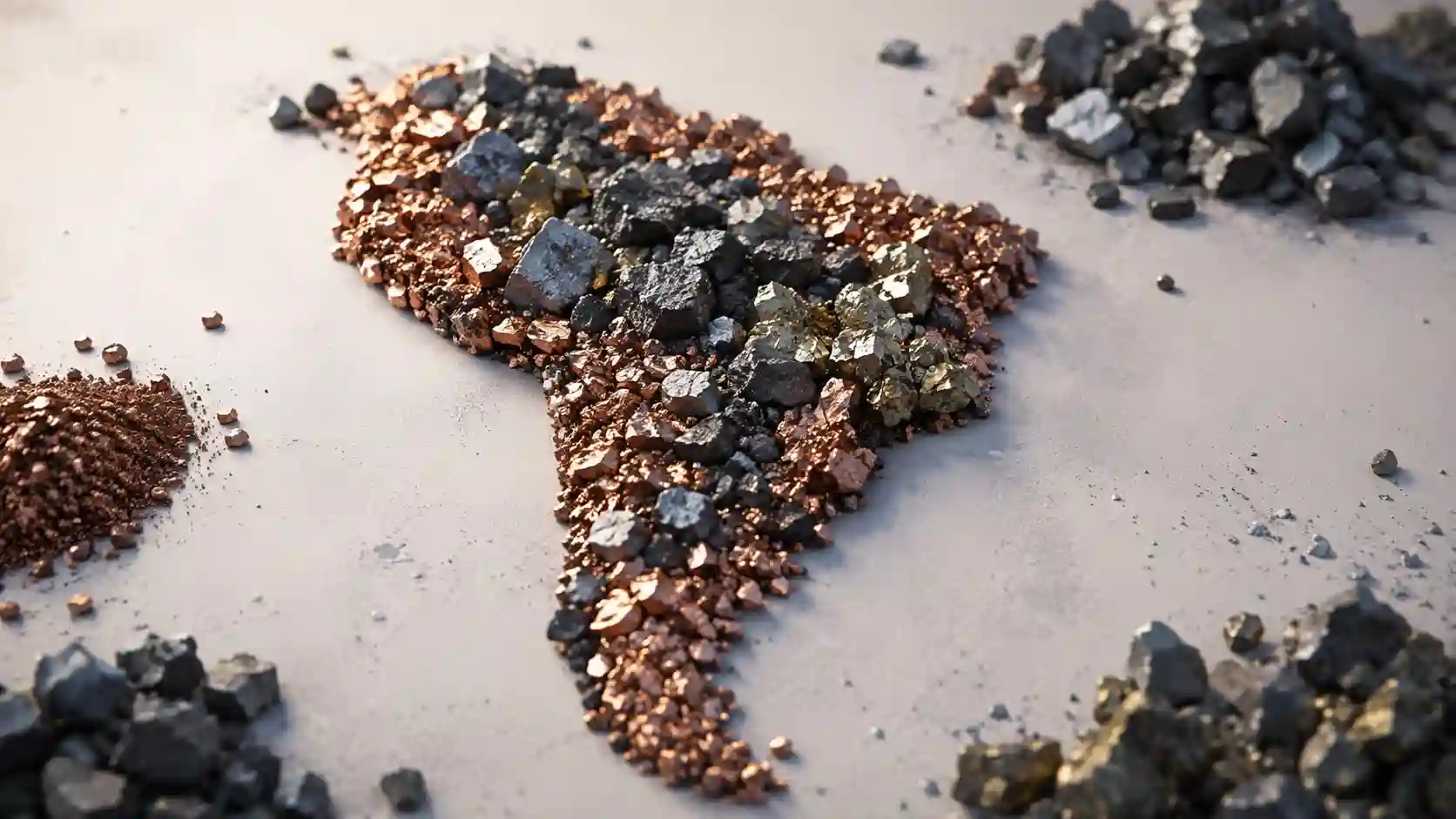
South America is not creating a critical-minerals cartel. It is beginning to coordinate its mineral power.
On 28 August 2026, Chile, Argentina, Bolivia and Peru signed a joint declaration on strategic minerals for regional integration. The stated agenda covers responsible investment, technical and institutional cooperation, research, skills, stronger regional value chains and the joint positioning of the region as a reliable supplier.
The more important development is the structure around that declaration. Chile has made mineral diplomacy a formal policy pillar. Argentina is combining regional cooperation with RIGI and a bilateral critical-minerals alignment with the United States. Brazil is pursuing its own long-term mineral and industrial strategy while remaining connected through CAMMA and bilateral cooperation. On 2 September, Brazil’s Senate approved the bill creating a National Policy for Critical and Strategic Minerals, including instruments for processing, transformation, traceability, innovation and domestic value creation. Law 15,506 was enacted on 16 September 2026.
The regional pattern points toward bargaining power without common pricing. The leverage comes from coordinating investment, infrastructure, value creation, skills, supplier ecosystems and diplomatic positioning while individual countries continue to compete for capital.
That is consistent with Econosur's earlier analysis that lithium is not one South American market. Regional resource concentration matters, but national rules, project economics, technology and execution still determine where business is actually done. The wider energy-minerals-food context is developed in South America’s Strategic Resource Advantage in a Fragmenting World Economy.
Core market reading:
The strategic shift is not from competition to cooperation. It is from isolated national mineral policies toward a layered system in which regional cooperation, national investment competition and external geopolitical alliances operate at the same time.
What Changed on 28 August 2026
Chile, Argentina, Bolivia and Peru signed their joint declaration in Santiago after a week of regional mining diplomacy. The document is framed around strategic minerals for regional integration and explicitly seeks to position the region as a strategic and reliable partner in the global supply of minerals required for decarbonisation, electromobility and artificial intelligence.
The agenda goes beyond extraction. The four governments commit to promoting responsible investment and economic development across the regional industry value chain. They also want to explore technical and institutional cooperation in mining oversight, geology, public policy and specialised human capital, while seeking multilateral technical and financial support for regional initiatives.
That matters because the declaration follows a broader ministerial process. Two days earlier, the XVI Conference of Mining Ministries of the Americas brought together authorities from twelve countries, including Argentina, Bolivia, Brazil and Chile. CEPAL described the meeting as a forum for regional coordination, joint action, knowledge exchange, local productive linkages, research and innovation.
Regional positioning: present the participating countries as reliable and competitive suppliers of strategic minerals.
Value-chain development: encourage responsible investment and greater economic value along the regional mining chain.
Technical cooperation: exchange experience in geology, regulation, mining policy, oversight and human-capital formation.
Joint project support: seek multilateral finance and design joint calls for public and private participation in research, innovation and institutional strengthening.
Not established: a common mineral price, export quota, marketing agency, production target or binding regional investment regime.
Chile is the clearest policy driver behind this logic. Its January 2026 National Critical Minerals Strategy includes five pillars, one of which is explicitly international insertion and mineral diplomacy. The August declaration turns that concept into a regional political platform.
This Is Not a Mineral Cartel — and That May Be the Point
The idea of collective mineral power is not new. In 2022 and 2023, Argentina, Chile and Bolivia discussed closer lithium coordination, and Brazil was later included in public discussion of a possible "lithium OPEC". The concept attracted attention because the lithium triangle concentrated a large share of known resources while battery demand was rising rapidly.
But the OPEC analogy was always structurally difficult. Lithium does not operate like crude oil. Countries differ sharply in ownership models, project maturity, extraction technology, investment policy and industrial objectives. Alternative producers exist outside South America, and pricing is more fragmented than in oil.
A 2024 academic feasibility study reached a similar conclusion: an OPEC-style lithium cartel was probably too ambitious given current production capacity and market influence, while more practical regional cooperation offered a more realistic path.
The 2026 declaration looks much closer to that practical model. It broadens the agenda beyond lithium and shifts the focus from direct price control toward supply-chain position, investment, technical cooperation, institutions and value addition.
South America does not need a common mineral price to increase its leverage. It can gain bargaining power by making investment, infrastructure, processing, standards and supply-chain access more strategic.
The Five-Country Equation Is More Important Than the Four Signatures
The new declaration is formally a four-country initiative. Economically, however, any South American critical-minerals strategy becomes much larger when Brazil is added to the map.
| Country | Core position | Strategic instrument | Role in the regional equation |
|---|---|---|---|
| Chile | Copper, lithium, mature mining ecosystem | National Critical Minerals Strategy; mineral diplomacy; bilateral mining agreements | Convenor, Pacific-facing mining platform, supplier and services hub |
| Argentina | Fast-growing lithium output and large emerging copper pipeline | RIGI; US critical-minerals framework; Chile mining-integration treaty | Investment-growth engine and major new project pipeline |
| Bolivia | Lithium potential and broader mining base | Regional declaration and state-led mineral policy | Large resource potential with a stated objective of greater value addition |
| Peru | Major copper mining base | Regional declaration; mining cooperation with Chile | Large established copper producer linking Andean production to the regional agenda |
| Brazil | Niobium, graphite, lithium, nickel, copper, manganese and rare-earth potential | National Mining Plan 2050; strategic-minerals policy; Chile-Brazil mining cooperation | Broadest diversification play and the potential industrial-scale extension of the regional system |
The complementarity is important. Chile, Peru and Argentina strengthen the copper axis. Chile, Argentina and Bolivia anchor the lithium discussion. Brazil adds minerals that change the strategic profile of the region, especially niobium, graphite and rare-earth potential.
For a closer look at the country-specific structure, Econosur's Chile mining investment analysis, Argentina copper analysis and Brazil critical-minerals and rare-earth analysis show why a single "South American minerals market" would be too simplistic.
Brazil Is Missing From the Signature — Not From the Strategy
Brazil did not sign the 28 August declaration. That is a fact. It should not automatically be interpreted as Brazilian rejection of regional mineral coordination.
Brazil participated in the CAMMA ministerial meeting on 26 August. More importantly, Brazil and Chile already signed a mining letter of intent in August 2024 covering strategic minerals for the energy transition. The Brazilian government described the implementation of those activities as creating a favourable environment for integration of the mining sector across South America.
At the same time, Brazil has developed a clearly national strategic framework. Its National Mining Plan 2050, presented in July 2026, treats mineral supply security, national sovereignty, stronger productive chains and critical and strategic minerals as long-term priorities. The National Mining Agency separately identifies Brazil as relevant in lithium, nickel, copper, niobium, manganese and graphite, with significant geological potential in rare earths.
Brazil’s framework advanced from parliamentary approval to enacted policy with Law 15,506 of 16 September 2026, establishing the national critical-minerals policy and industrialisation council. The enacted framework covers processing, value creation and traceability. Enactment should be distinguished from implementation, committed project finance and funds actually disbursed.
Brazil is also widening bilateral institutional links. On 9 September, the ANM met Natural Resources Canada and the Canadian embassy to discuss critical minerals, innovation, regulation and technical cooperation ahead of a planned Brazil–Canada mining memorandum of understanding.
That creates a different role from simply joining a lithium-centred producer group. Brazil can potentially supply a broader mineral portfolio and link it to a much larger domestic industrial base.
This is why Econosur's Brazil critical-minerals question is fundamentally an industrial one: whether geological potential is converted into mining output alone or into processing, technology and higher-value production. The Brazil rare-earth project pipeline adds another layer to that issue.
Verified: Brazil was represented at CAMMA and has a bilateral mining cooperation framework with Chile that explicitly references wider South American mining integration.
Verified: Brazil's 2050 mining strategy prioritises critical and strategic minerals, supply security and stronger productive chains. On 2 September, the Senate also approved PL 2.780/2024 creating a national critical-minerals policy focused on processing, traceability, innovation and industrialisation; Law 15,506 was enacted on 16 September 2026.
Not established: Brazil has not joined the 28 August four-country declaration, and the public evidence reviewed does not show a decision to join it.
Econosur interpretation: Brazil may be more important as a flexible regional and bilateral partner than as a formal fifth member of a single mineral bloc. That is an analytical inference, not an announced Brazilian policy.
Argentina Shows Why Cooperation and Competition Can Coexist
Argentina is the clearest example of the tension inside the emerging regional model.
On one side, Argentina signed the regional declaration and is deepening physical mining integration with Chile. On the other, it is aggressively competing for international capital through the Régimen de Incentivo para Grandes Inversiones, or RIGI.
Official Economy Ministry data published in June showed 16 approved RIGI projects with almost US$29.9 billion in committed investment and another 25 projects representing US$111 billion under evaluation across RIGI sectors. For mining specifically, the Argentine Chamber of Mining Companies reported to the Senate on 27 August that 17 mining projects worth US$39 billion had been submitted under RIGI, with 12 projects representing US$21 billion already approved.
Econosur has already examined the execution logic behind this incentive regime in its RIGI analysis. In critical minerals, the key point is that regional cooperation does not replace national competition for project capital.
Argentina's bilateral relationship with the United States makes that even clearer. On 4 February 2026, the two countries signed a specific framework to strengthen supply in critical-mineral mining and processing. One day later, on 5 February, they signed the broader Agreement on Reciprocal Trade and Investment (ARTI). Article 4.1 of ARTI commits Argentina to facilitate US investment in critical-mineral projects, fast-track eligible applications through RIGI and states an intention to prioritise the United States as a trade and investment partner for copper, lithium and other critical minerals over market-manipulating economies or enterprises.
The most important contradiction is only apparent.
I do not read Argentina's US alignment and RIGI strategy as evidence that regional cooperation is hollow. I read it as evidence of what the regional model will probably look like: countries cooperate where coordination increases leverage, but compete where investment, financing, processing capacity and export relationships are at stake.
The result is not one South American negotiating desk. It is a denser network of national and regional instruments that can make the region harder for external buyers to treat as a set of isolated commodity suppliers.
The Buyers Are Organising Too
Producer coordination only makes sense when viewed against changes on the demand side.
In April 2026, the European Union and the United States launched a strategic partnership on critical minerals and agreed a Critical Minerals Action Plan. The plan explicitly considers tools such as border-adjusted price floors, standards-based markets, price-gap subsidies and offtake agreements, alongside investment, research, stockpiling and rapid-response mechanisms for supply disruptions.
Chile has also expanded its own network of mineral agreements. Its international portfolio includes cooperation instruments with the United States, Brazil, Peru, China, Japan, Canada, the European Union, Germany, Argentina and other partners. That is a form of diversification rather than exclusive alignment.
China remains the structural midstream factor. The IEA's 2026 outlook shows that refining concentration reached new highs in 2025, with China the leading refiner for most key energy minerals. In several strategic materials — including graphite and rare earths — concentration is especially high. The issue for South America is therefore not only who mines the mineral, but who finances, processes, refines and converts it into industrial products.
A second buyer-side requirement is becoming more visible: traceability. On 9 September, the OECD published a new report on lithium and nickel supply chains based partly on field research in Argentina and Chile. It argues that traceability can strengthen supply-chain resilience, responsible sourcing and investment confidence. For suppliers and project developers, this means market access can increasingly depend on data, chain-of-custody systems and governance standards alongside price and production volume.
That dynamic is visible in Chile's existing relationship with China, which Econosur examines in Chile's copper and lithium connection with China.
Penco: mineral ownership and processing location are different questions
Aclara’s October 19 Penco assessment adds a Chilean rare earth case to this regional comparison. Its model estimates US$244 million in initial construction capital, while the proposed industrial route connects Chile and Brazil with separation in Louisiana.
This illustrates why mineral resources alone do not determine where industrial value is created. Chile hosts Penco and the Aclara–CAP metals-and-alloys demonstration plant at Huachipato; commercial separation is planned in the United States. The Penco rare earth project analysis examines those relationships alongside financing and environmental approval. Penco’s first-stage approval does not cover the entire modelled 17-year mine life.
The Real Test Is Whether Political Coordination Becomes Physical
The strongest evidence that regional integration can move beyond declarations came one day before the four-country pact.
On 27 August, Chile and Argentina approved operating protocols for Vicuña, NexoAndino and Filo Sur under their Mining Integration and Complementation Treaty. The projects straddle the border between San Juan and Atacama, and the protocols establish specific conditions for integrated development.
Chile's Mining Ministry described a portfolio above US$20.7 billion and linked the bilateral framework not only to extraction but also to infrastructure, connectivity, logistics, supplier integration, specialised services, innovation, technology, energy and human capital.
This is the point where regional mineral strategy becomes commercially meaningful. A declaration has limited value if projects, roads, power, ports, processing capacity and supplier systems remain nationally disconnected. Cross-border project execution changes that equation.
The Vicuña system has advanced again since the August protocols. On 10 September, Vicuña announced approximately 55,500 metres of diamond drilling for the 2026–2027 season, mainly at Filo del Sol, with Boart Longyear Argentina and Hy-Tech Griffith Drilling Argentina selected through a competitive process. On 11 September, the company awarded construction of the first 63.6 kilometres of the planned roughly 220-kilometre Northern Corridor to a joint venture formed by Contreras, BBC and San Juan-based Construmin. These are practical supplier and infrastructure decisions emerging from the cross-border project system.
It also connects directly to existing Econosur research on Argentina's emerging copper economy, Chile's copper and lithium investment pipeline and the broader South America strategic-resource analysis. The next generation of Andean projects will increasingly test whether the region can combine geology on one side of a border with ports, engineering, power systems or suppliers on the other.
Reliable mineral supply depends on operating companies
Regional coordination needs to translate into dependable production, processing and commercial relationships. In Chile’s Coquimbo region, Tres Valles combines existing processing assets, purchased ore and a planned underground restart. Its case connects ore performance with liquidity, settlement reliability and environmental compliance.
Minera Tres Valles: the operating conditions behind a viable copper restart examines these requirements at company level. Existing infrastructure and a restart target do not establish sustainable cash generation or a verified investment return.
Where the Commercial Opportunity Actually Opens
For international B2B companies, the value of regional coordination is not an abstract increase in geopolitical influence. It is the possibility that more projects become investable, more infrastructure becomes shared and more procurement demand develops around the same mineral corridors.
The IEA estimates that Latin America currently refines only around one-fifth of the key energy minerals it extracts, excluding lithium. Its 2026 analysis argues that stronger regional integration could improve investment attractiveness, support shared infrastructure, technology transfer and skills, and build more competitive and resilient mineral value chains.
That is the commercial space to watch. The opportunity is not created by a hypothetical South American mineral price. It is created when multiple countries begin solving shared bottlenecks in processing, infrastructure, project finance, traceability and supplier capability. The strategic value therefore sits across several control layers: resource ownership, project operation, finance, infrastructure, processing and long-term offtake.
Three Business Questions
1. Which country is the anchor for the part of the value chain you actually sell into?
Copper equipment, lithium processing, rare-earth separation, mining software and logistics do not follow the same country map. A regional strategy still needs a country-specific commercial anchor.
2. Which geopolitical and financing ecosystem is shaping the project?
A mine can be South American in geology but US-, European-, Chinese-, Japanese- or multilateral-financed in execution. Offtake, export credit, technology standards and strategic partnerships can influence procurement before a tender appears.
3. Where is regional integration becoming physical rather than political?
Cross-border projects, shared ports, power infrastructure, processing plants, water systems and supplier corridors are the places where cooperation can translate into recurring B2B demand.
Research Boundary
Verified: Chile, Argentina, Bolivia and Peru signed a joint declaration on strategic minerals for regional integration on 28 August 2026. Its public agenda covers sustainable mining, responsible investment, technical cooperation, value chains, research, skills and support for regional initiatives.
Verified: Brazil was represented at the CAMMA ministerial process two days earlier and has an existing bilateral mining cooperation framework with Chile. Brazil's PNM 2050 separately prioritises critical and strategic minerals, supply security and stronger productive chains.
Verified: On 2 September, Brazil’s Senate approved PL 2.780/2024 creating the National Policy for Critical and Strategic Minerals. The bill includes instruments for processing, transformation, traceability, innovation and domestic value creation. Law 15,506 was enacted on 16 September 2026.
Verified: Vicuña has moved beyond the August cross-border protocols into additional execution steps, including a 55,500-metre 2026–2027 drilling programme and the award of the first 63.6 kilometres of the Northern Corridor.
Verified: Argentina continues to pursue a national investment strategy through RIGI and a bilateral critical-minerals framework with the United States. Chile also maintains a diversified set of international mineral cooperation agreements.
Verified: Chile and Argentina approved project-specific cross-border protocols for Vicuña, NexoAndino and Filo Sur on 27 August, providing a concrete example of physical mining integration.
Not established: there is no common South American mineral price, export quota, production target, joint marketing body or binding regional critical-minerals institution in the evidence reviewed.
Unresolved: Brazil has still not joined the four-country declaration. Its future relationship to that initiative, the depth of common standards or financing, the scale of regional processing investment and the durability of coordination across changes of government remain open.
Econosur analytical boundary: "bargaining power" in this article means improved ability to shape investment terms, value-chain location, infrastructure, standards, financing and strategic partnerships. It does not imply proven collective power to set global mineral prices.
South America is beginning to coordinate without ceasing to compete. That tension is not a weakness of the strategy; it is the strategy's defining feature.
- Aclara, October 19, 2026 — Penco updated economic assessment and environmental scope.
- Grupo CAP, October 9, 2026 — Huachipato technology demonstration and planned US industrial scale-up.
- Chile Ministry of Mining — Joint declaration on strategic minerals, 28 August 2026: four-country declaration, regional positioning, value-chain development, technical cooperation and multilateral support.
- Bolivia Ministry of Mining and Metallurgy — Joint declaration coverage, 28 August 2026: detailed explanation of the declaration, regional integration objectives and value-added ambitions.
- CEPAL / CAMMA — XVI Conference of Mining Ministries of the Americas, 26 August 2026: participation of twelve countries including Brazil and the wider regional agenda on cooperation, capabilities, innovation and value chains.
- Chile Ministry of Mining — National Critical Minerals Strategy, 27 January 2026: five strategic pillars including value addition and international insertion / mineral diplomacy.
- Brazil Ministry of Mines and Energy — National Mining Plan 2050: long-term mineral strategy, supply security, sovereignty, critical minerals and productive-chain strengthening.
- Brazil National Mining Agency — Critical and Strategic Minerals, April 2026: Brazil's relevance in lithium, nickel, copper, niobium, manganese and graphite and geological potential in rare earths.
- Brazil Federal Senate — National Policy for Critical and Strategic Minerals approved, 2 September 2026: PL 2.780/2024, up to R$7 billion in support, processing and transformation, traceability, innovation and domestic value creation; legislative approval preceded enactment on 16 September 2026.
- Brazil Federal Senate — PL 2.780/2024 legislative status: legislative history; the enacted text is Law 15,506 of 16 September 2026.
- Brazil ANM — Brazil and Canada expand mining dialogue, 9 September 2026: critical minerals, innovation, regulation and technical cooperation.
- Chile-Brazil Letter of Intent on Mining, 5 August 2024: strategic-minerals cooperation and a stated objective of creating a favourable environment for wider South American mining integration.
- Argentina Ministry of Economy — Official RIGI project data, 11 June 2026: 16 approved projects representing US$29.892 billion and 25 projects under evaluation representing US$111.037 billion across RIGI sectors.
- CAEM — RIGI mining testimony, 27 August 2026: mining-sector figures of 17 submitted projects worth US$39 billion and 12 approved projects worth US$21 billion. CAEM is an industry association source, not an independent government statistic.
- Argentina Foreign Ministry — US-Argentina critical-minerals framework, 4 February 2026: bilateral cooperation on secure, resilient and competitive mining and processing supply.
- USTR — US-Argentina Agreement on Reciprocal Trade and Investment, 5 February 2026: Article 4.1 on US critical-mineral investment, RIGI fast-tracking and Argentina's stated intention to prioritise the United States for copper, lithium and other critical minerals.
- Chile SUBREI — Chile-US critical-minerals cooperation, 21 April 2026: investment, experience exchange and capability development across the critical-minerals value chain.
- European Commission — EU-US strategic partnership and Critical Minerals Action Plan, 24 April 2026: possible price floors, standards-based markets, price-gap subsidies, offtake agreements, investment, research and stockpiling.
- Chile Ministry of Mining — Argentina-Chile cross-border mining protocols, 27 August 2026: official approval of operating protocols for Vicuña, NexoAndino and Filo Sur under the bilateral Mining Integration and Complementation Treaty.
- Vicuña — 2026–2027 drilling campaign, 10 September 2026: approximately 55,500 metres of diamond drilling, mainly at Filo del Sol, with Boart Longyear Argentina and Hy-Tech Griffith Drilling Argentina selected.
- Vicuña — Northern Corridor Section A award, 11 September 2026: first 63.6 km of the planned approximately 220 km corridor awarded to Contreras, BBC and Construmin.
- International Energy Agency — Global Critical Minerals Outlook 2026: Latin America: regional copper and lithium position, limited refining share, value-creation potential and the case for stronger regional integration.
- International Energy Agency — Global Critical Minerals Outlook 2026: Market Overview: refining concentration and China's position in most key energy-mineral refining markets.
- OECD — Enhancing Resilience Through Traceability, 9 September 2026: lithium and nickel supply-chain traceability, responsible sourcing, governance and investment resilience, including field research in Argentina and Chile.
- Reuters — Four South American nations sign strategic minerals pact, 28 August 2026: independent reporting on the agreement and its regional strategic context.
- Reuters — Argentina, Chile revive cross-border mining framework, 27 August 2026: independent reporting on the investment context, including more than US$20.7 billion in projects and the potential use of Chilean infrastructure.
- MINING.COM — South America looks at creating “lithium OPEC”, 6 March 2023: historical reporting on Argentina, Chile, Bolivia and Brazil discussing closer lithium coordination.
- TIME — What Would Happen if South America Formed an OPEC for Lithium, 28 April 2023: historical analysis of the cartel analogy and its structural limits.
- Ibero-América Studies — Can Lithium OPEC be Realized?, 2024: academic feasibility analysis concluding that an OPEC-style model is too ambitious under current conditions and that practical regional cooperation is more realistic.
- Evidence note: Econosur distinguishes the signed regional declaration from the broader concept of a mineral bloc. The article's central interpretation — bargaining power through coordination rather than common pricing — is an analytical conclusion based on the interaction of the regional pact, national strategies, bilateral agreements and buyer-side supply-security policies.
- Econosur analysis updated 22 October 2026.
From a mineral map to a strategic supply-chain map
The new regional push creates a more complex commercial landscape across copper, lithium, rare earths, graphite, niobium and related infrastructure.
Econosur prepares country, sector, company and custom analysis for businesses evaluating mining projects, supply chains, suppliers, infrastructure and strategic positioning in South America.
Explore Custom Market AnalysisFrequently Asked Questions
Did Chile, Argentina, Bolivia and Peru create a critical-minerals cartel?
No. The 28 August 2026 declaration promotes cooperation, investment, technical exchange, research and regional value creation. It does not establish joint pricing, export quotas, common marketing or a binding cartel mechanism.
Why is Brazil important if it did not sign the four-country declaration?
Brazil has a broad strategic-minerals portfolio including niobium, graphite, lithium, nickel, copper and manganese, plus significant rare-earth potential. It also participated in the wider CAMMA ministerial process and has a bilateral mining cooperation framework with Chile.
What is different from the earlier idea of a lithium OPEC?
The earlier debate focused on coordinating lithium producers and potentially influencing processing, production and pricing. The 2026 declaration is broader across strategic minerals and more practical, focusing on cooperation, investment, institutions, research, skills and supply-chain positioning.
How does Argentina's RIGI fit into regional cooperation?
RIGI shows that cooperation does not eliminate competition. Argentina is simultaneously coordinating with neighbours and using national incentives to attract large mining investments, while also deepening bilateral critical-minerals ties with the United States.
What role could regional integration play for suppliers?
The strongest commercial effects would come from physical integration: cross-border projects, shared infrastructure, processing, ports, engineering services, geological data, energy systems and mining technology. Those layers can create supplier markets even without common mineral pricing.
What is still unresolved?
There is no confirmed common pricing policy, common export mechanism or binding regional minerals institution. Brazil has not joined the four-country declaration, and it remains unclear how far the participating governments will convert political coordination into shared infrastructure, standards, financing or project execution.