
Argentina · Falkland Islands · Sea Lion · Offshore Oil · Vaca Muerta · Investor Risk
Sea Lion Oil and Argentina’s Atlantic Energy Narrative
The Sea Lion oil project is moving from sanctioned development into execution. Argentina’s September 2026 enforcement changes now connect the Malvinas dispute more directly with RIGI, hydrocarbon permits and company exposure, turning a diplomatic conflict into a practical market-access question.
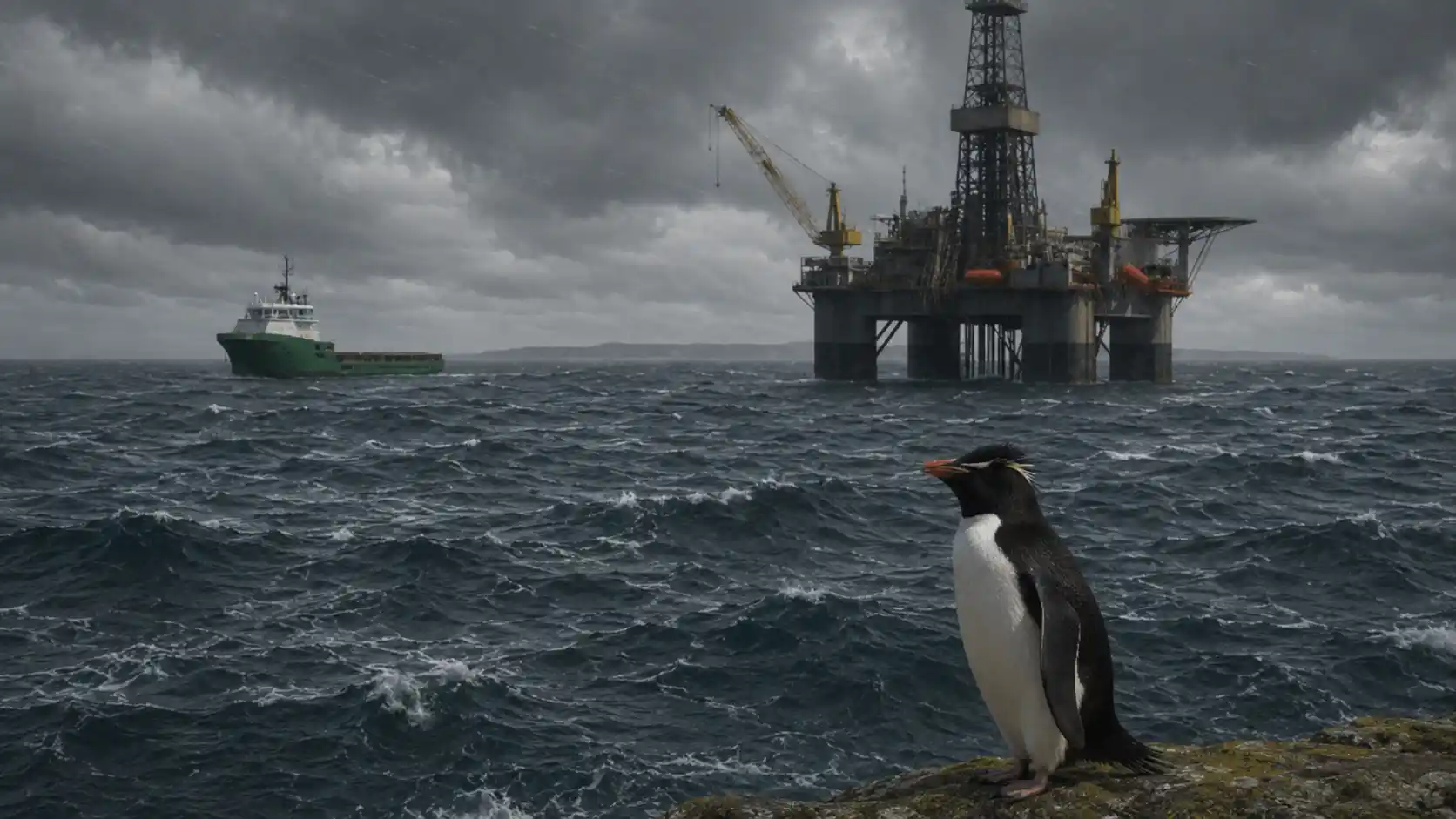
Sea Lion now matters as a market-access and corporate-risk question as well as an offshore-development project.
Navitas Petroleum and Rockhopper Exploration have taken final investment decisions for Sea Lion. Navitas currently targets first oil in March 2028, with Phase 1 built around 11 subsea wells tied to a redeployed FPSO. Argentina rejects the licences as unauthorized under its claim to the Malvinas and surrounding maritime areas.
On September 4, 2026, Argentina published Decreto 868/2026. The decree does not create the underlying sanctions regime from scratch: Ley 26.659 already covers unauthorized hydrocarbon activity, direct or indirect participation and a broad range of commercial, financial, logistics, technical and advisory services. The new decree centralizes enforcement in the Foreign Ministry and requires compliance declarations and screening for RIGI applications and Argentine hydrocarbon permits, including direct and indirect participants.
The key question is no longer whether Argentina objects to Sea Lion, but how far it can translate that objection into practical costs for companies doing business on both sides.
For broader context, see Econosur’s oil and gas sector page, energy infrastructure coverage, Argentina RIGI energy execution analysis and Argentina insights.
Market analysis framework
Core market reading:
Sea Lion turns the Falklands/Malvinas dispute into an energy-infrastructure, compliance and investor-risk question. The September 2026 enforcement changes matter because Argentina is now tying the existing Ley 26.659 framework more directly to access to RIGI benefits and Argentine hydrocarbon permits.
What is the signal?
The signal is that Sea Lion is no longer a remote oil discovery waiting for the right cycle. The project has entered a sanctioned development phase. Navitas Petroleum describes Sea Lion as an offshore oil project north of the Falkland Islands, with Navitas holding 65 percent and Rockhopper Exploration holding the remaining 35 percent.
Current operator materials are more specific than the early-July reporting. Navitas now targets first oil in March 2028 and describes Phase 1 as 11 subsea wells tied to the redeployed Aoka Mizu FPSO. Rockhopper’s FID materials describe Phase 1 peak production at approximately 50,000 barrels per day, while its May 2026 operator update states that the Aoka Mizu FPSO serving the first two northern phases is planned with 55,000 barrels per day of production capacity. The two figures describe different project measures and should not be treated as contradictory.
For Econosur, the signal is not the sovereignty dispute itself. The signal is the collision between two energy narratives. Argentina is trying to convert Vaca Muerta into export dollars, fiscal stability and international investor confidence. Sea Lion creates another oil story in the South Atlantic, with its own fiscal logic and service chain.
Sea Lion has moved from discovery to development
Rockhopper discovered Sea Lion in 2010. For years, the project sat at the intersection of oil-price volatility, financing constraints, political risk and operational distance. The new phase is different because final investment decisions have been taken.
Rockhopper announced in December 2025 that its board had taken final investment decision for Phase 1 of the Sea Lion field. The company also stated that Navitas, the operator and majority partner, had taken FID for the project. First oil from Phase 1 is planned for 2028.
The Falkland Islands Government also noted final investment decisions for the Sea Lion development programme. Its Executive Council had considered and approved matters related to tax treatment, petroleum valuation, investor security and access to land required to support the project.
This administrative layer matters. Sea Lion is becoming more than an offshore reserve estimate. It now has a fiscal framework, investor-security discussions, project contracts and a first-oil timetable.
The execution case strengthened again in August 2026. Rockhopper reported on August 24 that Navitas had exercised an option to acquire a second FPSO, OSX-1, for approximately US$125 million before upgrade costs. Navitas estimates that the additional vessel could add a further 125,000 barrels per day of production capacity for later Sea Lion phases. The accelerated Central Development Area is currently envisaged as 38 wells across two phases, with a development-plan submission targeted for 2027 and first production from CDA Phase 1 targeted by the end of 2030.
Execution update · August 2026:
Sea Lion is no longer only a Phase 1 development story. The second-FPSO plan and accelerated Central Development Area increase the potential scale of the project and deepen the future contractor, financing, logistics and supplier footprint exposed to the South Atlantic dispute.
Why Argentina sees a strategic problem
Argentina rejects the Sea Lion development because it claims sovereignty over the Falkland Islands, South Georgia, the South Sandwich Islands and surrounding maritime areas. The Argentine Foreign Ministry has described the Sea Lion FID as an announcement by unlawful licensees acting without authorization from the competent Argentine authority.
The language is legal and diplomatic, but the underlying market problem is broader. Sea Lion creates a real economic platform in the disputed South Atlantic. If production starts, the Falkland Islands move closer to becoming an oil-producing territory with a larger tax base, larger infrastructure needs and stronger fiscal capacity.
The economic significance goes beyond the field itself. A producing offshore project creates counterparties, insurers, lenders, contractors, offtakers, maritime logistics and a government revenue stream. For Argentina, that makes the dispute increasingly connected to real corporate relationships and investment decisions rather than diplomatic language alone.
By September 2026, Argentina’s practical leverage had moved beyond diplomatic statements. The relevant question is now how the existing legal framework is administered and whether it creates measurable costs for companies connected to Sea Lion or seeking access to Argentine investment incentives and hydrocarbon rights.
Argentina’s response to Sea Lion is becoming more relevant for companies because the dispute is moving beyond diplomatic objections.
By linking enforcement to investment incentives, hydrocarbon permits and potentially the wider ownership and supplier chain, Buenos Aires is turning the Malvinas question into a market-access issue. The key question is no longer whether Argentina objects to Sea Lion, but how far it can translate that objection into practical costs for companies doing business on both sides.
September 2026: from diplomatic objection to market-access rules
On September 3, 2026, Argentina’s Presidency announced a regulatory decree and a proposed National Sovereignty Defense bill in response to Sea Lion. The political announcement matters as context, but the immediate commercial development is Decreto 868/2026, published in the Boletín Oficial on September 4 and scheduled to enter into force on September 5.
The decree builds on Ley 26.659 rather than replacing it. That law already prohibits, from Argentina’s legal perspective, unauthorized hydrocarbon activity on the continental shelf, direct or indirect participation in entities carrying out such activity or providing services to it, and commercial, financial, logistics, technical, consulting or advisory transactions supporting those developments. Administrative breaches can lead to disqualification for five to 20 years, with additional consequences under the law.
Decreto 868 changes the enforcement architecture. It designates the Foreign Ministry as the authority responsible for Ley 26.659, formalizes the administrative procedure and requires public bodies to report possible violations. Most important for companies, it introduces a direct compliance gate into two Argentine market-access routes.
| Argentina access route | September 2026 requirement | Commercial relevance |
|---|---|---|
| RIGI | A project vehicle must declare that it and persons with direct or indirect participation comply and will comply with Ley 26.659. The Ley 26.659 authority must be consulted before the RIGI application is resolved. | Sea Lion-related ownership or participation can become relevant to access to long-term tax, customs, FX and stability benefits for major Argentine investments. |
| Hydrocarbon permits and concessions | Applicants must declare that they and persons with direct or indirect participation do not and will not engage in conduct covered by Ley 26.659. | The dispute can enter screening for companies seeking permits, concessions, authorizations or licences under Argentina’s Hydrocarbons Law. |
| Supplier and transaction chain | Ley 26.659 already covers certain services and commercial, financial, logistics, technical, consulting and advisory transactions connected with unauthorized hydrocarbon activity. | The relevant exposure is broader than the field operator alone, although the practical reach depends on facts, corporate structure and enforcement. |
This does not mean that every company doing business in the Falkland Islands is automatically excluded from Argentina. The relevant legal test is narrower and fact-specific: the connection to hydrocarbon activities covered by Ley 26.659, the role of direct or indirect participants and the specific Argentine permit, concession or RIGI application at issue.
The Vaca Muerta connection
Sea Lion’s production scale is modest beside Vaca Muerta. Argentina’s shale formation is the larger energy story. Reuters reported in 2026 that Vaca Muerta had lifted Argentina’s energy surplus, with 2025 oil production from the formation reaching around 600,000 barrels per day.
YPF is also pushing a much larger oil-export platform. In May 2026, Reuters reported that YPF had registered a US$25 billion oil project under Argentina’s RIGI investment scheme. The project aims to produce 240,000 barrels of crude per day by 2032, with the output destined for export and expected annual export revenues around US$6 billion.
The strategic comparison is asymmetric. Vaca Muerta is Argentina’s large-volume export platform. Sea Lion is much smaller, but it creates an offshore development outside Argentine regulatory control in a maritime area claimed by Buenos Aires. Both matter for energy exports, infrastructure, foreign-currency generation and investor confidence, but through very different market structures.
This is where Sea Lion becomes relevant to existing Econosur coverage of oil and gas in South America, energy infrastructure and Argentina’s wider market structure. It also connects directly to previous analysis of Vaca Muerta gas corridors toward Brazil, Vaca Muerta, urea and fertilizer security and Añelo’s boomtown logic.
Vaca Muerta is Argentina’s scale story. Sea Lion is its South Atlantic cross-market risk question.
Company and service-chain angle
The company angle starts with Navitas and Rockhopper. Navitas is the operator and majority partner. Rockhopper is the long-term Falklands specialist that discovered Sea Lion and stayed with the asset through delay, litigation, financing constraints and partner changes.
The second layer is the offshore-service chain. Industry sources describe the project through FPSO, drilling, subsea, logistics and support-vessel contracts. That matters because political disputes become commercially real when service providers begin to mobilize equipment, crews, insurance and financing.
Offshore service firms will read Sea Lion differently from political observers. The key questions are operational: FPSO availability, drilling schedule, subsea installation, metocean conditions, supply routes, port support, risk insurance, project finance, environmental compliance and standby logistics.
The third layer is Argentina exposure. The September 2026 rules make this less speculative. Ley 26.659 already reaches beyond operators to certain direct and indirect participation and service relationships, while Decreto 868 inserts compliance screening into RIGI and hydrocarbon-permit procedures. Reuters reported on September 4 that Argentina had already disqualified Navitas and Rockhopper from operating in the country for 20 years and that the current enforcement debate could extend to shareholders, directors and suppliers. The commercial issue is therefore company-specific exposure, not nationality alone.
| Actor | Role in the Sea Lion / Argentina question | Why it matters |
|---|---|---|
| Navitas Petroleum | Operator and majority partner of Sea Lion. | The company carries the project-development narrative, investor communication and execution risk. |
| Rockhopper Exploration | Discovery company and 35 percent partner. | Its history shows how long the field remained blocked by finance, price cycles and geopolitics. |
| Falkland Islands Government | Approvals, fiscal framework and local infrastructure planning. | Sea Lion could shift the islands from fisheries-led revenue toward oil-funded public finance. |
| Argentina Foreign Ministry | Official legal and diplomatic objection. | The Argentine position creates a risk layer for companies, banks, insurers and service providers. |
| YPF | Main Argentine energy-policy and export platform through Vaca Muerta. | YPF gives the mainland counterpoint: scale, export dollars, infrastructure and Argentina’s energy promise. |
| Sea Lion suppliers, financiers and participants | Potentially relevant where their activity falls within Ley 26.659 or where a direct or indirect participant later seeks RIGI benefits or Argentine hydrocarbon rights. | The September 2026 framework makes ownership, contracting and service-chain mapping a practical compliance question rather than only a political-risk scenario. |
The investor-risk layer
The strongest article angle is now the difference between project execution risk and cross-market corporate risk. Navitas and Rockhopper maintain that the Sea Lion licences were legally granted by the Falkland Islands Government and supported by the United Kingdom. Argentina treats the same activity as unauthorized under its domestic legal framework.
For investors, the practical question is no longer limited to whether that legal conflict can stop Sea Lion. Reuters reported on September 4 that the operators did not expect an immediate material effect on the project timetable. The wider question is whether Argentina can impose costs elsewhere: on access to its domestic hydrocarbon market, RIGI benefits, corporate structures, suppliers, financing relationships or future transactions.
Those costs will not be uniform. A contractor with no Argentine exposure faces a different risk profile from a company seeking an Argentine concession, participating in a RIGI vehicle or depending on local approvals. Ownership and indirect participation also matter because Decreto 868 explicitly requires declarations covering persons or entities with direct or indirect stakes in applicants.
This creates a measurable research problem. The relevant work is to map the actual corporate and supplier chain, identify which entities have Argentina-facing assets or applications, and distinguish legal exposure from political signaling. The enforcement record, not rhetoric alone, will determine whether the new framework materially changes corporate behaviour.
Sea Lion is no longer only a disputed offshore prospect. FID, project approvals and a first-oil timetable make it a development file.
Decreto 868 links Ley 26.659 compliance to RIGI applications and Argentine hydrocarbon permits, including direct and indirect participants.
Operators, shareholders, suppliers, financiers and service providers do not face identical risk. Corporate structure, contract role and Argentina-facing applications determine the practical exposure.
Investor-risk reading:
Sea Lion is now a test of whether Argentina can convert a long-standing domestic sanctions framework into material cross-market costs without materially slowing the offshore project itself. That distinction matters for investors, suppliers and future South Atlantic projects.
What to watch next
The next phase will show where Argentina’s new enforcement architecture produces observable corporate effects and where it remains primarily a legal or political signal.
Sea Lion’s larger South Atlantic question
Sea Lion does not compete with Vaca Muerta on volume. Its relevance comes from a different channel: it creates a growing offshore development and supplier ecosystem in a disputed South Atlantic area outside Argentine regulatory control.
Argentina wants Vaca Muerta to support export growth, foreign-currency inflow and long-term energy relevance. Sea Lion adds a separate offshore project whose ownership, financing and service chain now intersect more directly with Argentina’s domestic enforcement and market-access rules.
The most useful reading is therefore commercial and geopolitical at the same time. Sea Lion is a project-execution story for Navitas and Rockhopper, a fiscal and infrastructure question for the Falkland Islands, a sovereignty and enforcement issue for Argentina, and a cross-market risk-pricing problem for investors and service firms.
That is why the project belongs inside a wider Econosur reading of Argentina’s market profile, Argentina insights, energy infrastructure and South America sector briefs. The field is offshore, but the market question reaches energy strategy, diplomacy, logistics and corporate exposure across the Southern Cone.
Three business questions that require deeper research
Which offshore contractors and service providers are commercially exposed as Sea Lion moves into execution?
Public project information identifies the development concept and some contracting categories. Commercial research is needed to map the actual supplier chain, package ownership, incumbent contractors, procurement timing and where replacement or specialist capacity may still be open.
Which Sea Lion-linked companies, participants and suppliers have meaningful exposure to Argentina’s RIGI or hydrocarbon-permit system?
The relevant issue is company-specific and structural: direct and indirect ownership, Argentine assets, concessions, RIGI vehicles, partnerships, supplier roles, financing needs and regulatory dependencies. The objective is to identify where Ley 26.659 could create a real market-access consequence rather than a generic political-risk label.
Which execution risks belong to Sea Lion itself, and which arise from Argentina-facing corporate exposure?
Sea Lion’s distance, FPSO strategy and offshore logistics create conventional project risks. The September 2026 enforcement changes add a different layer: screening, sanctions and market-access exposure for particular companies. Separating those risk categories is necessary before commercial decisions are made.
Where Published Information Stops
Public sources now establish Sea Lion’s ownership, FID status, March 2028 first-oil target, current Phase 1 well plan, the accelerated second-FPSO concept, Argentina’s legal objections, Ley 26.659 and the September 2026 RIGI and hydrocarbon-permit screening changes.
They do not provide a complete current contractor and supplier map, the ownership links of every relevant participant, package-level procurement calendars, supplier qualification status, financing and insurance terms, or evidence showing how Argentine authorities will apply the new framework to specific future RIGI applications, permits or service relationships.
Those gaps require targeted company, supplier, contractor and market research rather than another summary of published project data.
Sea Lion and South Atlantic energy research
Econosur can extend the public analysis with focused research for companies, investors and service providers evaluating Sea Lion, Argentina exposure and the wider South Atlantic energy environment.
This article uses primary legal and government sources, operator disclosures, company statements and independent secondary reporting. Project timelines, capacities and investment figures should be read as project-stage information and may change as financing, contracting, regulation and construction advance. Legal references describe the Argentine framework and are not legal advice.
- Boletín Oficial: Decreto 868/2026, published September 4, 2026; enforcement authority, administrative procedure, RIGI compliance declaration and hydrocarbon-permit screening under Ley 26.659.
- Argentina official legal database: updated text of Ley 26.659, including prohibited direct or indirect participation, service and transaction categories, and five-to-20-year administrative disqualification.
- Argentina Presidency: September 3, 2026 announcement of the regulatory decree and proposed National Sovereignty Defense bill in response to Sea Lion.
- Navitas Petroleum: current Sea Lion project page, 65 percent working interest, March 2028 first-oil target and 11-well Phase 1 development plan.
- Rockhopper Exploration: May 20, 2026 operator update distinguishing the 55,000 bpd Aoka Mizu FPSO capacity for the first two northern phases from the approximately 50,000 bpd Phase 1 peak-production figure used in FID materials.
- Rockhopper Exploration: September 4, 2026 operator response stating that the partnership considers its licences valid and does not expect the latest Argentine developments to have a material effect on the Sea Lion development timetable.
- Rockhopper Exploration: August 24, 2026 update on the second FPSO OSX-1, approximately US$125 million acquisition cost before upgrades, potential additional 125,000 bpd production capacity and the accelerated Central Development Area.
- Rockhopper Exploration: August 26, 2026 independent reserves and resources evaluation incorporating the accelerated Central Development Area.
- Rockhopper Exploration: final investment decision on Sea Lion Phase 1.
- Falkland Islands Government: official note on Sea Lion final investment decisions, tax treatment, petroleum valuation and investor-security matters.
- Argentina Foreign Ministry: official Argentine rejection of the Sea Lion final investment decision.
- Reuters: September 4, 2026 independent reporting on Argentina’s escalation, the existing 20-year disqualifications of Navitas and Rockhopper, potential shareholder and supplier exposure and the companies’ response.
- Offshore Engineer: Sea Lion development data and offshore-contracting context.
- Riviera Maritime Media: FPSO, drilling, subsea and support-vessel context for Sea Lion.
- Reuters: YPF’s US$25 billion RIGI oil project, 240,000 bpd export target by 2032 and projected annual export revenues.
- Reuters: Vaca Muerta production, Argentina’s energy surplus and the export-infrastructure role of VMOS.
- YPF Argentina LNG: official project timeline and development updates for Argentina’s LNG export platform.
Need a project-specific South Atlantic risk view?
Sea Lion is now an execution and cross-market compliance question involving offshore contractors, ownership structures, financing, logistics, RIGI exposure and Argentine hydrocarbon-market access.
Econosur can structure a focused research assignment around a company, supplier category, contractor group, logistics route, Argentina exposure or defined project-risk question.
Explore custom market analysisFAQ
What is the Sea Lion oil project?
Sea Lion is an offshore oil development north of the Falkland Islands. Navitas Petroleum is the operator with a 65 percent working interest, while Rockhopper Exploration holds 35 percent. First oil is currently planned for March 2028.
Why does Sea Lion matter for Argentina?
Sea Lion matters for Argentina because it creates a real offshore oil development in a disputed South Atlantic area claimed by Argentina as part of the Malvinas question. The project also overlaps with Argentina’s wider energy-export narrative around Vaca Muerta.
Who are the main companies behind Sea Lion?
The main companies are Navitas Petroleum and Rockhopper Exploration. Navitas is the operator and majority partner. Rockhopper discovered Sea Lion in 2010 and remains a minority partner in the development.
How large is Sea Lion’s first phase?
Sea Lion Phase 1 is planned around 11 subsea wells tied to the redeployed Aoka Mizu FPSO, with first oil targeted for March 2028. Rockhopper describes Phase 1 peak production at about 50,000 barrels per day, while the FPSO serving the first two northern phases is planned with 55,000 barrels per day of production capacity.
How does Vaca Muerta connect to the Sea Lion story?
Vaca Muerta is Argentina’s central energy-export platform. Sea Lion creates a parallel South Atlantic oil development outside Argentine regulatory control, while Argentina’s September 2026 rules make dual exposure to Sea Lion-linked structures and the Argentine investment or hydrocarbon system more relevant for companies.
What should investors and service companies watch next?
Investors and service companies should watch drilling timelines, FPSO preparation, financing updates, enforcement under Ley 26.659, RIGI and hydrocarbon-permit screening, insurance conditions, logistics costs and whether Argentine measures create practical cross-market costs.
What changed in Argentina in September 2026?
On September 4, 2026, Argentina published Decreto 868/2026. The decree centralizes enforcement of Ley 26.659 in the Foreign Ministry and adds compliance declarations and screening linked to RIGI applications and Argentine hydrocarbon permits, including direct and indirect participants. It takes effect on September 5, 2026.