
Chile · Power Grid · Transmission · Storage · Mining · Data Centers
Chile’s Power Grid: Transmission, Storage and the Infrastructure Bottleneck
Chile can generate renewable electricity at scale. The harder task is moving it through a 3,100 km system while mining, desalination, storage, data centers and other new industrial loads reshape where electricity must flow.
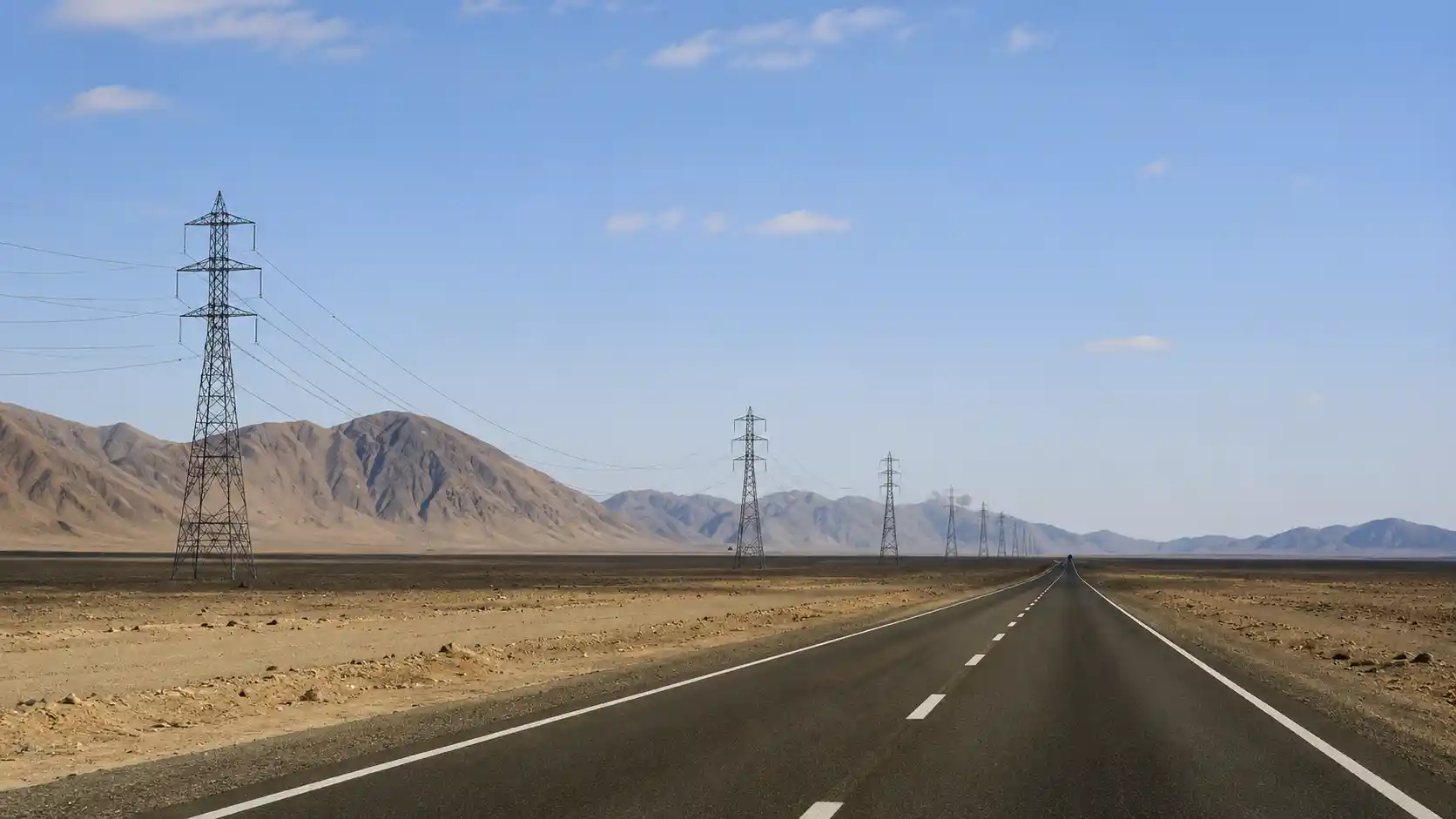
Chile’s energy transition is becoming a transmission challenge.
Solar and wind supplied about 38% of electricity injected into the national system in 2025, while batteries moved into industrial-scale deployment. The physical grid still has to move large volumes of electricity between northern generation zones, central consumption centres and mining regions whose demand continues to grow.
The 2026 transmission proposal from the Coordinador Eléctrico Nacional identifies likely congestion across northern, central and southern corridors. It also projects daytime marginal-cost separation between the north and centre, with the new Kimal–Lo Aguirre HVDC link expected to reduce that separation.
Kimal–Lo Aguirre is therefore a major infrastructure response, but it is not the end of Chile’s grid build-out. The project adds up to 3,000 MW of north-centre transfer capacity across approximately 1,346 km, while the planning system is already identifying the next constraints around transformers, 220 kV and 500 kV corridors, regional demand and future renewable growth.
Data centers now add another high-load demand category. In May 2026, the Comisión Nacional de Energía warned that electricity-infrastructure expansion was not keeping pace with data-center power demand, reinforcing the same central point: generation potential alone is not enough when grid connection and delivery infrastructure lag behind new loads.
By late September, the operating agenda had also moved from planning into new technical and regulatory work. On September 21, the Coordinador, ENGIE Chile and Huawei carried out Chile’s first field pilot of Grid Forming technology at BESS Los Loros. The same day, the CNE joined the launch of a participatory process for a broader electricity-network reform, with a bill planned for 2027. On September 22, the CNE opened a tender for a new multinodal and multi-reservoir Plexos database to model storage, transmission constraints, flexibility and other system conditions in greater detail.
The commercial bottleneck is moving toward the infrastructure that makes electricity usable: transmission lines, substations, transformers, converter stations, control systems, storage and grid-stability technology.
That shift matters for investors and suppliers because generation growth does not automatically create the same opportunity as grid expansion. The relevant buyers, procurement routes, technologies and project timelines are different.
Chile’s transmission build-out remains in active procurement. On September 4, the Coordinador Eléctrico opened technical bids for 19 new transmission works representing more than US$500 million in investment; nine bidders submitted 48 technical offers, while two projects received no offers.
Kimal–Lo Aguirre remains materially advanced in physical execution. The latest public construction snapshot located for this update is still the September 9 report published on the project company’s website, citing Diario Financiero: 20.35% construction progress, US$422 million of CAPEX disbursed, 179 of 2,694 structures installed and 95% of the project budget awarded to suppliers. No newer public progress percentage located by September 28 is substituted for that figure.
On September 21, the Coordinador, ENGIE Chile and Huawei carried out the first field pilot of Grid Forming technology at BESS Los Loros in Atacama. The tests used Power Block No. 1 with Huawei power-conversion equipment enabled for Grid Forming operation through a firmware update. The objective is to generate practical evidence for future verification criteria under real operating conditions.
The institutional agenda also widened. On September 21, the CNE joined the launch of a participatory process for a reform of Chile’s transmission and distribution networks, supported technically by the World Bank and intended to inform a bill planned for 2027. On September 22, the CNE opened a tender for a new multinodal and multi-reservoir Plexos database designed to model renewable variability, storage, transmission constraints, operational flexibility and complementary services in greater detail.
The 25F Blackout Turned Grid Resilience Into a National Issue
On 25 February 2025, Chile suffered a massive power interruption from Arica to Los Lagos. The initial event involved the disconnection of the 2×500 kV Nueva Maitencillo–Nueva Pan de Azúcar line, owned by Interchile, in the Norte Chico. The outage ultimately affected 98.5% of customers across that large part of the country.
Later investigations assigned responsibilities across several actors and showed that the event was more complex than the failure of one physical line. Protection systems, operational responses and system-defence performance all mattered in the way the disturbance propagated through the national grid.
The episode matters commercially because Chile’s electricity system is becoming more complex at the same time that the economy depends on it more heavily. Variable renewables, battery systems, large mining loads, desalination, new electronics-based resources and long-distance transmission all increase the value of monitoring, protection, control and system stability.
“Chile’s grid challenge is no longer measured only in kilometres of line. Resilience increasingly depends on how transmission, protection, storage and system control work together.”
One National Grid Has to Span 3,100 Kilometres
Chile’s Sistema Eléctrico Nacional was created in 2017 when the former northern SING and central-southern SIC systems were interconnected. The result is a single electricity system extending roughly 3,100 km from Arica to Chiloé.
That geography creates a structural planning problem. Some of the country’s strongest solar resources sit in the north, while the Metropolitan Region concentrates a large share of regulated consumers and industry. Northern Chile also contains major mining loads, desalination plants and future industrial demand that can consume electricity close to where renewable generation is produced.
The Coordinador’s 2026 planning assumptions project significant long-term demand growth in Antofagasta, driven by mining projects, desalination and potential green-hydrogen development. The same planning framework also expects continued high consumption in the Metropolitan Region.
Solar, wind, copper mining, desalination and possible hydrogen loads all compete for network capacity around northern substations and high-voltage corridors.
Santiago and the central zone remain major demand centres, making long-distance transfer capacity a core part of electricity-market integration.
The Bottleneck Shows Up in Congestion and Regional Price Separation
Chile’s grid constraint is visible in more than renewable curtailment. The Coordinador’s final 2026 transmission proposal models high probabilities of daytime congestion in several 500 kV and 220 kV corridors in the north and projects additional constraints in the centre and south.
The same report identifies a probable daytime separation in marginal electricity costs between northern and central parts of the market. The Kimal–Lo Aguirre HVDC link is expected to reduce that north-centre separation. In higher-demand long-term scenarios, however, spot-price separation can increase again as electricity demand, renewable output and interregional transmission needs continue to change.
Price separation matters because it is the market expression of a physical network constraint. Cheap renewable generation has less system-wide value when it cannot move to the place where demand is highest.
Transmission capacity affects both engineering and market economics. A congested corridor can separate regional marginal costs, change the value of generation and storage, and influence where future industrial loads become attractive.
Data Centers Are Becoming a New Grid-Planning Load
Chile’s data-center expansion is no longer only a digital-infrastructure question. It is becoming part of electricity planning. In May 2026, Danilo Zurita of the Comisión Nacional de Energía warned that expansion of the electricity infrastructure was not advancing at the same pace as the energy demand associated with data centers. The result, according to the CNE, is a more reactive planning position for projects that require large loads on shorter development timelines.
The same pressure is visible in metropolitan reinforcement. The Nueva Subestación Providencia project, which entered construction in May 2026 with investment of roughly US$70 million and planned operation in 2028, is intended to strengthen supply in high-demand Santiago districts. The CNE explicitly links future consumption growth there to electromobility, urban development, data centers and wider service electrification.
This does not mean data centers are replacing mining as the central grid driver. It means Chile now has another class of large, location-sensitive electricity demand competing for connection capacity and timely reinforcement. The environmental side has also become more formalised: the Servicio de Evaluación Ambiental’s dedicated data-center criterion has been mandatory for relevant projects entering the SEIA since February 25, 2026, covering project components, impacts and the conditions under which projects must enter environmental assessment.
Econosur’s seven-market AI data-center site-selection analysis compares Chile with Brazil, Argentina, Uruguay, Paraguay, Colombia and Peru through deliverable power, grid access, fiber, cooling, land, regulation and project execution. The companion analysis Why AI’s Cost Problem Could Reshape Data Center Investment in South America compares how the economic power-and-grid problem differs across five core South American markets.
For Chile, cheap renewable generation is not a complete data-center proposition. The commercially relevant unit is the full system: generation, transmission, substations, cooling, water, fiber, permitting, financing and the ability to connect a large load on schedule.
Batteries Solve a Different Part of the Problem
Chile is already developing battery storage at industrial scale. In a May 2026 presentation to the Senate, the Coordinador reported that the national system had 2,283 MW of BESS operating as of March 2026, representing 9,346 MWh of manageable energy. The same presentation projected total operating BESS capacity of about 5,081 MW and 18,643 MWh by the end of 2026.
Storage addresses the time dimension of the electricity problem. Batteries can absorb solar electricity during low-demand hours and release it later. They can also provide system services and increasingly contribute to grid stability through technologies such as Grid Forming.
That Grid Forming role moved from guidance into field testing in September. On September 21, the Coordinador, ENGIE Chile and Huawei completed the first pilot tests under real operating conditions at BESS Los Loros in Atacama. The tests are intended to identify practical implementation challenges and generate technical evidence for future verification criteria. For suppliers, this is relevant because storage procurement is increasingly expanding beyond energy capacity toward inverter behaviour, controls, firmware, testing and compliance with system-stability requirements.
Transmission addresses the geographic dimension. Large renewable surpluses in one region still require sufficient network capacity when electricity needs to move hundreds or more than a thousand kilometres to another region.
Econosur examines the storage layer separately in Chile’s Battery Boom Is a Grid Bottleneck Story. The two markets overlap, but they create different engineering packages and different investment timelines.
BESS can absorb excess renewable output, deliver it later and provide operating services such as fast response and Grid Forming capability.
HVDC and HVAC lines, substations and transformers move bulk electricity between generation zones, industrial loads and population centres.
Kimal–Lo Aguirre Is the Flagship Transmission Project
Kimal–Lo Aguirre is Chile’s first high-voltage direct-current transmission project. The current project design covers approximately 1,346 km between the Kimal area in Antofagasta and Lo Aguirre in the Santiago metropolitan area, with capacity to move up to 3,000 MW.
The project uses two converter stations to connect the HVDC link with the alternating-current network at each end. HVDC is particularly suited to moving large blocks of electricity over long distances and gives Chile a new technical tool for linking northern renewable generation with central demand.
The environmental approval became effective in 2025 and works moved into construction during 2026. In June, the Committee of Ministers maintained the favourable environmental qualification after reviewing outstanding appeals. The latest public construction snapshot located for this update remains the September 9 report: construction progress at 20.35%, US$422 million of CAPEX disbursed, 179 of 2,694 transmission structures installed and 95% of the project budget awarded to suppliers. The remaining permitting workload continues to affect how quickly new construction fronts can be opened.
The execution rights were awarded in 2021 to Consorcio Yallique, which at the time comprised ISA Inversiones Chile, Transelec and China Southern Power Grid International. The project illustrates Chile’s core transmission model: public planning identifies the infrastructure need, while private and international capital execute and operate the asset under the regulated framework.
| Kimal–Lo Aguirre element | Current position | Why it matters |
|---|---|---|
| Technology | First HVDC transmission line in Chile | Introduces long-distance direct-current transfer at national scale. |
| Route | Approximately 1,346 km | Connects the Antofagasta generation zone with the Santiago area. |
| Capacity | Up to 3,000 MW | Creates a large new north-centre transfer corridor. |
| Project status | Under construction; latest public progress located is 20.35% on September 9, 2026; planned commissioning in 2029 | The project is in physical execution. Current progress reporting also shows sector permitting remains relevant to opening additional work fronts. |
Kimal Does Not End the Expansion Cycle
The Coordinador’s own 2026 planning analysis already models transmission constraints that remain or reappear after Kimal enters the system.
| Area | Planning signal | Status of the statement |
|---|---|---|
| Lagunas–Kimal | High probabilities of daytime congestion are projected. In the high-demand scenario, the Kimal 500/220 kV transformation could exceed 40% of annual daytime hours in congestion from 2034. | Long-term planning projection |
| Nueva Cardones–Nueva Pan de Azúcar | Kimal is projected to mitigate congestion temporarily, with constraints returning as photovoltaic generation expands. | Long-term planning projection |
| Polpaico / Lo Aguirre / Alto Jahuel | 500/220 kV transformations are projected to show congestion above 30% from 2036 in the planning scenarios. | Long-term planning projection |
| South: Nueva Pichirropulli–Rahue and Puerto Montt area | The Coordinador identifies possible future congestion as wind, storage and electrification increase southern flows. | Long-term planning projection |
These are planning scenarios, not current measured congestion for every corridor. Their value is forward-looking: the system operator is already showing where another round of substations, transformers, line reinforcements and control equipment may be needed.
The PET2026 proposal recommends twelve national transmission works with a total referential investment value of about US$343 million: two new works and ten expansions. In the north, the proposal includes new 750 MVA 500/220 kV autotransformer banks at Nueva Lagunas, Kimal and Jadresic, together with higher capacity on the Crucero–Kimal 220 kV lines.
The procurement market is already moving beyond those planning documents. On September 4, 2026, the Coordinador opened technical bids for 19 new transmission works worth more than US$500 million. Nine bidders submitted 48 technical offers. Two projects received no bids, a reminder that an approved transmission need does not automatically guarantee competitive execution capacity.
The market is broader than one headline HVDC line. The planning documents point to recurring demand for transformers, substations, line uprating, protection, control, reactive-power equipment, power-flow management and engineering around existing assets.
Chile Plans the Grid Publicly and Builds It Through Multiple Private Actors
Chile’s transmission market combines central planning with private execution. Under Article 91 of the electricity law, the Coordinador Eléctrico Nacional sends annual expansion proposals to the Comisión Nacional de Energía. The CNE then conducts the formal transmission-planning process and issues the corresponding technical plan.
The 2025 annual transmission plan was approved by the CNE on 31 March 2026, while the 2026 process is already under way. This rolling structure means grid investment is not a one-off project cycle. New constraints, demand locations and technology assumptions feed into annual planning.
A broader regulatory review has now started as well. On September 21, the Ministry of Energy launched a participatory process for a future reform of Chile’s transmission and distribution networks. The CNE says the process will run through the end of 2026, with technical support from the World Bank, and is intended to provide the basis for a bill to be submitted to Congress in 2027. The reform is being framed around renewable integration, storage, electrification and the need for a more resilient and efficient network.
The planning toolset is also being updated. On September 22, the CNE opened a tender for development of a new multinodal and multi-reservoir Plexos database for regulatory simulations of the national system. The stated objective is to represent operational flexibility, uncertainty, transmission constraints, storage operation, complementary services and other technical restrictions in greater detail as the generation mix changes.
Law 21.721, promulgated in December 2024, added another important mechanism. Article 91 bis allows works classified as necessary and urgent for the system to be excluded from the normal planning sequence and handled through an accelerated route within defined limits.
The same legal reform also incorporates storage more explicitly into transmission rules and allows generation companies, under specified conditions, to propose and finance transmission expansions at their own risk to make greater use of their generation capacity.
Mining Makes the Transmission Question Larger
Chile’s power-grid problem cannot be separated from mining. COCHILCO projects electricity consumption by the copper-mining sector to rise from 27.6 TWh in 2025 to 33.2 TWh in 2034, an increase of 20.2%. Copper production is projected to rise by only 8.3% over the same period.
Concentration remains the largest electricity-consuming process. A second structural driver is seawater use. Desalination and especially the pumping of water from the Pacific coast to high-altitude mines add electricity demand to regions that are already central to renewable generation and transmission planning.
This is why Econosur treats seawater infrastructure as part of the energy system rather than as a separate utility topic. Projects such as Codelco’s northern desalination system combine reverse osmosis, long pipelines, pumping stations and high-voltage power in one operating chain.
The related Codelco company insight shows how a large mining operator connects production continuity, water infrastructure and capital investment. The wider South America copper analysis places these infrastructure requirements inside the regional supplier market.
Lower ore grades and processing requirements keep concentration at the centre of mining electricity consumption.
Water treatment and high-elevation pumping add new electricity loads in northern mining regions.
Hydrogen, electrification and other industrial projects can change where and when the transmission system is used.
Where the Supplier Market Sits
The transmission opportunity is distributed across equipment, engineering, digital systems and long-term operation. The relevant procurement point depends on whether the asset is a regulated new line, an expansion of an existing substation, a private connection project or a storage installation. The September 4 tender round, with 48 technical offers across 19 new works worth more than US$500 million, provides a current example of planning needs converting into an active procurement market.
| Supplier area | Grid need | Commercial relevance |
|---|---|---|
| HVDC equipment | Converter stations, valves, transformers, control and protection | Large long-distance projects such as Kimal–Lo Aguirre create specialized international packages. |
| Substations and transformers | 500/220 kV and zonal transformation capacity | PET2026 identifies additional autotransformer and substation needs across several regions. |
| Line reinforcement | Higher thermal capacity, uprating and new corridors | Existing lines can require reinforcement before entirely new corridors are justified. |
| Protection and control | System defence, relays, communications, automation and monitoring | The post-25F security agenda raises the value of operational reliability and protection performance. |
| Storage and Grid Forming | Fast response, energy shifting, inverter behaviour and system-stability support | Chile is moving Grid Forming from technical guidance into field testing, widening the supplier requirement beyond battery energy capacity alone. |
| Mining connections | Dedicated lines, substations, pumping loads and project-specific access | Mining and desalination create large industrial loads outside the main urban demand centres. |
1. Where is Chile’s next transmission investment cycle likely to emerge after Kimal–Lo Aguirre?
Kimal is a major north–centre reinforcement, but Chile’s 2026 planning process already identifies constraints that remain or reappear elsewhere in the system. The next investment cycle is therefore more likely to emerge through a sequence of corridor reinforcements, substations, transformer capacity, regional transmission works and project-specific connections than through one single successor megaproject. The strongest signals are the constraints that move from planning diagnosis into the formal CNE process and then into approved works.
2. Which parts of Chile’s grid expansion offer the most relevant opportunities for international suppliers?
The opportunity is broader than new transmission lines. Chile’s grid expansion creates demand for HVDC equipment, transformers, substations, protection and control systems, line uprating, Grid Forming technology, storage integration and mining-specific connections. For international suppliers, commercial relevance depends on the procurement route: regulated new lines, existing-owner expansions, private connection projects and storage installations have different buyers, qualification requirements and package structures.
3. What should investors watch to identify when a grid bottleneck becomes investable infrastructure?
A modeled constraint is not yet an investable project. The useful sequence is planning diagnosis → formal CNE process → project classification and approval → procurement structure → financing → construction. Chile’s rolling transmission-planning system, the accelerated route for necessary and urgent works under Article 91 bis, the emerging network-reform process and the growing role of storage create several pathways from system need to capital expenditure. Investors should therefore track institutional conversion, not congestion alone.
Research gap: Public documents can identify system constraints, proposed works and regulatory status. They usually do not show buyer priorities, supplier positioning, commercial qualification, procurement timing or which opportunities remain realistically accessible. Those questions require project-specific company research, primary interviews and market verification.
Chile’s power-grid story is increasingly a question of where new demand meets constrained infrastructure. Renewable generation, storage and large transmission projects are expanding at the same time as mining, desalination, electrification and data centers create additional large loads. That makes headline generation capacity less useful as a standalone indicator of investment attractiveness.
The September 21 Grid Forming field pilot and the new electricity-network reform process reinforce a second point: the bottleneck is not only physical capacity. Chile is also adapting the operating rules, verification methods and planning tools needed for a system with more inverter-based generation, storage and location-sensitive high-load demand.
The more relevant commercial distinction is between areas where electricity is abundant in the system and locations where firm connection capacity, substations, transmission reinforcement and project timing are actually available. Data centers make this distinction especially visible because their load can be large, continuous and highly sensitive to connection delays.
For international suppliers, Chile therefore should not be read as one broad transmission opportunity. The stronger approach is to follow the specific bottleneck as it moves from system diagnosis into approved works, procurement packages and construction. Kimal–Lo Aguirre is one large example, but the September 2026 tender round, new substations, Grid Forming tests and planning reforms show that the commercial opportunity is distributed across many smaller and technically distinct projects.
The decisive question is not whether Chile needs more infrastructure. It is which constraint has already moved far enough through planning, approval and procurement to become an addressable project.
Analytical Assessment
Chile’s renewable build-out has changed the economics of the electricity system. Generation capacity is increasingly abundant in some hours and locations, while the transmission system determines how much of that energy can reach industrial and urban demand.
Kimal–Lo Aguirre is the clearest symbol of this phase: a 1,346 km HVDC project designed to move up to 3 GW across the country. The 2026 planning documents already show that the next round of constraints will emerge around different substations, transformers and regional corridors.
This creates a long-duration infrastructure market. Battery storage, Grid Forming technology, grid-strength systems, transmission expansion, mining connections, water-related electricity demand and new digital loads all reinforce the need for continued investment in the network.
Data centers sharpen the same investment logic. They require large, reliable loads to be connected on development timelines that can be shorter than Chile’s transmission-planning and permitting cycle. That makes grid availability and reinforcement timing a site-selection variable, not merely an electricity-sector background condition.
The September network-reform process also shows that the market is not static. Chile is now reconsidering how transmission and distribution regulation should work as renewable generation, storage, electrification and new high-load demand change system requirements. For suppliers and investors, regulatory architecture and technical verification are becoming part of the opportunity alongside physical construction.
For suppliers, the useful question is where the next constraint moves procurement. Chile’s grid is becoming a sequence of project-specific engineering and operating markets rather than a single national transmission opportunity.
“Chile increasingly has the generation capacity. The commercial question is which infrastructure can move, stabilize and deliver that electricity where demand is growing.”
This analysis uses Chilean regulatory, system-operator, environmental and mining-sector sources. Forward-looking congestion figures are planning scenarios and should not be read as measured current congestion on every corridor. Status checked through September 28, 2026.
- Coordinador Eléctrico Nacional — Sistema Eléctrico Nacional
- Coordinador Eléctrico Nacional — 25 February 2025 system failure
- Ministerio de Energía — conclusion of SEC investigations into the 25F blackout
- Coordinador Eléctrico Nacional — Final Transmission Expansion Proposal 2026
- Comisión Nacional de Energía — Transmission Expansion Process 2025
- Comisión Nacional de Energía — Transmission Expansion Process 2026
- Biblioteca del Congreso Nacional — Law 21.721 on electric transmission
- Coordinador — 2025 solar, wind and storage system update
- Coordinador — Grid Forming verification guide, May 2026
- Conexión Kimal–Lo Aguirre — project scope and technical characteristics
- Ministerio de Energía — Kimal–Lo Aguirre construction milestone, February 2026
- SEA — Kimal–Lo Aguirre environmental status, June 2026
- Coordinador — Kimal–Lo Aguirre award to Consorcio Yallique
- COCHILCO — Copper-mining electricity demand projection 2025–2034
- Comisión Nacional de Energía — data-center electricity demand and grid-planning constraints, May 12, 2026
- Comisión Nacional de Energía — Nueva Subestación Providencia, May 18, 2026: approximately US$70 million project linked to rising metropolitan demand including data centers.
- Coordinador Eléctrico Nacional — Senate presentation on the SEN, May 2026: 2,283 MW of operating BESS as of March 2026 and 5,081 MW projected by year-end.
- Coordinador Eléctrico Nacional — transmission tender update, September 4, 2026: 19 new works, more than US$500 million, 48 technical bids from nine bidders.
- Coordinador Eléctrico Nacional — Grid Forming pilot at BESS Los Loros, September 21, 2026: first field pilot with ENGIE Chile and Huawei under real operating conditions.
- Comisión Nacional de Energía — launch of electricity-network reform process, September 21, 2026: participatory transmission and distribution reform process, with a bill planned for 2027 and technical support from the World Bank.
- Comisión Nacional de Energía — Plexos modelling tender, September 22, 2026: new multinodal and multi-reservoir database intended to improve representation of storage, transmission constraints, flexibility and complementary services.
- Servicio de Evaluación Ambiental — data-center evaluation criterion in force, February 25, 2026: formal SEIA guidance for data-center project components, impacts and entry conditions.
Secondary reporting is used for recent construction progress and supplier-execution detail where the primary planning record does not yet present the same current snapshot.
- Conexión Energía / Diario Financiero — Kimal–Lo Aguirre construction update, September 9, 2026: 20.35% construction progress, US$422 million of CAPEX disbursed, 179 structures installed and sector permits identified as an ongoing execution issue.
From public grid planning to commercial project evidence
Chile publishes unusually detailed information on transmission planning, system constraints and regulatory processes. That is the starting point, not the complete commercial picture. Public documents rarely show which buyers are prioritizing a package, how suppliers are positioned, what qualification barriers matter or when a technically identified need becomes an addressable opportunity.
Marcus A. Volz conducts project and company research for international B2B firms evaluating the Southern Cone and Mercosur. Research can combine primary interviews and supplier or competitor checks with project-status verification, market observation and analysis of procurement pathways.
Discuss a research questionFrequently Asked Questions
Why is transmission becoming a bottleneck in Chile?
Chile has added large volumes of solar and wind generation while electricity must travel through a long north-south system. Grid congestion, regional price separation, growing industrial demand and the time required to build new lines make transmission a central constraint.
What is Kimal–Lo Aguirre?
Kimal–Lo Aguirre is Chile’s first HVDC transmission line. The project is designed to carry up to 3,000 MW over approximately 1,346 km from Antofagasta toward the Santiago area.
Will Kimal–Lo Aguirre solve Chile’s grid congestion?
It should relieve an important north-centre constraint, but the Coordinador’s 2026 planning analysis projects additional congestion in northern, central and southern parts of the system over the longer term.
Can battery storage replace new transmission lines?
Battery storage can shift renewable electricity into higher-demand hours and provide grid services, but it does not eliminate the need to move large volumes of electricity between regions. Chile is developing storage and transmission in parallel.
Who plans transmission expansion in Chile?
The Coordinador Eléctrico Nacional develops annual expansion proposals and technical diagnoses, while the Comisión Nacional de Energía conducts the formal transmission-planning process under the electricity law. A broader participatory reform of Chile’s transmission and distribution rules was also launched in September 2026, with a bill planned for 2027.
Why does mining matter for Chile’s power grid?
Copper mining is a major electricity consumer and its demand is projected to grow. Concentration, desalination and seawater pumping add new loads in northern mining regions, increasing the importance of reliable transmission and substations.
Why are data centers becoming relevant to Chile’s power-grid planning?
The CNE has warned that expansion of the electricity infrastructure is not keeping pace with the power demand associated with data centers. These large digital loads add another location-sensitive demand category alongside mining, desalination, electrification and renewable integration. Chile’s dedicated environmental criterion for data-center projects has also been in force since February 25, 2026.
What changed with Grid Forming in September 2026?
On September 21, the Coordinador Eléctrico Nacional, ENGIE Chile and Huawei carried out the first field pilot of Grid Forming technology under real operating conditions at BESS Los Loros in Atacama. The tests are intended to provide practical evidence for future verification criteria and system-stability requirements.