
Argentina · Ports · Export Infrastructure · 2026
Argentina’s Ports: Where Investment Is Reshaping Export Infrastructure
Argentina’s export ports are being reshaped by distinct cargo systems: the Paraná grain corridor, Atlantic bulk and container terminals, and new oil export infrastructure. The question is which investments are becoming operational capacity — and which remain plans, tenders or construction projects.
 Econosur · Argentina
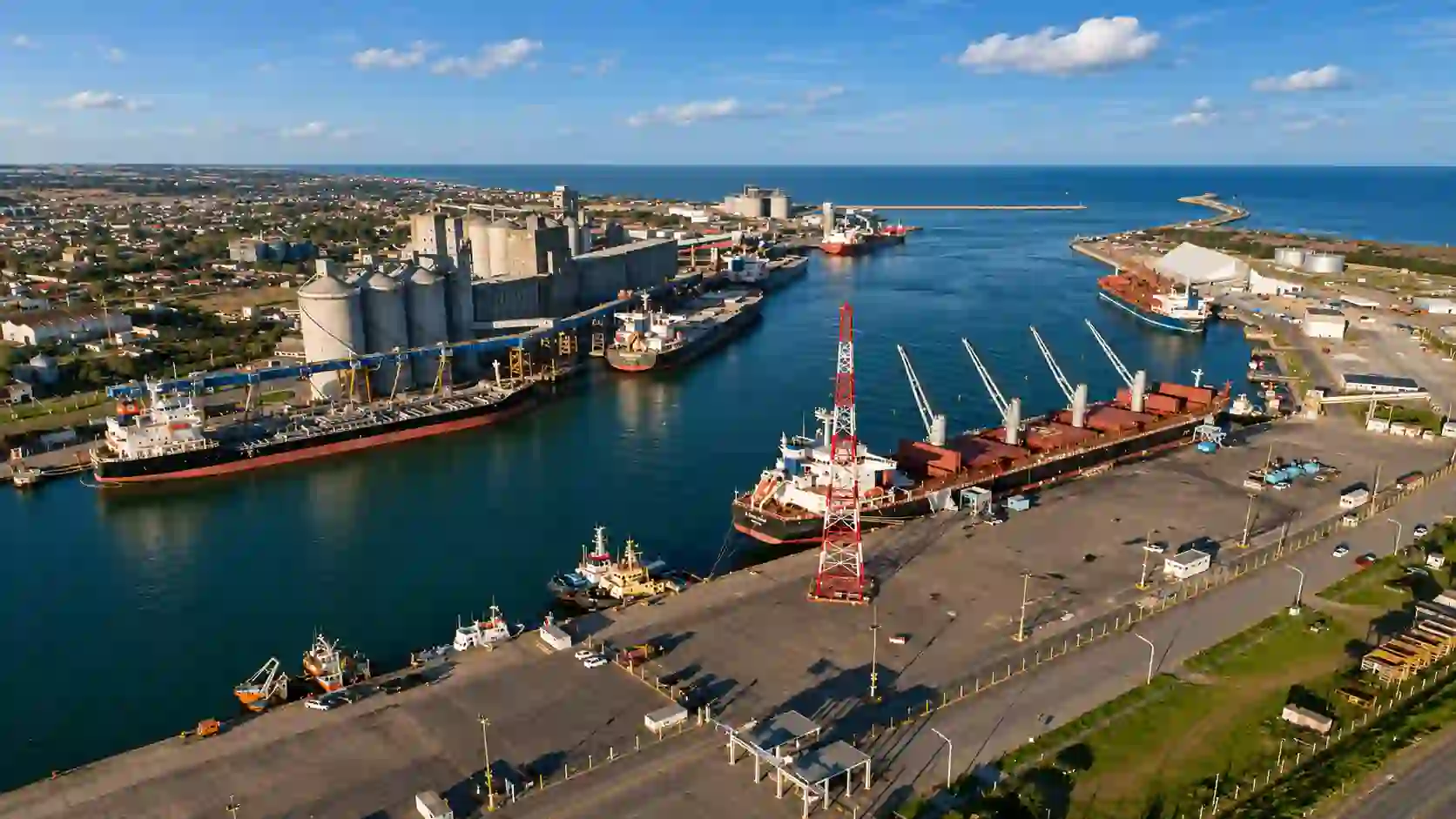
Argentina’s port investment is following different export economies, not one national modernisation model. Gran Rosario links the industrial processing of grains and oilseeds with a dense river-terminal system. Bahía Blanca and Quequén are upgrading maritime access and existing assets. Puerto Rosales and Punta Colorada are preparing different parts of an expanded Atlantic oil export chain. Dock Sud represents a separate container-handling investment cycle. [1] [5] [11] [15] [16]
The commercial distinction is between an investment announcement, an authorised project, a tender, an installed piece of equipment and a terminal already handling additional cargo. Those stages cannot be added together as if all represented new capacity. This review separates them using primary institutional and operator evidence available by 3 November 2026.
A federal survey shows demand — not completed investment
The Consejo Federal de Inversiones (CFI) examined 35 public ports in 11 provinces: 19 river ports and 16 seaports. In the September 2026 findings, 80% reported planned repairs, modernisation or infrastructure expansion, while 54% had an infrastructure masterplan. The sample describes the surveyed public port system, not all terminals in Argentina, including major private agro-export assets. [1] [2]
Reported needs range from quay rehabilitation and fenders to silos, yards, roadway access, cranes, reach stackers, grain-handling equipment, electrical systems and digital controls. These categories indicate potential industrial demand. They do not establish that a specific port has issued a tender or placed an order. The same survey found that 77% of ports with concessioned terminals had investment agreements intended to channel concessionaire funding into infrastructure. That percentage applies to this subgroup, not all 35 surveyed ports. [1]
A national figure for planned port works cannot be compared directly with a dollar sum of announced provincial projects, a construction milestone at one terminal, or tonnes of cargo already shipped. Each metric answers a different question. The relevant baseline must specify the terminal, cargo, reporting year, project status, financing and physical capacity.
Where the current projects sit in the export system
| Location | Export role | Documented stage | Key unresolved question |
|---|---|---|---|
| Gran Rosario / Timbúes | Grains, oilseed meals and oils; new multipurpose capacity | Established export operations; provincial investment announcements and a separate RIGI port project | Which commitments become built, qualified and operating terminals? |
| Vía Navegable Troncal | Shared inland shipping access to the Paraná port cluster | Concession awarded June, signed July and management transition begun September 2026 | What depths, reliability and charges materialise after the transition? |
| Bahía Blanca / Galván | Bulk, industrial and liquid cargo | Navigation dredging tender and berth / liquid-handling works reported | What works are contracted and when do they change ship operations? |
| Puerto Quequén | Grain exports | 2026 quay, electrical and access-road improvements reported | Do rehabilitation and inland connections improve throughput and reliability? |
| Puerto Rosales | Crude-oil loading | Two new loading arms installed at Rosa Negra in September 2026 | What is the commissioned loading performance of the expanded berth? |
| Punta Colorada (VMOS) | Future Vaca Muerta crude export system | Storage and offshore infrastructure under construction in October 2026 | When will the pipeline, tanks and marine loading system operate together? |
| Dock Sud / Exolgan | Containers | US$143m modernisation commenced in August 2025 | What is the verified current completion and new crane capacity? |
These projects are not directly substitutable. A grain berth cannot be counted as container capacity, a crude-loading buoy does not replace a navigable river channel, and a crane investment does not remove congestion on the access roads. The comparison therefore follows function and project status, not a single national investment ranking.
Gran Rosario: scale attracts investment but heightens dependence on the river
The Bolsa de Comercio de Rosario reports 75.7 million tonnes of grain, meal and oil shipments through Gran Rosario in 2025. Its study describes roughly 30 terminals along a 70-kilometre Paraná stretch between Timbúes and Arroyo Seco, including 18 handling agro-industrial export products. This is an observed 2025 cargo indicator, not a projection for 2026. [5]
The province of Santa Fe announced a US$521.9 million port-investment portfolio in January 2026. That total combines different public, private and concession-related commitments. It includes approximately US$276.9 million attributed to a RIGI-approved multipurpose port in Timbúes. Neither figure is proof that the entire amount had been disbursed or the resulting capacity commissioned. [6]
A separate development received provincial attention in October: Santa Fe awarded the long-idle Terminal I at Villa Constitución to the Southern Silica–Esesa consortium, with an estimated private investment of US$4.5 million to recover a riverfront site exceeding 33,000 m². This is an award and planned rehabilitation, not a statement that the terminal already has a new traffic record. [7]
La Nación also reported a proposed US$800 million port and oilseed-processing complex from Molinos Agro in Timbúes in May 2026. Its status as a preliminary development proposal must be kept separate from the approved RIGI multipurpose terminal and from Santa Fe’s January portfolio. Adding these announcements together would risk double-counting and presenting proposed capital as financed construction. [20]
For equipment and service companies, the distinction matters. A terminal expansion can create demand for mechanical handling, storage, belt conveyors, civil engineering, electrical systems and integration. The commercial entry point is the specific developer, the procurement package and its award stage — not the announced investment value alone.
The Vía Navegable Troncal is infrastructure shared by competing terminals
Port competitiveness on the Paraná depends on the navigable route as well as individual facilities. On 18 June 2026, Resolution 36/2026 awarded the Vía Navegable Troncal concession to Jan de Nul–Servimagnus. The government announced the signed agreement on 7 July, followed by a management transition in September. [8] [9] [10]
The government linked the transition to dredging, navigational technology and lower tolls, reporting a change from US$4.30 to US$3.80 in the published tariff. A quoted toll reduction is not the same thing as a demonstrated fall in an exporter’s full logistics bill. Total cost also reflects vessel draft, loading restrictions, waiting time, inland freight, handling charges and sailing schedules. [10]
For shipowners and exporters, the strongest evidence will be maintained channel depth, traffic reliability and effective charges over a reporting period. For suppliers, dredging equipment, bathymetry, signalling, monitoring and support services follow the concession’s technical requirements. Econosur’s Paraná–Paraguay waterway analysis covers the broader cross-border corridor; this article focuses on the Argentine investment interface.
Bahía Blanca and Quequén: modernising access and existing berths
Bahía Blanca’s port consortium published Tender 06-CGPBB/2026 for maintenance dredging of access channels and port manoeuvring areas, alongside a separate deepening component for the main access route. The published opening date was 31 August 2026. A tender notice establishes a procurement process; it does not by itself confirm a final construction contract, depth achieved or completion date. [11]
At Puerto Galván, industry reporting in September described refurbishment of liquid-cargo facilities, structural repairs, water supply infrastructure and additional marine loading arms. The combination reflects demand from established energy and industrial cargo operations, where safe liquid transfer and vessel access are just as important as nominal berth length. [18]
Puerto Quequén illustrates another type of investment: maintaining the operational value of a mature grain-export port. Its consortium reported concrete works at Muelle 3, earlier work at Muelle 1, electrical upgrades at Muelle 10 and replacement of road slabs on Avenida Almirante Brown. The authority stated that the works were financed from the port’s own operating resources. [12] [17]
Here the economic effect should be assessed through berth availability, interruption risk, truck access and operating cost rather than an assumption of large new greenfield capacity. Rail connections and hinterland freight also matter: Argentina’s freight-rail corridor analysis examines the inland side of this chain.
Two oil-export investments — Puerto Rosales and Punta Colorada
Puerto Rosales expands an existing crude-handling location. Terminal operator OTAMERICA reported on 28 September 2026 that its Rosa Negra project had completed the installation of two new loading arms for a third operating position at the new jetty. The equipment installation is a specific physical milestone. It does not by itself establish that the full berth has completed commissioning or quantify additional exports. [13]
Punta Colorada is a separate system. Vaca Muerta Oil Sur (VMOS) links Neuquén’s oil-producing region to new storage and marine loading infrastructure on the Río Negro coast. Provincial descriptions include six planned storage tanks of 120,000 m³ each and two offshore single-point mooring buoys for large tankers. The offshore connection involves approximately seven kilometres of subsea pipeline. Those are design and project figures, not observed shipping throughput. [14]
On 29 October 2026, the Río Negro government described ongoing work at the Punta Colorada tank and export terminal. El Cronista’s site report the same day provides additional construction context. The available evidence supports describing a substantial project under construction; it does not justify treating its planned export capacity as already in service. [15] [19]
Berth and loading equipment expansion at an established oil terminal. Verify commissioning and actual cargo handling after construction.
Integrated pipeline, tank farm, submarine connection and offshore loading. Verify interfaces and commissioning across the complete chain.
For an international supplier, these projects involve different buyers, packages and timeframes: pumps and valves, tank engineering, berth structures, loading arms, instrumentation, marine services and safety systems. Participation in one part of the chain does not imply access to another project’s procurement.
Dock Sud is a different capacity problem
Container terminals face a separate combination of vessel size, quay strength, crane reach, yard capacity and truck-gate performance. In August 2025, the Province of Buenos Aires announced the start of a US$143 million Exolgan investment at Dock Sud, involving quay works, widening of the channel in front of the berth and four new cranes. The project announcement indicated the goal of operating three ships simultaneously after completion, compared with two at the time. [16]
This is evidence of a project begun in 2025, not evidence that all the planned equipment was operational by November 2026. Its current completion status should be checked against new contractor or terminal disclosures. The national port authority’s container statistics provide a separate way to verify whether actual TEU throughput changes after commissioning. [4]
Who finances the assets — and what creates value?
The CFI survey’s financing data underline a structural feature of Argentina’s port system: public authorities, port consortia and private concessionaires do not all carry the same responsibility for infrastructure. Maintenance may be supported by port-generated revenues and provincial resources, while major capital projects often involve contractual investment commitments by terminal operators. In the survey, 77% of ports with concessioned terminals reported investment agreements. [1]
The economic test for each project is therefore different. A dredged channel may reduce vessel constraints for multiple terminals; a privately funded grain berth serves its own cargo system; and an oil-export pipeline terminal requires enough upstream production, storage, marine equipment and customers to run at a commercially useful rate.
- Demand: Which cargo and customers justify the capacity? Use tonnes, TEU, shipment frequency or contracted throughput rather than generic export-growth forecasts.
- Execution: Is the asset announced, permitted, awarded, under construction, commissioned or producing measured cargo?
- Interfaces: Can ships reach the berth, trucks and trains reach the gate, and power, storage and handling systems work together?
- Commercial access: Which operator or contractor controls the relevant procurement, and are supply packages still open?
A supplier mapping exercise should start with these stages. Machinery and technology demand can extend across dredging, cranes, conveyor systems, pumps, loading arms, substations, automation, safety equipment and digital port operations. The CFI survey documents broad categories of equipment demand, but it does not identify a live tender for every category. [1]
The useful way to read Argentina’s port investment cycle is through the cargo systems behind it. The Paraná is a dense agricultural and industrial corridor whose value depends on the interaction between terminals, processing plants and navigational conditions. The Atlantic is seeing both upgrades to existing berths and new facilities designed around expanding oil production.
These investments have different constraints. A grain exporter may be exposed to river draft, harvest concentration and inland transport. A crude exporter may be constrained by pipeline capacity, tank availability and loading reliability. A container terminal must coordinate crane technology, berth geometry and vessel schedules. Calling all of them “port modernisation” obscures what creates economic value.
The CFI survey demonstrates widespread planned work, while the individual projects show how uneven the transition from plans to operations can be. Some facilities have awarded contracts or installed equipment; others are early-stage proposals or still building critical interfaces. Project status is more informative than summing announced investment.
For international industrial and logistics companies, the most relevant question is not simply where money has been announced. It is where a specific operator has a funded requirement, a responsible contractor, a procurement schedule and a need that can realistically be supplied. That requires checking each port and project individually.
Econosur Research Services: Ports, Operators and Export Logistics
Econosur researches defined business questions involving South American infrastructure, industries, companies and supply chains. Port projects can be assessed as individual investments or as parts of a wider export corridor.
Ownership, concessions, cargo mix, operating facilities, rival terminals and documented expansion plans.
Permits, financing, tender status, contractors, construction evidence, commissioning targets and actual operating results.
Relevant operators and engineering firms, equipment requirements, qualification procedures and publicly identifiable purchasing structures.
Port access, inland transport, shipment constraints, cargo demand and competitor routes for a defined commodity or product.
Research can focus on a single terminal, a supplier segment or a cross-border logistics question. See Custom Market Analysis South America, Company Reports, and Logistics and Waterways in South America.
Scope: The CFI survey refers to 35 public ports and must not be treated as an inventory of every public and private Argentine terminal.
Measures: Investment plans and spending, tonnes, TEU, projected capacity and actual throughput are different metrics. Amounts from different projects are not added to construct a national total.
Status: A licence, concession, tender, construction milestone or installed component is not necessarily proof of commissioning or operational capacity. VMOS and specific terminal upgrades are labelled accordingly.
Commercial limits: The reviewed sources do not establish confidential purchasing decisions, current open vendor lists or quantified savings for every port or exporter. These require direct verification.
Primary and Secondary Sources
- Consejo Federal de Inversiones (CFI) — Plan de Competitividad Portuaria — federal survey results, September 2026: Primary institutional research: 35 public ports; repair and expansion plans, infrastructure masterplans, concessions and equipment needs.
- CFI — Port competitiveness programme: Official explanation of the survey's scope: 19 river and 16 seaports in 11 provinces.
- ANPyN — Non-containerised port cargo statistics: Official port-by-port cargo data; figures for 2026 remain provisional and subject to revision.
- ANPyN — Container cargo statistics: Separate statistical series, measured in TEU by port and quarter; 2026 is provisional.
- Bolsa de Comercio de Rosario — Gran Rosario agro-export terminals, 2025 volumes: Original commodity and logistics research reporting 75.7 million tonnes of grains, meals and oils shipped in 2025.
- Government of Santa Fe — Provincial port investment programme, 18 January 2026: Public and concession-related investment announcements totalling US$521.9 million, including a US$276.9 million Timbúes project.
- Government of Santa Fe — Villa Constitución Terminal I concession, 7 October 2026: Adjudication to Southern Silica and Esesa; approximately US$4.5 million announced and over 33,000 m² targeted for rehabilitation.
- Boletín Oficial / ANPyN — Resolution 36/2026, 18 June 2026: Official award of the Vía Navegable Troncal tender to Jan de Nul–Servimagnus.
- Government of Argentina — Vía Navegable Troncal concession agreement, 7 July 2026: Official record of the concession signing and terms announced at award.
- Government of Argentina — Start of private river-channel management, 10 September 2026: Reports transition into concession operation and announced toll change from US$4.30 to US$3.80.
- Consorcio de Gestión del Puerto de Bahía Blanca — Tender 06-CGPBB/2026: Official dredging procurement covering maintenance in multiple terminals and deepening of the main access channel.
- Consorcio de Gestión del Puerto de Quequén — 2026 civil works programme: Official reports on Muelle 3, Muelle 1, Muelle 10 electrical works and road-slab replacement.
- OTAMERICA — Rosa Negra terminal expansion, 28 September 2026: Operator reports installation of two loading arms for the new third operating position at Puerto Rosales.
- Government of Río Negro — VMOS offshore loading design, 2 September 2026: Two planned single-point mooring buoys and offshore pipeline concept; distinguish scheduled equipment arrival from installation.
- Government of Río Negro — VMOS site construction update, 29 October 2026: Reports ongoing construction at the Punta Colorada storage and export terminal.
- Province of Buenos Aires — Exolgan Dock Sud terminal project, 12 August 2025: US$143 million project launch: quay works, access widening and four planned cranes.
- ArgenPorts — Puerto Quequén works, 26 August 2026: Independent port-industry reporting, cross-checking construction and financing through operating revenues.
- ArgenPorts — Puerto Galván improvements, 30 September 2026: Industry reporting on marine loading arms, liquid-cargo berth repairs and terminal utilities.
- El Cronista — VMOS Punta Colorada construction report, 29 October 2026: On-site journalistic account of the oil terminal being built.
- La Nación — Molinos Agro Timbúes proposal, 11 May 2026: Reports a separate US$800 million port and oilseed-processing preliminary proposal, not completed investment.
- ArgenPorts — Bahía Blanca strategic plan, 13 May 2026: Port-sector reporting on the five-year programme, energy cargo and dredging.
Source method: Official records establish legal decisions, tender stages and government investment announcements; operators establish their own reported construction milestones; CFI and BCR provide original survey and cargo research. Journalistic reporting gives additional project context. All comparisons and the perspective section are Econosur’s analysis of that evidence.
Research an Argentine Port or Export Corridor
For a specific company, infrastructure project or supplier decision, Econosur can investigate project status, operator structures, competitive positions, purchasing systems and the practical logistics behind the published figures.
Explore custom market analysisFrequently Asked Questions
What is changing in Argentina’s port infrastructure?
The changes are not uniform. Gran Rosario combines agricultural exports and proposed multipurpose terminals; Bahía Blanca and Quequén are upgrading maritime access and existing facilities; Puerto Rosales and Punta Colorada are expanding the oil export chain; Dock Sud is investing in container facilities.
How many Argentine ports need modernisation?
A September 2026 CFI survey examined 35 public ports in 11 provinces. Eight in ten surveyed ports reported planned infrastructure repairs, modernisation or expansion. The sample excludes many privately operated facilities, and planned work is not completed construction.
What does the new Paraná navigation concession change?
ANPyN awarded the Vía Navegable Troncal concession to Jan de Nul–Servimagnus in June 2026; the agreement was signed in July and the transition began in September. Canal maintenance, depth, tolls and navigational services affect the export terminals using the route. Promised savings require operational verification.
What is the difference between Puerto Rosales and Punta Colorada?
Puerto Rosales expands the existing Atlantic oil-handling system near Bahía Blanca. Punta Colorada is the new Vaca Muerta Oil Sur storage and offshore-loading terminal on Río Negro's coast. They are distinct investment systems and their announcements cannot be summed as operational capacity.
Is the new Punta Colorada oil terminal operating?
The Río Negro government confirmed continuing construction at Punta Colorada on 29 October 2026. The reviewed sources do not establish full commercial operation or validated export throughput as of 3 November 2026.
Which port projects are most relevant for international suppliers?
Relevant categories include dredging and marine engineering, berth rehabilitation, grain and liquid-bulk handling, cranes, pumps, loading arms, instrumentation, electrical systems, tank construction, environmental services and logistics software. Opportunities depend on actual tender packages and procurement eligibility.