
Cono Sur · India · Trade and Market Access
Mercosur–India Trade Talks: Opportunities for Pharma, Agriculture and Industry
Existing trade flows, regulatory access and industrial interests explain where a broader agreement could matter—and what companies still need to verify.
 Econosur · Trade
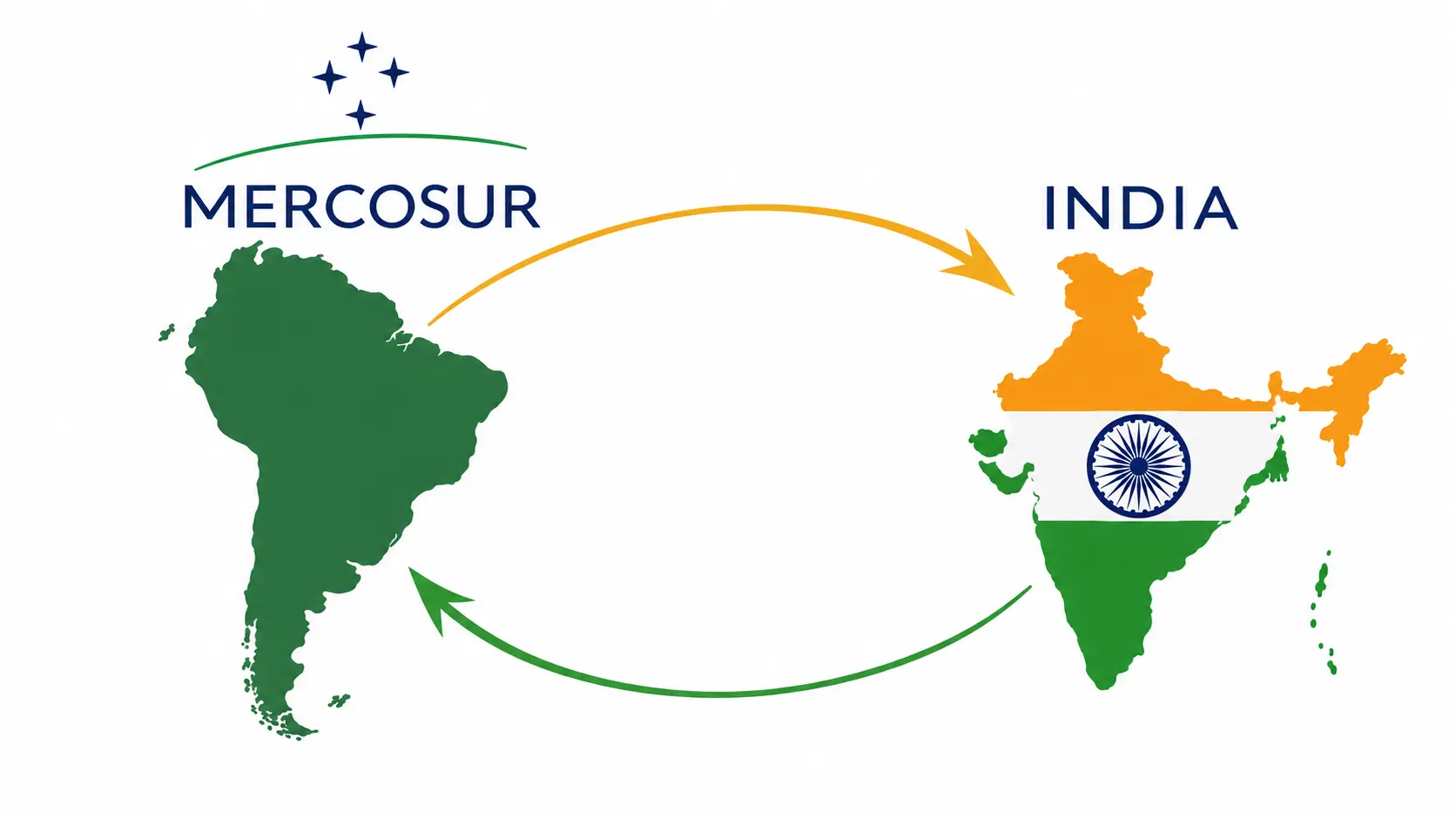
Mercosur and India launched negotiations to expand their preferential trade agreement on 14 September 2026. Commercial opportunities depend on the products eventually included and on practical access requirements. Agriculture, pharmaceuticals and industrial goods offer different starting points: existing demand, regulatory access and company-level investment decisions. [P1]
What the negotiations change
A preferential trade agreement, or PTA, grants specified concessions to selected products. The existing framework entered into force on 1 June 2009. Its schedules and rules of origin remain the starting point for checking a particular shipment. An expansion announcement alone does not establish new product coverage. [P5]
The September launch statement left the scope and structure to the negotiating terms of reference. On 1 October, Gulf News published IANS reporting that Brazil’s development minister said drafting work had been completed. This indicates progress on the framework; it does not provide an agreed tariff schedule or a confirmed comprehensive free-trade agreement. [P1] [S2]
Argentina and India agreed in August to seek to complete the Mercosur–India expansion negotiations within one year. This was an expressed negotiating objective, not a binding completion date. [P3]
For businesses, the next useful evidence will be published negotiating documents, product offers and implementation rules. A commercial forecast needs to identify which of these has actually been released.
Trade scale and country differences
India’s commerce ministry reports US$20.84 billion in India–Mercosur trade for 2025. It separately puts India–Brazil trade at US$15.07 billion in the 2025–26 fiscal year, with a bilateral goal of US$30 billion by 2030. Calendar-year and fiscal-year figures cannot be used interchangeably to calculate Brazil’s share. [P2]
Argentina reported US$5.472 billion in exports to India in 2025 and US$3.685 billion during January–July 2026. Uruguay’s 2024 exports to India were US$93 million, with wood and wood products accounting for 79%. These different periods illustrate country profiles; they are not a same-year ranking. [P3] [P7]
| Market | Starting point | Question for a company |
|---|---|---|
| Brazil | Industrial and pharmaceutical ties | Which products can gain both regulatory access and competitive distribution? |
| Argentina | Established agricultural demand and resource investment interests | Would a concession improve an existing trade flow or open a commercially viable new one? |
| Uruguay | Wood-dominated exports to India in the 2024 baseline | Can firms diversify beyond the existing product concentration? |
| Paraguay | Regional manufacturing and cross-border production | Would origin rules and industrial inputs support a defined production model? |
Paraguay’s relevance should be tested against actual production arrangements. Paraguay’s role in Mercosur and the Paraguayan automotive and maquila corridor provide the regional context for evaluating specific production opportunities.
Agriculture: vegetable oils and access beyond tariffs
Vegetable oils give the relationship an established commercial base. The Rosario Board of Trade, known by its Spanish abbreviation BCR, estimates that India imported approximately 3.5 million tonnes of vegetable oils from Argentina in 2025. It reports that India takes around 53% of Argentine soybean-oil exports and 35% of sunflower-oil exports. [P6]
This concentration creates a clear research question: could negotiated preferences improve the predictability of an existing trade flow? Any answer must consider the final concession, India’s domestic agricultural policy, competing origins, freight and the requirements attached to preference claims.
Market access also involves plant and animal health requirements. The August Argentine–Indian meeting identified sweet citrus fruit, walnuts, blueberries and lentils as Argentine priorities for phytosanitary authorisation. Reciprocal dairy access was announced for implementation within 30–45 days. That announcement alone does not establish that implementation was completed. [P3]
The wider production context is covered in Argentina’s soybean export industry and South American agriculture and food systems . For a new food product, research should distinguish eligibility to enter a market from demand, distribution and price competitiveness.
Pharma: regulatory access and established competitors
Brazil is already significant for Indian pharmaceutical exporters. BioSpectrum, reporting Pharmexcil data, ranked it second after the United States among India’s pharmaceutical export destinations in April–June 2026. This is a quarterly ranking, not an annual market-share estimate. [S1]
At the August India–Brazil dialogue, India pressed for more predictable pharmaceutical regulatory pathways. The official statement also cited a February 2026 memorandum between India’s Central Drugs Standard Control Organisation, CDSCO, and Brazil’s health regulator, ANVISA. Regulatory cooperation and tariff negotiations therefore need separate assessment. [P2]
A company still needs to evaluate product registration, quality documentation, the local commercial model and competing products. A lower import tariff would not, by itself, resolve these requirements. Nor does progress in Brazil establish approval in Argentina, Uruguay or Paraguay.
Existing participants such as Brazil’s Eurofarma , Uruguay-based Megalabs and Paraguay’s Laboratorios Lasca help frame the competitive research. The Econosur pharmaceutical industry overview connects these company cases to the regional market.
Industry and investment: identify the transaction
India and Brazil highlighted pharmaceuticals, chemicals, engineering goods and machinery in their August trade dialogue. The accompanying business delegation included Kirloskar, UPL and Aditya Birla. Their participation demonstrates engagement, while any resulting investment requires separate verification. [P2]
Argentina’s bilateral agenda included lithium, copper, uranium, oil and gas. These sectors featured in bilateral investment and cooperation discussions; the actual commercial prospects depend on the terms of individual transactions and project finance. [P3]
For industrial firms, the relevant unit of analysis is a specific transaction: a machinery sale, a distribution agreement, a processing partnership or a project investment. Each has different exposure to tariffs, origin rules, technical standards, finance and after-sales requirements.
Useful regional foundations include South American manufacturing and industrial cases , Argentina’s RIGI investment projects and South America’s critical minerals . A project announcement should be examined against ownership, permits, financing and execution milestones.
Electronic origin certificates: a separate implementation track
On 14 September, the parties signed an additional protocol intended to give electronically issued and signed certificates of origin the same legal validity as paper certificates. The announcement makes entry into force conditional on internal procedures and mutual notification. [P4]
For an exporter, the practical issue is whether customs authorities accept the electronic certificate and whether the goods satisfy the applicable origin rule. Digital documentation may simplify proof of origin; existing tariff coverage remains unchanged.
Why the parallel EU agreements matter
The EU–Mercosur interim trade agreement has applied provisionally since 1 May 2026. EU–India negotiations concluded in January 2026; the Commission’s September update still listed signature, approvals and Indian ratification among the necessary steps before entry into force. Their legal stages differ. [P9] [P8]
Analytical implication: wider access to the EU could change competitive conditions for both Mercosur and Indian companies. Effects on direct trade depend on product-specific schedules and implementation, with distinct legal stages across the agreements.
This provides an additional angle to Brazil’s economic relationships in Asia beyond China : India adds a distinct combination of agricultural demand, industrial exports and commercial partnerships.
The most useful way to assess these talks is through the differences between commercial activities. An Argentine oil processor already selling to India wants dependable access and competitive landed costs. An Indian pharmaceutical company needs a viable regulatory and distribution route. An industrial investor must establish whether the proposed local activity has customers, infrastructure and finance.
These questions also differ by country. Brazil’s scale, Argentina’s agricultural and resource base, Uruguay’s export specialisation and Paraguay’s regional production links require separate analysis. A Mercosur-wide headline can help identify the opportunity; it cannot establish the business case for a particular company.
The next stage of research should follow the product and buyer: what is traded today, which obstacle affects the transaction, and whether a negotiated change would materially alter costs or commercial access. That approach gives the agreement a measurable business meaning.
Econosur Research Services: Trade and Market Access
Econosur researches South American markets, companies and projects for defined business decisions. An India–Mercosur assignment can examine the South American side of a product opportunity, competitive position or investment assumption; specialist customs and regulatory questions require the relevant professional validation.
Assess demand, existing trade flows, competitors and the commercial significance of a potential tariff change.
Identify relevant manufacturers, buyers, distributors and potential partners, together with documented commercial contacts.
Examine ownership, permits, financing, execution status and the evidence behind proposed industrial opportunities.
Compare South American market conditions, logistics constraints, industry structures and practical routes to market.
Available formats include South America sector briefs , company reports and custom market analysis for South America .
Evidence cut-off: 23 October 2026. Trade statistics retain their source periods. Calendar years, fiscal years and partial-year totals are not combined.
Legal and commercial status: Negotiation launch, a drafted framework, signed protocols and operational preferences are different stages. This article does not claim that an expanded tariff schedule has entered into force.
Geography: The commercial examples focus on Brazil, Argentina, Uruguay and Paraguay. Current Mercosur membership does not by itself establish a country’s eligibility under an older external agreement; Bolivia’s position requires separate treaty and customs verification.
Interpretation: The country comparison, business questions and perspective are analytical judgments. Bilateral initiatives are not presented as commitments by the whole bloc. No sector-wide sales or investment forecast is made.
Primary and Secondary Sources
- [P1] India, Ministry of Commerce and Industry — Negotiation launch, 14 September 2026 : Official launch; the September statement says the negotiating terms of reference were being finalised.
- [P2] India, Ministry of Commerce and Industry — Eighth India–Brazil Trade Monitoring Mechanism, 31 August 2026 : Trade totals, sector priorities, pharmaceutical regulatory cooperation and business engagement. Figures retain their reported periods.
- [P3] Argentina, Ministry of Foreign Affairs — Argentina e India avanzan en el crecimiento de su comercio bilateral, 25 August 2026 : Original statement on the August meetings, Argentine exports, agricultural access priorities and the aim of completing the Mercosur–India expansion negotiations within one year.
- [P4] India, Ministry of Commerce and Industry — Electronic certificates of origin, 14 September 2026 : Current tariff-line coverage and signed additional protocol; entry into force requires domestic procedures and mutual notification.
- [P5] Brazil, Siscomex — Mercosul–Índia : Existing agreement, tariff schedules and origin rules. Page last updated 12 December 2023; used for the legal baseline, not the 2026 negotiation status.
- [P6] Bolsa de Comercio de Rosario — Argentina and India’s vegetable-oil trade, 16 January 2026 : Original sector analysis. The report gives 3.56 million tonnes in its introduction and 3.53 million in its body; this article uses approximately 3.5 million.
- [P7] Uruguay XXI — India country report, 2025 edition : Original institutional analysis based on customs data; pages 13–15 cover bilateral trade in 2024.
- [P8] European Commission — EU–India trade agreement, updated 11 September 2026 : Negotiations concluded; signature and approval steps remain necessary before entry into force.
- [P9] European Commission — EU–Mercosur agreement : Confirms provisional application of the interim trade agreement from 1 May 2026.
- [S1] BioSpectrum India — India’s pharma exports in Q1 FY27, 12 August 2026 : Trade-press reporting of Pharmexcil data; Brazil’s ranking refers specifically to April–June 2026.
- [S2] Gulf News / IANS — Brazil, India move to widen Mercosur trade pact, 1 October 2026 : Attributed ministerial comments on drafting the negotiating framework. Used as secondary reporting, not as proof of a published final mandate.
Government releases establish official statements and procedural milestones. BCR and Uruguay XXI provide original sector and country analysis. Secondary reporting adds attributed context; it does not replace the underlying legal instruments.
Assess a South American Market Opportunity
Define the product, country and business decision. Econosur can examine the companies, demand, competition and project evidence that determine whether an apparent trade opportunity deserves further work.
Discuss custom South America market researchFrequently Asked Questions
Is a new Mercosur–India trade agreement already in force?
The September 2026 announcement launched expansion negotiations. The existing preferential trade agreement remains the baseline; this analysis does not identify an implemented expanded tariff schedule.
How broad is the existing preferential agreement?
The current agreement offers concessions on 450 tariff lines on the Indian side and 452 on the Mercosur side. Product-level eligibility depends on the applicable schedule and origin requirements.
Are pharmaceutical approvals covered by tariff reductions?
A tariff concession does not itself grant pharmaceutical approval. Registration, quality requirements and the relevant national regulatory procedures must be assessed separately.
Are electronic certificates of origin already operational under the new protocol?
The protocol was signed on 14 September 2026. The announcement makes entry into force conditional on domestic procedures and mutual notification; signature alone does not confirm implementation.
Do the talks guarantee new investment in South America?
No investment outcome is established by the negotiation launch. Company decisions depend on demand, project status, finance, regulation and commercially workable local arrangements.