
Mercosur · Global Trade · Energy · Agriculture · Mining · Industry
How Global Shocks Are Reordering Mercosur’s Economic Map
Global fragmentation is not simply making Mercosur more important. It is changing what Mercosur is important for. Energy, critical minerals and selected agricultural exports are gaining strategic weight, while fertilizer-dependent agriculture and parts of the region’s automotive value chain are becoming more exposed.
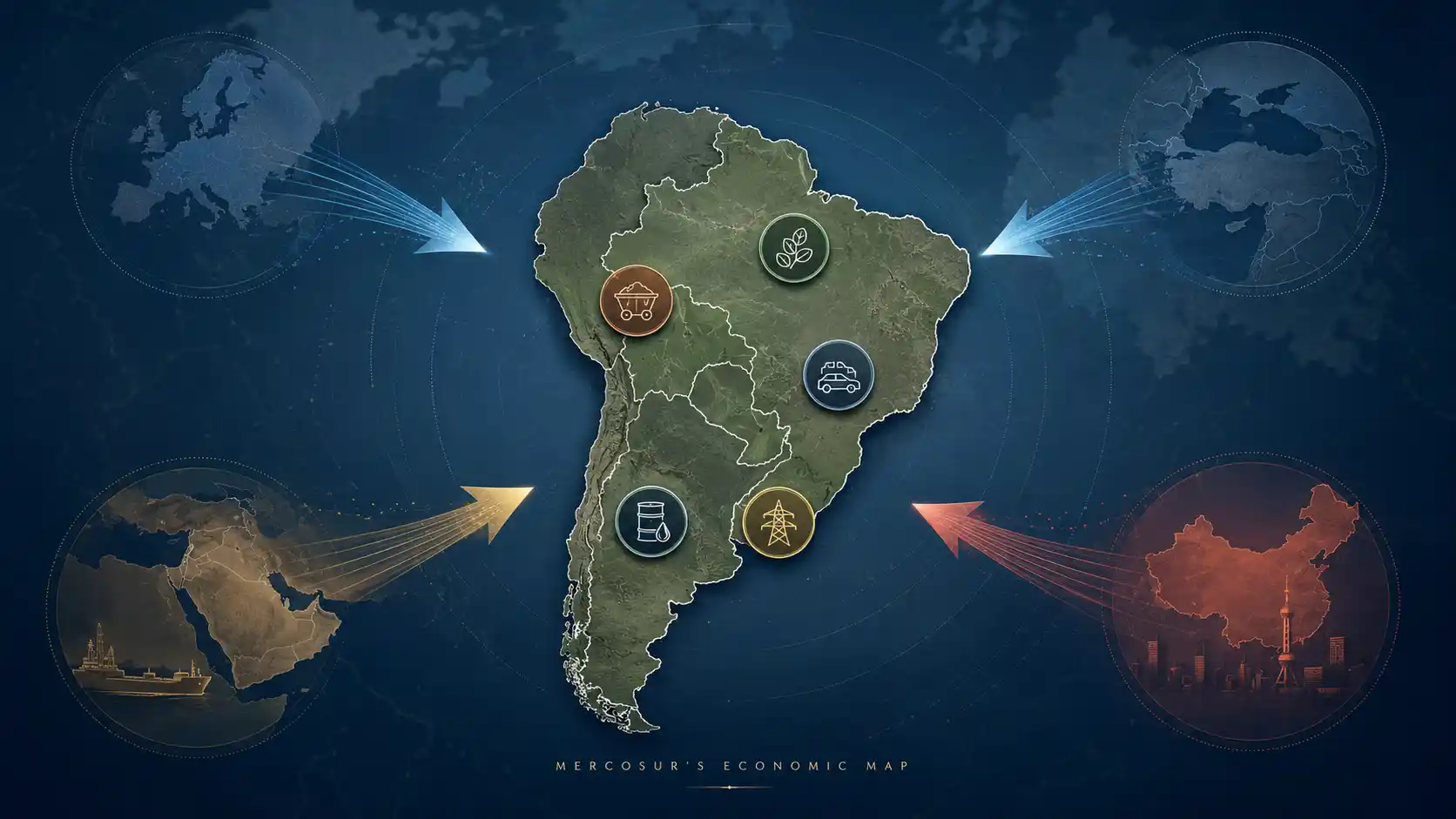
The strongest current change is not that Mercosur as a whole is becoming a geopolitical winner. The stronger finding is that global shocks are changing the relative value of its sectors.
The same disruption can produce opposite outcomes inside the same country. The Strait of Hormuz raises the strategic value of Brazilian and Argentine oil exports, but it also raises fertilizer, diesel, freight and insurance costs for agriculture. By 15 September, Kpler data cited by Reuters showed only four commodity vessels transiting Hormuz in a day, compared with a pre-war average of about 125, while a drone attack had also shut Saudi Arabia’s East-West pipeline — a major bypass route carrying roughly 4–5 million barrels per day. China strengthens Brazil’s soybean position while simultaneously increasing pressure on the region’s established automotive trade. Black Sea disruption is creating substitution opportunities for Argentine wheat and corn while fertilizer and shipping risk remain elevated.
At the same time, critical-mineral security increases the strategic weight of Argentine copper and lithium and Brazilian rare-earth, graphite and niobium resources. AI creates a different channel: electricity itself becomes a location asset, illustrated by Paraguay’s planned 10 MW sovereign AI computing project with Taiwan.
The result is a more fragmented Mercosur economic map: resource, energy and power advantages are gaining weight, while the bloc’s traditional industrial integration is facing stronger external pressure.
Core market reading: Global fragmentation is not simply making Mercosur more important. It is changing what Mercosur is important for. The commercial consequence is that country exposure must increasingly be read at sector level rather than through one macro narrative.
The Transmission Map: One Shock, Different Sector Outcomes
The useful analytical unit is not the geopolitical event itself. It is the transmission channel between that event and a Mercosur sector: commodity prices, trade diversion, input dependency, shipping risk, tariff access, technology demand or infrastructure scarcity.
| External force | Transmission channel | Mercosur sector effect | Current reading |
|---|---|---|---|
| Hormuz / Middle East | Oil, LNG, urea, ammonia, sulfur, freight and insurance | Oil exporters gain strategic value; agriculture absorbs higher input and transport risk | Mixed |
| Ukraine / Black Sea | Wheat availability, shipping risk, Russian fertilizer supply | Argentine wheat gains substitution demand; farm inputs remain exposed | Mixed |
| US-China fragmentation | Trade diversion, Chinese export capacity, industrial competition | Brazil soy gains; automotive integration faces pressure | Mixed |
| Critical-mineral security | Diversification away from concentrated processing and supply | Copper, lithium, rare earths, graphite and niobium gain strategic weight | Positive, execution-dependent |
| AI infrastructure boom | Demand for electricity, grids, computing and cooling | Abundant power becomes a new industrial location advantage | Positive for power-rich markets |
| EU-Mercosur trade opening | Lower tariffs and changing competitive access | New export opportunities, but also stronger European competition in industry | Sector-specific |
This framework connects with Econosur’s earlier work on Mercosur agriculture and external dependency, the South American car market, critical-mineral bargaining power and Argentina-Paraguay AI infrastructure.
Hormuz: Energy Becomes More Valuable — Agriculture More Exposed
The Strait of Hormuz is a useful example because it creates a positive and negative Mercosur channel at the same time. The disruption has intensified since this article was first published.
On 15 September, Reuters reported that only four commodity vessels had transited Hormuz the previous day, according to Kpler data, compared with a pre-war average of about 125 daily transits. The same disruption is now compounded by the temporary shutdown of Saudi Arabia’s East-West pipeline after drone attacks. That pipeline had been carrying roughly 4–5 million barrels per day toward the Red Sea, making it one of the main routes used to bypass Hormuz.
Brazil produced 4.498 million barrels of oil per day in July 2026, up 13.6% year on year, according to the ANP. Argentina reached a record 916,200 barrels per day, including 643,100 barrels per day from Vaca Muerta. Reuters reported on 3 September that importers in Asia were increasingly sourcing crude from the Americas, including Brazil and Argentina, as Middle Eastern flows remained disrupted and buyers accepted longer routes in exchange for supply diversification.
That improves the strategic position of Mercosur’s two largest oil producers. Argentina’s January–July trade data already show crude-oil export revenue rising by US$2.1 billion year on year, the largest product-level increase reported by the Foreign Ministry’s Centre for International Economy.
But Brazil’s agribusiness sees the opposite side of the same shock. The Agriculture Ministry states that more than 80% of fertilizers used in Brazil are imported. Soybeans, maize and sugar cane account for more than 73% of national fertilizer consumption. The World Bank reported that its fertilizer price index rose more than 12% in the first quarter of 2026 and projected an increase of more than 30% for the full year, with urea prices particularly exposed to Hormuz disruption.
Reuters reported in March that Brazilian urea prices had risen around 35% in two weeks, while farmers and importers began considering cheaper nitrogen alternatives. Diesel represents another channel: Brazil imports part of its diesel requirements, so higher oil prices also raise farming and inland-logistics costs.
Verified: Brazilian and Argentine oil output is rising; Asian buyers are diversifying crude supply toward the Americas; Brazil remains heavily dependent on imported fertilizer.
Verified: Hormuz disruption has raised urea, freight and marine-insurance costs. By mid-September, vessel traffic had fallen sharply and the temporary outage of Saudi Arabia’s East-West pipeline had reduced one of the main bypass options.
Not established: that every South American export corridor automatically gains competitiveness. Higher geopolitical shipping costs create a potential relative advantage, but corridor-specific benefits still require route-by-route analysis.
For deeper context, see Econosur’s Oil & Gas cluster, Vaca Muerta and fertilizer-security analysis and Vaca Muerta Pacific-route analysis.
Ukraine and the Black Sea: Argentina Gains a Grain Window, but Input Risk Remains
The Ukraine war creates another dual transmission channel. On 3 September, Reuters reported that Asian buyers had recently purchased at least 500,000 tonnes of Australian and Argentine wheat to replace delayed Russian and Ukrainian shipments after renewed attacks on Black Sea vessels and export infrastructure.
The substitution effect now extends beyond wheat. On 9 September, Reuters reported that Argentina was on course to export about 10 million tonnes of corn across August and September, a record for the two-month period. The shift is supported by disruptions to Ukrainian Black Sea exports, low water levels on the Danube, a European heat wave that reduced local crop availability and lower Brazilian export availability as domestic ethanol demand absorbs more corn.
Argentina’s official trade data already show wheat exports rising by US$683 million in January–July 2026 compared with the same period of 2025. These figures do not prove that the entire increase came from Black Sea disruption, but the current wheat and corn substitution flows show how Argentina can gain when traditional suppliers become less reliable.
The negative channel remains fertilizer. Russia is a major supplier of nitrogen fertilizers and accounts for a large share of global ammonium-nitrate trade. In March, Russia temporarily restricted some ammonium-nitrate exports while global supply was already tight. Brazil was among the affected export markets.
The lesson is important: a grain exporter can benefit from higher demand and still suffer from higher production costs. Looking only at export prices would miss the margin pressure created by fertilizers, fuel and logistics.
China Is Strengthening Brazil’s Soy Position — and Pressuring Mercosur’s Auto Axis
China is probably the clearest example of why the article cannot classify countries simply as winners or losers.
Soybeans: Brazil remains dominant, but China is still diversifying tactically
ANEC statistics show that China accounted for about 70% of Brazilian soybean exports from January through August 2026. Brazil shipped about 94.3 million tonnes of soybeans during the period, up from 88.1 million tonnes in the same eight months of 2025.
China’s reliance on Brazil remains structurally high, but the trade flow is not one-directional. Reuters reported on 10 September that Chinese state-linked buyers had purchased about 1 million tonnes of US soybeans ahead of a possible Xi Jinping visit to Washington. The better reading is therefore that Brazil remains China’s dominant supplier while China continues to use US purchases tactically when supply, price or diplomacy makes them attractive.
Automotive: the opposite effect
The automotive channel runs in the other direction. Anfavea’s September update shows that Brazilian vehicle exports fell 24.2% year on year from January through August 2026. The association said Argentina — still Brazil’s main external vehicle market — accounted for almost the entire decline. Anfavea also noted that four of Brazil’s ten best-selling models in August were from Chinese brands and that inventories remained heavily influenced by imported Chinese vehicles.
Argentina is experiencing parallel pressure. Reuters reported in May that cheaper imported parts, particularly from China, were weighing on local component manufacturers and that automotive-sector output had weakened sharply in early 2026.
This is more important than a generic statement that “Chinese cars are gaining market share.” The deeper Mercosur issue is that Chinese competition is beginning to erode one of the bloc’s most established intra-regional industrial trade relationships.
China can strengthen Brazil’s commodity position and weaken Brazil’s industrial position at the same time.
See also Econosur’s Agriculture & Food Systems, Automotive Market, Paraguay Soy Model and South America car-market analysis.
Critical Minerals: Strategic Weight Is Rising, but Execution Determines the Gain
The critical-minerals story is structurally different from oil or wheat. The main driver is not one short-term disruption. It is a longer shift toward supply-chain diversification, security and lower dependence on concentrated processing.
The IEA’s 2026 Global Critical Minerals Outlook identifies Latin America as a major supplier of copper, lithium and strategic minerals and estimates that the region currently refines only around one-fifth of the key energy minerals it mines, excluding lithium. The IEA argues that greater local processing could materially increase regional value capture.
Within Mercosur, this changes the strategic weight of Argentina and Brazil in different ways. Argentina’s strongest opportunity is in copper and lithium. Brazil has a broader mineral portfolio including rare earths, graphite, niobium, nickel and other strategic materials. Bolivia adds lithium potential but should not be reduced to a lithium narrative: its July 2026 export rebound was led by manufactured gold, zinc, silver, soy derivatives and beef, according to the national statistics institute.
Argentina also illustrates why resource potential alone is not enough. The Vicuña project — integrating Josemaría and Filo del Sol — has an estimated US$18 billion long-term development plan, with about US$7 billion expected before first copper concentrate in 2030. Vicuña received RIGI approval in 2026, while the official approval record defines a large infrastructure requirement including a concentrator, power, water, roads and worker accommodation.
Since this article was first published, the execution picture has advanced further. On 10 September, Vicuña announced a 55,500-metre diamond-drilling campaign for the 2026–2027 season, primarily at Filo del Sol, with Boart Longyear Argentina and Hy-Tech Griffith Drilling Argentina selected through a competitive process. On 11 September, Vicuña awarded construction of the first 63.6 kilometres of the planned roughly 220-kilometre Northern Corridor to a joint venture formed by Contreras, BBC and San Juan-based Construmin.
This makes the RIGI mechanism commercially important, but the more immediate signal is now project execution itself. Global copper demand creates the opportunity; engineering, infrastructure, contracting, financing and construction determine whether the advantage becomes production. The broader resource-security context is examined in Econosur’s South America’s Strategic Resource Advantage in a Fragmenting World Economy.
Mercosur’s resource advantage is becoming more valuable precisely when its industrial advantage is under greater pressure.
That does not imply deindustrialisation is inevitable. It means the relative economic weight of energy, mining and infrastructure is rising faster than the old Mercosur narrative of automotive integration and protected regional manufacturing would suggest.
Relevant Econosur research includes South America’s Strategic Resource Advantage in a Fragmenting World Economy, South America’s Critical Minerals Push, Argentina’s Emerging Copper Economy, Vicuña company/project analysis, Copper Mining, Lithium Mining and Brazil Critical Minerals & Rare Earths.
AI Changes the Value of Electricity
AI creates a new transmission channel that has little to do with traditional Mercosur trade. It increases the value of reliable electricity as an industrial input for computing infrastructure.
Paraguay is the clearest current example. In August, the Ministry of Information and Communication Technologies said the country and Taiwan are studying a 10 MW sovereign AI computing centre. Paraguay would contribute stable surplus electricity and physical space while Taiwan would provide high-performance computing equipment. Earlier government statements estimated first-phase investment in the range of US$300–500 million.
This matters because Paraguay’s hydropower advantage has traditionally been discussed through electricity exports and energy-intensive industry. AI adds another possible use: converting power availability into digital infrastructure and compute capacity.
That does not yet establish Paraguay as a regional AI hub. The project remains in feasibility work. But it shows how the economic value of electricity is changing.
For context, see Econosur’s Digital Infrastructure & AI Data Centers, Argentina–Paraguay AI Data Centers and Paraguay Power Grid & Regulation.
EU-Mercosur Adds Another Competitive Layer
The EU-Mercosur interim trade agreement began provisional application on 1 May 2026 for Argentina, Brazil, Paraguay and Uruguay. It reduces tariffs across industrial and agricultural categories and immediately changes the competitive conditions for cars, car parts, machinery, pharmaceuticals and food products.
For Mercosur producers, the agreement creates export opportunities but also lowers some of the protection facing European suppliers. The European Commission, for example, states that duties on EU electric and hybrid cars fell from 35% to 25% from day one, while internal-combustion-car duties fell to 17.5%. Duties on most machinery and appliances are scheduled for progressive dismantling.
That means Mercosur industry is facing two external competitive forces at once: strong Chinese export pressure and gradually easier European market access into the bloc.
Bolivia needs to be treated separately. It is now a Mercosur State Party, but it deposited its ratification instrument only in July 2024 and has up to four years to incorporate the bloc’s legal acquis. The current EU-Mercosur interim trade agreement is explicitly framed around Argentina, Brazil, Paraguay and Uruguay; Bolivia’s membership does not automatically place it inside that existing agreement.
How the Relative Country Positions Are Changing
| Country | Areas gaining weight | Main pressure points | Econosur reading |
|---|---|---|---|
| Brazil | Oil, soybeans, critical minerals, large-scale digital infrastructure | Fertilizer dependence, Chinese vehicle imports, weaker auto exports | Broadest opportunity set, but also the widest exposure to global shocks |
| Argentina | Vaca Muerta, wheat, copper, lithium, gold | Automotive pressure, infrastructure execution, project financing | Export structure is visibly shifting toward energy and minerals |
| Paraguay | Electricity, AI compute potential, logistics corridors, soy and maquila | Small domestic market, grid and execution constraints | Power and connectivity can diversify the traditional agriculture-led model |
| Uruguay | Beef, pulp, services, stable export infrastructure | Climate sensitivity, smaller scale, commodity concentration | Less direct geopolitical upside, but diversification and reliability matter more |
| Bolivia | Minerals, gold, zinc, soy derivatives, beef; long-term lithium optionality | Mercosur integration transition, infrastructure, policy and execution risk | New member with resource relevance, but current export reality is broader than lithium |
Uruguay’s August 2026 trade report is a useful reminder not to force every country into the same narrative. Beef remained the largest export at US$214 million and pulp followed at US$205 million, while soy exports fell 70% year on year because of drought-related crop weakness. China remained the largest destination, but exports to Brazil and the United States moved differently. For Uruguay, resilience and market diversification may matter more than a direct commodity windfall from geopolitical disruption.
Bolivia’s July trade data show a similarly mixed structure. Exports rose sharply month on month, driven by manufacturing and mineral extraction, with strong increases in metallic gold, zinc, silver, soy derivatives and beef. That is more useful than simply labelling Bolivia a future lithium winner.
I would not describe the current shift as “Mercosur benefits from a more unstable world.” That is too simple.
What is changing is the relative economic value of different capabilities inside the bloc. A country that can export oil, copper, soybeans or reliable electricity becomes more useful to global buyers looking for diversification. But the same country can simultaneously lose ground in manufacturing or face higher imported-input costs.
Brazil is the clearest example. China still absorbs about 70% of Brazilian soybean exports while Chinese vehicle competition is weakening the traditional Brazil–Argentina automotive axis. Hormuz strengthens Brazil as an oil exporter while exposing its agricultural system to fertilizer and fuel costs.
Argentina shows a different version of the same shift. Its January–July export gains are concentrated in crude oil, gold, lithium and wheat, while passenger-vehicle exports declined. That does not prove a permanent structural transformation, but it is consistent with a reweighting toward resources and energy.
The practical conclusion is that the old question — “Is Mercosur attractive?” — is becoming less useful. The better question is: which sector, in which country, is being strengthened or weakened by which external transmission channel?
Three Business Questions
1. Is the external shock increasing demand for your customer’s output, or only increasing its costs?
Oil producers, grain exporters, fertilizer users and automotive manufacturers can react very differently to the same geopolitical event.
2. Is the opportunity structural or temporary?
A wheat substitution cargo created by Black Sea disruption is different from a decade-long copper project or a permanent shift in Chinese soybean sourcing.
3. Which domestic execution layer determines whether the opportunity becomes accessible demand?
Infrastructure, permitting, financing, grid access, logistics, local-content rules and procurement structures can decide whether a macro advantage becomes a real B2B market.
Research Boundary
Verified: Brazilian and Argentine oil production is rising; Brazilian soybean exports remain heavily concentrated on China; Brazilian vehicle exports were down 24.2% year on year through August and Anfavea attributes almost the entire decline to Argentina; Brazil remains highly dependent on imported fertilizer.
Verified: Argentine trade data show strong year-on-year export gains in crude oil, gold, lithium carbonate and wheat, alongside lower passenger-vehicle exports.
Verified: Paraguay is studying a 10 MW AI computing project with Taiwan; Bolivia is now a Mercosur State Party but remains in a multi-year legal-acquis transition.
Verified: Hormuz traffic had fallen sharply by mid-September and Saudi Arabia’s East-West bypass pipeline was temporarily shut after drone attacks, increasing the value of diversified crude supply routes.
Verified: Argentina is currently gaining grain-substitution demand in both wheat and corn, while Vicuña has moved further into drilling and access-road execution.
Strongly indicated: global fragmentation is increasing the strategic value of energy, selected agricultural supply, critical minerals and reliable electricity within Mercosur.
Strongly indicated: the region’s traditional automotive integration is under greater external competitive pressure, especially from Chinese imports.
Not established: that Mercosur is undergoing inevitable deindustrialisation, that every commodity sector is a durable winner, or that geopolitical disruption automatically improves the economics of every South American logistics corridor.
Analytical boundary: this article compares sector-level transmission channels. Company-specific exposure, project economics, buyer behaviour and supply-chain alternatives require separate market and company analysis.
- Brazil ANP — July 2026 oil and gas production, 1 September 2026: 4.498 million b/d oil production, +13.6% year on year.
- Argentina Secretariat of Energy — July 2026 oil production, 24 August 2026: 916.2 thousand b/d nationally; 643.1 thousand b/d from Vaca Muerta.
- Argentina Foreign Ministry / CEI — Argentine Trade Exchange, January–July 2026: export gains in crude oil, gold, lithium carbonate and wheat; decline in passenger-vehicle exports.
- Brazil Ministry of Agriculture — National Fertilizer Plan: more than 80% import dependence; soy, corn and sugar cane account for more than 73% of fertilizer consumption.
- Brazil MDIC — Consolidated foreign trade data, January–July 2026: official soybean export value and year-on-year development.
- ANEC — 2026 grain export statistics: soybean destination structure, including China’s dominant share.
- Vicuña Corp. — Phased development plan, 16 February 2026: US$18 billion long-term investment and roughly US$7 billion to first concentrate.
- Vicuña Corp. — RIGI approval update, 16 May 2026.
- Argentina Official Gazette — Resolution 1154/2026, Vicuña RIGI approval: project purpose, infrastructure scope and formal RIGI status.
- Paraguay MITIC — Sovereign AI data center, 25 August 2026: 10 MW project in technical feasibility stage.
- Uruguay XXI — August 2026 Foreign Trade Report: beef, pulp, soy and destination structure.
- Bolivia INE — July 2026 trade balance: gold, zinc, silver, soy derivatives and beef export movements.
- MERCOSUR — Member countries: Bolivia as a new State Party and up-to-four-year acquis transition.
- European Commission — EU-Mercosur Interim Trade Agreement, 30 April 2026: provisional application from 1 May 2026.
- WTO — Global Trade Outlook 2026: trade slowdown, Middle East energy shock and AI-related trade as opposing global forces.
- WTO — Q1 2026 global goods trade update, 31 July 2026: AI goods growth offsetting part of the Middle East drag.
- World Bank — Fertilizer prices and Hormuz, 14 May 2026: urea, fertilizer-index and supply-route effects.
- IEA — Global Critical Minerals Outlook 2026: Latin America: diversification opportunity, refining gap and infrastructure constraints.
- Vicuña — 2026–2027 Filo del Sol drilling campaign, 10 September 2026: approximately 55,500 metres of diamond drilling; Boart Longyear Argentina and Hy-Tech Griffith Drilling Argentina selected.
- Vicuña — Northern Corridor Section A award, 11 September 2026: 63.6 km awarded to Contreras, BBC and Construmin as the first segment of the planned approximately 220 km access corridor.
- Reuters — Hormuz traffic dwindles after Middle East attacks intensify, 15 September 2026: four commodity-vessel transits in a day versus a pre-war average of about 125.
- Reuters — Saudi East-West pipeline outage, 13 September 2026: temporary loss of a bypass route carrying roughly 4 million b/d toward the Red Sea.
- Reuters — Argentina corn exports, 9 September 2026: around 10 million tonnes expected across August and September as Black Sea disruption and other supply constraints reshape trade.
- Reuters — China buys US soybeans, 10 September 2026: approximately 1 million tonnes purchased, illustrating continued tactical supplier diversification.
- Anfavea — September 2026 sector update: Brazilian vehicle exports down 24.2% year on year through August; association commentary identifies Argentina as the main source of the decline.
- Reuters — Why oil importers are learning to live with longer trade routes, 3 September 2026: increased crude sourcing from the Americas including Brazil and Argentina.
- Reuters — Asian buyers turn to Australian, Argentine wheat amid Black Sea disruptions, 3 September 2026.
- Reuters — Brazil fertilizer price spike, 18 March 2026.
- Reuters — Russian ammonium-nitrate export restrictions, 24 March 2026.
- Reuters — Argentina auto-parts pressure, 5 May 2026.
- DatamarNews / Anfavea data — Chinese vehicles in Brazil, 2026: import share and export decline.
- Lloyd’s List — Hormuz crisis and container rates, 29 May 2026: SCFI and bunker-cost effects.
- S&P Global / Marsh — Hormuz war-risk insurance, 22 July 2026: additional premiums of 7.5–10% of hull value.
- The Oregon Group — Lithium price recovery and volatility, 9 February 2026: used as a secondary market source; not treated as evidence that Middle East tensions caused the lithium recovery.
- Evidence note: Econosur separates official production/trade/project data from journalistic reporting and from its own interpretation. Short-term trade diversion is not treated as proof of permanent structural change.
From geopolitical headlines to sector-level commercial exposure
The same global event can strengthen one customer group and weaken another. Econosur builds country, sector, company and custom analysis for international businesses that need to understand how South American markets actually transmit external shocks.
Research can cover market structure, competitors, projects, suppliers, infrastructure, trade exposure, local-source verification and the commercial implications for a specific B2B decision.
Explore Custom Market AnalysisFrequently Asked Questions
Is Mercosur becoming more important because of global geopolitical tensions?
In several sectors, yes, but not uniformly. Energy, critical minerals and some agricultural exports gain strategic relevance, while fertilizer-dependent agriculture and parts of the automotive and manufacturing base face higher costs or stronger import competition.
Which Mercosur sectors currently gain most from global disruptions?
Oil and gas, copper and selected critical minerals, Brazilian soybean exports to China, Argentine wheat substitution trade and electricity-linked digital infrastructure show some of the clearest positive channels. Each has different time horizons and execution risks.
Which sectors face the greatest pressure?
The Brazil–Argentina automotive value chain faces strong Chinese competition, while agriculture remains exposed to fertilizer, diesel, shipping and insurance costs generated by geopolitical disruption.
Why is China both positive and negative for Brazil?
China is Brazil’s dominant soybean buyer and trade friction with the United States reinforces Brazil’s position in that market. At the same time, Chinese vehicle imports are taking a much larger share of Brazil’s import market and are competing with Brazilian models in Argentina.
Is Bolivia now a Mercosur member?
Yes. Bolivia is a Mercosur State Party. It deposited its ratification instrument in July 2024 and has up to four years to incorporate the bloc’s legal acquis, so some aspects of integration remain transitional.
Does the EU-Mercosur interim trade agreement apply to Bolivia?
The interim agreement that began provisional application on 1 May 2026 is framed around the EU and Argentina, Brazil, Paraguay and Uruguay. Bolivia’s newer Mercosur membership does not automatically place it inside that existing agreement.